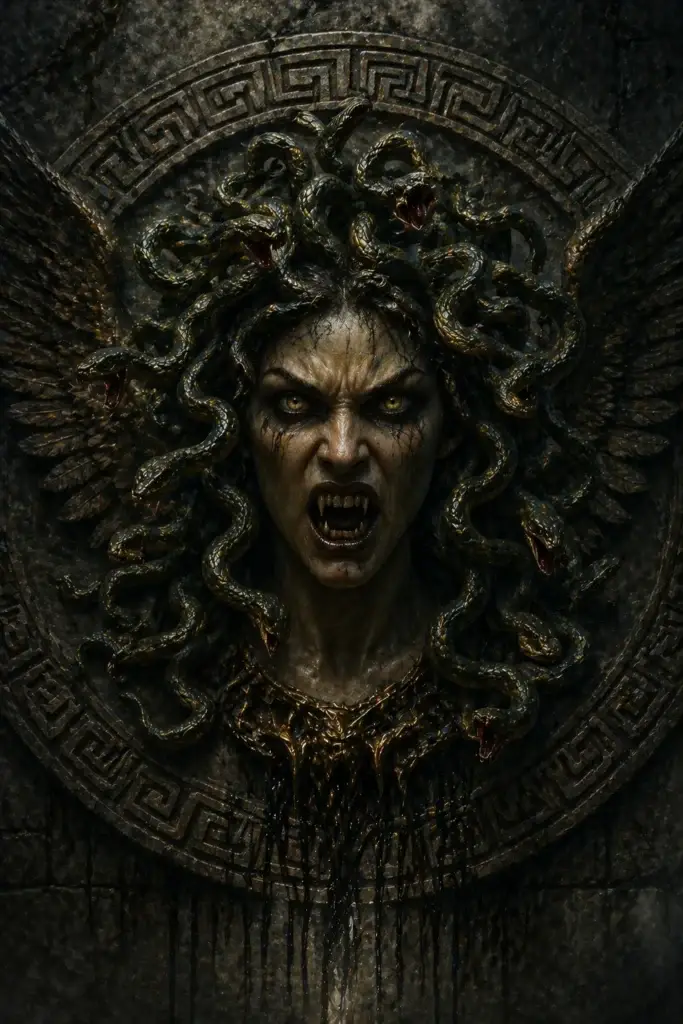
The Harpies are demons of the Greek tradition.
Plundering storm beings, bird-women with talons, messengers of wrath and plague. The Harpies are storm beings that suddenly sweep in, snatch and vanish. They are faster than the wind, unyielding and cruel.
In the Argonaut saga they torment the seer Phineus until the Argonauts drive them off. They are not goddesses but demons, functions of evil rather than personalities with depth.
The Harpies in Hesiod and early Greek cosmology
Hesiod’s Theogony names the Harpies as daughters of the Titan Thaumas and the Oceanid Electra; they thus belong to the generation of the gods, but are not Olympian.
Hesiod gives them names: Aello (the one swift as the storm wind), Ocypete (the swift-flying one) and, in some manuscripts, also Podarge (Swift-foot). From the outset they are conceived as wind beings, not as pure bird-women.
This cosmological placement is telling: the Harpies are older than the Olympians and embody the untamed natural forces of the cosmos.
According to Hesiod they are not malicious but function as agents of the divine world, specialized in plunder and rapid movement. Their genealogy links them with other chthonic and aerial powers that precede the ordered Olympus.
Type: Mythical being (bird-women, hybrid)
Tradition: Greek mythology
Class: Goddess/demon (sub-divine)
Role: Punishing goddesses of Zeus
Sources: Hesiod Theogony, Homer, Aeschylus, Apollodorus, Ovid
Sphere of action: The skies, food, divine punishment, plague
Main conflict: Between the will of the gods and human prosperity
Hesiod’s Theogony, around 700 BC, names the Harpies as daughters of Thaumas and Electra (Aello, Ocypete). Homer’s Odyssey I, 240, 245 as bringers of ruin. Aeschylus’ Oresteia expands the theme with a curse. Apollodorus, 1st to 2nd century AD, and Ovid’s Metamorphoses: the Argonaut episode.
Area of distribution: Thrace and the northern Aegean (birthplace of Thaumas). Argonaut saga: the Propontis and the Black Sea (the curse of Phineus). Rome: Harpyiae (Furies of the air). Venerated in cult as messengers of wrath, less as individual beings.
Primary sources:
Hesiod, Theogony 265, 270
Homer, Odyssey I, 240, 245
Aeschylus, Oresteia
Apollodorus, Bibliotheca I, 9, 21
Ovid, Metamorphoses III, 209, 258
Secondary sources: Burkert; Bremmer; West; Rohde
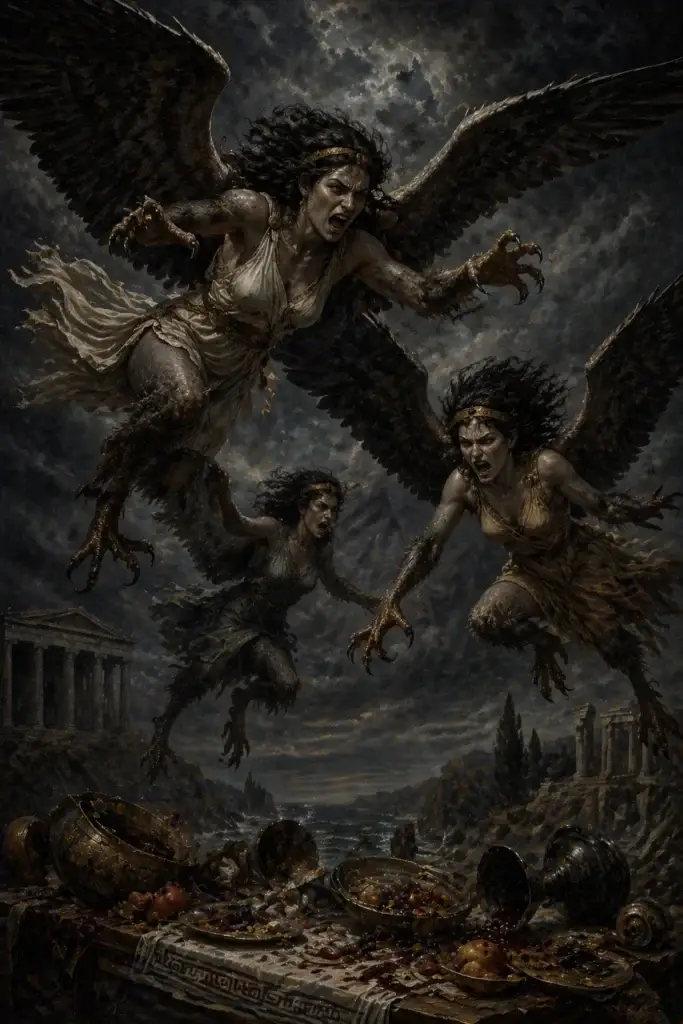
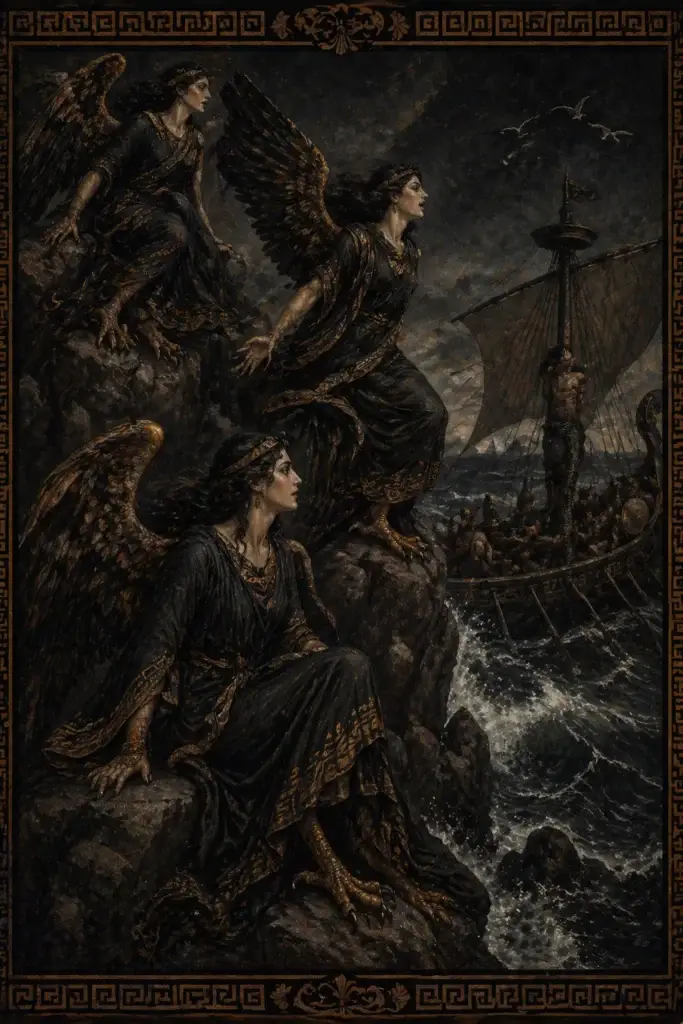
The Harpies are depicted as hybrid beings: the upper body of a woman, the lower body of a bird (eagle or bird of prey). They have sharp talons instead of hands.
Sometimes they are shown smeared with foul smell or excrement (in the Phineus episode). Their symbols are plunder, the whirlwind, plague and lightning speed. They are aggressive, not depicted aesthetically like the Sirens, but rather monstrous and menacing. Wings and talons dominate their iconography.
The Harpies are not venerated but feared and fought. They are instruments of punishment: in the Phineus episode Zeus or Poseidon sends them to plague Phineus for his disobedience. They are bringers of plague, raptor demons, forces of chaos.
They represent uncontrollable natural powers, storms that destroy the harvest, animals that tear at humans. They sometimes work for the gods (as instruments of punishment), but have no independent agenda beyond plunder and chaos. They are lower than other demons, more animal than reflective.
Appearance and symbolism
The Harpies are depicted as hybrid beings, the upper body of beautiful women (sometimes with wings at the shoulders) and the lower body or legs of eagles or sometimes dragons.
They bear clawed hands and feet. Their hair flies wild, their eyes glint with evil intent. Sometimes they are shown with bird feathers and a wild sheen.
The eagle is their sacred animal, or they are themselves half eagle. Their colors are gray-brown or dark red, the colors of decay and plunder. They smell terrible; a central feature is their stench, which spoils everything. They embody the rapacious and wild aspect of nature, the experience of being robbed, of being torn away.
The Harpies in the Argonautica of Apollonius of Rhodes
Apollonius of Rhodes (3rd century BC) depicts in his Argonautica 2.188-300 the famous episode in which the Argonauts free the blind king Phineus from the Harpies.
These Harpies (Aello and Ocypete) are malicious and destructive: they scratch and befoul all the food that Phineus touches. Apollonius describes them as winged maidens with bird-like lower bodies and human upper bodies, swift as the wind.
The hero Zetes and his brother Calais, themselves winged (sons of Boreas, the god of the north wind), pursue the Harpies across the sea to the Strophades Islands. This literary dramatization strongly shaped the visual iconography: Harpies were increasingly depicted as bird-women in classical reliefs and vase paintings, less as abstract wind demons.

The Harpies are female storm demons of Greek mythology, half woman, half bird, whose name derives from the Greek word for snatching. They are best known from the legend of the blind seer Phineus, whose food they stole or defiled until the winged sons of Boreas drove them off during the voyage of the Argonauts. The Argonautica of Apollonius of Rhodes and Virgil’s Aeneid are the most important literary sources for their figure.
Genealogy: Daughters of Thaumas (wonder, amazement) and the Oceanid Electra. Demigoddesses of the second generation. Sister: Iris (goddess of the rainbow).
Main Harpies: Aello (storm wind), Ocypete (swift flyer), Podarge, Celaeno, Thyella.
Function: Punishing goddesses of Zeus who bring ruin when humans commit outrage. Not independently evil, but executors of divine vengeance. They steal food, befoul offerings, bring plague and hunger.
Target group: Kings and rulers, the example being Phineus: punishment for blood guilt.
The ancient sources describe the Harpies as hybrid creatures of woman and bird: winged, with claws and a woman’s face. In Homer and Hesiod they still appear as swift storm spirits; only later poetry stresses the repulsive side of their appearance. In the Aeneid, Virgil portrays them as starved bird bodies with pale girls’ faces that befoul everything they touch.
Mythical effect: Phineus of Thrace: the Harpies pursue him, devour and defile his food, a psychological torment as he starves. Jason and the Argonauts send Zetes and Calais (sons of Boreas), who drive the Harpies off. Aeschylus: continuation of the curse of the house of Atreus. Amphitheater mosaics in Rome: a symbol of divine wrath.
Against the Harpies, who were regarded as plundering storm and abduction demons, the ancient tradition knows above all ritual and narrative defense.
In the myth of the blind seer Phineus, the winged Boreads Zetes and Calais drive off the Harpies, who steal and befoul his food, a narrative that itself served a protective function by holding up the conquerability of the demons before the eyes.
In funerary art, for example on the so-called Harpy Monument of Xanthos, harpy-like hybrid beings appear as carriers of souls and marked the threshold between the living and the dead. A distinct amulet tradition against Harpies has not been transmitted; the defense remained bound to prayer, purification and mythical narrative.
Close to the Harpies stand the Sirens, likewise bird-women of Greek mythology, who however bring ruin through song rather than through theft. Also related are the storm and wind spirits as well as the Erinyes, with whom the Harpies share common ground in their function as executors of divine punishment. Genealogically they count as daughters of the sea being Thaumas and the Oceanid Electra, which makes them sisters of the divine messenger Iris.
Rituals of defense
In Thrace and the Aegean, protective rituals at sacrificial festivals with cloths or nets for defense. Sanctuaries of Apollo: prayers for protection against wind demons.
Invocations and summonings
No direct invocations of the Harpies, but rather formulas of defense. Stoic tradition: prayer to Apollo or Zeus for restraint. Magical papyri of Egypt: apotropaic spells against swift women.
Amulets and protective symbols
The net (σάγηνος) as an amulet for symbolic capture. Depictions of eagles or falcons (enemies of the Harpies). Roman houses: mosaics of fleeing Harpies at entrance thresholds for defense.
Plundering and storm beings exist everywhere: Valkyries (Scandinavia, plunder of battle, but nobler), Banshees (Ireland, heralds of death), Tengu (Japan, raptor demons). The Harpies also resemble demons in other cultures that plunder and plague: Rakshasas (India), Jinn (Islam, though more complex).
They differ in that they have almost no personality; they are functions of punishment and chaos. They are the principle of disorder in Greek cosmology.
The Harpies in Virgil and the Roman adaptation
Virgil’s Aeneid 3.209-258 presents the Harpies as demonic forces of punishment. The fleet of Aeneas lands on the Strophades and finds magnificent herds there; the Harpies swoop down and desecrate everything the Trojans eat. The Latin description is darker than that of Apollonius: they smell horribly, are loud as thunder, their touch is a curse.
Virgil’s version links them with karmic punishment; the Harpies act at the bidding of higher gods (especially Venus and Fate). This shifts the function from the merely chaotic nature being toward the cosmic agent of punishment.
Roman writers adopted this interpretation: Harpies as embodiments of rapacity, sin and waste. They appear in later allegorical works, for example in Dante Alighieri, as symbols of boundless hunger and of robbery.
The most detailed ancient account of the Harpies is found in the second book of the Argonautica of Apollonius of Rhodes from the 3rd century BC. There, on their voyage to Colchis, the Argonauts encounter the blind seer Phineus, king of Thrace, who was punished by the gods because he had revealed the future too freely.
His punishment consisted in the Harpies snatching the food away at every meal or spoiling it with their stench, so that he was close to starvation. Phineus prophesied to the Argonauts their voyage on the condition that they free him from the Harpies.
The winged sons of Boreas, Zetes and Calais, pursued the monsters through the air as far as the Strophades Islands. There the divine messenger Iris held the Boreads back and swore by the Styx that the Harpies would no longer trouble Phineus.
This episode was known even before Apollonius; it was treated in the lost epic of early poetry and in Attic tragedies, for example by Aeschylus and Sophocles, whose Phineus dramas survive only in fragments.
Scholarship sees in the story an ancient motif of the starving king plagued by demonic beings, whose deliverance is tied to the hero’s voyage. In Virgil the Harpies return in the Aeneid, where they encounter the landing Trojans on the same Strophades.
The conception of the Harpies changed considerably over the course of antiquity. In the oldest texts, in Homer and Hesiod, they are not ugly bird-women but personified storm winds.
Homer mentions a Harpy named Podarge, who with the west wind Zephyros begets the immortal horses of Achilles. In the Theogony Hesiod names two Harpies, Aello and Ocypete, daughters of Thaumas and the Oceanid Electra, and describes them as beautiful-haired and swift as the wind.
Their name is usually derived from the Greek verb harpazein (to rob, to snatch away), which suits their function as beings that make people and things disappear without a trace. When in the Odyssey someone disappears inexplicably, it is said that the Harpies have carried him off.
Only in post-classical times, clearly tangible in Apollonius and Virgil, does the image of the repulsive hybrid being with a bird body, a woman’s face, claws and foul smell take firm shape.
Religious studies explains this change as a fusion of the old wind-spirit concept with the conceptions of plundering demons of the dead, with which the Harpies were iconographically and functionally related. The later demonization almost entirely displaced the older, more neutral image from memory.
In Greek visual art, Harpies and the Sirens, Keres and Sphinxes closely related to them are often difficult to distinguish, since they were all depicted as winged hybrid beings of woman and bird.
On Attic vases they appear mostly in connection with the Phineus episode, in flight over a laid table or in pursuit by the Boreads.
The best-known monument that bears their name is the so-called Harpy Monument from Xanthos in Lycia, a tall pillar tomb from the early 5th century BC, whose relief panels are today in the British Museum. The reliefs show winged female beings carrying off small human figures in their arms.
Older scholarship interpreted these figures as Harpies, hence the name of the monument. Newer archaeology is more cautious: they are probably Sirens, or more generally soul-guides who lead the deceased into the afterlife. The scene thus illustrates not so much a robbery as an orderly conveyance of the soul.
The case shows in exemplary fashion how difficult the identification of such beings in visual art is, and how much the namings of antiquity rest in part on modern conjectures. The close kinship of Harpy, Siren and soul demon in Greek thought becomes especially clear here.
Beyond antiquity, the Harpies continued to exert influence above all through Virgil’s Aeneid, which belonged to the school texts in the Middle Ages. The most influential reception is found in Dante’s Divine Comedy.
In the thirteenth canto of the Inferno, Dante and Virgil enter the wood of the suicides, whose withered trees are the souls of those who took their own lives.
In the branches of this wood the Harpies nest. Dante describes them with broad wings, human necks and faces, clawed feet and feathered bellies.
They tear the leaves of the soul-trees, which causes the damned pain and is at the same time the only way through which they can speak at all. Dante draws expressly on Virgil’s depiction of the Strophades and transfers the ancient motif of the food-robbers to the torment of the suicides.
This connection of Harpy and self-destruction strongly shaped the post-medieval image. In the Renaissance and the Baroque, the Harpies became a fixed pictorial motif that stood in emblematics for avarice, greed and harmful influence.
In heraldry they appear as a heraldic creature uniting a woman’s head and a bird’s body. The path from the Homeric wind spirit by way of the Virgilian food-robber to the Dantean creature of hell shows how a motif was interpreted anew again and again over two millennia.
From the perspective of religious studies, the question is interesting of how the Harpies relate to other female beings of punishment and vengeance in Greek mythology, in particular to the Erinyes. Both groups appear as executors of divine punishment, both are female, both are depicted with wings and a terrifying appearance.
In some sources the boundaries blur. In Apollonius the Harpies are called the hounds of Zeus, a formula that is also used for other executors of punishment.
In the Phineus myth the Harpies do not act on their own impulse but as the instrument of a punishment imposed by the gods. In this they resemble the Erinyes, who pursue blood guilt on behalf of the cosmic order.
The differences are nonetheless clear. The Erinyes are bound to concrete offenses, above all to the murder of kin and the breaking of oaths, and they possess an elaborated cultic position, for example as the Eumenides in the Athenian cult.
The Harpies, by contrast, remain almost without cultic significance; no temples or sacrifices are known for them.
They are narrative figures rather than objects of veneration. Scholarship places them in a broad spectrum of hybrid beings that reaches from the abducting Keres through the Sirens to the Erinyes, and in which the Greek imagination gave form to the sudden, inexplicable and punishing intervention of superhuman powers.
The placement of the Harpies in the Greek genealogy of the gods is, despite their slight cultic significance, astonishingly consistent. In the Theogony Hesiod names them as daughters of the sea god Thaumas and the Oceanid Electra. They are thus sisters of Iris, the winged messenger of the gods and personification of the rainbow.
This kinship is more than a genealogical detail. It anchors the Harpies firmly within the sphere of wind, water and air phenomena, to which they belong by their oldest function.
Iris as messenger between heaven and earth, the Harpies as embodiments of the plundering storm gust, both stem from the same district of natural powers. It is therefore consistent that of all figures it is Iris who intervenes in the Phineus myth and calls her sisters to order.
The number and the names of the Harpies vary in the tradition. Hesiod knows two, Aello (storm gust) and Ocypete (swift flight), Homer a third, Podarge (Swift-foot). Later authors add the name Celaeno (the dark one), which plays a particular role in Virgil, where a Celaeno gives the Trojans a gloomy prophecy.
These variations are typical of mythological collectives without a fixed cult. The speaking names, however, show throughout that the ancient conception understood the Harpies primarily as beings embodying speed and wind, long before the image of the loathsome bird-women prevailed.
Further standard works in the literature index.
The protective practice described here is a religious-studies classification of historical traditions. iWell Guard ties in with this cultural-historical line of portable protective objects and represents a contemporary form of it. More about the iWell Guard →
Against its influence, cross-cultural tradition names these protective means:
Recommended protective means
The simplest protective means in this collection: 41 layers of fine gold 999, platinum, silver and silicon, manufactured in Ruhla, Thuringia. It requires no activation, is bound to no person, and is effective within a radius of around 50 meters, even without being worn.
Related Beings

The Lutin, France's mischievous house goblin. Origin, the motif of tangled manes and its classifi...

Belial in the Hebrew Bible, at Qumran, and in the Goetia. Etymology, royal rank, sigil, and class...

Bannik, the Slavic bathhouse spirit of the banya. Rituals around the bathhouse, rules of conduct,...

In Christian tradition, Lucifer is the figure of the highest fallen angel. The equation with Sata...

Shinigami, the Japanese death spirit. Origin as a young figure of the Edo period, its closeness t...

Kan-Laon, the highest creator god of the Visaya, seated in the Kanlaon volcano. Origin, the deity...