Nyen, spirit of the Tibetan tradition
By Ralf Ittermann · last reviewed on
Nyen is a spirit of the Tibetan tradition.
Air and dwelling spirits of the Tibetan tradition, border guardians between the worlds.
Nyen (gnyan)
The Nyen (Tib. gnyan) are a broad class of Tibetan spirit beings that is difficult to pin down in detail.
Traditionally they are understood as spirits of the air and of the middle world, in contrast to the Lu of the underworld and the Lha of the upper world. In practical terms, Nyen dwell on mountain slopes, alpine pastures, certain trees, stones and in dwelling places.
Nyen are often invisible and are usually recognized by their effects: sudden swellings, joint pains, ulcers or persistent malaise. They are not evil, but sensitive to violations of their territories and to impure actions.
Nyen in Bon cosmology and the layered model
In the Bon model of the cosmos, Nyen are described as beings of a middle elevation layer between the heaven of the Tsen and the earth. They inhabit rocks, mountain forests and waterfalls.
According to Bon sources, Nyen arose in an earlier cosmic phase, when the world had not yet stabilized. They are therefore not evil, but unguarded in their impulses.
A pacified Nyen can be valuable; a provoked Nyen can destroy family and fields. Unlike the Tsen, who are warriors, the Nyen are wilderness keepers.
They guard the boundary between human space (field, house, village) and wild space (mountain, forest, gorge). A large category of Nyen illnesses is so-called boundary violation: when people penetrate too deeply into Nyen territory or destroy Nyen habitat.
Nyen at a Glance
Type: air and dwelling spirits
Origin: pre-Buddhist Bon; close kinship with Sa-Dag earth spirits
Texts: Padmasambhava texts, local ritual handbooks, folk invocations
Effect: skin rashes, joint ailments, ulcers, swellings
Defense: Sang offerings, Nyen invocations, avoidance of impure actions
Historical Classification
Period of the Texts
The category of the Nyen belongs to the oldest layers of Tibetan religiosity; it is connected with the concepts of the three worlds (upper/middle/lower) and their associated classes of beings. Bon texts treat Nyen in detail, especially in invocation handbooks against Nyen illnesses.
With the introduction of Buddhism, the Nyen category was also integrated into the new cosmos; Padmasambhava cycles record the ritual subjugation of individual Nyen and their installation as protective spirits.
Area of Distribution
Nyen are invoked and appeased throughout the Tibetan cultural area. Common places: mountain slopes between high valley and summit zone, alpine pastures with cattle grazing, certain old trees (especially juniper and poplar), free-standing rocks, roofs and beam structures of dwelling houses, hearths.
Some Nyen are bound to lineages and families (nyen rus) and are tended as ancestral protective spirits within particular clans.
State of the Sources
Core sources: Bon ritual handbooks and invocation texts; Padmasambhava cycles; the sutra literature of the Buddhist transformation; local ritual texts of individual monasteries and families.
Modern reference works: Nebesky-Wojkowitz (1956); Samuel (1993); Karmay (1998); Bellezza, John Vincent (2005) Spirit-Mediums, Sacred Mountains and Related Bon Textual Traditions in Upper Tibet.
Name and Variants
Tibetan gnyan, pronounced Nyen or Nyaen. Sometimes combined with klu as klu gnyan, especially powerful Lu-Nyen spirits.
- Nyen chen, “great Nyen”; individual important figures, such as Nyen Chen Tanglha (mountain god at Lake Namtso).
- Nyen gyi rgyal po, “king of the Nyen”.
- Khyab ‘jug, partly associated with nyen-like beings; in later tradition interpreted as the planetary deity Rahula.
Characteristics
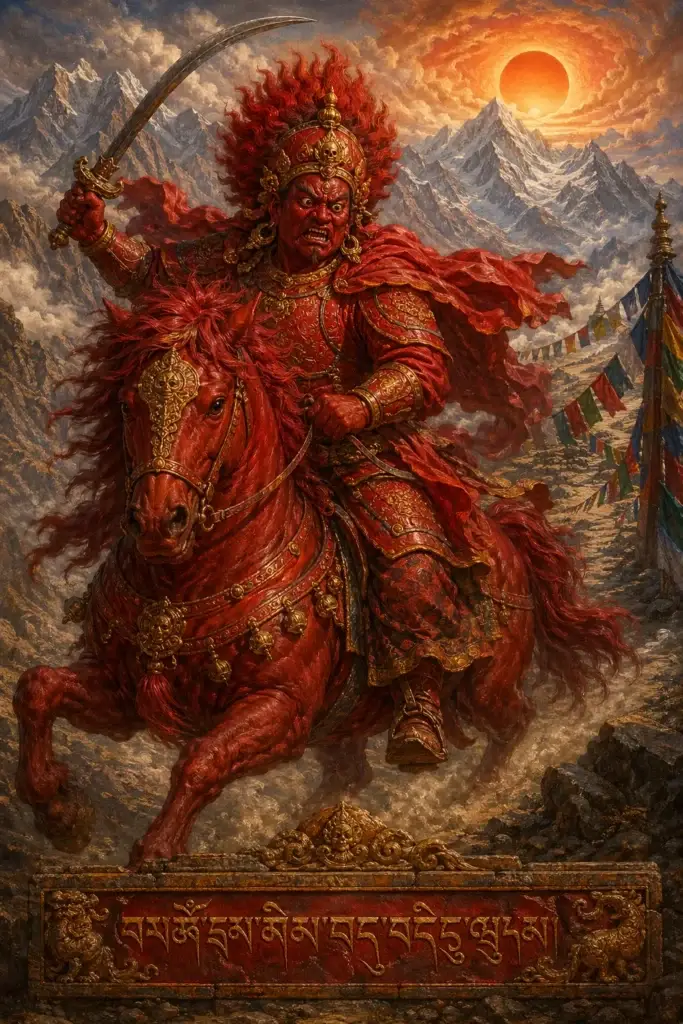
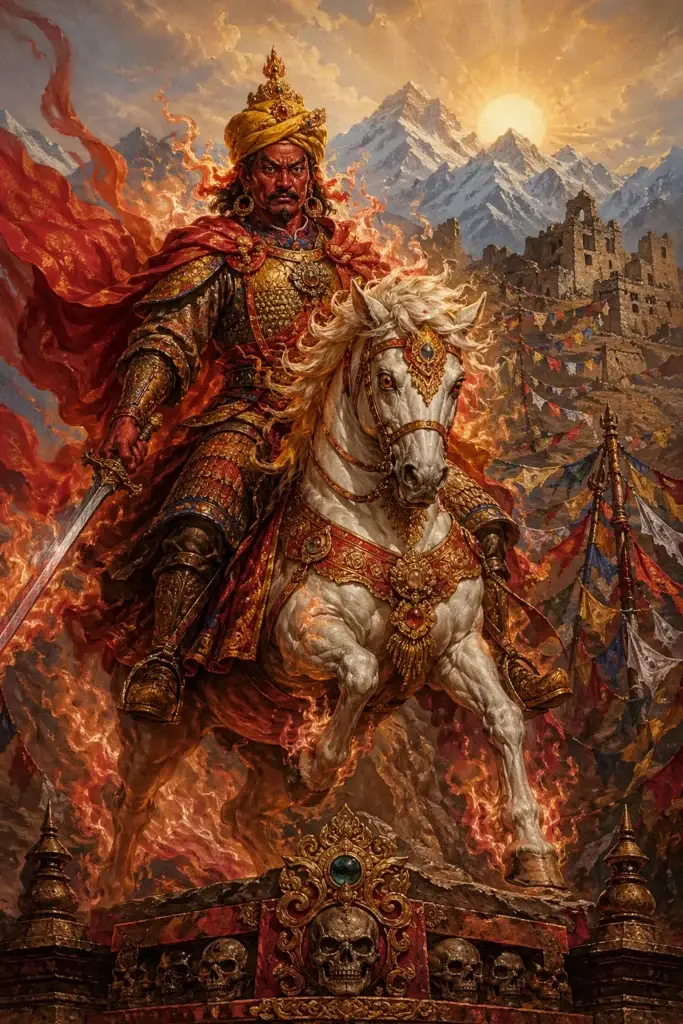
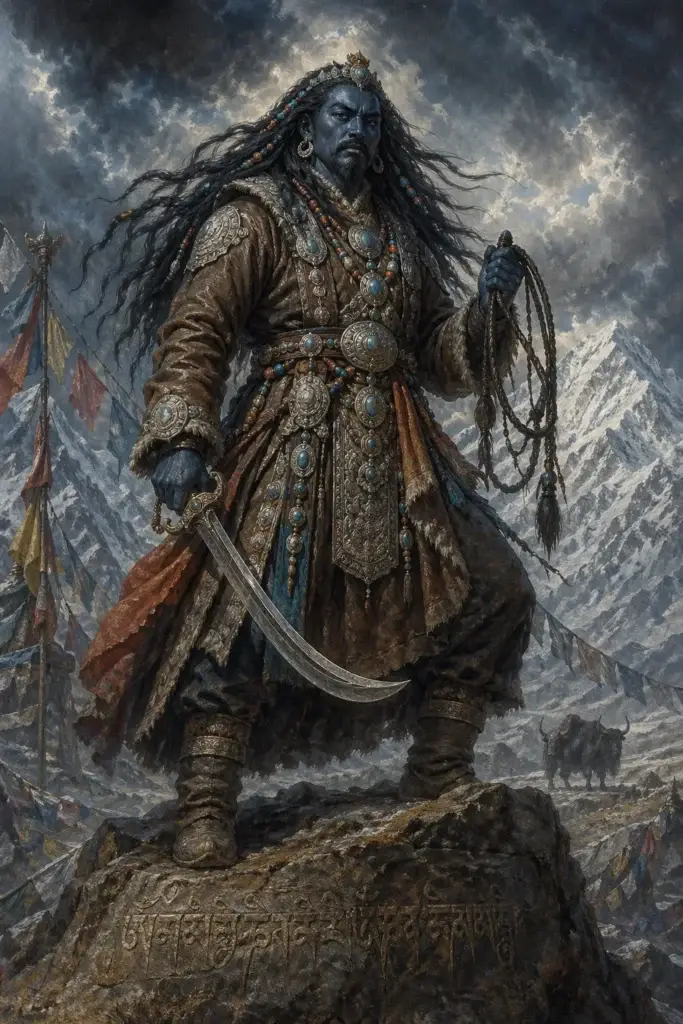
Appearance. Nyen are mostly invisible. When they show themselves, it is in gray or yellowish colors, as shapes in the air, as shadows at dwelling places, as flying mists. Individual important Nyen, such as Nyen Chen Tanglha, have iconographically fixed forms (a white rider on a white horse, sword in hand).
Behavior. Nyen react to defilement and boundary crossing: when a house is kept impurely, when smoke drifts in the wrong direction, when sacred places are disturbed. They punish through illnesses of the skin and the musculoskeletal system.
Function. In their bound state, Nyen are important border guardians, between order and wilderness, between settlement and highland.
Wrathful aspects and pacification through ritual
A core feature of the Nyen is their wrath. Unlike demons, whose wrath is evil intent, Nyen wrath is the natural aggression of an injured force.
To pacify Nyen wrath requires understanding, not mere magic. The ritual pacification is complex: it involves offerings (butter, blood, dried fish), blessing water, special prayers and sometimes a shamanic session dance.
The ritual acknowledges that the Nyen has a right to veneration. If a pacification fails, the person is often afflicted by paralysis, blindness or memory loss. This somatic symptomatology distinguishes Nyen damage from other supernatural illnesses and says a great deal diagnostically.
Profile: Nyen
The most important aspects of the Nyen at a glance.
Pre-Buddhist Bon tradition; class of the middle world between the Lha of the heavens and the Lu of the waters.
Herders, households with impure management, people on alpine pastures and mountain slopes, construction workers at sacred sites; some Nyen are bound to families.
Mostly invisible; as mist, shadow or fleeting shapes; individual great Nyen with concrete thangka iconography.
Swellings, ulcers, skin rashes, joint ailments, suppurating wounds, chronic joint inflammations, infertility of the grazing animals.
Nyen torma made of tsampa and milk; specific invocation rituals; purification rites in dwelling places; avoidance of injury to sacred trees and grounds.
Indian yaksha; Chinese air and house spirits; Siberian-shamanistic dwelling-place spirits.
Practical Defense
Sang offerings and Nyen torma. Small offerings of tsampa, milk, butter and honey are laid down at Nyen sites; daily smoke offerings on the roof keep the house Nyen gracious.
Purification rituals. Dwelling places are cleansed annually by a lama or by a head of household with blessing texts; sweeping in front of the door, keeping impure substances away, and proper alignment of the hearth are part of everyday protection.
Grazing rules. On alpine pastures, rituals for the local Nyen are held before the first grazing; herders avoid certain places at certain times.
Healers (dpa’ bo) and invocations. For specific Nyen illnesses, local healers or lamas are called in, who combine specific rituals and herbal applications.
Nyen, Parallels in Other Cultures
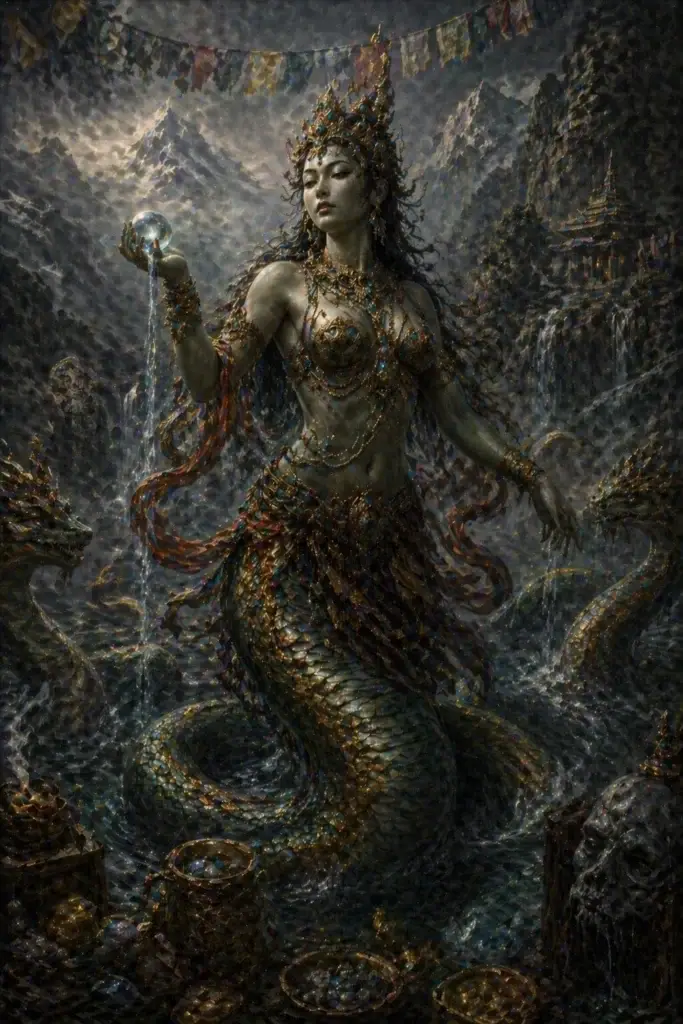
India. Yaksha as ambivalent guardian figures share numerous traits; the Tibetan Nyen category, however, has an independent, locally anchored development.
Mongolia. After the Buddhist permeation, the Mongolian tradition adopted nyen-like beings as dwelling-place and path guardians.
Siberia. Shamanic conceptions of house and place spirits share the basic profile.
Europe. House spirits and farmstead goblins of the Alpine, German-speaking and Slavic traditions show structural similarities.
Nyen and Buddhist integration as a protective power
With the Buddhization of Tibet, many regionally venerated Nyen were taken up into Buddhist pantheons. They were often declared protective deities (chos-skyong). One example is the Nyen of Mount Kailash, who is venerated across various Buddhist schools.
This integration enabled a coexistence between Bon practice and Buddhist orthodoxy: a believer could bring offerings to their local Nyen and at the same time venerate the Buddha.
In modern Tibet, Nyen veneration is strongly carried by nationalist sentiment: the mountain spirit is read as a guardian of Tibetan identity. Environmental movements have also modernized Nyen veneration by embracing the Nyen as a symbol of the forest and of ecological wholeness.
The gnyan in Tibet's Tripartite Spatial Model
The gnyan (pronounced nyen) form a class of their own in Tibetan spirit lore, one that has its fixed place in a vertically structured worldview.
The indigenous Tibetan cosmology, as René de Nebesky-Wojkowitz reconstructed it in Oracles and Demons of Tibet, recognizes roughly three spheres: the height of the heavens with the lha, the depth of the waters and the earth with the klu, and the intermediate region of the earth’s surface, the slopes, trees and rocks. The gnyan inhabit this middle space.
They are thus the spirits of that zone in which human activity unfolds most immediately: the clearing of forest, the breaking of stone, the plowing of soil, the disturbing of the earth’s surface. Precisely herein lies their danger.
The gnyan are considered irritable and avenge intrusions into their domain with illness. They are especially credited with ulcers, swellings, growths and plague-like afflictions, that is, diseases that visibly erupt on the body. The name itself carries the meaning of dangerous and fearsome.
Unlike the mostly clearly malevolent classes of demons, the gnyan are ambivalent. They are not out to do harm of their own accord, but react to violations of their territory. This logic of the disturbed balance is characteristic of the place-bound classes of spirits of Tibet.
Whoever fells a tree or dislodges a stone from the mountain without taking the responsible spirits into account acts, according to traditional understanding, negligently. The gnyan thus appear less as enemies of humankind than as guardians of an order whose disregard has consequences.
Ritual Handling and the Avoidance of Illness
Since the gnyan react to intrusions into earth, stone and wood, the traditional way of dealing with them aimed at avoidance and appeasement. Before major building works, before the laying out of fields or the felling of trees, offerings were made and permission was requested.
In practice, pre-Buddhist conceptions merged with Buddhist ones and with elements of the Bon tradition. Lamas or local ritual specialists performed ceremonies intended to pacify the affected spirit and to avert an impending harm.
If an illness had already set in, it was interpreted according to its symptoms. Ulcers and skin growths were considered typical gnyan illnesses and called for a specific healing ritual that addressed the cause, namely the injured spirit.
Here the close connection between Tibetan medicine and spirit lore becomes apparent: a treatment had to address not only the physical symptom but also restore the disturbed relationship with the spirit world. Scholarship points out that this interlocking of medical and ritual diagnosis is a continuous feature of the traditional Tibetan healing system.
Important is the demarcation from neighboring classes. The gnyan were occasionally named together with the klu and the btsan, and in some texts mixed designations appear. De Nebesky-Wojkowitz pointed out that the boundaries between the classes of spirits are not always drawn sharply in the sources and vary regionally.
For understanding, however, the core remains stable: the gnyan are the spirits of the immediately inhabited and worked land, and their relationship to humankind is one of mutual consideration whose breach is registered on the body.
Further Links
Sources and Literature
Further standard works in the literature index.
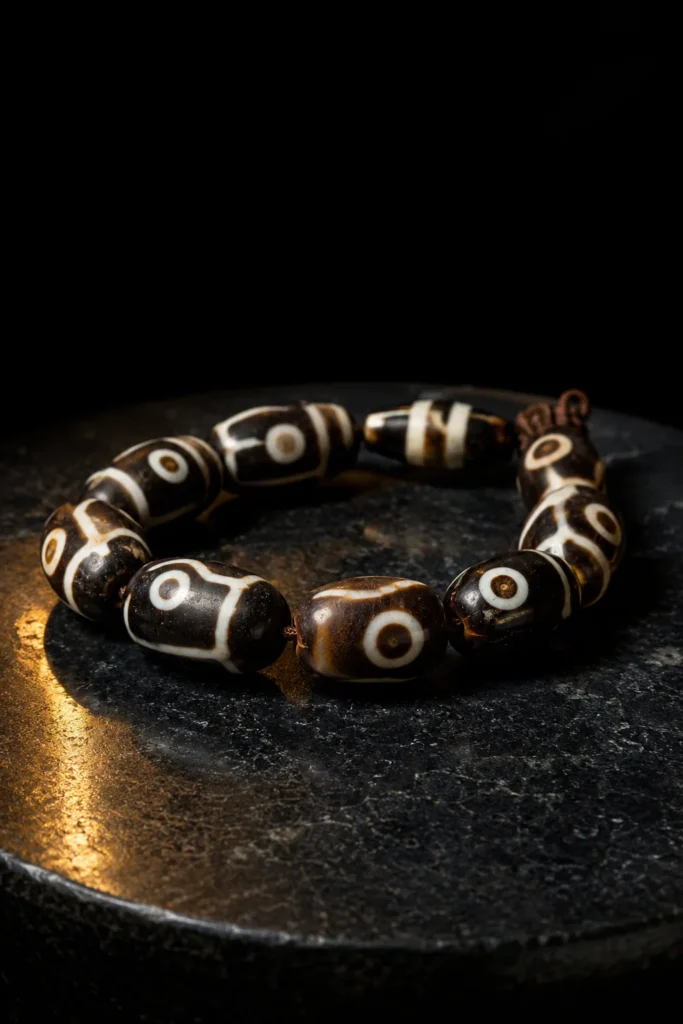
The protective practice described here is a religious-studies classification of historical traditions. iWell Guard ties in with this cultural-historical line of wearable protective objects and represents a contemporary form of it. More about the iWell Guard →