Kappa is a spirit of the Japanese tradition.
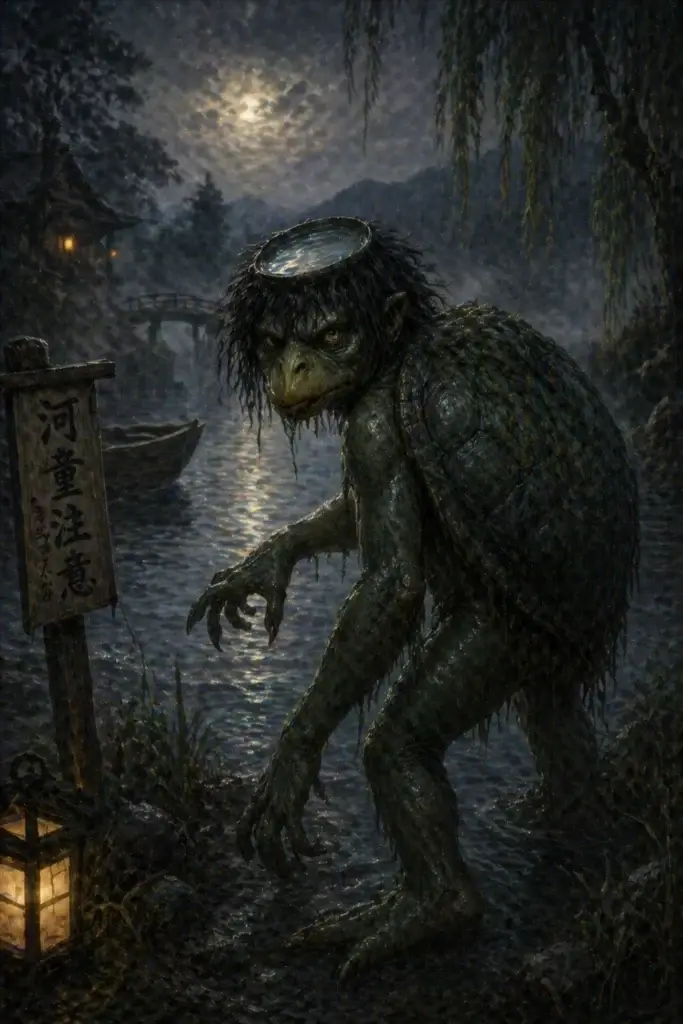
A child-sized water being with a turtle shell and a water dish on the crown of its head.
Kappa (河童, „river child“) are the best-known water beings of Japanese folk demonology.
They are described as ranging from man-high to child-sized, with greenish, scaly skin, webbed limbs, a turtle shell on the back and, the most important attribute, a flat depression (sara) on the crown of the head that must be filled with water. If this dish dries out, the kappa loses its power.
Kappa live in rivers, ponds, rice paddies and smaller bodies of water. They are portrayed as troublemakers who pull bathers and travelers into the depths, frighten horses and steal cucumbers.
The kappa are anchored etymologically and theologically in the Suijin tradition (the tradition of water deities), one of the oldest Shinto animist classes of gods.
Suijin are documented in classical Shinto texts such as the Engi Shiki (10th century) as powers that rule over rivers, springs and waterholes. In local folk practice the kappa often function as subordinate manifestations of suijin, especially those types associated with dangerous whirlpools or deep waterholes.
The transition from suijin to kappa reflects a degradation of divine status through local sacralization: a suijin of a large river remains a deity, while the suijin of a small brook or a dangerous body of water is reduced in folklore practice to a kappa.
Yet the structure of veneration is preserved: villages near kappa-inhabited waters erected small shrines, places of offering or sites for food offerings.
Type: Water demon, river being
Origin: Regional river deities, ancient water-cult traditions
Texts: Konjaku Monogatarishū, Edo-period Yōkai literature, Yanagita Kunio‘s Tōno Monogatari
Period: Attested from the Middle Ages, canonical from the Edo period
Defense: Bowing (empties the water dish), offerings of cucumbers, defeat in sumō
Kappa-like water beings are tangible in Japanese sources from the Middle Ages onward. The first episodes that can be clearly identified as kappa appear in setsuwa collections of the 12th to 14th centuries. The comprehensive cataloging and fixing of the iconography took place in the Edo period through Yōkai picture books and local research.
Yanagita Kunio’s Tōno Monogatari (1910) recounts numerous kappa episodes from the Iwate region and marks the starting point of modern kappa research.
Kappa are known almost throughout Japan, with regional variants of the name. Core regions of intensive transmission are the Tōno basin (Iwate), Kyūshū (especially Kumamoto with the famous kappa statue at the Ushibuka bridge) and the Kantō area.
Typical places: rice-field irrigation ditches, fords, weirs, remote mountain lakes. In some regions small shrines for the local kappa are set up directly on the riverbank.
Important sources: Yanagita Kunio, Tōno Monogatari (1910); Toriyama Sekien’s Yōkai encyclopedias (1776 onward); numerous local collections.
Modern research: Komatsu Kazuhiko, Ishikawa Junʼichirō (Kappa no sekai, 1985), Michael Dylan Foster. The figure was also strongly developed in literature through Akutagawa Ryūnosuke’s story „Kappa“ (1927).
The name is composed of 河 („river“) and 童 („child“).
Appearance. Child-sized (about 1 to 1.20 m), greenish, scaly skin, a turtle shell on the back, webbed hands and feet, a beaked mouth. On the crown of the head a flat depression filled with water; without this water the kappa loses strength and agility.
Behavior. Malicious and cunning, yet polite and ambitious in wrestling. Kappa challenge humans to sumō. They pull horses and careless people into the water. A practice attributed to them is the extraction of the mythical „liver ball“ (shirikodama) through the anus of the drowned.
Preferences. Cucumbers are their favorite food; from this the sushi roll kappamaki takes its name.
The distinguishing feature of the kappa is the sara (dish) on its head, an element with deep cultic implications. According to folkloric understanding this dish is the seat of its supernatural power: were the dish to break or dry out, the kappa would lose its potency.
This folk theology was so dominant that there were Edo-period folk customs of neutralizing kappa by drying out their sara.
Ethnographic collections by the folklorist Yanagita Kunio (1875-1962) documented regional variations: some communities believed the sara could be filled with sake to appease the kappa; others claimed the sara was filled with the life-water of the water itself.
These elaborated interpretations show how a simple anatomical peculiarity differentiates into a complex cultic system that structured behavior, protection and practices of respect.
The most important aspects of Kappa at a glance.
Ancient river deities and regional water-cult traditions; in part influences of the Chinese suiko notions.
Bathing children, rice farmers at irrigation ditches, horses by the bank, travelers passing fords at night.
A child-sized, green-skinned water figure with a shell, webbed limbs and a water-filled dish on the head.
Drowning, extraction of the shirikodama, theft (especially cucumbers), frightening horses and livestock.
A polite bow (causes the kappa to bow back and thereby lose the water on its head); an offering of cucumbers with the giver’s name carved into them; victory in sumō.
The Chinese suiko („water tiger“); the Korean mul-gwishin; the Indian nāga and the Tibetan lu.
A polite bow. The classic countermeasure: when a kappa is encountered on the bank, you greet it politely. The kappa bows back, and in doing so water spills from the dish on its head. Weakened, it must return to the river and abandons the attack.
Cucumber offering. In some regions parents carve the child’s name into a cucumber and throw it into the river before bathing, as an offering and a protection.
Kappa contracts. Folk tales report of kappa who, after losing an encounter with a human (for example after an arm has been cut off, which the defeated one asks to have back), enter into a contract no longer to attack houses and livestock.
Sumō. Kappa are proud of their wrestling skills. A defeat in a sumō match binds them to promises toward the victor.
China. The suiko („water tiger“) is a direct iconographic model, transmitted to Japan in early encyclopedias.
Korea. Mul-gwishin (water spirits) pull bathers into the depths like kappa, but have a different genesis, usually the dead who perished in bodies of water.
India/Buddhism. Nāga as water-serpent beings are typologically related, but rather divinely ambivalent.
Tibet. Lu as water and earth spirits share the binding to bodies of water and the double profile of protection and danger.
The Edo period (1603-1868) established the kappa as a central figure of urban and rural folk belief. Merchants in river-port towns such as Edo and Osaka developed precautions against kappa attacks, such as avoiding bathing alone in the evening hours or offering cucumbers.
Yanagita Kunio, the founder of modern Japanese folklore studies, systematically classified regional kappa variants in his works according to geographical distribution and local differences in attributes.
Yanagita’s research showed that kappa reports were more frequent in inland river regions than in coastal areas and that larger rivers tended to display kappa narratives of higher status. His work raised the kappa from mere superstition into a scholarly category of cultural memory and considerably influenced subsequent ethnographic studies.
The most striking feature of the kappa in Japanese transmission is a bowl-shaped depression on the crown of its head, called sara in many descriptions, a dish.
According to folk belief this hollow is always filled with water, and in this water lies the supernatural power of the kappa. As long as the dish stays moist, the kappa is strong and dangerous, even on land.
From this follows the best-known rule of defense. Whoever meets a kappa should bow deeply before it. The polite kappa returns the bow, and in doing so the water runs out of the dish, and it loses its power until it can fill the dish again.
In some variants it is enough to make the kappa perform a sudden movement of the head. These tales connect the dangerous water spirit with an almost comic weakness and with the appreciation of politeness.
Folklorists such as Kunio Yanagita, the founder of Japanese folklore studies, collected and interpreted the kappa intensively. In his work Tono monogatari of 1910 the kappa appears as a fixed component of the rural narrative world of the Tono region.
Among other things, Yanagita saw in such water spirits the remnants of older, demoted water deities. The dish, according to a widespread interpretation, could originally be a sign of the kappa’s connection to water as the element of its power, not a random anatomical detail.
In scholarship the kappa is a classic example of the thesis of the demoted god.
Several Japanese folklorists, among them Yanagita and, after him, numerous regional researchers, have argued that behind the kappa stand older water deities that lost their cultic dignity with the change of religious circumstances and sank into feared but also mocked fiends.
In some regions the kappa is explicitly connected with the suijin, the water god, or interpreted as its lower form of appearance.
This double nature shows itself in the ambivalent behavior of the kappa. On the one hand it is regarded as dangerous.
Drowned people, and above all drowned children and horses, are attributed to it. On the other hand the kappa, if you stay on good terms with it or defeat it, can become a helpful ally.
Numerous regional legends tell how a kappa, after a lost contest of strength, teaches humans the healing arts, above all the setting of bones, or supplies them with fish regularly.
The regional variety is great. In Kyushu and western Japan designations such as gataro or garappa are widespread, and in the north other names.
In some places it is assumed that the kappa migrates with the seasons between river and mountain, so that it is a water being in summer and a mountain being in winter.
This notion of migration connects it with the Japanese ideas of the seasonal ascent and descent of the deities and supports the interpretation that the kappa is not a mere bogey but a remnant of more complex religious notions.

Several fixed motifs characterize the kappa in the narrative tradition. One is its fondness for cucumbers. In many areas it was considered advisable to throw a cucumber into the water before bathing in the river, in order to appease the kappa, or to write the name of the bathing persons on a cucumber.
From this connection the name of the sushi roll kappamaki, the cucumber roll, is also derived.
A second motif is the kappa’s delight in wrestling. The kappa challenges passers-by to sumo, and it is precisely here that the defense via the dish comes into play, because the kappa loses the water on its head while wrestling or bowing.
In some regions wrestling with the kappa has even found its way into local customs and children’s games.
The darkest motif concerns the shirikodama, a spherical substance believed in folk belief to be located in the human anus, which the kappa tears from its victims. According to some tales, whoever has the shirikodama taken from them dies or loses their vital force.
In religious studies this motif is usually interpreted as a popular explanation for deaths by drowning, especially for the anatomical observation on the body of the drowned.
The kappa thus also served as a cautionary figure meant to keep children away from dangerous waters. This pedagogical function explains part of its enduring presence in Japanese everyday culture, down to mascots and signs at rivers.
The protective practice described here is a religious-studies contextualization of historical traditions. iWell Guard ties into this cultural-historical line of wearable protective objects and represents a contemporary form of it. More about the iWell Guard →
The kappa is a water being from Japanese folk belief, a humanoid spirit with a turtle shell, webbed limbs and a bowl-shaped depression on its head in which water collects.
As long as the water is in the head, the kappa is strong; if it runs out, it loses its power. Kappa live in rivers and ponds, are regarded as tricksters and can pull children into the water and drown them.
The classic protective gesture is the deep bow: when a person approaches the kappa politely and bows, the kappa, as a spirit bound by etiquette, is obliged to return the bow, whereby the water runs out of its head and it becomes powerless.
Another method is the offering of a cucumber, the kappa’s favorite food (which is why a certain sushi roll is called Kappa-Maki).
Against its influence, cross-cultural tradition names these protective means:
Compare in the Protection Compass →Recommended protective means
The simplest protective means in this collection: 41 layers of fine gold 999, platinum, silver and silicon, manufactured in Ruhla, Thuringia. It requires no activation, is bound to no person, and is effective within a radius of around 50 meters, even without being worn.
Related Beings

Almas, the wild mountain man of the folklore of the Caucasus and Altai. Origin, the distinction f...

Seongju, the supreme Korean household god in the ridge beam. Origin, the Seongju-gut ritual, and ...

Goddess of love, music, beauty, motherhood. Dendera temple, sistrum, celestial nurturing mother i...

Rübezahl, the moody mountain spirit of the Giant Mountains: attested since 1561, collected by Pra...

Marena, Slavic goddess of winter and death. Her melting ritual for spring, her burning as a Masle...

The Šotek, the mischievous house goblin of Bohemia and Moravia. Origin, the distinction from the ...