Protective Hand Gestures: Fig, Horns Gesture and Warding Hand
By Ralf Ittermann · last reviewed on
Protective gestures are particular hand positions to which a warding meaning is ascribed. Unlike the amulet, a protective gesture is not bound to any object; it is performed with the hand alone and in the moment.
This article places the protective gesture within the study of religion and traces it from antiquity to its present-day reception. In doing so it distinguishes between historically documented custom and modern interpretation.
Classification: What a Protective Gesture Is
A protective gesture is a fixed hand position performed in a situation felt to be threatening, in order to ward off harmful influences. It is a bodily act and not an object.
What is special about the protective gesture is its immediacy. It requires no material and no preparation. The hand alone forms the sign, and the gesture is available in the moment.
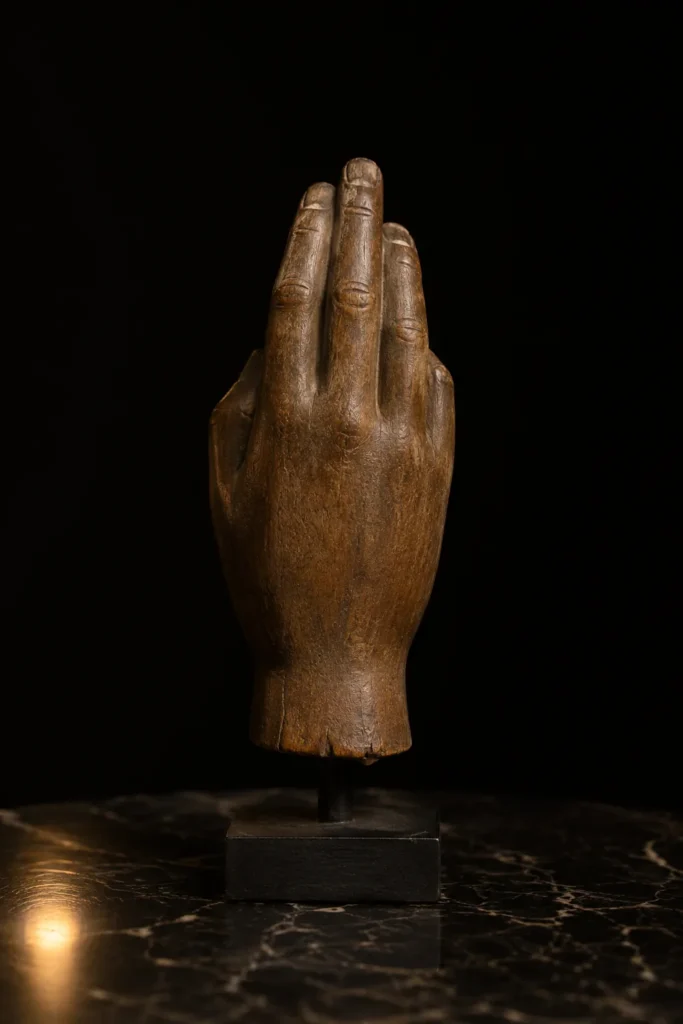
Three gestures are especially widespread. The fig gesture (mano fico) consists of a fist in which the thumb is placed between the index and middle finger. The horns gesture (mano cornuta) extends the index finger and the little finger. The warding hand shows the open palm raised flat.
In many traditions these gestures are directed against the gaze regarded as harmful. They are meant to ward off such a gaze or to deflect it from the person performing the gesture.
Within the protective symbols, the protective gesture belongs to the group of bodily protective acts. It thus stands alongside objects, signs and substances.
At the same time, the gesture is closely linked to the pictorial motif. The fig gesture and the warding hand also appear as pendants and as engraved signs. The gesture can therefore be both act and motif at once.
The protective gesture combines two qualities that set it apart from other means of protection. It is available at any time and it leaves no trace. This makes it especially suited to situations in which a person wished to react inconspicuously and without preparation.
Origin and Historical Depth of the Protective Gestures
Gestures are among the oldest means of human expression. Particular hand positions carry fixed meanings in many cultures, and some of them have acquired a warding interpretation.
The fig gesture is securely attested since Roman antiquity. Written sources and small pendants in the form of a fig show that the gesture and its pictorial motif were known in Roman everyday life.
In the Roman world the gesture has a double meaning. On the one hand it counted as a crude, insulting gesture, on the other as a means of warding off harm. This duality accompanies the fig gesture into the modern age.
The warding hand with its raised open palm is known in many cultures as a gesture of halting and keeping away. It appears at the same time as a pictorial motif, for instance in the widespread hand with the eye motif.
The horns gesture is known above all from the Italian region, where it is still used today against the gaze regarded as harmful. Its precise history is harder to grasp than that of the fig gesture.
Overall it is clear that several protective gestures are attested over long periods. The fig gesture is the best documented among them, because it can also be grasped early on as a pendant.
In scholarship the horns gesture is connected with the widespread meaning of the horn as a sign of strength. Horns appear on helmets, on altars and as pendants. The gesture thus belongs to a broad field of horn motifs that was associated with strength in many cultures.
The Underlying Conception of the Protective Gesture
A widespread notion is the idea that a gesture can draw a harmful gaze to itself and thereby deflect it. The conspicuous hand position is meant to bind the attention that would otherwise be directed at the person performing it.
With the fig gesture the form plays a role. The thumb protruding between the fingers was interpreted in scholarship as an allusion to the sexual. Such allusions counted as warding in many cultures, because they drew the gaze to themselves.
With the horns gesture the form points to horns. Horns counted as a sign of strength in many cultures. According to this notion, a gesture that imitates horns was meant to share in that strength.
With the warding hand the open palm is central. The raised flat hand is a gesture of halting. It is meant to hold back an influence before it reaches the person performing it.
Common to all the gestures is the idea of the directed act. The gesture is deliberately performed against a direction felt to be dangerous, for instance against a person whose gaze is feared.
The conceptions described here are cultural-historical explanations. They describe why a warding meaning was given to particular gestures, and they document a belief. They are not proof of an effect. Scholarship describes the conception without confirming it.
All three gestures also have in common that they could easily be transferred into a lasting pictorial motif. The shaped hand could be reproduced as a pendant and worn continuously. This closeness of act and object is a hallmark of the protective gesture.
Examples from Antiquity and the Ancient Near East
In the Roman world the fig gesture is especially well attested. Writers mention the gesture, and small pendants in the form of a fig were worn as jewelry and as an amulet, frequently by children.
These fig pendants show that the gesture was transferred early into a lasting pictorial motif. From the fleeting hand position came an object that could be worn continuously.
In the Ancient Near East the open hand is widespread as a pictorial motif. The hand with the eye motif is attested over many centuries and across several religions.
In the ancient world the open hand counted generally as a gesture of greeting, of protection and of halting. This meaning forms the background of the warding interpretation of the warding hand.
From the Greek world too, indications of warding gestures have been handed down. Ancient sources mention acts with which a gaze regarded as harmful was to be averted.
These examples show that protective gestures were known in the ancient Mediterranean and the Ancient Near East. The fig gesture and the open hand are the most clearly tangible among them.
From the Etruscan and early Italic region too, small pendants in the form of a fist have been handed down, which precede the Roman fig gesture or stand alongside it. They show that the warding interpretation of the hand form has a longer prehistory in the Mediterranean.
The fig gesture thus belongs to a broad tradition of shaped hand signs.
Examples from European Folk Magic
In European folk magic the fig gesture is widespread. Folklore collections report the gesture as a spontaneous warding act, performed at an encounter with a person felt to be dangerous.
The fig gesture was often performed covertly, for instance in the pocket or behind the back. In this way the gesture could be made without the other person noticing it.
The fig gesture also appears in Europe as a pendant. Small figs of coral, bone or precious metal were placed especially on children. They connect the gesture with the lasting form of the amulet.
The horns gesture has been handed down above all from the Italian region. There it is used against the gaze regarded as harmful and is still known today.
Reports about protective gestures document the expectations of those who used them and not a proven effect. They show that the gesture was understood as an immediately available, reassuring act.
With the decline of magical household custom, the warding interpretation of the gestures lost weight. The fig gesture and the horns gesture, however, remained known as gestures, in part with a different meaning.
In Spain and Portugal the fig gesture is widespread as a pendant under the name higa into the modern age.
Small higas of jet, coral or silver were placed especially on children and are richly represented in folklore collections. These examples show how closely the fleeting gesture and the lasting amulet remained connected with one another.
Examples from Asia and Other Cultures
In South and East Asia, fixed hand positions are widespread in religious contexts. In the Hindu and Buddhist traditions, such hand signs carry fixed meanings and appear in ritual and pictorial art.
Some of these hand signs are connected with the idea of protection and fearlessness. The raised open hand appears there as a gesture meant to take away fear and to protect.
The open hand as a protective motif is known beyond Asia. In the Islamic sphere and in Jewish contexts the hand is widespread as a pictorial motif and is among the best-known protective signs.
In various cultures the extending or spreading of the fingers has been handed down as a warding act. The precise form of the gesture varies by region.
Across these regions it becomes clear that the hand as a protective sign is not a motif of a single culture. The open hand is connected with protection in a particularly large number of traditions.
The diversity of the examples makes clear that the protective gesture is to be understood as a principle. It arises wherever a meaning beyond the everyday is given to a hand position.
In Christian pictorial art the raised open hand has a fixed place as a gesture of blessing. It appears in depictions of blessing figures and was associated with the idea of protection and aid. This religious use stands alongside the folk-magical warding gesture and shows the broad field of meaning of the open hand.
Use in Ritual and Everyday Life
The protective gesture was usually performed spontaneously in everyday life. It was available in the moment in which a situation was felt to be threatening, for instance at an encounter with a feared person.
Often the gesture was made covertly. The fig gesture in the pocket or behind the back made it possible to ward off harm without openly insulting the other person. This covertness belongs to the handed-down custom.
The gesture could be linked with spoken words. A quiet formula or an invocation accompanied the hand position in some traditions and belonged to the complete act.
As a pendant the gesture was transferred into a lasting form. A fig of coral or a hand of metal carried the motif with it continuously and did not have to be performed in the moment.
In ritual contexts, above all in the religious traditions of Asia, hand signs are part of fixed sequences. There the gesture follows a handed-down order and a fixed meaning.
There is no uniform ritual order for protective gestures. In the folk-magical sphere the gesture was usually spontaneous, whereas in the religious sphere of Asia it was fixed. The precise form depended on tradition and occasion.
The direction of the gesture was also significant. The fig gesture and the horns gesture were performed deliberately toward a person felt to be dangerous. This orientation shows that the gesture was understood not in general terms but in relation to a particular counterpart.
Related Forms of Protection and Distinctions
The protective gesture stands in close kinship with the pictorial amulet. The fig gesture and the open hand appear both as a gesture and as an amulet or talisman. Gesture and motif merge into one another.
The protective gesture is closely connected with the warding of the gaze regarded as harmful. Like the blue eye bead, the gestures are frequently directed against this gaze, yet they do so with the body instead of with an object.
The pure gesture differs from the amulet through its fleetingness. An amulet is lasting and bound to material. The gesture is an act in the moment and leaves no trace.
A boundary exists toward the gesture as mere insult. The fig gesture and the horns gesture are used in some contexts purely as insults. In this use the warding interpretation is absent.
The protective gesture is further to be distinguished from the purely religious ritual gesture. Hand signs in worship and in prayer follow a cultic order and do not primarily carry a warding meaning.
Placing it within this neighborhood helps to define the protective gesture precisely. It is a bodily warding act that is related to the pictorial amulet and that differs from insult and from the pure ritual gesture.
Within the bodily protective acts, the protective gesture stands alongside further acts such as spitting and touching particular objects. In folklore sources these too count as spontaneous warding acts. The gesture thus belongs to a broad group of bodily reactions.
Present-Day Reception of the Protective Gestures
Some protective gestures are still known as gestures today, though often with a changed meaning. The fig gesture and the horns gesture are understood in several countries, in part as a crude gesture, in part as a custom.
The horns gesture has found its own circulation in popular culture, above all in the environment of certain styles of music. This modern use no longer stands in any connection with the old warding interpretation.
In modern esotericism, hand gestures are sometimes described as a means of warding off harm. Effects are ascribed to such practices that are not proven. They should be viewed critically.
As a pictorial motif the open hand is widespread to this day. The hand with the eye motif appears on jewelry and decoration and is generally known as a protective symbol.
For the study of religion, protective gestures are an instructive example. They show how a fleeting bodily act could become a fixed sign and could even pass over into a lasting amulet.
Anyone who engages with protective gestures today finds in them above all a cultural-historical subject. A sober approach separates the attested history of the gestures from modern promises of effect that do not withstand scrutiny.
In the study of body language, gestures are today recorded and compared systematically. Such investigations show that the same hand form can be understood very differently in different cultures. This finding makes clear why the warding interpretation of a gesture remains bound to its cultural context.
Literature (Selection)
Related key terms: protective gestures, fig gesture, horns gesture, warding hand, mano cornuta, open hand, hand signs, evil eye, apotropaic, warding gesture.
iWell Guard and Protective Traditions
iWell Guard stands in the cultural-historical line of portable protective objects, to which the protective gesture also belongs. A modern companion for people who live with protective symbols: crafted in Germany, 41 layers of solid gold, platinum and silver, with a 30-day right of return.
Personal experiences may vary. Not a medical device. No promise of healing.