Hephaestus, Greek smith god
By Ralf Ittermann · last reviewed on
Hephaestus is a Greek smith god and the master of artful fire, to whom the most artful works of the Olympian gods are attributed. In the Greek pantheon, Hephaestus is the god of metalworking, fire, and craft invention.
Unlike Athena Ergane, who protects the intellectual and planning side of craftsmanship, Hephaestus represents the practical mastery of material: the control of fire and the melting, forging, hammering, and casting of metal.
In Homer he bears the epithet «amphigyeeis», «with limping feet», and «kyllopodion», «lame-footed». His disability belongs to his oldest profile and carries no moral or negative connotation; on the contrary, it marks him as an exceptional artist whose works compensate for what his body lacks in mobility.
His cult is pronounced on the volcanic islands of Lemnos and Sicily, in Athens, and in the Hellenistic workshop centres.
Myth and Lineage
There are two competing traditions concerning the origin of Hephaestus. In Hesiod (Theogony 927 to 929) he is born of Hera alone, as a defiant answer to the parthenogenetic birth of Athena from the head of Zeus. This version makes him a pure son of Hera, with no part of the father of the gods.
A second tradition in Homer (Iliad I, 578 and XIV, 338) names him the son of both Zeus and Hera. The Hesiodic version is the older and better attested in the history of religion; it fits the function of Hephaestus as an independent smith figure whose relationship to the Olympian kings remains distant.
His disability is explained in two fall narratives. The first, in Homer (Iliad I, 590 to 594), reports how Zeus threw him from Olympus because Hephaestus intervened on Hera’s side in a quarrel of his parents; he fell for a day until he struck Lemnos, badly injured, and was taken in by the Sintians.
The second version, in Homer (Iliad XVIII, 395 to 405), reverses the order: Hera herself casts her newborn son from Olympus because he was born lame-footed; Thetis and Eurynome catch him and hide him for nine years in a grotto by the Oceanus, where he learns his smith’s craft.
Hephaestus’ wife in Homer (Odyssey VIII, 266 to 366) is Aphrodite; in Hesiod and the later tradition she is Aglaia, the youngest of the Charites. With Athena, in the Attic local tradition, he fathers the autochthonous king Erichthonius, without a regular union taking place.
The fatherhood of Erichthonius is significant insofar as it inscribes Hephaestus into the foundation narrative of Athens and makes him the true progenitor of the Athenian royal line, alongside Athena as foster mother.
In the later tradition further children are added: the Argive Cabir Cabeiros, with whom the subterranean mysteries of Lemnos and Samothrace are connected, and the shrieking, malevolent Cabeiroi sons according to Strabo. Through these connections Hephaestus becomes a central figure in the oldest mystery-religious layer of Greek religion, far beyond his Olympian function.
Symbols, Iconography, and Attributes
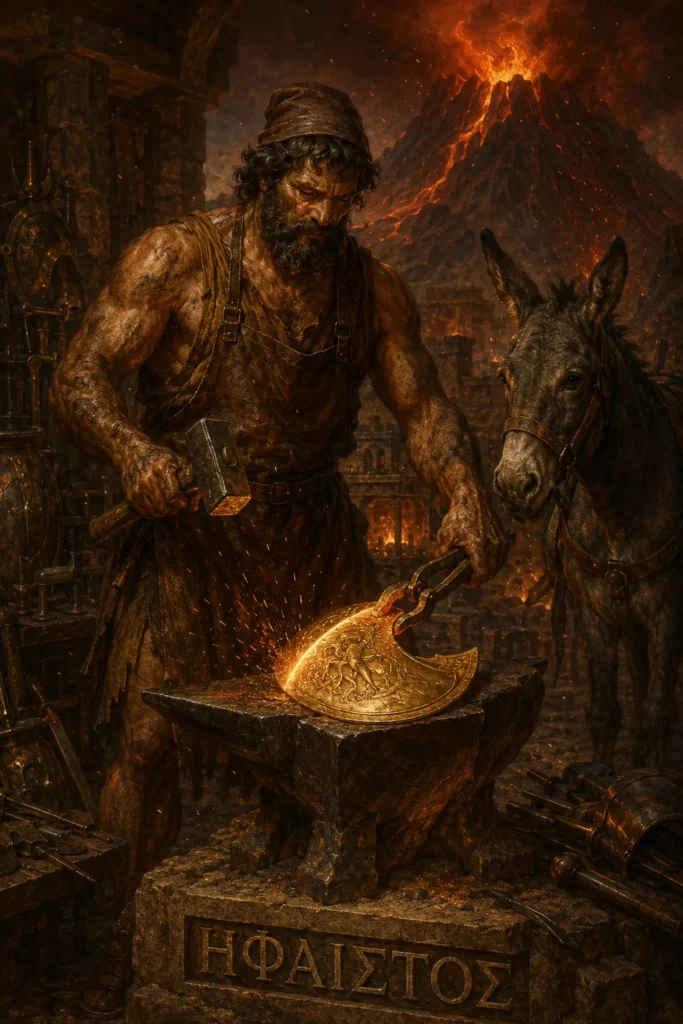
Hephaestus is typically depicted with hammer, tongs, and smith’s bellows, occasionally seated on a stool, because his disability makes prolonged standing difficult. He wears a conical felt cap, the «pilos», a characteristic headwear of craftsmen that distinguishes him from the uncovered Olympians.
His chiton is short, often covering only one shoulder (exomis), as worn by labourers. In Attic vase painting of the sixth and fifth centuries he frequently appears in the company of satyrs, maenads, and Dionysus, together with whom his return to Olympus is depicted.
His workshop is traditionally regarded as underground, within the volcanoes of Lemnos, Hiera (Hephaistia, today Vulcano), and Aetna.
In the Homeric workshop the helpers are not mortals but automatic machines: golden maidservants who think, speak, and work like living beings (Iliad XVIII, 417 to 420), and fiery tripods on wheels that roll of their own accord to the assembly hall of the gods.
This early vision of technical self-operation is among the oldest records of a mythical robotics in European literature.
Among the most famous works of Hephaestus are the new shield of Achilles (Iliad XVIII, 478 to 608), in whose pictorial programme Hephaestus depicts the entire world from the city at peace to the city at war, from the harvest festival to the wedding; the unbreakable bonds with which Prometheus is forged to the Caucasus (Aeschylus, Prometheus Bound 1 to 87); the sun chariot of Helios; the aegis of Zeus and Athena; the breastpin of Harmonia, which brings ruin upon her lineage; and the bronze giant Talos, who guards the island of Crete (Apollonius Rhodius IV, 1638 to 1693).
Sculptural representation of Hephaestus in the classical period is rarer than that of the other Olympians, because his craftsman’s modesty seemed to conflict with monumental sacred building. One exception is the Athena-Hephaestus group that Alcamenes created for the Hephaisteion on the Athenian Agora; today it can be reconstructed only from descriptions.
Cult and Worship
In Athens, Hephaestus had a central function as the patron god of craftsmen. The Chalkeia, celebrated on the last day of the month Pyanopsion (October/November), was the joint festival of Hephaestus and Athena Ergane. On this day the weaving women of the Acropolis began work on the new peplos for the Panathenaia.
A festival procession of craftsmen moved from the Hephaisteion on the Agora to the Acropolis. Pausanias (I, 14, 6) reports that at the foot of the temple stood a sacred olive tree, said to have grown from the staff of Erichthonius.
A dedicated festival of Hephaestus was the Apaturia for the phratries of Athens, on which, on the third day of the family festival (Koureotis), every citizen’s son offered Hephaestus a torch for initiation.
The Hephaisteia torch-race (a torch relay from the Academy to the city) was among the oldest athletic contests of Athens and was associated in particular with Hephaestus. Victors received clay lamps bearing the depiction of the smith god.
Lemnos was the oldest and most strongly pronounced cult of Hephaestus. On the volcanic island, the fumaroles on Mount Moschylos were regarded as the visible evidence of his workshop.
Once a year all the fires of the island were extinguished and kept out for nine days in a ritual phase of purity; afterwards a ship from the sanctuary on Delos brought new, pure fire to Lemnos, with which hearth and smith fires were rekindled (Philostratus, Heroikos 28, 6).
This period was regarded as the «Lemnian deed», recalling the mythical deed of the women of Lemnos, when the Lemnian women killed their husbands, which rendered the island «impure» until Hephaestus established reconciliation.
In Sicily the cult was connected with Mount Etna. The islands north of Sicily (Lipari, Vulcano, Stromboli) were interpreted in Hellenistic times as workshops of Hephaestus; Pindar (Pythian I, 17 to 28) has the god hold the giant Typhon beneath Etna.
At Olympia, Hephaestus appeared in the row of the twelve altars of the Olympian gods; at Argos he shared a temple with the Erinyes. Italic adoptions brought the cult into the Roman pantheon under the name Volcanus as well.
Important Sanctuaries and Temples
The most significant surviving temple of Hephaestus stands on the north-western height of the Athenian Agora, the Hephaisteion. Built between 449 and 415 before the common era, it is the best-preserved Doric temple in Greece; its preservation is owed to its conversion into a church of Saint George in the seventh century.
The metopes show the deeds of Heracles and Theseus; the interior held the bronze group of Athena and Hephaestus by Alcamenes. The temple served until the nineteenth century as a cemetery for British travellers, to which numerous gravestones attest.
On Lemnos lay the Hephaestus sanctuary at Hephaistia, on the northern coast of the island. Archaeological investigations by Italian schools since the 1930s have documented the sanctuary; it was a gathering point of the pre-Greek «Sintians», and then of the Greek population.
In the theatre and in the sanctuary of Kabirion, references to Hephaestus can be traced in numerous inscriptions.
In the Aeolian Islands, Hiera, today the island of Vulcano, was a site of Hephaestus in antiquity; the volcanic activity was regarded as visual confirmation of the workshop. Strabo (VI, 2, 11) describes the regular eruptions as rhythmic hammer-strokes of the smith.
At Argos, Hephaestus shared a sanctuary with the Erinyes, which Pausanias (II, 24, 2) describes as a small civic cult centre. On Crete there was a shrine at Olus that venerated Hephaestus as the builder of Talos.
Myth Narratives
The marriage myth of Aphrodite and Hephaestus is the most famous story of the god. In Homer (Odyssey VIII, 266 to 366), the singer Demodocus relates before the Phaeacians: Aphrodite, unfaithful to her limping husband, meets with Ares in Hephaestus’ bedchamber. Helios, the all-seeing, betrays the adultery.
Hephaestus forges an invisible net of the finest bronze threads and lays it over the bed. The lovers are caught in flagrante; Hephaestus summons the Olympian gods, who burst into Homeric laughter. The episode is one of the oldest comedies of European literature and treats the constant tension between craftsman’s virtue and aristocratic beauty.
The myth of the golden throne depicts a Hera-Hephaestus episode. Hephaestus sends his mother, who had cast him from Olympus, a wondrous throne as an apparent gift of reconciliation. Hera sits on the throne and is held fast by invisible bonds. The Olympians cannot release the work; only Hephaestus knows the secret.
Only when Dionysus makes the smith god drunk and brings him to Olympus on a mule does Hephaestus consent to free his mother. This «return» of Hephaestus to Olympus is one of the most frequent motifs in Attic vase painting between 580 and 470 before the common era.
At the birth of Athena, Hephaestus plays the role of midwife: with a blow of his axe he splits the skull of Zeus, from which Athena springs in full armour (Pindar, Olympian Odes VII, 35 to 38).
This paradoxical constellation, in which the limping smith becomes the deliverer of the virgin goddess, is regarded in comparative mythology as a model for the mediation of form and matter through technical knowledge.
The binding of Prometheus, depicted in Aeschylus’ «Prometheus Bound», shows Hephaestus in his second role as enforcer of the divine order: by command of Zeus he forges the Titan to the rock of the Caucasus.
Yet in the tragedy he carries out the work with undisguised grief, confesses his kinship with the punished (both are gods of fire), and questions the harshness of the task. This scene presents Hephaestus as an ethically sensitive god who obeys the command yet stands morally above it.
Relationships within the Pantheon
Hephaestus’ relationship to Hera is ambivalent. On the one hand she is his mother, often without any paternal part; on the other hand she cast him from Olympus. The golden throne and his return through Dionysus show the reconciliation between mother and son, made possible by a third figure (Dionysus).
With Zeus there is a professional relationship: Zeus gives him the heavy commissions (the aegis, the creation of Pandora, the binding of Prometheus), and Hephaestus carries them out without complaint, occasionally with inner distance.
According to Homer he is married to Aphrodite, and connected to Athena through the Erichthonius event. Both connections show the tension between the limping one and the fairest goddesses of the pantheon.
The connection with Aphrodite is regarded as a cosmic allegory of the union of matter (metalwork) and form (beauty), an interpretation elaborated in Plutarch and in the Neoplatonic tradition. The relationship to Athena is practical in terms of work: both are patrons of craftsmen, and the Hephaisteion was dedicated to both.
With Ares there is rivalry over Aphrodite, but also a professional difference: Hephaestus forges the weapons, Ares uses them. In Attic vase painting the two are frequently set against each other as contrasting figures in the pictorial programme.
With Dionysus he is connected through the «return to Olympus», one of the oldest and most frequently depicted divine scenes of archaic pictorial art. With the Cyclopes he shares the underground workshop; they are regarded as his assistants in forging the Olympian weapons.
Reception
In Roman religion, Hephaestus corresponds to Volcanus, an old Italic fire god whose cult was concentrated above all in the Volcanal on the Forum.
The Vulcanalia on 23 August were a festival to ward off the late-summer danger of fire; the festival programme included the burning of small fish, presumably as an expiatory offering for the hot weeks.
Virgil (Aeneid VIII, 416 to 453) locates Vulcan’s workshop on the island of Hiera (Vulcano) and describes the making of the weapons for Aeneas, a direct reception of the Achilles-shield episode from the Iliad.
In the Middle Ages, Hephaestus remained present as an allegory of the smith’s craft. Boccaccio treats him in «De genealogia deorum gentilium» with allegorical interpretations. The Renaissance brought new iconographic creations with Velázquez’s «The Forge of Vulcan» (1630) and Tintoretto’s «Vulcan Surprising Mars and Venus».
In the Baroque, Rubens and Cortona interpreted the subject as an allegory of artistic creation; the smith driven by the hammer becomes the emblem of the productive artist.
The eighteenth century saw in Vulcan above all the emblem of Enlightenment technology, the nineteenth century that of industrial smithing. Karl Marx, in the «Theories of Surplus Value», cites the myth to illustrate the relationship of labour and capital.
The modern scholarship of Marcel Detienne and Jean-Pierre Vernant («Les ruses de l’intelligence», 1974) has placed Hephaestus within the mythical concept of «metis», cunning inventive intelligence, and thereby re-emphasised his intellectual dimension.
Classification in Religious Studies
The etymology of the name Hephaestus is uncertain. An Indo-European derivation is regarded as unlikely; most scholars, among them Robert Beekes, assume a pre-Greek, possibly Lemnian origin.
The Mycenaean Linear B tablets name no god of this name, which could point to an introduction into Greek religion only in the Geometric period. The connection with the volcanic island of Lemnos and with the non-Greek Sintians supports this thesis.
In a comparative religious context, parallels stand out to the Hurro-Hittite smith Hasamil, the Ugaritic Kothar-wa-Hasis, and the Vedic Tvaṣṭṛ, all of whom fill the profile of the divine craftsman who forges the weapons of the gods and, through special inventions, helps construct the mythical world.
The disability of the smith god is a widespread motif: the Germanic Wieland, called Völundr in the North, is likewise physically disabled.
Marcel Detienne and Jean-Pierre Vernant have interpreted this motif as a symbolic marking of exceptional status: the smith steps out of the normal course of life and thereby gains extraordinary access to the elemental forces of fire and metal.
Walter Burkert, in «Greek Religion», elaborated the religious-historical function of Hephaestus: he is the god who sacralises workshop production and grants the craftsman a religious dignity of his own, alongside the warrior nobility and the priestly class.
This function explains his strong presence in the Athenian civic cult, which regarded craftsmen as equal members of the polis. The more recent scholarship of Robert Parker has reconstructed the social stratification of the worshippers of Hephaestus in Athens and shown that the Chalkeia and the torch-race were borne primarily by metics and native craftsmen.
Etymology and Pre-Greek Layer
The name «Hephaestus» (not attested in Mycenaean, Doric «Aphaistos») is etymologically unexplained. An Indo-European derivation is regarded as unlikely; most scholars, among them Robert Beekes, assume a pre-Greek origin.
The connection with the volcanic island of Lemnos and with the non-Greek Sintians supports this thesis. The Sintians, who according to Homer catch Hephaestus after his fall, are regarded in scholarship as a pre-Greek population of the northern Aegean, possibly with Anatolian or Thracian connections.
Notable is the absence of Mycenaean attestation. While most Olympian gods are attested in the Linear B tablets, Hephaestus is entirely absent from the Mycenaean texts found so far.
This could indicate that the god was incorporated into the Greek pantheon only after the collapse of the Mycenaean palace culture, possibly in the course of contacts with the volcanic islands of the northern Aegean and with the Anatolian smith deities of the Iron Age transitional phase.
The theological kinship of Hephaestus with Hurro-Hittite smith deities has been systematically investigated by Sandra Blakely («Myth, Ritual and Metallurgy in Ancient Greece and Recent Africa», 2006) and Walter Burkert.
In particular the Hittite «Hasamil» and the Ugaritic «Kothar-wa-Hasis» (Kothar for short) show structural similarities to the Greek Hephaestus: all three are creators of the weapons of the gods, all three have an unusual physical status, all three are located in workshops at extraordinary places.
This kinship suggests an old Eastern Mediterranean tradition of the divine smith, into which the Greek Hephaestus fits.
Sources
Homer, «Iliad» I, 571 to 600 (fall from Olympus), XVIII, 369 to 617 (shield of Achilles); «Odyssey» VIII, 266 to 366 (Aphrodite and Ares). Hesiod, «Theogony» 927 to 929 (birth). Aeschylus, «Prometheus Bound» 1 to 87. Pindar, «Olympian Odes» VII, 35 to 38. Apollonius Rhodius, «Argonautica» IV, 1638 to 1693 (Talos).
Apollodorus, «Bibliotheke», I, 3, 5 and III, 14, 6 (Erichthonius). Pausanias, «Description of Greece», I, 14 (Hephaisteion), II, 24 (Argos). Virgil, «Aeneid» VIII, 416 to 453. Walter Burkert, «Greek Religion», Stuttgart 1977. Marcel Detienne, Jean-Pierre Vernant, «Les ruses de l’intelligence. La mètis des Grecs», Paris 1974. Karl Kerényi, «The Gods of the Greeks», Zürich 1951.