iWell Guard

Taniwha, guardian and terror of the deep waters

Taniwha is a spirit of Māori tradition.

Protective spirit of one’s own tribe, terror of the foreign one.

SpiritPolynesia

Table of Contents

Taniwha, spirit of Māori tradition
Taniwha

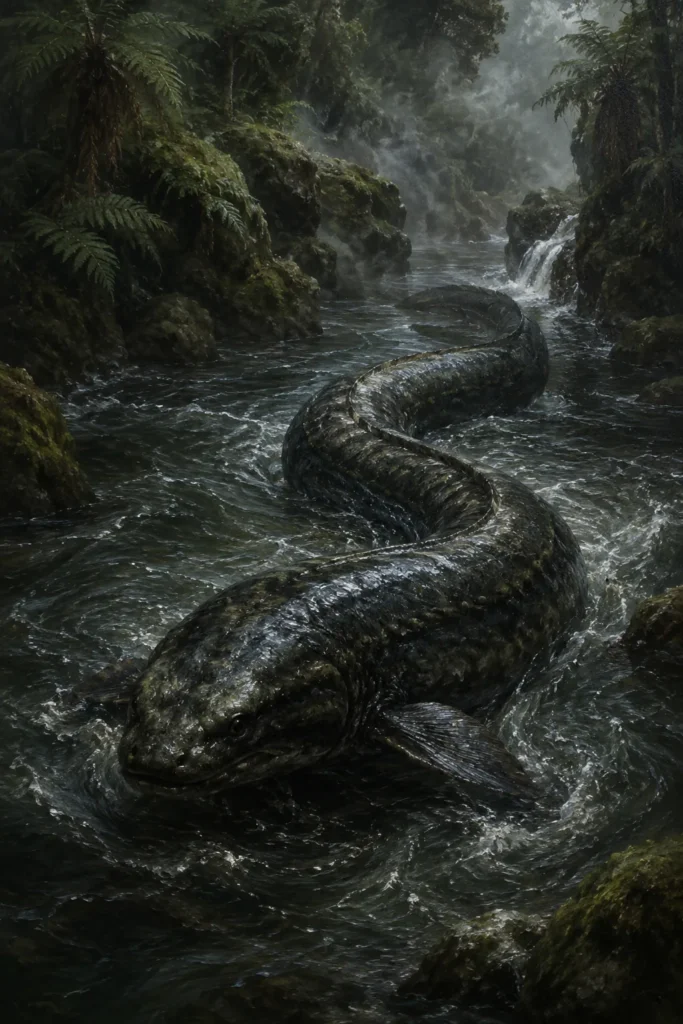
The Taniwha is a powerful Māori water being, dwelling in river pools, caves and dangerous stretches of sea; its form shifts between reptile, eel and whale.

Central is the kaitiaki concept: it protects its tribe or is regarded as a predator.

At a glance: Taniwha

Type: water being, protective spirit or monster
Origin: oral Māori tradition
Texts: written down from the 19th century
Period: pre-colonial to present
Appearance: reptile- or eel-like, sometimes shape-shifting

Source Context

Period of the Texts

Carried orally, committed to writing from the 19th century.

Area of Diffusion

New Zealand: deep river pools, caves and dangerous stretches of sea.

Sources

Good: the Te Ara Encyclopedia and specialist literature.

Name and variants

Māori: Taniwha means powerful water being. The saying Waikato taniwha rau points to their density along the river.

Appearance and workings

Appearance

No fixed form: reptile, giant eel or whale.

Effect

Protectively, it warns and rescues; predatorily, it threatens people. One’s own Taniwha is an ally, a foreign one a danger.

Profile: Taniwha

The most important aspects of the Taniwha at a glance.

Cultural Context

A central figure in oral Māori tradition.

Relates To

Its own tribe as protector, strangers as possible prey.

Depiction

A reptile- or lizard-like being, giant eel or whale-like form.

Function

Warns of enemies, watches over tapu rules or threatens people.

Approach

Upholding tapu and respectful behaviour at the water.

Related

In the Māori realm, Marakihau and Pania stand alongside him.

Kaitiaki: the Taniwha as guardian of its tribe

The Taniwha belongs to oral Māori tradition, first written down from the 19th century onwards. Central to it is the kaitiaki concept: Taniwha protect their iwi and punish breaches of tapu, as with Ureia, the protective Taniwha of the Hauraki Māori. The saying Waikato taniwha rau alludes to their density along the river.

From tribal myth to legal figure

The Taniwha is visible in New Zealand law: in 2002 a motorway near Meremere was rerouted to avoid its dwelling place, and the Whanganui River was recognised as a legal person. From a religious-studies perspective: an ambivalent guardian and boundary spirit.

Upholding tapu rather than challenging the Taniwha

Protection lies in upholding tapu and behaving respectfully at the water: one’s own Taniwha is considered an ally. Common: amulet, protective circle, salt.

Guardians and monsters of the waters compared

The Taniwha stands alongside the Australian Bunyip; in its predatory aspect it resembles the Nixe and the Kelpie, and in its protective aspect the Vodník.

Frequently asked questions about the Taniwha

Are Taniwha good or evil?

Both: some protect their tribe, others are predators.

Did a Taniwha reroute a motorway?

Yes, in 2002 near Meremere, to protect its dwelling place.

Further links

Literature (selection)

Source:
  • Orbell, Margaret: The Illustrated Encyclopedia of Māori Myth and Legend. Christchurch 1995.

Further standard works in the bibliography.

Those searching for Taniwha Maori legends or the water being of New Zealand will find the same ambivalent figure: protector of its own tribe, danger to strangers.

Classification & Protection

IIILEVEL
The Protection Compass assigns this being to influence level III, Burdensome influence.

Against its influence, cross-cultural tradition names these protective means:

Compare in the Protection Compass →

Recommended protective means

iWell Guard

The simplest protective means in this collection: 41 layers of fine gold 999, platinum, silver and silicon, manufactured in Ruhla, Thuringia. It requires no activation, is bound to no person, and is effective within a radius of around 50 meters, even without being worn.

All protective means at a glance →