Näcken and the fiddle that lures into the water
By Ralf Ittermann · last reviewed on
Näcken is a spirit of the Germanic/Nordic tradition.
His fiddle playing enchants and draws bathers into the depths.
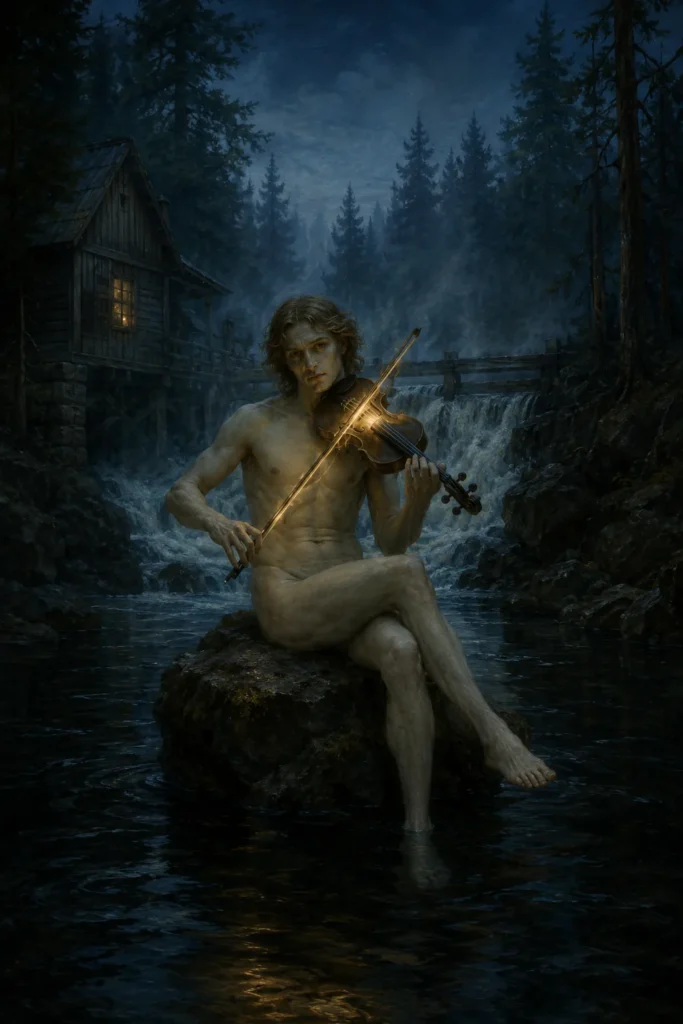
The Näcken, water spirit of Scandinavia, sits in the evenings by streams and weirs and plays the fiddle so bewitchingly that listeners walk into the water.
At the same time he is teacher of fiddlers: for gifts, he passes on his playing.
Type: fiddling water spirit
Origin: Scandinavia, nykr word family
Texts: legends from the early 19th century
Period: Old Norse to today
Appearance: naked fiddler, also a white horse
Historical Background
Period of the Texts
Attested in Old Norse, legends recorded from the early 19th century.
Area of Diffusion
Sweden, Norway, Denmark.
Sources
Realm: legends and folk music.
Name and variants
Language: Old Norse nykr, Old High German nihhus: from these come Näcken, Nøkken, Nøkke and the German Nix.
Form and effect
Appearance
Naked man in the river with a fiddle, also a grey horse (Bäckahäst in southern Sweden).
Effect
His fiddle lures people into the depths; dancers only come to rest once the strings are cut.
Profile: Näcken
The key aspects of the fiddling water spirit at a glance.
Scandinavian form of the Germanic nykr word family.
Bathers as a danger, minstrels as pupils.
Naked fiddler in the river, also appearing as a grey horse.
Temptation and danger of drowning, yet also a master of music.
Steel in the water, speaking his name as a means of banishment.
The fiddle distinguishes him from the Finnish Näkki.
From the Nykr to the Fiddler of the Streams
Jacob Grimm treated the nykr family in 1835 as a pan-Germanic figure. The tales were recorded from the early 19th century onward, in Norway by Faye, in Sweden by Hyltén-Cavallius. One tale concerns redemption: a clergyman calls out to the Neck that his staff will sooner turn green than the spirit find salvation; the staff sprouts leaves, and the Neck sings for joy.
From Stagnelius to the Ice Queen
The Romantic era turned the Näcken into an artistic figure: Stagnelius’ poem Näcken (1821) and Kittelsen’s painting Nøkken (1904) shaped his image. He personifies the danger of drowning at mills and the half-uncanny art of the minstrel.
Steel in the Water and Speaking the Right Name
Näcken, Näkki and the Water Powers of Northern Europe
Frequently Asked Questions about the Näcken
Is the Näcken the same as the Nix?
Linguistically yes, both share the Germanic root; the Näcken’s distinguishing feature is the fiddle.
What is Näckens Polska?
A melody type from Swedish folk music that, according to legend, cannot be broken off once begun.
Literature (selection)
Further standard works in the bibliography.
As the Näcken water spirit, he remains unforgotten: his fiddle playing lures bathers into the depths, while those who learn from him receive rare melodies. Whether as Nøkken in Norway or Näcken in Sweden, it remains uncertain whether the spirit itself will ever find salvation.