Myling, the Child Spirit on the Wanderer's Back
By Ralf Ittermann · last reviewed on
Myling is a spirit of Nordic tradition.
The spirit of an abandoned child that demands a grave.
The Myling, called Utburd in Norway, is in Scandinavian folk belief the spirit of a child that died unbaptised, was secretly killed, or was abandoned. At night it follows lone travellers, leaps onto their backs and demands to be carried to consecrated ground, growing heavier with every step.
The Swedish name Myling and the Norwegian Utburd denote the same being, in Iceland Útburður. The tale material is recorded in the context of the Norwegian folk-tale and legend collections of Asbjørnsen and Moe. Burial in consecrated earth releases the restless child spirit.
Type: Spirit of a child that died unbaptised or was abandoned
Origin: Scandinavian folk belief concerning infanticide and burial
Texts: Tale material in the context of Asbjørnsen and Moe
Period: Folk tradition, recorded in the tale material
Appearance: usually perceptible only as nocturnal crying

Area of origin and sources
Period of the Texts
Scandinavian folk tradition: the belief is recorded in the tale material, particularly in the context of the Norwegian collections of Asbjørnsen and Moe.
Area of Diffusion
Utburd in Norway, Myling in Sweden, Útburður in Iceland. Its preferred place of appearance is lonely roads at night.
Sources
Well documented: a broad folk tradition and the collected tale material of the Scandinavian countries.
Name and variants
Language: The Swedish name Myling derives from mord (murder) and means the little murdered one; the Norwegian Utburd means the carried-out one, the child abandoned to die. The Icelandic form is Útburður.
Appearance and behaviour
Appearance
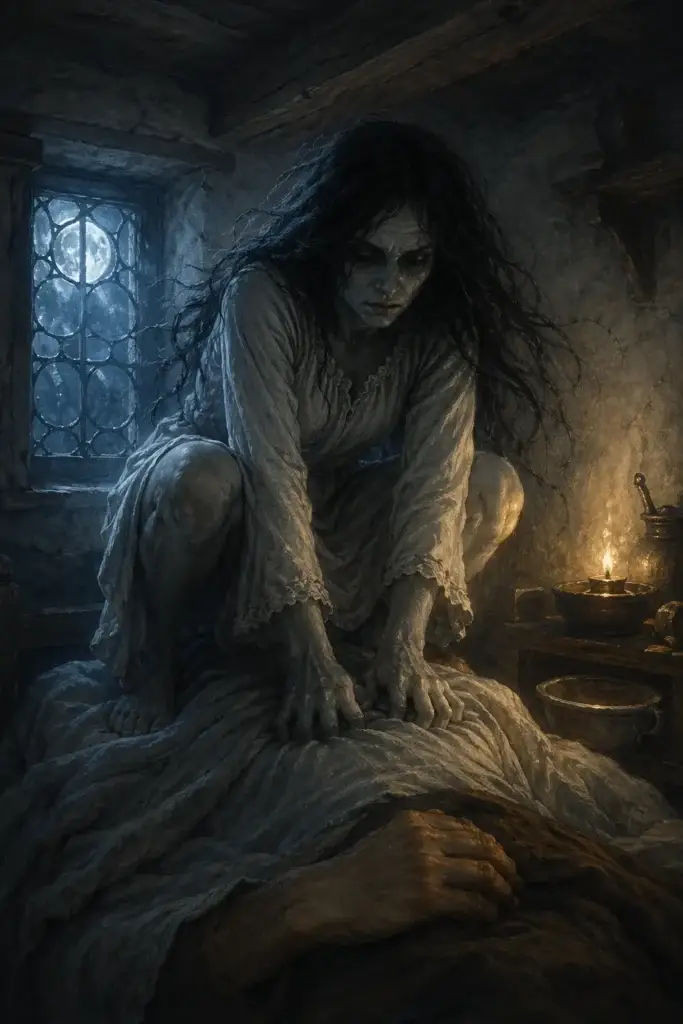
The Myling is often perceptible only as screaming in the night and is rarely seen in bodily form. Where it becomes visible, it appears as the dead child clinging to the wanderer.
Effect
It follows nocturnal wanderers, jumps onto their back and demands a burial. On the way to consecrated ground it becomes ever heavier; should the carrier’s strength fail, it can overwhelm him and put him in danger.
Profile: Myling
The key aspects of the Scandinavian child spirit at a glance.
Scandinavian folk belief concerning unbaptised, unburied children, recorded in Norwegian and Swedish legend material.
Nocturnal wanderers and lone travellers, onto whose back the spirit throws itself and from whom it demands a grave.
Usually invisible and audible only as screaming; where tangible, as a clinging dead child that grows heavier the closer it comes to the graveyard.
Warning and demand: its appearance calls for the belated burial of the impurely or unredeemed deceased.
Giving the child a name and burying the body in consecrated ground; the belated baptism calms the spirit.
The Gjenganger and the Germanic Wiedergänger as further restless dead, along with the Slavic Nav as souls of those who died young.
The abandoned child and the call for the grave
The Mylingar arise from illegitimate, unbaptised children, or children killed and abandoned out of poverty, in times when abortion was forbidden and illegitimate birth was shameful. The spirit finds no rest because it was denied the passage through baptism and burial.
The motif of growing heavier when approaching the graveyard figuratively carries the burden of unatoned child-killing: the closer redemption comes, the heavier the weight upon the carrier becomes. The legend material is recorded in the context of the Norwegian collections by Asbjørnsen and Moe.
Afterlife and classification
The Myling is a firm part of Scandinavian ghost-story and legend culture and appears in modern folklore literature and popular culture as one of the better-known Nordic child-spirit motifs.
From a religious-studies perspective, it links fear of the dead, the taboo of child-killing, and the ritual of baptism and burial: the unbaptised, unburied dead find no rest. In social-historical terms, it reflects hardship, illegitimate birth, and church discipline, and belongs to the type of the impurely or unredeemed deceased.
Naming and burial as redemption
What is well attested is not defence against the being but redemption through the ritual completion of the passage. Giving the child a name, in effect baptising it, calms it; finding the body and burying it in consecrated ground redeems the spirit. Holy water connects to this redeeming baptism, while the protective candle carries the light of the wake, and salt serves as a purifying agent in dealing with the unredeemed dead.
Child spirits between North and East
The Myling is a special form of the unredeemed Wiedergänger, here that of a child. A close Slavic parallel in meaning are the Nav, the souls of children who died unbaptised or before their time. It differs from bodily grave-dead such as the Gjenganger in that it is not destruction but burial that brings it to rest. The name variants Utburd and Útburður refer to the same being.
Frequently asked questions about the Myling
How is a Myling redeemed?
Through naming and burial in consecrated ground, which make up for the missed baptism and passage.
Why does it grow heavier while being carried?
The closer the graveyard comes, the more pressing and heavier the burden that demands redemption.
Is the Myling a vampire?
No, it is an unredeemed child spirit and revenant, not a blood-drinker.
Further links
Further reading:
- Germanic – beings of Germanic and Nordic tradition
- Gjenganger, Wiedergänger, Nav – related restless dead
- Holy water, protective candle, salt – traditional protective means
- Protection Compass – protective means at a glance
Literature (selection)
Further standard works in the bibliography.
As Utburd, the Myling is the spirit of an abandoned child in the most literal sense: not a blood-drinker, but an unredeemed dead being who finds rest only once given a name and a grave.