iWell Guard

Vanadevata, the guardians of the sacred groves

The Vanadevatas are deities of Indian tradition.

Female tree deities who preserve sacred groves.

DeitiesIndia

Table of Contents

Vanadevata, goddess of Indian tradition
Vanadevata

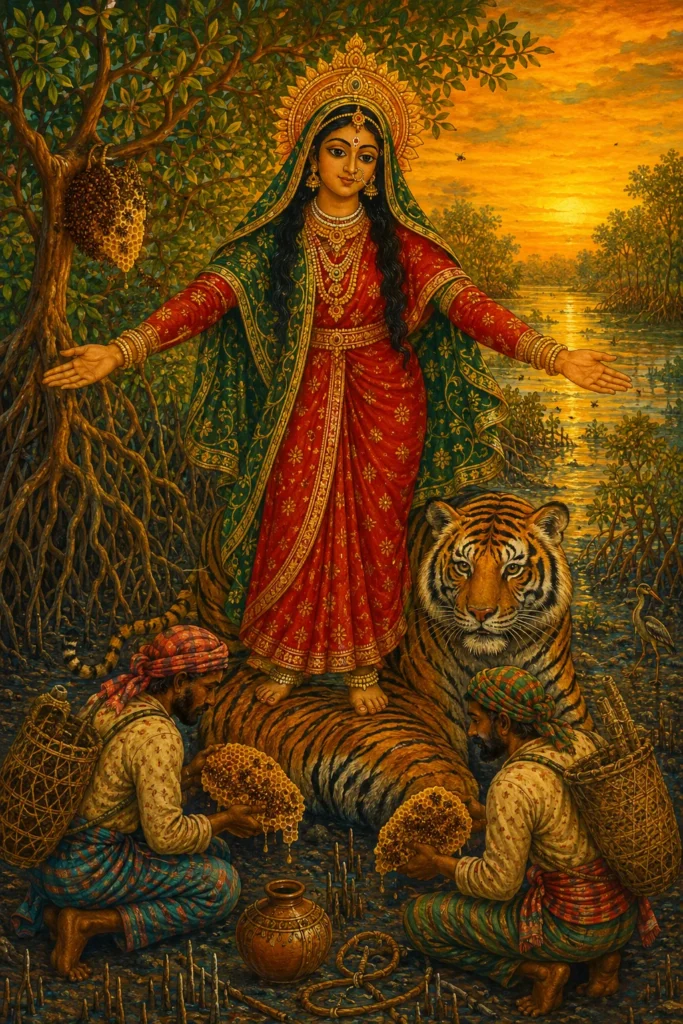
Vanadevata is the collective term for Indian forest deities and tree deities: female protective spirits believed to dwell in trees and sacred groves. They preserve the integrity of the forest and establish usage prohibitions that effectively protect biodiversity.

Vanadevatas are attested in classical Sanskrit poetry, from the Ramayana to Kalidasa, and equally in living folk piety, especially in Goa and Konkan, in Himachal Pradesh and in Kerala.

At a glance: Vanadevata

Type: Class of female forest and tree deities, dryad-like
Origin: Pan-India, especially Goa and Konkan, Himachal Pradesh and Kerala
Texts: Ramayana, Kalidasa’s Kumarasambhava and Raghuvamsha
Period: classical Sanskrit poetry to present-day folk piety
Appearance: protective spirits dwelling in trees and groves, often as a class

Historical Classification

Period of the Texts

The collective term spans from classical Sanskrit poetry to living folk piety; in the history of religion, the Vanadevatas are considered possible descendants of early nature-spirit cults.

Area of Diffusion

Pan-India, with particular emphasis in Goa and Konkan, in Himachal Pradesh and in Kerala, where they are linked with grove sanctuaries.

Sources

The source material is scattered and based on collected attestations: classical poetry such as the Ramayana and Kalidasa on one side, regional folk piety on the other.

Name and variants

Sanskrit: The name combines vana, forest, and devata, deity: the forest deity. The feminine form is Vanadevata; the class is thought of as predominantly female, as one of several devata classes alongside the village deities.

Form and effect

Appearance

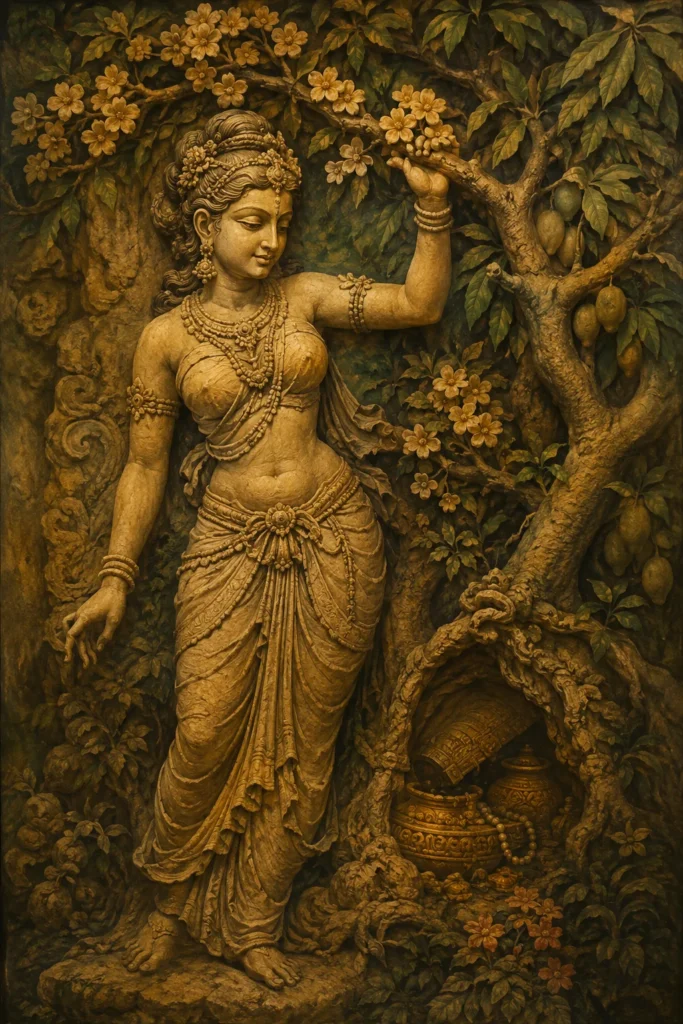
The Vanadevatas are conceived as female, dryad-like forest and tree deities who mostly appear as a class. They embody the divine harmony of nature and are protective spirits of groves, in Kerala often linked to grove sanctuaries.

Effect

The Vanadevatas preserve the integrity of forest and grove; their presence establishes prohibitions such as felling trees or hunting, which in practice protects biodiversity. In Himachal Pradesh they are known as Van Devtas and linked to a sacred forest ecology in which taboos protect the groves.

Profile: Vanadevata

The key aspects of the forest deities at a glance.

Cultural Context

A class of devatas alongside the village deities, possible descendants in religious history of earlier nature spirit cults.

Responsible for

Forest users and village communities who preserve sacred groves: the deities watch over tree, grove and their integrity.

Depiction

Female, dryad-like figures who dwell in trees and groves; in poetry they grace forest scenes or accompany divine figures.

Sphere of Influence

Protection of forest and grove: their presence establishes taboos against felling and hunting, which in practice preserve biodiversity.

Cult

Sacred groves as dwelling places, tree veneration at sacred trees, in Kerala grove cult sites; veneration and preservation rather than warding off.

Distinctions

The ambivalent Yakshas are neighbours, but not a class of deities; the western counterpart is the Dryad, the eastern the Kodama.

From Kalidasa to the sacred grove

In the Ramayana, Kalidasa’s Kumarasambhava and Raghuvamsha, Vanadevatas appear as forest spirits who grace forest scenes or accompany divine figures. In religious history they are regarded as possible descendants of earlier nature spirit cults, as one of several devata classes alongside the village deities.

The second line of tradition is living folk piety: in Kerala the Vanadevatas are linked to grove sanctuaries, in Himachal Pradesh as Van Devtas to a sacred forest ecology in which taboos protect the groves. Both lines share the same idea: the forest is inhabited, and its inhabitants demand consideration.

Sacred ecology: reception and classification

The Vanadevatas are a prime example of Indian tree worship and grove sanctity, a link between Vedic nature deities and today’s folk piety. In ecological discourse they are being rediscovered as sacred ecology.

In religious studies, the Vanadevatas are the classic expression of Indian tree worship and grove sanctity. They combine the animation of forest and tree with a religiously grounded protective ethic and stand at the intersection of Vedic nature deification and today’s folk piety. It should be noted that Vanadevata is a collective term; reliable individual attestations are scattered across classical poetry and regional folk piety.

Groves, taboos and tree veneration

Well attested are the sacred groves as dwelling places of local deities and ancestral spirits, protected by taboos that make them biodiversity hotspots, as well as tree veneration at sacred trees. In Kerala the Vanadevatas are linked to grove cult sites. Since they are benevolent, the focus is on veneration and preservation rather than warding off; danger threatens only those who violate the grove taboos.

Tree deities of other cultures

The Vanadevatas correspond to the Greek Dryad, the tree nymph, with whom they are explicitly compared, and to the Japanese Kodama, the tree spirit. Within India they are related to Vanadurga and Aranya Devi; the Vedic Aranyani and the ambivalent Yakshas belong to the same neighbourhood, though the Yakshas are nature spirits and not a class of deities.

Frequently asked questions about the Vanadevatas

Is Vanadevata a single god?

No, it is a collective term and a class of female forest and tree deities.

Where are they worshipped today?

Especially in Goa and Konkan, in Himachal Pradesh and in Kerala at sacred groves and trees.

How does veneration protect the forest?

The taboos surrounding the sacred groves forbid felling and hunting and thus in practice preserve biodiversity.

Further links

Recommended internal links:

Literature (selection)

A selection of key sources and studies:
  • Dalal, Roshen: The Religions of India. A Concise Guide to Nine Major Faiths. New Delhi 2010.
  • Ramayana and Kalidasa: Kumarasambhava, Raghuvamsha. Classical Sanskrit sources.

Further standard works in the bibliography.

As a collective name for Indian forest and tree deities, the Vanadevatas stand for a quiet protective ethic: where they dwell, the grove remains untouched, and belief in the inhabitants of the trees still preserves entire tracts of forest today.

Classification & Protection

ILEVEL
The Protection Compass assigns this being to influence level I, Minor influence.

Against its influence, cross-cultural tradition names these protective means:

Compare in the Protection Compass →

Recommended protective means

iWell Guard

The simplest protective means in this collection: 41 layers of fine gold 999, platinum, silver and silicon, manufactured in Ruhla, Thuringia. It requires no activation, is bound to no person, and is effective within a radius of around 50 meters, even without being worn.

All protective means at a glance →