Shu, who carries the sky
By Ralf Ittermann · last reviewed on
Shu is a god of the Egyptian tradition.
The air god who lifts Nut above Geb. Shu counts among the oldest deities of ancient Egypt.
Shu is the Egyptian god of air, wind and breath. As the son of Atum, he separates the sky, Nut, from the earth, Geb, thereby creating the space of air in which life becomes possible.
He belongs to the Ennead of Heliopolis and is among the best known cosmogonic gods of Egypt; already the Pyramid Texts refer to him as the giver of breath.
Type: Cosmic god of air, wind and breath
Origin: Ennead of Heliopolis, son of Atum
Texts: Pyramid Texts, Coffin Texts
Period: Pyramid Texts through to the Late Period
Appearance: a man with an ostrich feather, lifting Nut above Geb

Region of origin and sources
Period of the Texts
Attested continuously from the Pyramid Texts through to the Late Period; already the oldest text corpora name Shu as the giver of breath.
Area of Diffusion
Egypt, with its centres at Heliopolis, the seat of the Ennead, and Leontopolis, where Shu was worshipped together with Tefnut as a lion pair.
Sources
Good: the Pyramid Texts and Coffin Texts as primary sources, along with the standard reference works of Egyptology.
Name and variants
Egyptian: Šw, often connected with emptiness, dryness or rising up; the exact root remains disputed. The ostrich feather on his head is a wordplay on his name, not the Maat symbol, even though both appear as an ostrich feather.
Appearance
Appearance
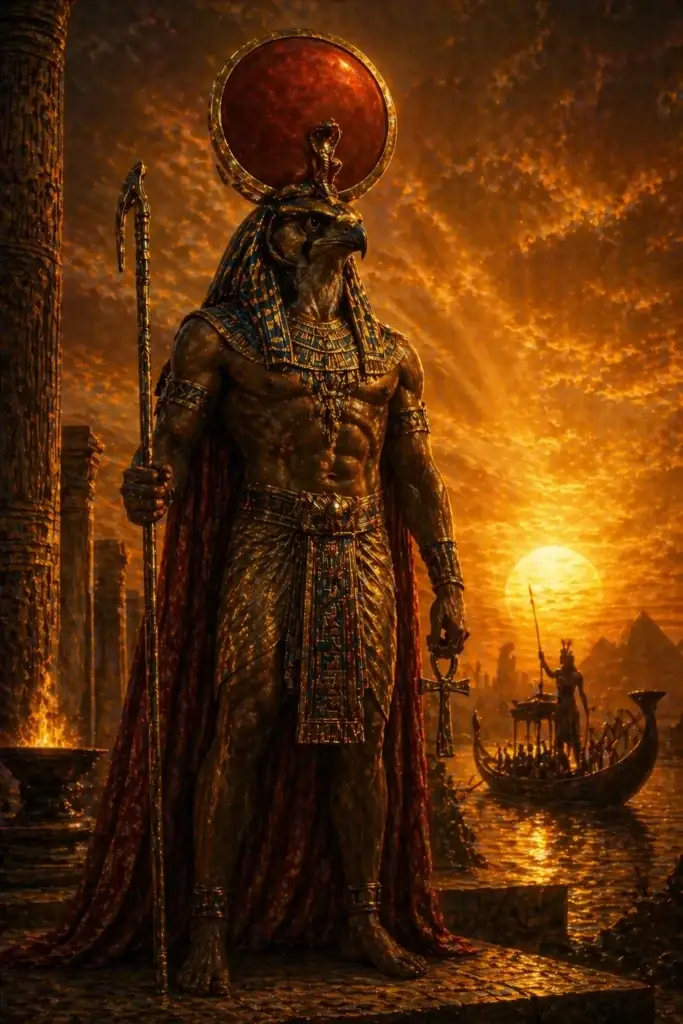
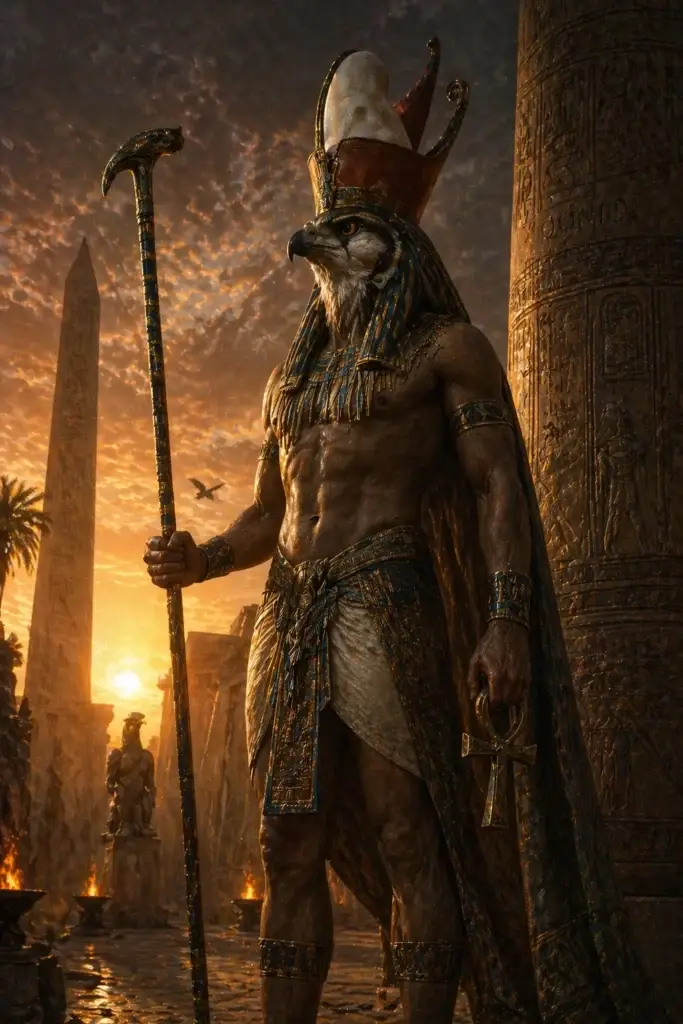
Shu is anthropomorphic, depicted as a man with an ostrich feather on his head. He is often shown kneeling with raised arms, lifting Nut above Geb; this is the canonical image of the separation of sky and earth.
Effect
Shu keeps the sky separated from the earth, thereby creating the space of air in which life becomes possible; he is the giver of breath and life-sustaining air. At times he is also linked with light and, in lion form as the double lion Ruti together with Tefnut, carries solar aspects.
Profile: Shu
The key aspects of the air god at a glance.
Member of the Ennead of Heliopolis: son of Atum, brother and husband of Tefnut, father of Geb and Nut.
Airspace, wind and breath: Shu keeps sky and earth separated and provides the life-sustaining air, in funerary spells also for the deceased.
A man with an ostrich feather, canonically kneeling with raised arms beneath the sky goddess; with Tefnut also as the double lion Ruti.
Cosmically the permanent separation of sky and earth, in everyday terms breath and life-sustaining air, and at times also light.
Worshipped in Leontopolis with Tefnut as a lion pair and invoked in funerary spells; distinct apotropaic amulets are not attested in large numbers.
Not a directional wind god like Qebui and the four winds, but the airspace as a principle; closely related to the wind aspect of Amun the Hidden.
Son of Atum, father of sky and earth
Shu belongs to the Ennead of Heliopolis. He is the son of Atum and, together with his sister-wife Tefnut, moisture, forms the first sibling pair of creation; their children are Geb, the earth, and Nut, the sky. Thus the air god stands precisely at the centre of the genealogy: between the primordial god and the habitable world.
Already in the Pyramid Texts Shu is attested as the giver of breath. His name Šw is often linked with emptiness, dryness or rising up, though the exact root remains disputed; what is certain is the wordplay with the ostrich feather he wears as a headdress.
An iconic image and its interpretation
Shu is one of the best known Egyptian cosmogonic gods; the image of the air god lifting Nut above Geb is iconic and widely reproduced.
In religious studies, Shu represents the airspace and breath as a principle, not a directional wind god like the four winds. An important clarification: his ostrich feather is a wordplay on his name and not the Maat symbol, even though both appear as an ostrich feather.
The lion cult of Leontopolis and funerary invocation
Shu was worshipped, among other places, in Leontopolis together with Tefnut as a lion pair, and was invoked in funerary spells as the giver of breath and life. Distinct apotropaic amulets specifically for Shu, however, are not attested in large numbers; his role was less that of a protector against danger than that of the guarantor that space to breathe exists at all between sky and earth.
Gods of the in-between space and principles of air
As the separator of sky and earth, Shu is structurally comparable to other air and in-between deities. Within Egypt, he forms a complementary pair with Tefnut, moisture; he is close, as a principle of air, to the wind aspect of Amun the Hidden, while the directional wind gods around Qebui form a system of their own.
Frequently asked questions about Shu
What is Shu’s most important role?
He separates sky and earth and creates the space of air in which life becomes possible; he is the giver of breath.
What does his feather mean?
It is a wordplay on his name, not the Maat symbol, even though both are ostrich feathers.
Is Shu a directional wind god?
No. He is the airspace and breath as a principle, unlike the four directional wind gods.
Further links
Further reading:
- Egypt – all beings of the Egyptian cultural sphere
- Amun the Hidden – the hidden wind aspect of the supreme god
- Qebui – the north wind from the four-winds system
- Protective candle, smoke cleansing, amulet – traditional protective means
- Protection Compass – protective means at a glance
Literature (selection)
Further standard works in the bibliography.
As the Egyptian air god and separator of sky and earth, Shu stands for a thought of great simplicity: there must be air between sky and earth for life to breathe.