Lob Lie-by-the-Fire, the shaggy giant at the hearth fire
By Ralf Ittermann · last reviewed on
Lob Lie-by-the-Fire is a spirit of English folk tradition.
Works at night for ten, lies sluggishly by the fire by day. Lob Lie-by-the-Fire figures as England’s hearth spirit, and what follows sorts the name and the household setting into their tradition.
Lob Lie-by-the-Fire, also Lob-lie-by-the-fire or the lubber fiend, is a benevolent hearth spirit of English folklore: a large, shaggy relative of the Brownie and Hobgoblin, who works for the family at night and lies sluggishly by the fire during the day.
The classic literary source is John Milton’s poem L’Allegro of 1631, in which the lubber fiend is described as a giant, hairy spirit who does the work of ten farmhands and afterwards stretches out before the fire.
Type: Benevolent, sluggish hearth spirit of the brownie type
Origin: English folklore, shaped in literature by Milton
Texts: Milton’s L’Allegro (1631), Briggs, Ewing
Period: 17th century into Victorian children’s books
Appearance: large, shaggy, hairy, sluggish
Historical Classification
Period of the Texts
The classic source is Milton’s L’Allegro of 1631; the name Lob is attested in Shakespeare as lob of spirits for Puck, reaching back into the 16th and 17th centuries.
Area of Diffusion
England; the being’s fixed place is the warm corner by the hearth, around which the entire tradition is grouped.
Sources
Sources: Milton’s poem as the literary core, along with Briggs; solid independent custom is rare and transferred from the brownie complex.
Name and variants
English: lob, related to lubber, a clumsy fellow, and lob, a sluggish figure; attested in Shakespeare as lob of spirits for Puck. Alongside this stands Milton’s term lubber fiend.
Description
Appearance
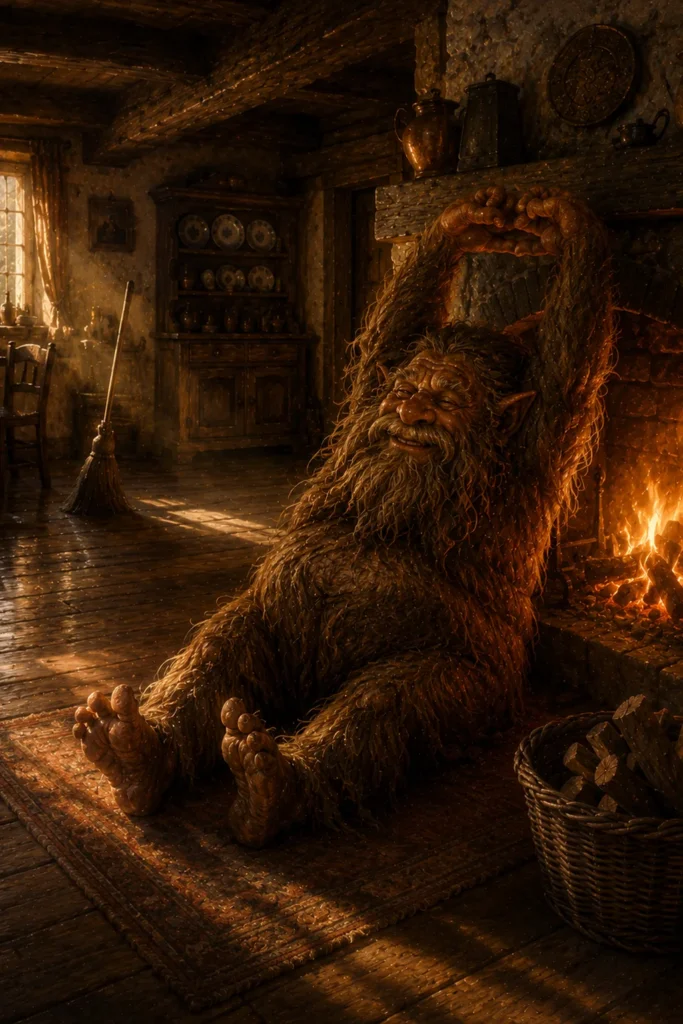
Lob is large, shaggy and hairy, noticeably bigger than the small Brownie, and seems sluggish and lazy, yet works vigorously at night. His place is the warm corner by the hearth.
Effect
At night Lob performs the heavy housework, threshing, grinding and tidying, in exchange for a small bowl of cream or food, and lies down by the fire during the day. He shares the brownie pattern: helpful when respected, offended by payment or mockery. His core nature is that of a benevolent service spirit bound to the hearth.
Profile: Lob Lie-by-the-Fire
The key aspects of the hearth spirit at a glance.
English folklore with strong literary shaping: Milton described the lubber fiend in 1631, and Victorian children’s books kept him alive.
Home and hearth: at night Lob takes over the family’s heavy housework and claims the warm corner by the fire in return.
Large, shaggy and hairy, noticeably bigger than the small Brownie; sluggish and lazy, stretched out before the fire during the day.
Threshing, grinding and tidying at night, according to Milton the work of ten farmhands; a small bowl of cream is enough in return.
Leave cream or food by the hearth and do not offend him with payment or clothing; independent rituals are hardly recorded.
Milton's lubber fiend and the name Lob
The classic literary source is John Milton’s poem L’Allegro from 1631: there the lubber fiend appears as a huge, hairy spirit who does the work of ten servants and then stretches out before the fire. Hardly any other British house spirit owes its image so much to a single text.
The name Lob is older than Milton’s poem: it is related to lubber, a clumsy fellow, and lob, a sluggish figure, and is attested in Shakespeare as lob of spirits for Puck. Sluggish body and diligent night have belonged together in this being from the outset.
Children's book and afterlife
Juliana Horatia Ewing made Lob Lie-by-the-Fire the titular being of a popular tale in 1873, and Kipling included him in Puck of Pook’s Hill; this kept the figure alive in Victorian and Edwardian children’s literature.
In terms of religious studies, Lob is a benign, sluggish hearth spirit who works for food. Important clarifications: Milton’s lubber fiend, despite the word fiend, is not a devil but a helpful house spirit. Lob is a size and style variant of the Brownie, not a distinct type of being. And Victorian literature shaped this image strongly.
Dealing with the hearth spirit
Part of a good relationship is leaving Lob cream or food by the hearth at night and not offending him with wages or clothing. Solid independent rituals are rare; the material is literary in character and transferred from the brownie complex. Anyone wishing to keep the hearth spirit followed the simple rule of all brownie-like beings: gift instead of wages, respect instead of mockery.
A brownie type in oversize
Lob corresponds closely to the Brownie, the Hobgoblin and the Hob; in a broader sense the Welsh bwca and the German Kobold stand alongside them. He is clearly a brownie type, distinguished only by size, daytime sluggishness and the literary shaping by Milton. Where the offended house spirit turns into a Boggart, Lob remains the most good-natured representative of the family.
Frequently asked questions about Lob Lie-by-the-Fire
What is Lob Lie-by-the-Fire?
A benign, large and sluggish hearth spirit of English folklore, related to the Brownie, who works at night and lies by the fire during the day.
Is the lubber fiend a devil?
No. Despite the word fiend, in Milton he is a helpful house spirit who does the work of ten servants.
Where does the figure originate?
Literarily, chiefly from Milton’s L’Allegro of 1631; the name Lob is already attested in Shakespeare for Puck.
Further links
Further reading:
- Brownie – the prototype of British house spirits
- Hobgoblin, Hob – the closest relatives
- Salt, Amulet, Smoke cleansing – traditional protective means
- Protection Compass – an overview of protective means
Literature (selection)
Further standard works in the bibliography.
As an English hearth spirit, Lob Lie-by-the-Fire combines two images that Milton brought together in his lubber fiend: the strength that works for ten at night, and the sluggishness that stretches out before the fire by day.