Hob, Yorkshire's name for the good house spirit
By Ralf Ittermann · last reviewed on
The Hob is a spirit of English folk tradition.
Northern England’s nocturnal helper, whose name became a generic term. Hob serves as Yorkshire’s name for the good house spirit, and the entry below sorts the figure into that regional naming tradition.
The Hob is a usually benign, helpful house spirit of northern England, especially Yorkshire, and at the same time a generic term for the place-bound hobgoblin of the Brownie type. Many local spirits carry the name as part of their own, such as Hob Hole Hob or Hob of Hart Hall.
At night the Hob helps with threshing, harvest and housework in exchange for food and respect; if offended, it turns into a noisy poltergeist. Hills, caves and farms are often named after specific Hobs.
Type: Helpful house spirit and generic term for the brownie-like hobgoblin
Origin: Northern English folklore
Texts: Briggs, Gutch, Wright
Period: folkloric material collected in northern England
Appearance: small, shaggy, often invisible

Source context
Period of the Texts
The Hob belongs to northern English folklore; it is documented chiefly in folkloric collections, for instance by Eliza Gutch for the North Riding of Yorkshire and by Katharine Briggs.
Area of Diffusion
Yorkshire, northern England and the Midlands; numerous named Hobs are linked to hills, caves and farms that bear their name.
Sources
Good: the collections of Briggs and Gutch, as well as Wright’s folkloric studies on language and folk belief.
Name and variants
English: hob, like in Hobgoblin a pet form of Robert and Robin, which became a collective name for the helpful house spirit. The name is embedded in many northern English toponyms.
Form and effect
Appearance
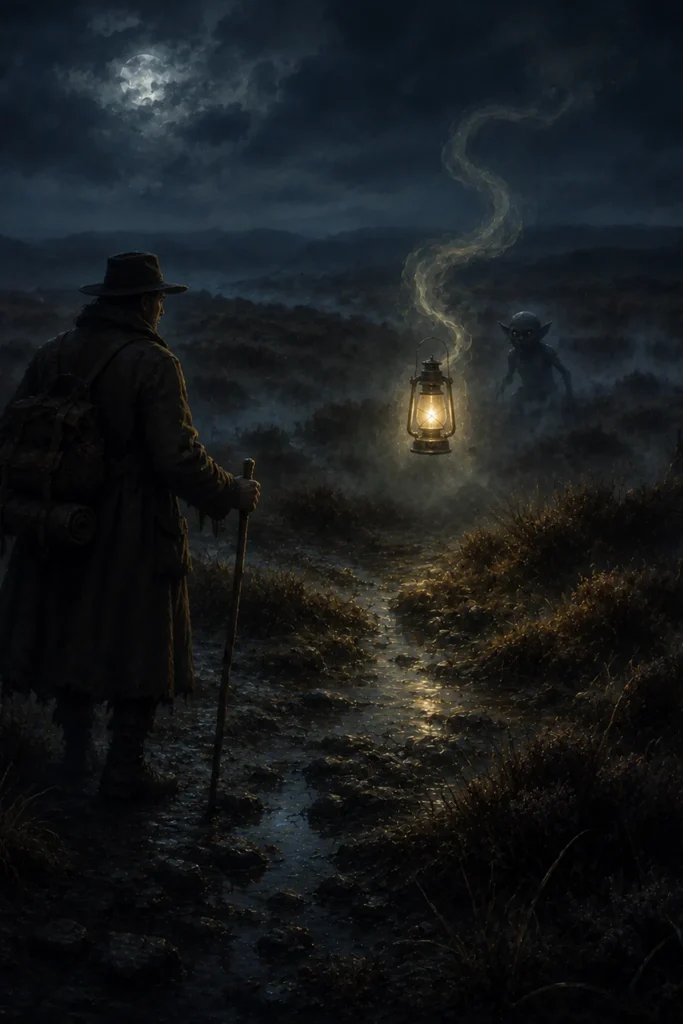
The Hob is small, shaggy and rough, often naked, and frequently invisible; it is recognised more by its nocturnal work than by its form. Like the brownie, it is driven away by a gift of clothing.
Effect
The Hob helps at night with threshing, harvest and housework in exchange for food and respect, and turns into a noisy poltergeist when offended. A famous Hob Hole Hob on the Yorkshire coast was believed by folk tradition to be able to cure whooping cough if parents brought their child to him; this is to be understood as historical superstition, not as a medical claim.
Profile: Hob
The key aspects of the North English house spirit at a glance.
North English folklore, particularly Yorkshire and the Midlands; the name shifted from a single being to a generic term for the helpful hob-goblin type spirit.
House, farmyard and livestock: the Hob helps at night with threshing, harvest and household chores, as long as he is given food and respect.
Small, shaggy and rough, often naked and frequently invisible; he is recognised by the work done, not by his shape.
Nocturnal help with work in return for food; folk belief also credited Hob Hole Hob with curing whooping cough, a historical superstition.
Leave food out, do not reward the work, do not mock him; a piece of clothing is taken as an insult and drives the Hob away.
Brownie, Hobgoblin and Lob Lie-by-the-Fire; in a broader sense also the German Kobold and the Scandinavian Nisse.
Hob, Robert and Robin: the story of a name
Hob, as in Hobgoblin, is a pet form of Robert and Robin, and it became a collective name for the helpful house spirit. This makes the Hob both at once: an individual being of legend and a generic term under which North English folklore gathers its place-bound helpers.
Numerous named Hobs are recorded across North England and the Midlands, such as Hob Hole Hob or Hob of Hart Hall; hills, caves and farms are often named after them. In this way the house spirit has written itself into the landscape itself, long after the legends have faded.
Place names and afterlife
The Hob lives on in North English place-name and field-name folklore and in collections of legends; his name is embedded in many toponyms. In popular fantasy he often merges with hobbit, hobgoblin and brownie motifs into a general notion of the small house spirit.
From a religious-studies perspective, the Hob is a usually good-natured, helpful house spirit who turns into a poltergeist when insulted. Important clarifications: Hob is both a generic term and an individual being. The whooping-cough cure is historical superstition, not a promise of healing. And he shares the brownie pattern of help in exchange for food and offence caused by payment.
Gifts and counter-gifts
Maintaining a good relationship means leaving food out for the Hob, not rewarding his work and not mocking him. A piece of clothing is taken as an insult and drives him away, the same taboo as with the Brownie. These ideas are folkloric material collected in North England; they describe a reciprocal relationship in which respect is the true currency.
Relatives of the brownie type
The Hob corresponds to the Brownie, the Hobgoblin, Lob Lie-by-the-Fire and the Manx Fenodyree; in a broader sense the German Kobold and the Scandinavian Nisse stand alongside him. His insulted counterpart is the Boggart. The Hob is the prototype of the place-bound, helpful house spirit whose name became a generic term.
Frequently asked questions about the Hob
What is a Hob?
A usually good-natured house spirit of North England and, at the same time, a generic term for the brownie-like, place-bound sprite.
Should you give the Hob payment?
No. Like the Brownie, he feels insulted by payment or clothing and either disappears or turns into a poltergeist.
Could the Hob cure illnesses?
Folk belief credited Hob Hole Hob with curing whooping cough. This is a historical superstition and not a medical claim.
Further links
Further reading:
- Brownie – the prototype of British house spirits
- Hobgoblin, Boggart – the Hob’s relatives
- Salt, Amulet, Smoke cleansing – traditional protective means
- Protection Compass – protective means at a glance
Literature (selection)
Further standard works in the bibliography.
As a North English house spirit and helpful sprite, the Hob has even given his name to the landscape: he lives on as a place name in the hills, caves and farms of Yorkshire.