Pakhet, She Who Scratches, of the desert wadis
By Ralf Ittermann · last reviewed on
Pakhet is a goddess of Egyptian tradition.
She Who Scratches, the nocturnal huntress of the desert-edge wadis.
Pakhet, She Who Scratches, is a lion-headed desert and hunting goddess of Middle Egypt. She hunts alone at night in the desert-edge wadis and unites two sides: she is warlike and yet protective, also acting as protector of motherhood.
She is known from the Coffin Texts of the Middle Kingdom; her cult region is Beni Hasan in Middle Egypt. There also lies her main sanctuary, the rock temple Speos Artemidos, which Hatshepsut had built and which still secures the goddess her Greek epithet today.
Type: desert and hunting goddess, warlike and yet protective
Origin: Middle Egypt, cult region Beni Hasan
Texts: Coffin Texts (including Spell 470), inscriptions of the Speos Artemidos
Period: Middle Kingdom to Late Period
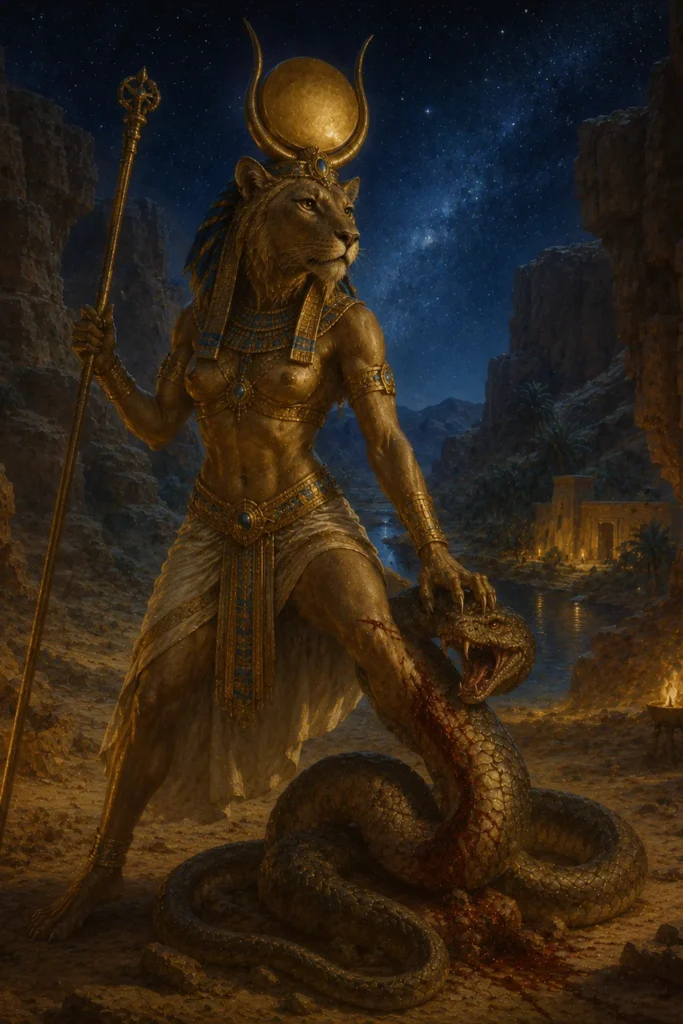
Appearance: lion-headed woman or lioness
Region of origin and sources
Period of the Texts
Pakhet appears in the Middle Kingdom and remains attested into the Late Period, when large cat cemeteries were built in her honour.
Area of Diffusion
Middle Egypt, the region around Beni Hasan. Her sphere of activity is the wadis at the desert edge, at whose entrance she stands.
Sources
Well documented: the Coffin Texts, such as Spell 470, and the inscriptions of the rock temple Speos Artemidos, along with the standard reference works of Egyptology.
Name and variants
Egyptian: Pakhet, reliably translated as She Who Scratches, with the secondary meaning She Who Tears. The name refers directly to the aggressive character of the goddess, whose epithets are Mistress of the Desert and Mistress of the Sky.
Nature and effect
Appearance
Pakhet is depicted as a lion-headed woman or entirely as a lioness, often shown killing snakes with her claws; as a solar deity she wears the sun disc in her crown. Only a few depictions have survived.
Effect
Pakhet is the goddess at the entrance of the wadi and hunts alone at night in the desert-edge wadis. She is at once protective and warlike, also protector of motherhood, and carries a storm aspect as the one who opens the paths of the torrential rains.
Profile: Pakhet
The key aspects of the hunting goddess at a glance.
Lion goddess of Middle Egypt within the group of great lion goddesses around Sekhmet and Bastet; her cult region is Beni Hasan.
Hunters, mothers and soldiers: the nocturnal huntress protects motherhood, and her cult was popular among career soldiers.
Lion-headed woman or lioness, often shown killing snakes with her claws; as a solar deity with the sun disc in her crown.
Nocturnal hunting in the desert-edge wadis, protection and war at once; as a storm aspect she opens the paths of the torrential rains.
Her main sanctuary is the rock temple Speos Artemidos south of Beni Hasan; in the Late Period, large cat cemeteries with mummified cats were added.
Sekhmet and Bastet as lion goddesses of the same type, along with associations with Weret-Hekau and Isis; in Greek times she was equated with Artemis.
From the Coffin Texts to the rock temple
The name Pakhet reliably means She Who Scratches, with the secondary meaning She Who Tears, and refers to the aggressive character of the goddess. She appears in the Middle Kingdom and is known from the Coffin Texts, such as Spell 470, where she is called the lioness whose eyes are sharp and whose claws are pointed.
Her cult region is Beni Hasan in Middle Egypt. There also stands her main sanctuary, the rock temple south of the town, which Hatshepsut built and which Thutmose III and Seti I continued to extend. Through this temple, the goddess remained alive into the Late Period, when large cat cemeteries were built in her honour.
The Artemis interpretation and its limits
In Greek times, Pakhet was equated with Artemis because of her hunting character. This equation gave the rock temple the name still used today, Speos Artemidos, Grotto of Artemis; Champollion identified the temple accordingly.
From a religious-studies perspective, Pakhet is a warlike, yet also protective, desert and hunting goddess. Important clarifications: the Speos Artemidos was always dedicated to Pakhet, the Artemis interpretation is a Greek interpretatio graeca; and the equation with Bastet and Sekhmet is syncretism, not identity.
The Speos Artemidos and the soldiers' cult
Pakhet’s main sanctuary is the rock temple Speos Artemidos south of Beni Hasan, built by Hatshepsut and continued by Thutmose III and Seti I. In the Late Period, large cat cemeteries with mummified cats dedicated to the goddess were established. Notable is the social anchoring of her cult: it was popular among career soldiers, for whom the warlike yet protective lioness had particular appeal.
Lion goddesses in comparison
Pakhet belongs to the type of lion goddesses together with Sekhmet and Bastet and was also associated with Weret-Hekau and Isis. In Greek times, she was equated with Artemis because of her hunting character. Within the desert gods of Egypt, she stands alongside Ha, Lord of the West, as an independent Mistress of the Desert.
Frequently asked questions about the goddess Pakhet
Who is Pakhet?
A lion-headed desert and hunting goddess of Middle Egypt, She Who Scratches. She hunts alone at night in the desert-edge wadis and is at once warlike and protective.
Where was she worshipped?
In the rock temple Speos Artemidos near Beni Hasan, built by Hatshepsut and continued by Thutmose III and Seti I.
Is she the same as Bastet?
No, that is syncretism; Pakhet is a distinct lion goddess who shares only the same type with Bastet and Sekhmet.
Further links
Further reading:
- Egypt – all beings of the Egyptian cultural sphere
- Sekhmet, Bastet – the related lion goddesses
- Ha, Sopdu, Ash – further desert gods of Egypt
- Amulet, Smoke cleansing, Iron – traditional protective means
- Protection Compass – protective means at a glance
Literature (selection)
Further standard works in the bibliography.
As Egyptian goddess of the hunt and lion goddess, Pakhet embodies both faces of the desert at once: the deadly huntress of the nocturnal wadis and the protector trusted by mothers and soldiers.