Ceres: Goddess of Grain, Agriculture, and the Plebs
By Ralf Ittermann · last reviewed on
For the Romans, Ceres was the goddess of grain, agriculture, and growth. Her cult was closely tied to the city’s food supply and to the political role of the plebs.

Classification
Ceres belongs among the oldest and most important deities of Roman religion. She was the goddess of grain, agriculture, and the growth of field crops in general. Her sphere of responsibility therefore touched a foundation of Roman life, since the city’s grain supply was a constant concern of state and society.
From a history-of-religions perspective, Ceres is significant for several reasons. She was an ancient Roman deity, probably worshipped already in the early Italic period, whose name goes back to a root meaning growth and nourishment.
At the same time she was shaped early by Greek influence and largely identified with the Greek Demeter. Her cult on the Aventine also linked her closely to the plebs, the non-noble part of the Roman citizen body, and gave her a distinctly political dimension.
Ceres thus exemplifies the many-layered character of Roman religion. In her, ancient agrarian cult, the adoption of Greek ideas and myths, and a concrete social and political function within the city all combine. She was at once a goddess of the fields and a goddess with a fixed role in the fabric of Roman society.
The civic importance of Ceres can be read from the grain supply of the capital, which became a permanent political task as the population grew.
The plebeian aediles, who were connected with the Aventine sanctuary, held among other duties the supervision of the grain market. Ceres therefore stood not only for the growth of corn in the field but also for its orderly distribution within the city.
Name and Etymology
The name Ceres is linguistically traced to an Indo-European root denoting growth, bringing forth, and nourishing. The same root appears in Latin words such as crescere, to grow, and creare, to create or bring forth. The name thus directly identifies Ceres as the power that makes plants, and grain in particular, grow.
This transparent etymology is instructive from a history-of-religions perspective. It shows that Ceres was by nature a functional deity whose name described her task. Such meaningful divine names are common in ancient Roman religion and suggest that many deities were originally bound tightly to a specific sphere of activity.
From the name Ceres is derived the adjective that appears in the festival name Cerialia, as well as the word cerealis, from which terms for grain products are still derived today.
This linguistic afterlife makes clear how firmly Ceres remained associated with the concept of grain. Even as the goddess was enriched over time with Greek myths, her core remained the domain of corn and field produce.
Description and Iconography
In the pictorial tradition, Ceres appears as a dignified, mature woman, often seated or standing, in a long robe.
Her most important attribute is ears of grain, which she holds in her hand or which adorn her head as a wreath. Poppy capsules, a cornucopia, a basket of fruit, and occasionally a torch also appear.
The torch refers to the mythological cycle adopted from the Greek Demeter, in which the goddess searches for her abducted daughter with torches.
The cornucopia and fruit basket stand for abundance and harvest, the poppy for the fields where grain and poppy grew side by side. Ceres is sometimes accompanied by a chariot drawn by serpents, likewise a motif taken over from the Greek tradition.
The iconography consistently emphasises maturity, abundance, and maternal dignity. Ceres is not a youthful but an adult, giving figure. This visual language corresponded to her function as goddess of the food supply.
She appears frequently on coins of the Republic and the imperial period, often in connection with the state grain supply, which shows how closely her image was linked to the idea of provision and prosperity.
Mythological Narratives and Tradition
The best-known myth of Ceres is the story of the abduction of her daughter Proserpina. In Roman literature it is transmitted above all by Ovid, who tells it in both the Metamorphoses and the Fasti, and also by the later epic of Claudian.
The myth is largely taken from the Greek Demeter-Persephone material but was embedded in Roman language and context.
According to the narrative, Proserpina is abducted by the god of the underworld. Ceres searches for her desperately with torches and neglects her task in doing so, causing the earth to become barren and famine to threaten.
Eventually a compromise is reached by which Proserpina spends part of the year in the underworld and part with her mother. The alternation of the seasons, particularly the alternation between growing and resting vegetation, is thereby given a mythical interpretation.
Beyond this, Roman tradition preserves narratives that connect Ceres with the city of Rome itself. Her temple on the Aventine is said to have been founded early in the Republic, and with it was linked the memory of the social role of the cult.
The mythical tradition of Ceres is thus doubly shaped: by the great Greek-influenced mythological cycle of mother and daughter, and by the specifically Roman association of the goddess with the history of the plebs and the grain supply.
Roman tradition also knew a separate narrative about the introduction of the cult of Ceres in connection with a severe famine in the early Republic.
According to an oracle of the Sibylline Books, the Aventine temple was said to have been dedicated in order to appease the goddess and secure the food supply. This tradition connected Ceres directly with concern for daily bread and with the management of crises.
Cult and Veneration
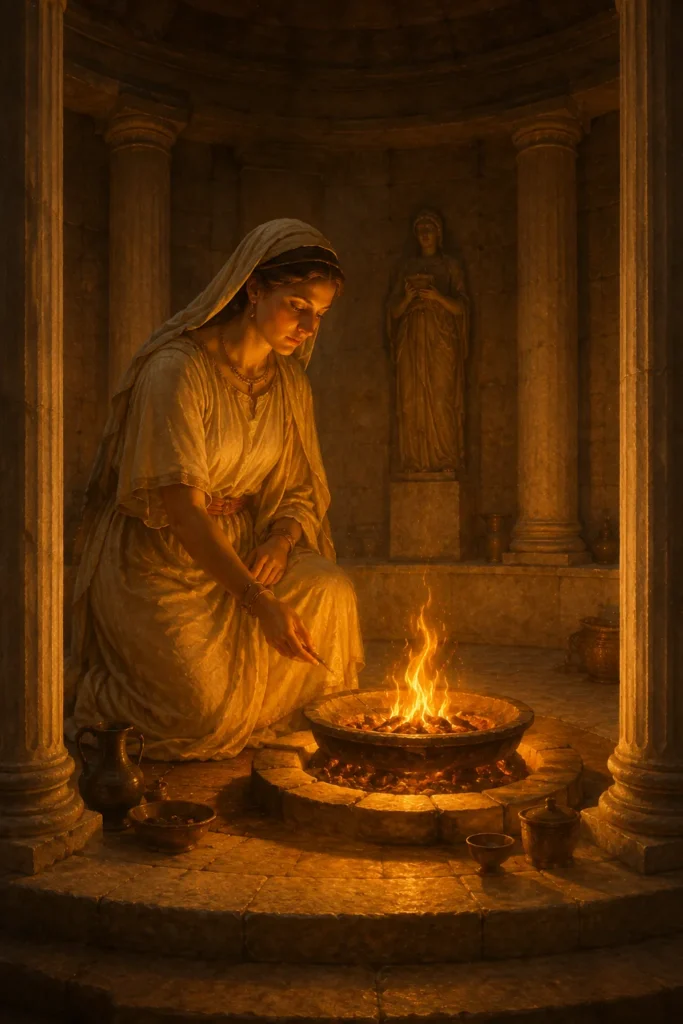
The cult of Ceres in Rome had several layers. An ancient, rural veneration honoured her as protector of sowing and harvest.
During field work, at sowing time, and at the bringing in of the corn, sacrifices to Ceres were a matter of course. She also played a role in connection with household and family, for instance in certain rites surrounding death and purification.
The most important urban sanctuary was the temple of Ceres, Liber, and Libera on the Aventine. This triad was brought into alignment with the Greek triad of Demeter, Dionysus, and Persephone. The Aventine temple was closely associated with the plebs.
Resolutions of the plebs were stored there, and the plebeian magistrates, the aediles, had a special relationship with this cult. The cult of Ceres was therefore a religious point of reference for the non-noble citizenry.
The central festival was the Cerialia in April, which was associated with games in the Circus. A remarkable custom is recorded in which foxes with burning torches were driven through the Circus; its precise meaning could no longer be reliably explained even in antiquity.
There was also a festival of women in honour of Ceres, shaped by Greek influence, which was observed by women over several days of abstinence. The cult of Ceres thus united rural agrarian piety, urban politics, and adopted Greek festival forms.
The temple of Ceres, Liber, and Libera on the Aventine was, according to tradition, consecrated in 493 BCE and is regarded as one of the oldest temples with a pronounced Greek character in Rome.
It was richly furnished with works by Greek artists, and its location outside the old city centre, in an area of plebeian population, reinforced its social associations. Resolutions of the plebs were deposited there, and the sanctuary served as the archive of the aediles.
The Cerialia extended over several days in April and culminated in games in the Circus.
Ovid describes in the Fasti the remarkable custom of tying burning torches to the tails of foxes and driving the animals through the racecourse, and admits at the same time that even in his day no one knew for certain the original meaning.
Alongside the Cerialia there was a women’s festival derived from the Greek Demeter celebration, observed in midsummer by married women in several days of abstinence, from which men were excluded.
Protective Practices and Apotropaic Aspects
Ceres was primarily a promoting and nourishing deity, not an averting one. The practice directed at her aimed above all at securing the growth and prosperity of field crops and thereby ensuring the community’s food supply. Sacrifices and prayers to Ceres accompanied the course of the agricultural year.
Nevertheless, there were areas in which her cult had an ordering and protective function. Ceres was associated with ideas of law and social order.
Whoever committed certain serious offences, for instance against the order of the plebs, could be forfeited to the goddess, meaning that his person and property were considered consecrated to her. This connection shows that the cult of Ceres also served to stabilise the social order.
In the domestic and family sphere, Ceres appears in rites surrounding death and purification. When a death occurred in the family, there were prescriptions by which a sacrifice to Ceres restored the family to a ritually ordered state. Here too the function is less one of warding off than of restoring order.
On the whole, the protection offered by Ceres was the protection of the foundations of life and of social and ritual order, not the averting of particular evil powers. This clearly distinguishes her from explicitly protective or apotropaic deities.
Ceres also had an ordering function in the law of marriage and in the sphere of ritual purity.
Certain offences against marital order required sacrifices to Ceres, and her cult was associated with notions of marital fidelity and moral order. Her sphere of activity thus extended from the sowing in the field to the order of the family.
Parallels in Other Cultures
The most obvious parallel to Ceres is the Greek goddess Demeter. From an early date Ceres was identified with her, and the entire mythological cycle of mother and abducted daughter was taken over from the Greek tradition.
The Aventine temple with its triad was also modelled on Greek precedents. Nevertheless, Ceres remained an independent Roman deity, whose name, oldest cult, and connection with the plebs are specifically Roman.
Beyond the Greek sphere, Ceres belongs to the widespread type of grain and earth goddesses found in many agricultural cultures.
Such deities embody the fertility of cultivated land and are frequently connected with myths about the alternation of the seasons and about the death and return of vegetation. The myth of the daughter’s temporary disappearance into the underworld is a well-known example of this widely attested narrative pattern.
From a religious-studies perspective, Ceres is a good example of how a religion combines an old native functional deity with foreign myths and festival forms without abandoning its original core. The Roman Ceres is neither pure Demeter nor pure early Italic goddess of sowing, but a figure in which both layers interact.
Reception and Research Today
In research on Roman religion, Ceres is a frequently discussed subject because several major questions converge in her: the relationship between native and Greek religion, the connection between cult and politics, and the role of agrarian cult.
Georg Wissowa and Kurt Latte placed Ceres within the ancient Roman pantheon, Georges Dumézil and others have debated her position in the system of functions, and more recent scholarship emphasises above all the social dimension of the Aventine cult.
The connection of Ceres with the plebs has been investigated with particular intensity. The Aventine temple as a site of plebeian resolutions and the role of the aediles make the cult of Ceres a key to understanding early Roman social history. The Cerialia and the Greek-influenced women’s festival are likewise subjects of religious-historical studies.
In contemporary general culture, Ceres is present above all through language. Terms for grain products are derived from her name, and the goddess regularly appears in art, literature, and allegory as the embodiment of harvest and fertility.
For the study of religion, Ceres remains an important example of the layering of Roman religion and of the close intertwining of cult, economy, and society.
The connection of Ceres with crisis management is also emphasised in scholarship. The recourse to the Sibylline Books and the founding of the Aventine temple are regarded as an early example of how Rome responded to economic hardship by introducing a new cult.
The layering of ancient Italic sowing cult, Greek overlay, and political function makes Ceres a paradigmatic case in the history of religions.
She thus remains, even in contemporary scholarship, a frequently consulted example.
Selected Bibliography
- Georg Wissowa: Religion und Kultus der Römer (1912)
- Kurt Latte: Römische Religionsgeschichte (1960)
- Georges Dumézil: La religion romaine archaïque (1966)
- Mary Beard, John North, Simon Price: Religions of Rome (1998)
- Jörg Rüpke: Die Religion der Römer (2001)
Related key terms: Ceres Cerialia Liber Libera Aventine Plebs Grain Demeter Agriculture.
iWell Guard and Protective Traditions
iWell Guard draws on the cultural-historical tradition of wearable protective objects, in the tradition of Rome and many other cultures worldwide. 41 levels, real gold, platinum, silver, made in Germany. 30-day return policy.
Personal experiences may vary. Not a medical device. No healing promises.