Vesta, Roman goddess of the hearth fire
By Ralf Ittermann · last reviewed on
Vesta is the Roman goddess of the hearth fire and of the state cult. Her sanctuary on the Forum Romanum was among the oldest and politically most important in Rome. The fire that burned without interruption in her temple was regarded as a guarantor of the city’s welfare.
The cult was administered by the Vestals, a consecrated college of priestesses of the highest ritual rank. Their history reaches back to the beginnings of Italic religion and ends only with the formal dissolution of the cult in the year 391 under Theodosius.

Profile: Vesta
Vesta: the most important aspects at a glance. The following fields summarise origin, function, appearance, veneration, symbols and parallels.
Vesta belongs to the oldest stock of Italic religion and is linguistically related to the Greek Hestia. Numa Pompilius is said to have organised her cult and established the college of the Vestal Virgins. The cult was ended in the year 391 under Emperor Theodosius.
Vesta is the goddess of the hearth fire and of the state cult. The fire burning uninterruptedly in the temple was regarded as guarantor of the city’s welfare. With fire and water in pure form she stands for the elemental preconditions of human life.
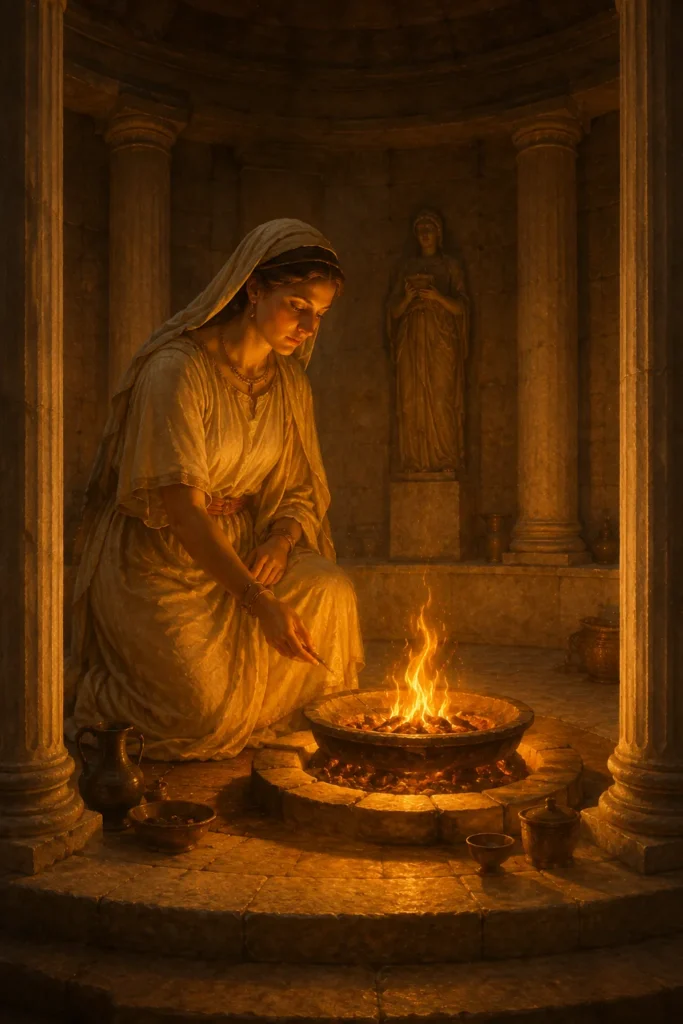
Vesta is rarely depicted in personified form, most likely as a veiled matron with bowl and torch. More often the flame on an altar is at the centre. On coins of the imperial period she appears enthroned with patera and sceptre, often with the inscription Vesta Mater or Vesta Sancta.
The cult lay with the Vestal Virgins, who were chosen at an age between six and ten years and served for thirty years. Their sanctuary was the Aedes Vestae, a circular building on the Forum. The main festival Vestalia lasted from 7 to 15 June, during which housewives too were allowed to make offerings barefoot.
The most important symbol is the flame, which was regarded as the real presence of the goddess and was never allowed to go out. Water also plays a role, which the Vestals drew from the spring of Egeria. The mola salsa, a consecrated salted meal of spelt and salt, was scattered at public sacrifices.
Vesta was identified with the Greek Hestia but remained distinct through her state function. A parallel to fire goddesses such as Tabiti in Scythian religion and to the Indo-Iranian Atar is discussed but cannot be directly demonstrated genealogically. Georges Dumézil compares her typologically with the Vedic Aramati.
Myth and origin
Vesta belongs to the oldest stock of Italic religion and is linguistically related to the Greek Hestia. Both names can be traced back to an Indo-European root denoting burning or glowing. Unlike the Greek Hestia, Vesta developed a pronounced state and political dimension in Rome.
According to Livy, Numa Pompilius is said to have organized the Vesta cult and established the college of the Vestals. Plutarch reports comparably in the “Numa” vita and emphasizes the religious ordering power of the legendary king.
The myth surrounding Vesta herself is poor in stories. In the literary tradition she rarely appears as an acting goddess, but rather as an allegorical embodiment of the hearth fire.
Ovid devotes a detailed passage to her in the “Fasti” about the festival of the Vestalia on 9 June and emphasizes the difficulty of picturing the goddess visually.
She has “nothing but the living fire,” and is worshipped not in statues but in the flame itself. This concentration on the bare element gives Vesta a theological special position in Roman religion.
The close connection of Vesta with the Penates, the protective gods of the house, and with the Palladium, the cult image of Minerva rescued from Troy, made her a reference point of the Roman state myth.
Virgil has Aeneas flee from Troy with the Penates and the Vesta fire in the “Aeneid.” This linkage of Trojan origin, the state hearth fire and protective gods formed the religious self-interpretation of Augustan Rome.
In Italic prehistory, tending the household fire was a central task of the unmarried daughters of the house. In terms of the history of religion, the Vestals are a mirror image of this practice, elevated into the state cult.
The archaic model of the Italic farmhouse, in which a central hearth supplied the whole house, is architecturally preserved in the circular temple of Vesta.
Symbols and attributes
Vesta’s most important symbol is the flame. The eternal fire in her temple was regarded not as an image but as the real presence of the goddess. It was fed with wood from the sacred grove on the Velia and was under no circumstances allowed to go out.
If it did go out anyway, which Cicero and Livy describe as a dangerous omen, it had to be rekindled by rubbing two pieces of wood together or by sunlight and a burning glass, never from a profane source. This rule of purity shows the theological rigor of the cult.
Water also played an important role. The Vestals drew water daily from the spring of Egeria or from the Camenae fountain and were not allowed to set it down on the ground.
This water served for the ritual cleansing of the temple. The combination of fire and water, both in pure form, made Vesta the goddess of the elementary preconditions of human existence.
Vesta’s sacred grove near Lavinium was the source of the mola salsa, a consecrated salted flour that the Vestals produced from spelt and salt.
The mola salsa was sprinkled on animal and altar at public sacrifices and gives the word “immolare,” meaning “to sacrifice,” its name. In this way almost every public sacrifice was co-sanctified by a Vestal product.
In the visual arts Vesta rarely appears in personified form, most often as a veiled matron with a bowl and torch. More frequently her iconic sign, the flame on an altar, stands at the center of reliefs, coins and wall paintings.
On many imperial-era coins Vesta is depicted enthroned with a patera and scepter, often with the inscription Vesta Mater or Vesta Sancta. This iconographic restraint underscores the abstract character of her worship.
Cult and worship
The Vesta sanctuary on the Forum, the Aedes Vestae, was a circular building near the Regia, the old official seat of the Pontifex Maximus. Beside it lay the Atrium Vestae, the dwelling house of the six Vestals.
The circular form of the temple probably took up the archaic house form of Latium and thereby symbolized the ancient Italic dwelling, in the middle of which the hearth fire burned. Archaeological excavations have identified several building phases, from an early wooden structure to the marble reconstruction by Julia Domna in the 3rd century AD.
The Vestals were chosen between the ages of six and ten from a list of Roman families and consecrated by the Pontifex Maximus. Their term of service was thirty years.
They were not subject to the patria potestas of their father, were allowed to draw up wills and to sit in special seats in the theater.
This legal special position was unique in Roman society. In return, their chastity was inviolable. Violations were punished with being buried alive near the Porta Collina. Such cases are attested several times in the source literature, for example Cornelia under Domitian and Minucia during the Republic.
The main festival was the Vestalia from 7 to 15 June. During this period the temple was exceptionally also opened to Roman housewives, who brought sacrifices barefoot. On the final day the temple was ritually cleansed and the swept-out remains brought to the Tiber.
The associated day, 15 June, was thereafter considered a profane date and could be used for business. The 9th of June was also especially singled out, because donkeys were wreathed with bread, in memory of a donkey said to have saved Vesta from an assault by Priapus.
With the religious reform under Augustus, the Vesta cult was closely tied to the imperial house. Augustus assumed the pontificate and had a new Vesta sanctuary built in his residence on the Palatine, so that state, pontificate and imperial house were symbolically interwoven.
Vesta’s presence in the palace underscored that the princeps personally vouched for the eternal fire of the state. In the Severan dynasty the cult was once again enhanced by Julia Domna.
The cult was officially ended in the year 391 AD under Emperor Theodosius. The eternal fire was extinguished, the Atrium Vestae closed, and the last Vestals lost their privileges.
Symeon Stylites and other Christian ascetics were in part read in late antiquity as a spiritual echo of the Vestal ideals, which underscores the long-lasting radiance of the institution.
Important myths
The story of Rhea Silvia and the twins Romulus and Remus is the most important mythical link between Vesta and Rome. According to Livy, Rhea Silvia, the mother of the twins, was a Vestal in Alba Longa.
Impregnated by the war god Mars, she gave birth to the founders of Rome and was taken into custody in chains.
The episode connects the strictest Vestal discipline with the birth of Rome and thus makes the goddess the silent companion of the city’s founding. In a figurative sense it has held ever since that Roman history itself springs from a consecrated, then violated, purity.
A second story tells of the Vestal Tuccia, who was under suspicion of unchastity. To prove her innocence, she drew water from the Tiber with a sieve and brought it to the temple without losing a single drop.
Pliny the Elder and Augustine relate this miracle story, which in the Middle Ages became an allegory of chaste steadfastness.
A third story describes the rescue of the Palladium and the sacred fire by L. Caecilius Metellus in the year 241 BC. When the Vesta temple was burning, Metellus broke into the sanctuary and saved the sacred pledges.
In doing so he lost his eyesight and was thereafter regarded as a hero of the state cult. The Senate granted him the extraordinary right to ride in a carriage to the assemblies. The episode attests how strongly the existence of the state depended on the safety of the Vesta sanctuary.
A fourth story concerns the Vestal Aemilia, who was able to compensate for her fault in the fire going out through a miracle. She threw her veil over the extinguished altar, whereupon the flame rekindled itself. Dionysius of Halicarnassus reports this story, which illustrates the trust in divine intervention on behalf of pure priestesses.
Relationships within the pantheon
Vesta is closely connected with the Penates Publici, the public protective gods of Rome. Together they form the innermost circle of the state deities.
She is moreover closely coupled with Jupiter, since the Vesta fire was interpreted as the fire of the supreme god and the Pontifex Maximus was at the same time the overseer of the Vesta cult. This personal union made Vesta the theologically most important goddess of the Roman state.
With Juno, Vesta shares the care for women, family and birth, though in a radically different orientation. While Juno protects marriage, Vesta represents consecrated virginity. With Minerva she is connected through the Palladium, which was kept in the Vesta temple, as well as through the aspect of knowledge guarded by the state.
In Hellenistic syncretism, Vesta was identified with Hestia, but remained independent through her pronounced state function.
A parallel to ancient Near Eastern fire goddesses such as Tabiti in Scythian religion or the Indo-Iranian Atar has often been discussed in the history of religion, but cannot be directly demonstrated genealogically. Scholarship sees here rather a typological kinship based on an Indo-European predisposition to fire worship.
Vesta and Jupiter Pistor appear together in the festival calendar at the baking-sacrifice rite, which secures the purity of the flour for the sacrificial bread.
This rare connection makes clear that the flour was understood as a sacred medium between hearth and altar. The combination was interpreted in scholarship by Robert Schilling as evidence of an archaic complex of fire, flour and storage economy.
A rare fusion shows itself with the Hellenistic Hestia, whose myth is mostly discreetly passed over in Roman texts, because the presence of a father-daughter pursuit motif would have contradicted the archaic Roman dignity of Vesta.
Ovid deliberately plays out this field of tension in the “Fasti” by incorporating Greek stories but always dimming them through a Roman turn.
Reception and influence
Vesta remained, in the visual art of late antiquity and the Renaissance, a symbol of purity and quiet power.
Allegories of chastity, fidelity and steadfastness were frequently shaped in a Dianic-Vestal key in the 16th and 17th centuries. The figure of Tuccia with the sieve became a favored motif in emblem books and on triumphal chariots.
In Classicism the image of the Vestal comes to the fore. Antonio Canova created several sculptures showing the ideal of a pure, serious priestess.
In the works of Jacques-Louis David and in French revolutionary allegory, too, the Vestal was stylized as the patroness of republican virtue. Maria Antonia of Habsburg-Lorraine had herself immortalized in the year 1769 in a Vestal pictorial program that takes up the Augustan virtue theology.
In modern times Vesta became, through the word “Vestal,” a proverbial metaphor for chaste fulfillment of duty. In 1807 astronomy named the fourth discovered asteroid Vesta, which symbolically continued the goddess’s position as a preserving, order-establishing power.
Astrology today takes up the meaning of the guarding fire as a symbol of focused self-devotion. The NASA probe Dawn provided the first detailed images of this asteroid in 2011.
In the Middle Ages Vesta remained present as an allegory. Dante names her in Convivio II as an emblem of continuity and of domestic fidelity. In the Renaissance she appeared on numerous wedding chests as the guardian of the sacred fire, often in connection with Diana as an allegorical pair of female virtue.
In the Renaissance the Vesta-temple type was used in architectural quotations, for example by Andrea Palladio in his Tempietto design and by Donato Bramante in the Tempietto of San Pietro in Montorio.
In modern astronomy, Vesta is one of the first four discovered asteroids. Heinrich Olbers named the minor planet discovered in 1807 on the suggestion of Carl Friedrich Gauss.
The NASA probe Dawn orbited Vesta from 2011 to 2012 and mapped its crater-rich surface. A series of brand and company names, too, from the English match brand Swan Vestas to Scandinavian match manufacturers, derive their name from the Vesta complex.
Religious-studies classification
Robert Schilling and Kurt Latte place Vesta within the circle of the domestic protective goddesses of Latium, whose function was expanded in the Roman state into a public cult. From this view, the Aedes Vestae is the cultic enlargement of the farmhouse-like hearth room into the state.
Georges Dumézil sees in Vesta the embodiment of the first of the three Indo-European functions, that is, priestly-juridical sovereignty, and compares her typologically with the Vedic Aramati.
Mary Beard has analyzed the social position of the Vestals in influential studies and shown that their legal special position was a deliberate construct that marks the separation of “normal” femininity from religious function.
John Scheid emphasizes the close connection of the Vesta cult and the pontificate, which made the Vesta sanctuary one of the few places at which state and religion coincided in immediate personal union.
Jörg Rüpke classifies the Augustan reform as a shift in the perspective of religious sovereignty, because the imperial house took the place of the Republic. Robin Lorsch Wildfang comprehensively reconstructed the Vestals in a 2006 monograph and re-examined the archaeological material.
Atrium Vestae and sanctuary
The temple of Vesta on the Forum Romanum was a round building surrounded by twenty columns, with a conical roof and an opening at the apex through which the smoke of the sacred fire could escape.
The round form was unique in Roman temple architecture and was interpreted by antiquarians such as Plutarch and Festus as a reference to the archaic pastoral origin of the goddess.
Ovid reports in the “Fasti” VI that the original sanctuary was a simple straw hut erected on the city ground by Numa himself. The later stone and marble execution preserved the archaic basic format.
The adjoining Atrium Vestae served as the residence of the six Vestals. It was a three-story complex with an inner courtyard, fountain and statue gallery. A large number of statues of the head priestesses, the Virgines Maximae, were excavated in the 19th century and attest to the high social standing of this office.
The complex was one of the few women’s spaces in the public center of Rome and stood under the direct protection of the Pontifex Maximus. In the cellars, according to ancient belief, the Penates of the city and the Palladium, a sacred image of Athena said to have come from Troy, were concealed.
Inside the temple the ignis perpetuus burned on a central hearth. Its going out was regarded as a prodigium, an omen of gravest disaster that could only be healed through an expiatory sacrifice and the rekindling of the fire by means of friction sticks from the wood of a fateful tree.
The building inscriptions on the walls of the complex, above all the inscription CIL VI 32421 with the list of Vestals honored by the Senate, give a detailed insight into the office.
Vestals, office and criminal law
The six Vestals were chosen between their sixth and tenth year of life from patrician, later also plebeian, families. They vowed a vow of chastity for thirty years, which was performed by the Pontifex Maximus in a solemn captio ceremony.
After the term had elapsed they could marry or remain in the Atrium Vestae. The Vestals enjoyed immunity before the court, were allowed to draw up wills independently, had lictor-like precedence on the street and, if they happened to meet a condemned person, were associated with his pardon.
Violations of the vow of chastity were regarded as high treason against the state, because the sacred fire was linked to the purity of the Vestals.
The penalty was burial alive at the Campus Sceleratus near the Porta Collina, as Livy describes in the case of Minucia in 337 BC and Pliny the Younger in the case of Cornelia under Domitian in 91 AD. This penalty was not carried out by the executioner’s hand, because the blood of a Vestal was not allowed to be shed; instead the condemned were locked in an underground chamber with bread, water and a lamp, in which they had to starve.
The immense ritual severity of this procedure was interpreted by Mary Beard in her study of Vesta religion as an expression of a paradoxical double position, in which the Vestals were both loved by the people and lived in extreme ritual danger.
Besides tending the fire, the Vestals saw to the making of the mola salsa, a consecrated flour-and-salt mixture that was sprinkled on the forehead of the sacrificial animal at public sacrifices.
They kept the Penates and the Palladium, collected the water of the Egeria spring from the sanctuary of the Camenae and carried out the task of the Fordicidia, a fertility rite in April. These manifold tasks linked their service with the three central aspects of fire, purity and fertility.
Vestalia and festival calendar
The Vestalia from 7 to 15 June were the main festival of the goddess. On the first day the Penus Vestae, an inner sanctuary normally kept closed, opened for the matrons of Rome, who entered barefoot and offered bread cakes.
Ovid reports in the “Fasti” VI, 311 ff. the mythologization of the festival days through an episode in which Vesta was warned of the importunate Priapus thanks to the donkey of Silenus.
On the last day the Vesta temple was solemnly cleansed and the accumulated refuse given over the Cloaca Maxima into the bed of the Tiber. This cleansing day, called Q. St. D. F. (quando stercus delatum fas), could only be considered lawful for business again after the sweeping out.
The 9th of June was regarded as the donkey day, because the donkey played a role as a helper of Vesta in mythology. Donkeys that turned the grinding wheel in Rome’s bakeries had bread wreaths hung around them on this day and were not allowed to work.
This gesture is an example of the archaic linkage of goddess, household economy and animal. The festival was at the same time the patronal feast of the Pistores, the bread bakers, whose professional association in Rome held its own elections on the Vesta day.
In the annual cycle Vesta appears in numerous further festivals, without her name being directly noted in the festival calendars: at the inauguration rite of a new Pontifex Maximus, at the renewal of the fire on 1 March, the old Roman New Year, and at the Vestalia.
1 March was considered the day on which the Vesta fire was renewed, often with a fire-and-war significance. This overlay with the Mars calendar is evidence of the old connection between hearth fire and the fate of the city.
Symbols, oath and law
In the matter of oaths Vesta was the highest authority, above all for oaths concerning fidelity within the state. Cicero swears several times in his speeches “per Vestam,” a formula that was considered more binding than other invocations of the gods.
In proceedings for high treason a Vesta oath was the highest form of swearing, which attests to the close interlocking of goddess, state and law. Treaties, too, were concluded before the Vesta temple or with symbolic reference to the ignis perpetuus.
The oath also stood in the background of adoption law, since the Vesta Penates vouched for the genealogical protection of the family.
Sources and further reading
Ancient sources: Virgil “Aeneid,” Ovid “Fasti,” Livy “Ab urbe condita,” Cicero “De natura deorum” and “De legibus,” Plutarch “Numa,” Pliny “Naturalis historia,” Augustine “De civitate Dei,” Dionysius of Halicarnassus “Roman Antiquities.”
Scholarly literature: Robert Schilling, “Rites, cultes, dieux de Rome,” Paris 1979. Kurt Latte, “Römische Religionsgeschichte,” Munich 1960. Georges Dumézil, “La religion romaine archaïque,” Paris 1966. Mary Beard, “The Sexual Status of Vestal Virgins,” JRS 1980. Robin Lorsch Wildfang, “Rome’s Vestal Virgins,” London 2006. John Scheid, “An Introduction to Roman Religion,” Edinburgh 2003. Jörg Rüpke, “Die Religion der Römer,” Munich 2001.