Hwanung, God of the Korean Tradition
By Ralf Ittermann · last reviewed on
Hwanung is the god of heaven and earth in Korean mythology, son of the supreme sky god Haneul-nim. In the Samguk yusa he is described as a being who descended to earth in order to found a realm. His veneration embodies the mediation between cosmic and earthly forces.
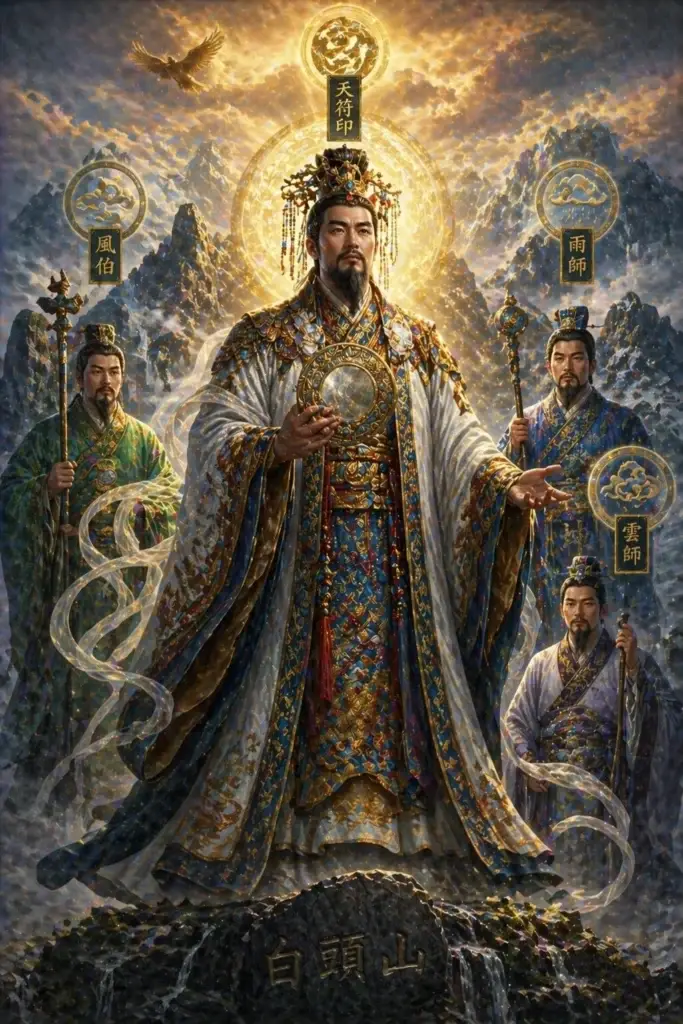
Hwanung
Hwanung is portrayed as a celestial being who descended to earth of his own wish in order to civilize it. He united with the bear goddess Ungnyeo and thus fathered Dangun, the founder of Gojoseon.
Hwanung appears as a god of cultivation, civilization and supernatural knowledge. His myths recount the bringing of cosmic knowledge to earth and the establishment of divine order among humans. In contrast to purely celestial gods, Hwanung exercises active rule over earthly realms.
The Hwanung legend is transmitted in the Samguk yusa of the monk Iryon (1281), but probably arose from older proto-Korean sources. The story of the sky god’s descent and his union with the bear is regionally widespread in Korea.
James H. Grayson mentions Hwanung in his religious history of Korea as a central figure of mediation between heaven and earth. His veneration is less personalized than the Dangun veneration, yet theologically fundamental to the cosmic order.
Historical Context
Between the events the myth describes and its recording in the Samguk Yusa of the 13th century lie, according to the narrative itself, millennia, and yet the material has survived. To this day Hwanung is present in Korea: the holiday Gaecheonjeol on October 3 commemorates the descent of the heavenly prince, and Mount Taebaek is still regarded as the site of the events. The narrative has changed, from a founding myth of the realm to material of national memory, but its core has remained the same.
Hwanung was not confined to a particular region or locality, but was universally known and venerated, or respectfully feared, throughout the entire Korean world.
Whether in large urban centers or in peripheral rural regions, whether among the social elite or among the common people, the spiritual or cultural significance of this entity was consistently and universally acknowledged.
The Hwanung myth did not remain a local mountain story: as part of the Dangun narrative it became the founding story of Korea and thus a tradition through which the entire nation affirmed its origins. The Samguk Yusa provided the unified written version, and the national holiday Gaecheonjeol later carried the story into every part of the country. As a result, the tale of the heavenly prince on Mount Taebaek is known throughout Korea today in the same basic form.
Hwanung is documented in the Samguk yusa, the most influential text of Korean mythology (Iryon, 1281). Further references are found in Confucian historical works such as the Goryeosa (History of Goryeo) and the Dongguk yeoji seungnam. The mytheme of the celestial descent connects cosmological Chinese conceptions (heaven as the highest power) with Korean ancestral myths.
Scholars of religion such as David A. Mason examine Hwanung as a bridging figure between Chinese cosmology models and distinctly Korean traditions. Yi Sang-ok and Kim Tae-gon treat him as an archaic deity whose functions were later transferred to specialized deities.
Name
Hwanung is depicted in the various sources and artistic traditions with certain recurring iconographic elements that remain relatively constant across decades and across different geographical regions. These elements are not purely decorative or chosen at random, but are deeply symbolically encoded and carry great meaning.
They centrally convey the being’s functions, sources of power, areas of responsibility and cosmic role.
The overall system is like a sacred script or an encoded image: it allows the initiated or culturally educated to grasp the essential deeper meaning and to understand it correctly. Colors, sacred objects or weapons, physical attributes, specific accessories, all are significant and traditionally transmitted.
Characteristics
Hwanung was central to the religious practice, the everyday rituals and the daily understanding of the Koreans. People turned to this entity in critical or particular life situations or at specific ritual seasons, with structured, often elaborate rituals, prayers or offerings.
The tradition surrounding Hwanung was not passed on casually but fixed in writing: the monk Iryeon included it in the thirteenth century in the Samguk Yusa, drawing on older sources. The myth of the heavenly prince is thus preserved in a learned, Buddhist-influenced compilation, not merely in oral storytelling.
The continuity of these practices over many generations clearly shows that the practice was regarded as effective and necessary. The functions were manifold: some were preventive (warding off potential misfortune), some healing (alleviation of illness or suffering), some transformative (accompaniment through transitions between life stages).
Profile: Hwanung
The profile presents Hwanung from six perspectives: geographical and mythological origin, social groups of veneration, iconographic features, protective aspects and cultic parallels. These dimensions illustrate his role as a mediator between heaven and earth as well as between mythology and state religion.
Hwanung is described as the son of the supreme sky god Haneul-nim, or also of the Jade Emperor (under Chinese influence). His descent is located only vaguely in time, but is geographically associated with the Korean peninsula and its northern hinterland (Manchuria).
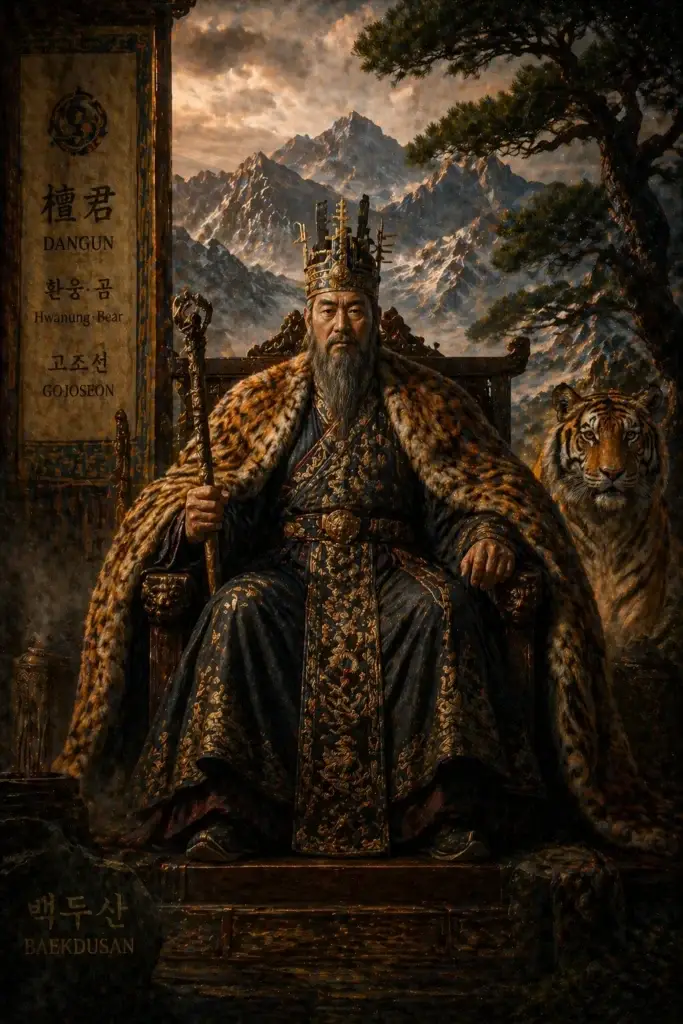
The legendary site of his descent is Mount Taebaek or Baekdusan. The mythological dating is prehistoric; in terms of religious history, the legend is understood as a cosmological narrative that does not aim at historical events, but at the founding of the cosmic order.
Hwanung was venerated by priests, shamans and the educated elite who concerned themselves with cosmic questions. His veneration was also part of a cult of scholars and priests.
In later periods his figure was integrated into Confucian cosmology. Today he is primarily a literary and national mythical figure without an active cult, but with cultural prestige.
In early depictions Hwanung is shown as a radiant celestial being with a halo, often in colorful robes that suggest divine spheres. His attributes are the heavenly seal, a scepter or a staff with cosmic symbols (sun, moon, stars).
In later images he resembles a noble, androgynous being with supernatural radiance. The bear woman (Ungnyeo) is often depicted at his side, to show the union and the coming into being of Dangun. Celestial landscapes with mountains and clouds frame him.
Hwanung is a benevolent being and not a harmful being. His cult involved traditional rituals of veneration at mountain sanctuaries, especially at Baekdusan and Taebaek. Shamans invoked Hwanung in order to preserve cosmic harmony and to secure fertility.
In contrast to protective rituals against evil spirits, the veneration of Hwanung took place through reverence and petitionary prayers for cosmic order. Respect was maintained through mountain offerings and prayers, less through apotropaic practices.
Comparable are other gods of cosmic mediation: the Chinese Jade Emperor as mediator between heaven and earth, the Japanese Izanagi and Izanami as primordial creators who establish land and order, and the Indian Indra as king of the gods who intervenes in the world.
Common to all of them is the function of cosmic order through active intervention and the secularization of the divine through contact with the earthly.
Warding Off in Everyday Life
Rituals and Veneration
Hwanung was venerated as a mediator; rituals took place on mountains (such as Paekdu, the most sacred mountain). Mudang shamanesses performed dance rituals in order to request Hwanung’s blessing for the harvests. Rites of passage (for example weddings) referred to Hwanung’s union with Ungnyeo as a sacred model.
Conjurations and Invocations
Classical formulas emphasize his office as mediator: “Hwanung, messenger between heaven and earth, bless our land.” Priestesses recited ritualized chants that recounted Hwanung’s descent. One transmitted invocation ran: “Son of heaven, grant us wisdom and prosperity.”
Amulets and Protective Symbols
The celestial symbol (white above, dark below) in traditional amulet designs represents Hwanung’s position. Mountain temples displayed symbols of transition (stairs, bridges). Women wore fertility amulets with motifs of the heavenly messenger.
Hwanung, Parallels in Other Cultures
Jewish tradition: In Judaism there is a partial correspondence in God’s descent to create the world and in his communication with humanity.
Particularly relevant is the figure of the Logos or of the Shekhinah (the presence of God), which acts as a mediating divine force. Unlike Hwanung, this is not personalized as a son of God, but conceived as an attribute or emanation.
Greco-Roman world: Zeus and the Demiurge (in Plato) resemble Hwanung in their role as cosmic ordering powers. Zeus actively intervenes in earthly affairs and, through union with mortals (Danae, Leda), begets new beings.
The Demiurge creates or orders the material world according to higher principles. Both are mediators between the ideal (celestial) and the real (earthly) order.
Mesopotamia: The Akkadian Enlil, as god of the air and ruler of earthly fates, corresponds to Hwanung’s role. Enlil intervenes actively in order to create and preserve order.
Marduk (Babylon) too is depicted as a cosmic ordering power who, through his actions, structures and governs the world. The shared function is the mediation between cosmic principles and earthly reality.
India / Asia: In the Indian tradition Hwanung resembles Brahma as creator or Indra as ordering power of the world. In Tibetan cosmology there are similar mediating figures between the pure divine realm and material manifestation. In Chinese Daoism the “Supreme Pure One” or an emanation of the Dao would play a comparable role.
Hwanung in the Dangun Foundation Myth: the Descent from Heaven
Hwanung is the key figure of the Korean foundation myth as it is transmitted in the Samguk Yusa, the “Memorabilia of the Three Kingdoms,” which the Buddhist monk Iryeon compiled in the 13th century.
According to this account, Hwanung is the son of the heavenly ruler Hwanin. Hwanung looks down from heaven upon the human world and wishes to act there. His father recognizes this wish and entrusts the earth to him for ordering.
Hwanung descends with a retinue onto the mountain, in the myth the Taebaek mountain, namely to a place beneath a sacred sandalwood tree. There he founds the “divine city” and takes up the rule over the human world.
Decisive is that he brings with him three heavenly seals and a retinue of three thousand beings, as well as the lords over wind, rain and clouds.
With this apparatus he regulates, according to the text, three hundred and sixty affairs of humans, among them agriculture, lifespan, illness, punishment and the distinction between good and evil.
Hwanung is thus not a creator god in the strict sense, but a founder of culture and a bringer of order. He does not create the world, but he makes it habitable and arranges human coexistence.
Scholarship has pointed out that this myth bears the typical features of a myth legitimating rule: the order of the world goes back to a son of heaven, and thereby the later earthly rule, which derives from Hwanung’s son Dangun, is anchored in heaven.
The descent of Hwanung is the mythical foundation on which the entire foundation narrative of Korea rests.
The Bear and Tiger Episode and the Birth of Dangun
The best-known section of the myth is the transformation trial of bear and tiger. According to the Samguk Yusa, a bear and a tiger turn to Hwanung with the wish to become humans.
Hwanung gives them sacred mugwort stalks and twenty cloves of garlic and commands them to eat these and to avoid sunlight for a hundred days.
The tiger does not endure the deprivation and leaves the cave. The bear, however, perseveres and is transformed, after the prescribed period, in the text after twenty-one days, into a woman, the Ungnyeo, the “bear woman.”
Ungnyeo, however, finds no partner and prays beneath the sacred tree for a child. Hwanung thereupon temporarily takes on human form, marries her, and she gives birth to a son: Dangun Wanggeom, the mythical founder of the first Korean realm Gojoseon.
This episode is multilayered in terms of religious history. The transformation trial bears clear features of an initiation rite: withdrawal into the darkness of the cave, fasting, deprivation, proving, and rebirth in a new form. Scholarship has also seen in it a possible reflex of totemic conceptions, with the bear playing a special role.
Important is the constellation that the myth establishes: Dangun unites in himself heavenly origin, through Hwanung, and earthly, animal origin, through the bear woman.
This connection of heaven and earth, of the divine and earthly sphere, is the mythical foundation for the special position of the Korean ruling lineage and ultimately of the Korean people in the self-interpretation of this tradition.
Hongik Ingan: the Guiding Principle of the Welfare of Humanity
A short expression from the Hwanung myth has gained, in Korean intellectual history, a significance that reaches far beyond the text: Hongik Ingan, usually translated as “to be of great benefit to humans” or “to bring comprehensive welfare to humanity.” In the Samguk Yusa it is the intention with which Hwanung, or rather his father Hwanin, justifies the descent to earth.
The son of heaven comes not to rule, but to benefit humans.
From this brief mythical justification, a state and cultural guiding principle developed in the 20th century. Hongik Ingan was raised, after the liberation of Korea, to the declared guiding idea of the national education system and remains to this day a fundamental pedagogical ideal.
The phrase appears in educational policy documents and shapes the national self-understanding as a humanistically oriented one.
This history of influence is instructive in terms of religious history. It shows how a single sentence from a medieval collection of myths can become, in modern times, the bearer of a national identity.
Scholarship critically discusses to what extent the modern interpretation corresponds to the original textual context and to what extent it reinterprets it out of later needs.
It is undisputed that the Hwanung myth received, through Hongik Ingan, an ethical core that sets it apart from a mere myth legitimating rule.
In this reading Hwanung appears not as a conqueror, but as the founder of an order oriented toward the common good. Whether this emphasis was already inherent in Iryeon’s text or whether it was first worked out by modern reception remains the subject of scholarly debate.
Source Criticism: the Samguk Yusa and the Age of the Myth
The question of how old the Hwanung myth actually is belongs to the most difficult of Korean religious history, and it calls for sober source criticism. The authoritative version is found in the Samguk Yusa from the late 13th century.
Iryeon, the author, was a Buddhist monk, and he states that he drew on older sources, among them a work not preserved, which he calls the Gogi, “old record.” A further, roughly contemporaneous or somewhat later mention is found in the Jewang Ungi of Yi Seunghyu.
This gives rise to a methodological problem. The oldest preserved written attestation dates from the 13th century, that is, millennia after the events named in the myth. Whether and in what form the myth existed beforehand, orally or in writing, cannot be directly attested.
Some researchers assume that core elements, such as the heavenly descent and the bear woman, are considerably older and go back to early shamanistic or totemistic conceptions.
Others emphasize that the transmitted version is strongly shaped by Buddhist and Chinese historical thought and, at least in its literary form, represents a work of the High Middle Ages.
In addition, the myth became strongly politically charged in the 20th century, both in national identity formation and in religious movements that invoke Dangun and Hwanung. This modern instrumentalization has at times complicated scholarly discussion.
A serious classification of Hwanung must therefore separate two things: the question of the actual age and roots of individual myth elements, which can be answered only cautiously, and the question of the documented tradition, which clearly begins in the 13th century.
Whoever cites the myth should rely on the well-attested textual basis and mark speculations about the prehistory as such.
Further Links
Literature (Selection)
Further standard works in the literature index.