Dharmachakra: the Wheel of the Teaching as a Symbol of Buddhism
By Ralf Ittermann · last reviewed on
Dharmachakra is the name for the Wheel of the Teaching, the most important symbol of Buddhism. Its eight-spoked wheel stands for the eightfold path that the Buddha taught as the way to insight. As a symbol of the teaching itself, it carries both a protective and an orienting meaning.
Classification
Dharmachakra is the Sanskrit name for the Wheel of the Teaching. It is the most important and the best-known symbol of Buddhism.
The word is made up of two parts. The first part denotes the teaching of the Buddha, the second part means wheel. The Dharmachakra is therefore the wheel of the Buddhist teaching.
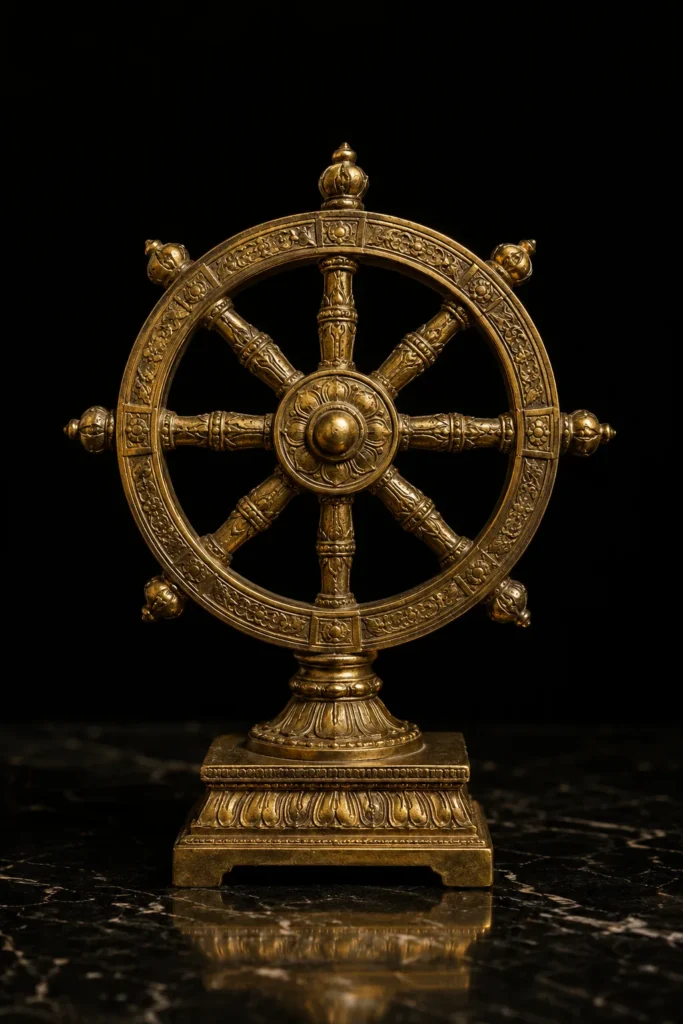
The symbol is depicted as a wheel with a hub, a rim, and a number of spokes. In its best-known form, the wheel has eight spokes.
The Dharmachakra stands for the teaching of the Buddha as a whole. Wherever it appears, the teaching itself is present. It is thus the most comprehensive symbol of Buddhism.
Among the eight auspicious symbols, the Ashtamangala, the Wheel of the Teaching is the eighth and at the same time the most significant symbol. On the page about the Ashtamangala, this group is presented.
In religious studies, the Dharmachakra is a good example of a symbol that embodies an entire teaching. It protects and guides by recalling the way to insight.
The Wheel as an Ancient Symbol
The wheel is an ancient symbol that already carried meaning in the Indian world before Buddhism. Buddhism adopted it and gave it a new sense.
In the older Indian conception, the wheel was a symbol of the just ruler. An exemplary world-ruler was associated with a wheel that signified his dominion over the world.
This wheel of the ruler stood for right order. It moved without meeting resistance and brought law and order everywhere it reached.
Buddhism took up this image. The wheel of worldly rule became the Wheel of the Teaching. Instead of an empire, it was now the teaching of the Buddha that spread.
In this image, the Buddha himself became a spiritual world-ruler. He does not rule over a country, but with his teaching sets in motion a wheel that points the way for people.
The origin of the Dharmachakra thus shows a widespread process. An older symbol of worldly power was taken up and transformed into a symbol of spiritual teaching.
The Turning of the Wheel of the Teaching
Connected with the Dharmachakra is a figurative expression that occurs frequently in the Buddhist texts. This is the talk of turning or of setting in motion the Wheel of the Teaching.
This expression refers to a decisive moment in the life of the Buddha. After he had attained insight, he gave his first sermon and proclaimed the teaching for the first time.
This moment of the first sermon is called the first turning of the Wheel of the Teaching. With this sermon the Buddha, as it were, set the teaching in motion.
The image is aptly chosen. Just as a wheel, once pushed, rolls on, so the teaching, once proclaimed, spreads ever further and reaches ever new people.
The Buddhist tradition speaks of several such turnings of the wheel. By this it denotes different stages or phases in which the teaching was unfolded.
The Dharmachakra as a symbol is inseparable from this expression. The wheel is not a static image but a moving one. It stands for a teaching that is in motion and spreading.
The Eight Spokes and the Eightfold Path
In its best-known form, the Dharmachakra has eight spokes. This number is not chosen at random but has a precise meaning.
The eight spokes stand for the eightfold path. This path is a central content of the Buddhist teaching and describes the way that leads out of suffering.
The eightfold path is divided into eight elements. They concern right view, right intention, right speech, right action, right livelihood, right effort, right mindfulness, and right concentration.
Each of the eight spokes of the wheel stands for one of these eight elements. The wheel thus brings the entire way together in a single image.
The spokes bear the rim of the wheel, and only together do they hold the wheel. In the same way, the eight elements of the path belong together and only together make up the complete way.
The eight-spoked Dharmachakra is thus a symbol of great conceptual density. In a simple form, a wheel with eight spokes, the entire Buddhist way to insight is contained.
Hub, Spokes, and Rim
The Dharmachakra consists of three parts: the hub in the centre, the spokes, and the outer rim. Each of these parts is interpreted and carries its own meaning.
The hub in the centre is the resting core of the wheel. It is associated with ethical conduct (sīla), which forms the firm centre of the way.
The spokes are interpreted differently according to their number. Eight spokes stand for the eightfold path. Other numbers point to further divisions of the teaching.
The rim, the outer ring of the wheel, holds the spokes together. It is associated with mindfulness and with concentration, which hold the way together and make it complete.
Some depictions give the wheel additional ornamentation. Ribbons, a base, or a pair of animals may accompany the wheel and signal its dignity.
This structured form makes the Dharmachakra a carefully conceived symbol. Its very construction, the centre, the spokes, and the holding rim, reflects the structure of the teaching.
The Wheel in Buddhist Art
The Dharmachakra is among the oldest symbols of Buddhist art. It appears even in a period when the Buddha was not yet depicted in human form.
In early Buddhist art, the Buddha was suggested by symbols rather than by his image. An empty throne, a tree, a footprint, or indeed a wheel stood for his presence.
In this early period, the wheel stood for the Buddha as teacher and for his first sermon. Wherever the wheel appeared, the moment of the proclamation of the teaching was meant.
Even after the Buddha was depicted in human form, the wheel remained significant. It appears on gateways, on pillars, on temples, and in the hands of figures of the Buddha.
A particularly well-known depiction shows the wheel between two deer or gazelles. This depiction recalls the place of the first sermon, a park in which deer lived.
Throughout Buddhist art from India to East Asia, the Dharmachakra is thus a continuous symbol. It accompanies the art of Buddhism through its entire long history.
The Wheel as a Protective Symbol
The Dharmachakra is first and foremost a teaching symbol. Its protective meaning arises from what it stands for, namely from the teaching of the Buddha itself.
According to Buddhist understanding, it is the teaching that preserves people from suffering. It shows the way that leads out of entanglement. The wheel that embodies this teaching therefore carries a protective sense.
Whoever wears or contemplates the Dharmachakra is reminded of the teaching and of the eightfold path. This reminder is meant to keep people on the right way.
The protection of the Dharmachakra thus does not lie in warding off something from outside. It lies in the orientation of the person, in their turning toward the teaching and the way.
In this it differs from defensive protective symbols. It does not ward off evil but points a direction. Its protection is the right orientation of life.
The Dharmachakra is thus a good example of protection through orientation. It preserves people by placing before their eyes the way that Buddhism teaches as the way out of suffering.
The Wheel as a Symbol of Buddhism as a Whole
Among all the symbols of Buddhism, the Dharmachakra holds a special position. It is not one symbol among many but the symbol of Buddhism as such.
Other Buddhist symbols stand for individual contents, for a virtue, for a blessing, or for a particular figure. The Dharmachakra, by contrast, stands for the teaching as a whole.
This comprehensive meaning explains its wide distribution. Across all schools and all regions of Buddhism, the Wheel of the Teaching is a shared symbol.
For this reason the Dharmachakra has also become the universally recognised emblem of Buddhism. Wherever it appears, the Buddhist teaching is meant, independent of the individual school.
In this position the Dharmachakra resembles the great symbols of other religions. As the cross stands for Christianity, so the Wheel of the Teaching stands for Buddhism.
The Dharmachakra is thus the principal symbol of an entire religion. In a single, simple image, the teaching of the Buddha and the way to insight are brought together.
Contemporary Reception
The Dharmachakra is omnipresent in the Buddhist world to this day. In temples, in monasteries, and in art, the Wheel of the Teaching is a familiar sight.
As ornament and as a pendant, the Dharmachakra is worn by many people. In this form it is a profession of Buddhism and a reminder of its teaching.
Beyond religious use, the Wheel of the Teaching has become a widely recognised symbol. It appears on flags, on coats of arms, and on state emblems in countries with a Buddhist history.
In the West, too, the Dharmachakra has become known along with interest in Buddhism. There it is understood as a symbol of Buddhism and used as an ornament and an emblem.
In this broader use, the precise meaning of the eight spokes may recede into the background. The wheel is then understood generally as a symbol of Buddhism.
At its core, however, the Dharmachakra remains what it has been since the Buddha’s first sermon: the Wheel of the Teaching, which embodies the eightfold path and the way to insight.
Literature (Selection)
Related key terms: Dharmachakra Wheel of the Teaching eight-spoked wheel eightfold path Buddhism Buddha first sermon teaching symbol.
iWell Guard and Traditions of Protection
iWell Guard stands within the cultural-historical line of wearable protective objects to which the Dharmachakra also belongs. A modern companion for people who live with protective symbols: made in Germany, 41 layers of solid gold, platinum, and silver, with a 30-day right of return.
Personal experiences may vary. Not a medical device. No promise of healing.