Hei Matau: the fish-hook pendant of the Māori made of bone or jade
By Ralf Ittermann · last reviewed on
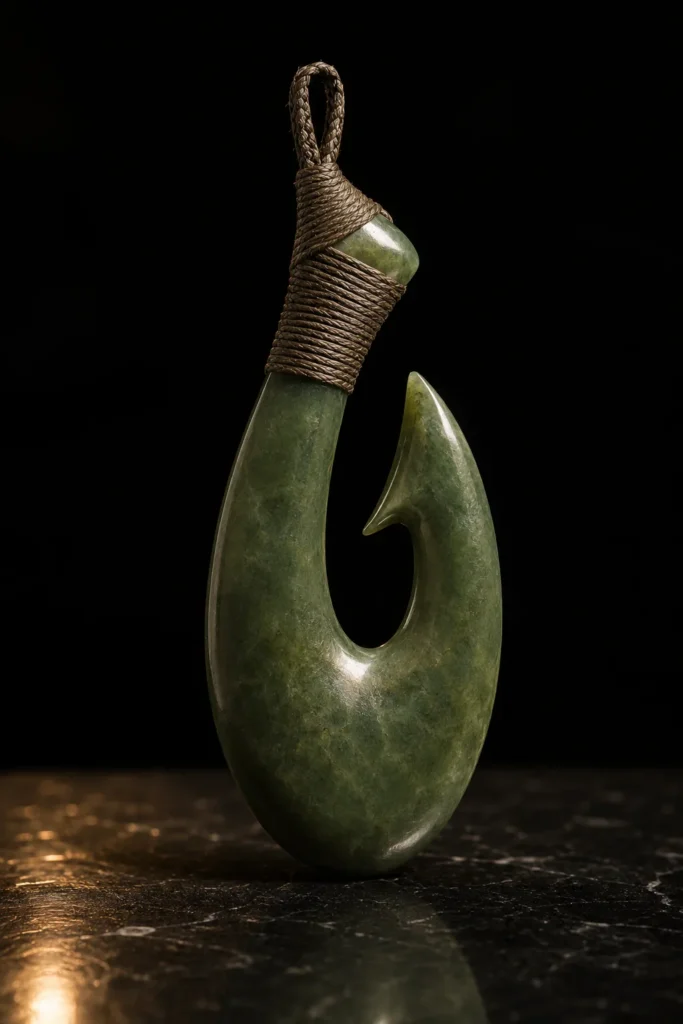
Hei Matau is the term used by the Māori in New Zealand for a pendant in the shape of a stylised fish-hook. It is traditionally made from bone, from the green stone Pounamu, often referred to as jade, or from shell, and is worn around the neck.
The Hei Matau points to the importance of the sea and of fishing for the Māori and is connected with narratives about the origin of the land.
From the perspective of religious studies and cultural studies, it is an object that expresses origin, a bond with the sea and the wish for a safe crossing. This text describes its origin, form and meaning from an outside perspective.
The fish-hook pendant of the Māori, traditionally carved from whale bone or Pounamu jade, goes back to the myth of the demigod Māui, who is said to have pulled the North Island of Aotearoa out of the sea with such a hook.
Classification of the Hei Matau
The Hei Matau is a pendant of the Māori that has the shape of a stylised fish-hook. The word hei denotes a pendant worn around the neck, matau means fish-hook. The name therefore designates the object directly.
Unlike an ordinary decorative pendant, the Hei Matau is bound up with a cultural meaning. It points to the sea, to fishing and to narratives that are significant for the identity of the Māori.
The Māori are the indigenous people of New Zealand, who inhabited the islands before European settlement and whose language and culture remain alive there to this day. The Hei Matau belongs to their rich tradition of personal adornment.
The Hei Matau is worn on a cord around the neck, often on the chest. In this position it is at once adornment, a sign of origin and the bearer of a cultural message.
In terms of religious studies and cultural studies, the Hei Matau belongs to the wider context of protective symbols and of meaningful objects worn on the body. It is an example of how an everyday implement can become a cultural sign.
The Hei Matau also stands for a broader characteristic of Polynesian cultures, in which everyday objects of seafaring and fishing were charged with cultural meaning. The implement on which sustenance depended became a sign that makes origin and way of life visible.
Important for a factual account is the distinction between the Hei Matau as a cultural object of the Māori and the pendant sold worldwide by the tourism and jewellery trade. Both bear the same form, but not the same meaning.
Origin and History
The ancestors of the Māori settled New Zealand in the course of the far-reaching migrations of the Polynesian peoples across the Pacific. These migrations were shaped by seafaring and fishing, which were vital for the survival of the travellers.
In this world, the fish-hook was an implement of great importance. A good hook secured food. It stands to reason that the high regard for the fish-hook had its origin in this practical significance.
From the everyday implement developed the worn pendant in hook form. Even before European settlement, the Māori made finely worked pendants from bone, stone and shell. The Hei Matau belongs to this tradition of personal adornment.
A special significance is attached to the green stone Pounamu. It is found on the South Island of New Zealand, is hard, beautiful and difficult to work. Objects made from Pounamu are regarded by the Māori as especially valuable and are passed down over generations.
With European settlement from the 19th century onward, the culture of the Māori came under pressure. Language, land and traditions were threatened. Nevertheless, the making of pendants from Pounamu and bone remained alive.
Pounamu was already traded over long distances before European settlement. The stone occurs in only a few places on the South Island, yet was used across the whole North Island. The routes by which Pounamu reached the working communities from its sources are among the well-researched topics of New Zealand archaeology.
In the 20th and 21st centuries, the culture of the Māori experienced a renewal. The Hei Matau became a widely known sign in this process. At the same time it spread far beyond New Zealand as a souvenir and item of jewellery.
Form, Material and Manufacture
The basic form of the Hei Matau is the stylised fish-hook. From the practical hook shape developed a curved object, often designed in a rounded or spiral manner, that takes up the original form but shapes it artistically.
The materials traditionally used are bone, Pounamu and shell. Bone, for example from whales, was carved, ground and polished. Pounamu, the green stone, is particularly hard and demands an elaborate working process.
Working Pounamu was very laborious before the introduction of metal tools. The stone was sawn and ground with sand and water. This effort contributed to the high value of the finished objects.
Hei Matau exist in many sizes and forms. Some are plain, others richly decorated with carving. Decorations can additionally provide the object with patterns of Māori art.
The making of a Hei Matau is part of the carving art of the Māori. Carvers pass on their knowledge, and the carving of Pounamu is bound up with its own ideas about the proper handling of the stone.
Today, Hei Matau are made by Māori artists, but also industrially and in plastic. From the perspective of religious studies as well as culture, the Hei Matau made by a Māori carver from Pounamu is to be distinguished from the cheap imitation.
Religious and Mythological Background
The Hei Matau is connected with one of the best-known narratives of the Māori, the narrative of the demigod Māui. According to this narrative, Māui pulled a giant fish out of the sea with a mighty fish-hook, which became the North Island of New Zealand.
In this narrative, the fish-hook is the tool with which the land itself is drawn up from the sea. The Hei Matau thus recalls the origin of the land and the bond of the Māori with the sea and with Māui.
The sea is of central importance for the Māori. It is a source of food, a route of travel and part of the world of the ancestors. The Hei Matau expresses this bond with the sea in a worn object.
Objects made from Pounamu hold a special rank in the culture of the Māori. Pounamu is linked with ideas of value, permanence and connection. A Hei Matau made from Pounamu carries this meaning with it.
In terms of religious studies, the Hei Matau can be understood as an object that brings a narrative, a way of life and an origin into a worn form. Its meaning is disclosed through the context of the culture of the Māori.
It is important that the Hei Matau is not a magical tool, but a sign of cultural connection. Its meaning lies in the memory of narratives, of the ancestors and of the sea.
The narrative of Māui is widespread in many variants beyond Polynesia. In New Zealand it is connected especially closely with the landscape, since in this tradition the North Island is interpreted as the fish caught by Māui. The Hei Matau keeps this connection of narrative and land present in a worn object.
Ritual Use and Wearers
The Hei Matau is worn around the neck and accompanies its wearer in everyday life. It is at once adornment and cultural sign. In this use it is less a ritual object than a permanently worn object of meaning.
Pendants made from Pounamu are frequently passed on as a gift in the culture of the Māori. Such a gift connects giver and recipient and can remain in a family over generations.
With the passing on of a Pounamu pendant, ideas are often associated according to which the object gains meaning through its wearers. It carries the memory of the people who previously owned it.
The Hei Matau can be presented on special occasions, for example at a farewell, a journey or an important step in life. In this context it expresses good wishes and connection.
Wearers of the Hei Matau are Māori, who wear it as a sign of their origin, but equally people without Māori origin who have acquired it as adornment or a keepsake. These different contexts are to be borne in mind.
A strictly fixed ritual use is not associated with the Hei Matau. Its meaning unfolds rather in the wearing, in the giving and in the memory of the narratives linked with it.
Regional Variants and Related Objects
The Hei Matau is only one of several well-known pendants of the Māori. Another is the Hei Tiki, a pendant in the shape of a human figure, which is likewise often made from Pounamu.
Other forms of Māori carving art are also related to the Hei Matau, for example pendants in spiral or knot form. They all belong to the rich tradition of personal adornment of the Māori.
Within the wide realm of Polynesian cultures there are further traditions of finely made fish-hooks and pendants. They reflect the shared importance of seafaring and fishing for the peoples of the Pacific.
In terms of religious studies, the Hei Matau can be compared with other signs of origin and protection worn on the body. The article on amulet and talisman explains the conceptual differences of such objects.
In popular perception, the Hei Matau is often mentioned together with other objects of indigenous peoples. In terms of religious studies, however, it is firmly anchored in the culture of the Māori and is not to be arbitrarily mixed with other traditions.
Māori carving art also distinguishes regional styles. The carving schools of individual tribal groups, the iwi, cultivate their own form traditions, which show in the lines and in the patterns.
A Hei Matau made by a Māori carver can therefore often be assigned to a particular cultural context, whereas industrial mass production levels out such differences.
Within the field of protective symbols, the Hei Matau is an example of an object whose protective meaning is closely bound up with a particular world, namely with the sea and seafaring.
Meaning as a Protective Object
The Hei Matau is frequently associated with the wish for a safe crossing over the water. Since the sea meant both a basis of life and a danger for the Māori, the pendant expresses the wish for protection at sea.
Protection here is closely linked with the bond to the sea. Whoever wears a Hei Matau establishes a relationship with the sea and with the narratives connected to it. From this relationship protection is hoped for.
In addition, the Hei Matau is associated with strength, with prosperity and with good fortune. These meanings are widespread in present-day use and are present to varying degrees.
In terms of religious studies, the protective meaning of the Hei Matau can be understood as an expression of a bond with origin and world. The pendant recalls the narratives and the ancestors and thereby gives stability.
This text makes no statements about actual protective effects. It describes only what meaning wearers ascribe to the object. Promises of healing and assurances of effect are expressly excluded.
It remains to be noted that the protective meaning of the Hei Matau stems from the culture of the Māori. In use as a mere souvenir, only a general allusion to luck and a safe journey often remains of this meaning.
History of Research, Ethical Questions and Cultural Appropriation
The carving art and adornment of the Māori have long been subjects of ethnology and art history. Researchers documented forms, materials and narratives and exhibited the objects in numerous collections.
Part of this history is problematic. Many Māori objects reached Europe and North America in the course of the colonial era, partly through sale, partly under unequal conditions. The return of individual objects is still being negotiated today.
The cultural appropriation of the Hei Matau is a current topic. The pendant is sold worldwide as a souvenir and fashion jewellery, often without reference to the Māori. Some industrially made pieces also disregard the proper form of the motifs.
Māori artists and organisations work to ensure that the origin of the Hei Matau is recognised and that Pounamu is protected as a culturally significant material. On the South Island of New Zealand, Pounamu is specially protected by law.
What is ethically required is an exact account that describes the Hei Matau as an object of the Māori, names its narratives and makes clear the distinction between authentic carving art and arbitrary imitation.
A serious account refrains from promoting the Hei Matau as a magical protective tool. It describes it as a cultural object of the Māori and recommends paying attention, when purchasing, to an origin from Māori artists.
Contemporary Reception
In New Zealand the Hei Matau is a living cultural sign. It is worn by Māori as an expression of their origin and has at the same time become a symbol of New Zealand known beyond the country.
The carving art of the Māori is flourishing. Contemporary artists make Hei Matau from Pounamu, bone and other materials and combine traditional forms with their own design. These works are valued and collected.
At the same time the Hei Matau is a widespread souvenir. In shops, at the airport and in mail-order trade, pendants in hook form are offered. Part of these pieces comes from Māori artists, another from industrial manufacture without cultural reference.
In the international world of jewellery and fashion the form of the Hei Matau is taken up. In terms of religious studies, this use is a reception form of its own that adopts the motif without continuing the cultural context.
Museums display Hei Matau and other objects of the Māori. Many institutions work together with Māori organisations in order to classify the objects factually and to respect the cultural meaning.
For interested readers, a conscious approach is recommended. Whoever acquires a Hei Matau can pay attention to an origin from Māori artists and inform themselves about the narratives connected with it. Further protective objects are presented in the section protective symbols.
Literature (Selection)
Related key terms: Hei Matau Māori New Zealand fish-hook pendant Pounamu jade bone carving art Māui Polynesia sea.
iWell Guard and Protective Traditions
iWell Guard stands in the cultural-historical line of wearable protective objects to which the Hei Matau also belongs. A modern companion for people who live with protective symbols: made in Germany, 41 layers of genuine gold, platinum and silver, with a 30-day right of return.
Personal experiences may vary. Not a medical device. No promise of healing.