Frankincense: Incense Resin for Cleansing and Protection
By Ralf Ittermann · last reviewed on
For at least 4,000 years, frankincense has been the most important incense in religious and ritual practice. The resin obtained from the trunk of the Boswellia tree was burned alike in Egyptian temples, ancient Israelite sanctuaries and Roman altars.
Its significance for cleansing, protection and contact with the sacred runs through the history of religion in a way no other substance achieves. On the overview page on incense and cleansing, frankincense is the reference work against which the other incense substances are placed.
Frankincense is probably the best-known incense resin and has been regarded since antiquity as a means of cleansing.
Quick overview
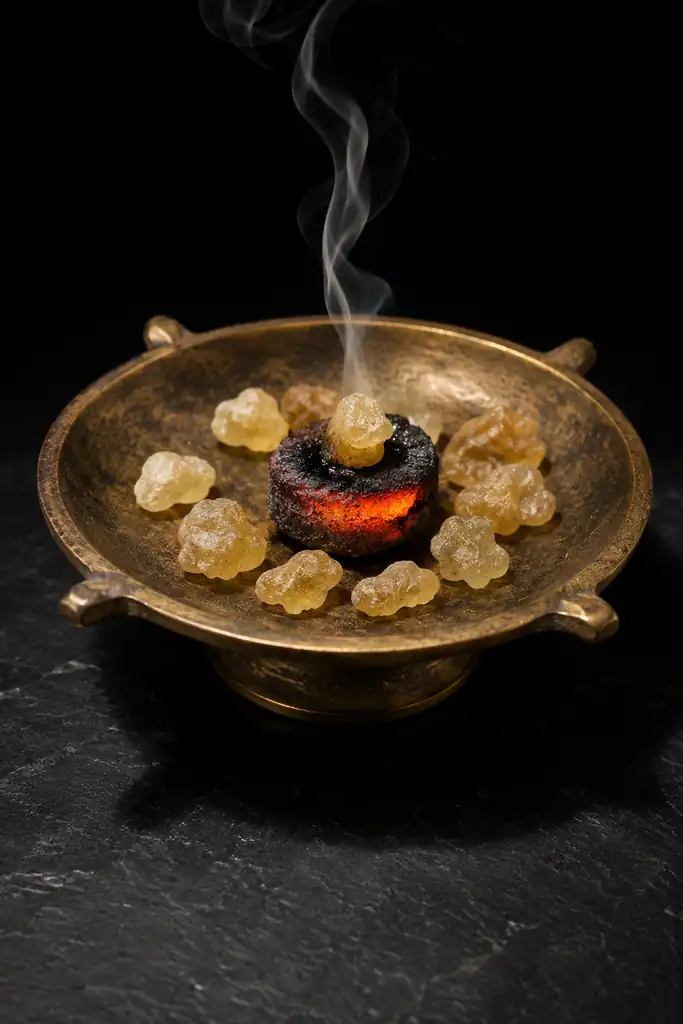
Frankincense is the dried resin of the Boswellia tree, native mainly to East Africa and the Arabian Peninsula. In tradition, the rising smoke is regarded as a carrier of prayer and of protection, carrying harmful influences upward and opening the space for the sacred.
The characteristically sweet, resinous scent marks the presence of the divine in many traditions. Frankincense is burned as grains of resin on charcoal or in the form of incense sticks.
Origin and tradition
The earliest evidence for the use of frankincense comes from ancient Egypt, where it was burned in temples under the name Kapet or as a component of the compound incense Kyphi.
The Old Testament prescribes frankincense as part of the temple offering: the Book of Exodus describes the recipe for the holy incense, and the smoke of the frankincense is regarded there as a visible sign of prayer rising up to God.
Psalm 141 takes up this image: “Let my prayer be set before you like incense.”
In Mesopotamia, frankincense was part of the rituals for appeasing and warding off demons (Utukku). The priest-exorcists of the Old Babylonian tradition used specific incense substances for particular protective rituals; frankincense stood there for the cleansing of the space before a binding spell was spoken.
In the Greco-Roman world, frankincense, Greek libanos, was the standard offering to deities. The smoke carried the prayer upward and set the sacred precinct apart from the everyday.
In the Christian tradition, frankincense was taken up into the liturgy from late antiquity onward. In the Byzantine and the Latin rite, it is regarded to this day as a sign of prayer, reverence and sanctification. In Catholic and Orthodox practice, frankincense accompanies the Mass, baptism, the last rites and the blessing of houses.
Traditional principle of action
Tradition knows two main modes of action of frankincense. On the one hand, its smoke is regarded as a means of demarcation: it transforms an ordinary place into a sacred precinct by marking the invisible boundary between profane and sacred space.
Whatever enters this precinct comes into contact with the consecration that the smoke carries, and harmful influences are regarded in tradition as incompatible with this state.
On the other hand, the scent of frankincense is regarded as repellent to lower or harmful beings. In Old Babylonian, Jewish and Christian demonology, the incompatibility of demons with the sacred and with certain scents is described.
The Book of Tobit, one of the deuterocanonical books of the Bible, recounts how the smoke of burned fish liver and incense drives away the demon Asmodeus. Although frankincense is not directly the means there, it belongs within the same interpretive framework.
Cross-cultural distribution
Frankincense is the incense with the widest geographical and temporal distribution.
In the Near East and North Africa it was the central cultic material for millennia; the trade routes of antiquity, the so-called incense roads, are named after it. In India it belongs to the puja ritual, where incense attracts the deities and keeps impure spirits at bay.
In Tibetan practice, frankincense is used as part of cleansing rituals (sang) to ward off harmful spirits and inauspicious influences.
In European folk belief, frankincense is associated above all with Christian protective practice. Consecrated frankincense from the Epiphany procession was burned in many regions above the doors and windows of the house in order to protect the home for the new year.
The blessing of houses with frankincense at Epiphany is still widespread in Bavaria, Austria and Switzerland today.
In combination with myrrh, frankincense forms a classic incense pairing regarded in several traditions as especially effective: frankincense for the bright and welcoming, myrrh for the demarcating and protective against death and misfortune.
What it is used against
In tradition, frankincense is used against a broad category of harmful beings. These are primarily impure spirits and demons as described in the Mesopotamian, Jewish, Christian and Islamic tradition: beings that cling to houses, thresholds or particular persons and cause harm.
The smoke is meant to drive these beings away or to prevent them from re-entering a cleansed space.
In European folklore studies, frankincense further appears as a means against the evil eye and against sorcery in the wider sense. The fumigation of a sickroom with frankincense was meant not only to favor the process of recovery but also to push back harmful influences from outside.
The Protection Compass on iwell-guard.com lists the kinds of beings against which frankincense is recorded as a countermeasure in various traditions.
Application and limits
Traditionally, frankincense is burned on a piece of charcoal; the smoke is carried through the space with a vessel, the censer. In everyday practice, incense sticks with frankincense extract or frankincense oil are common, although folk tradition attributes a stronger effect to the pure resin smoke than to processed products.
Tradition sets clear frameworks for action: incense burning should take place with intention and concentration, not casually.
Depending on the tradition, windows and doors are either closed (so that the smoke permeates the space) or opened (so that harmful influences can be carried outside with the smoke). Which variant applies depends on the goal pursued: cleansing through binding or through expulsion.
As a limit of the practice, tradition itself holds that frankincense alone is not complete protection. It belongs within a ritual context and complements other means of protection. People who suspect a concrete influence will find in the Protection Compass indications of which combinations the respective traditions recommend.
Literature (selection)
Related key terms: frankincense olibanum incense effect.
iWell Guard and traditions of protection
Frankincense stands for the principle that protection arises through a continuous practice, through repeated incense burning, through the renewal of consecration.
The iWell Guard translates this principle into a worn form: a protective sign that carries within it the traditions of several cultures developed over millennia and is permanently with the person, without the need for a regular ritual.
The idea of understanding protection as something that is actively maintained connects the ancient incense priest and the modern wearer of the pendant.
Personal experiences may vary. Not a medical device. No promise of healing.