Rama: Seventh Avatar of Vishnu and Hero of the Ramayana
By Ralf Ittermann · last reviewed on
Rama is regarded as the seventh avatar of Vishnu and as the hero of the epic Ramayana. He embodies the ideal of the just king and of the fulfillment of duty. His story, the loss and recovery of Sita, has shaped the religious culture of South and Southeast Asia.
Classification
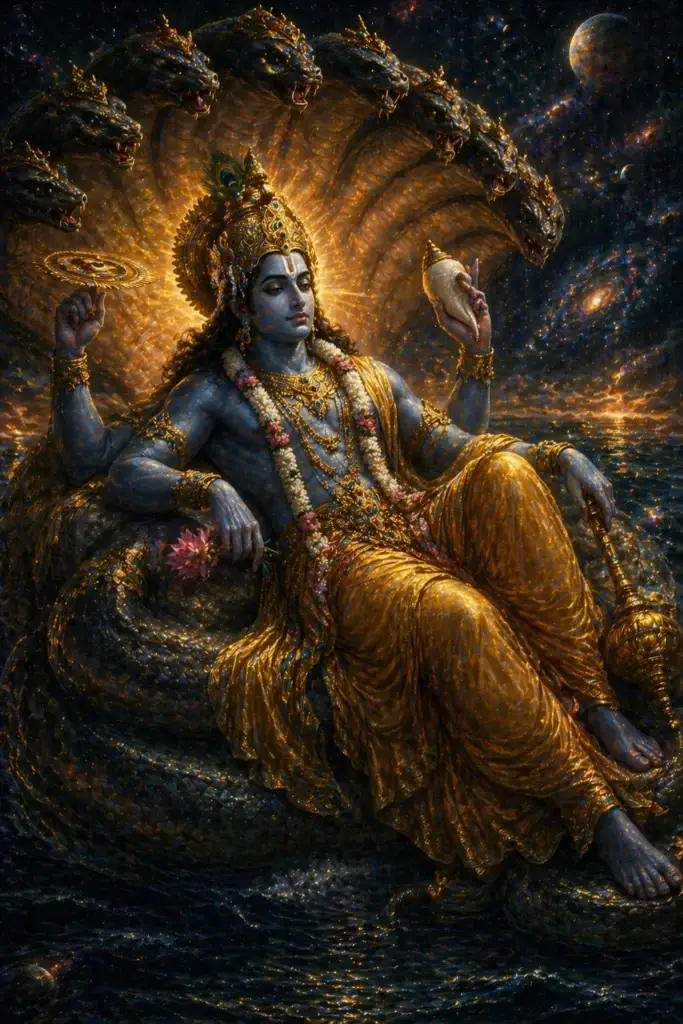
Within Hinduism, Rama belongs to the ten principal incarnations of Vishnu and, in the usual sequence, is counted as the seventh avatar.
Unlike the early avatars in animal or hybrid form, Rama appears in fully human form as a prince and later king. This shifts the focus from cosmic threat to the question of right human conduct.
The main source is the Ramayana, attributed to the traditional poet Valmiki. It is one of the two great epics of India and exists in numerous regional and linguistic versions.
Scholarship generally dates the oldest layers of the Valmiki text to the final centuries before the Common Era, while the framing books, in which Rama is explicitly regarded as divine, are younger. This diversity of versions is significant for religious studies, since it shows how a subject was retold and reinterpreted over the centuries.
Rama is regarded as the epitome of Dharma, the right order and fulfillment of duty. His conduct in difficult situations is understood within the tradition as exemplary.
At the same time, some of his decisions, particularly in his treatment of his companion Sita, have long been debated controversially, which makes the figure a continuing subject of ethical reflection.
In terms of religious history, it is notable that the deification of Rama occurred only gradually. In the oldest textual layers he appears primarily as an ideal human being and hero.
Only over the course of the second millennium of the Common Era, with the rise of the Bhakti movement, did Rama become a principal deity, with his own temples, festivals, and theological schools dedicated to him.
Name and Etymology
The name Rama is associated in Sanskrit with meanings such as the one who delights, the pleasing one, or the dark one. In religious usage the name itself has acquired great significance and is frequently recited in Bhakti practice. The combination Sita-Rama is a widespread invocation that names the divine couple together.
Rama bears several epithets that point to his origin and his actions. Raghava designates him as a descendant of the lineage of Raghu, Ramachandra likens him to the moon in grace, Dasharathi names him the son of King Dasharatha.
Designations such as Kosalendra refer to his rule over the land of Kosala, while other names point to his descent from the solar dynasty.
In religious life the repeated invocation of the name, for instance in the form Ram or in the formula Sita-Ram, holds a firm place in several Bhakti traditions. Reformers and poets of past centuries made the name of Rama a central component of their devotional practice.
In some currents, such as that of the poet Kabir, Ram was at the same time understood as the name of a formless, supreme divinity pointing beyond the epic figure.
Description and Iconography
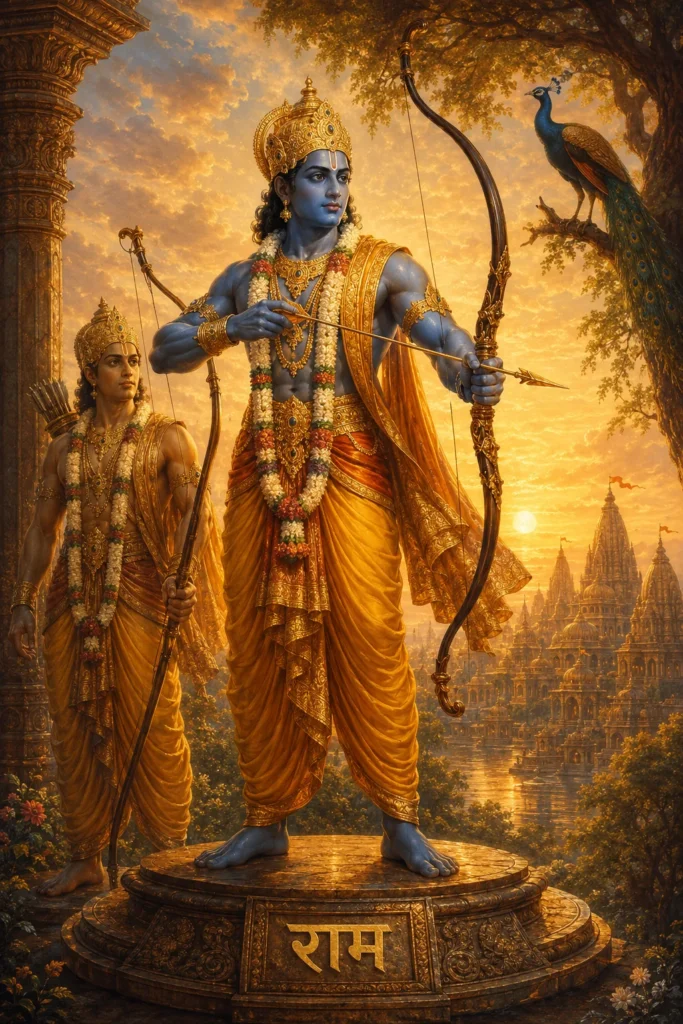
In the visual tradition Rama is usually depicted as a youthful, dignified prince. His skin frequently appears in a dark or dark-blue color, which links him iconographically with Vishnu. His characteristic attribute is the great bow, which points to his role as warrior and protector; he often also holds an arrow or a quiver.
Very widespread is the depiction as a group, the so-called Rama-Parivar. It shows Rama together with his companion Sita, his loyal brother Lakshmana, and the monkey hero Hanuman, who often kneels in a serving posture at the feet of the couple.
This image group is widespread in temples and household shrines and summarizes the central relationships of the epic.
Alongside these there are depictions of individual scenes from the epic, such as Rama drawing or breaking the great bow of Shiva while courting Sita, fighting against the demon king Ravana, or returning to his home city of Ayodhya.
The iconography consistently emphasizes the union of royal dignity, martial prowess, and moral exemplariness. In North Indian miniature painting and in the wall paintings of South Indian and Southeast Asian temples, entire pictorial cycles of the Ramayana have been preserved.
Mythological Narratives
The Ramayana recounts the life of Rama from his birth to his kingship. Rama is the eldest son of King Dasharatha of Ayodhya and is to ascend the throne as rightful heir.
In his youth he accompanies the sage Vishvamitra, protects his sacrificial fire from demons, and at a contest at the court of Mithila wins the hand of Sita by being the only one to draw the mighty bow of Shiva, breaking it in the process.
However, owing to an old promise made by the king to his wife Kaikeyi, Rama is sent into a fourteen-year exile in the forest immediately before his coronation, while Kaikeyi’s son Bharata is to receive the throne.
Rather than resisting, Rama accepts the exile in the spirit of fulfilling his duty. His companion Sita and his brother Lakshmana accompany him voluntarily. Bharata, however, refuses to claim the throne for himself and rules only as a deputy by placing Rama’s sandals upon the throne.
In the forest Sita is abducted by Ravana, the ten-headed demon king of the island of Lanka, after he has separated her from her protectors through the ruse of a golden deer.
The subsequent search for and liberation of Sita form the main part of the epic. Rama allies himself with the monkey people, whose king Sugriva he helps to the throne and whose most important hero is Hanuman.
Hanuman leaps across the sea, finds Sita held captive in the grove of Lanka, and brings her a token from Rama. There follows the building of a causeway to the island by the monkey army and finally the great battle in which Ravana and his warriors are defeated.
After the victory Rama returns to Ayodhya with Sita and his companions and takes up the kingship. His reign is referred to in the tradition as Ramarajya, the epitome of a just and peaceful rule in which prosperity and order prevail.
However, the final book of the epic also recounts a later, bitter episode: on account of talk among the people about the period of Sita’s captivity, Rama banishes her, although she is pregnant.
She finds refuge with the sage Valmiki and gives birth to the twins Lava and Kusha. In the end Sita returns to the earth, from which, according to tradition, she had once emerged. This episode has long been felt to be ethically difficult and is treated differently in the various versions or omitted entirely.
The individual regional Ramayana versions set different emphases.
The Tamil version of Kamban, the Hindi version of Tulsidas titled Ramcharitmanas, the Bengali Ramayana of Krittibas, and numerous further adaptations emphasize in part more strongly the devotion to Rama, in part the royal duty, while still others give greater weight to individual figures such as Sita or Hanuman.
This diversity makes the epic a living subject that is continually reinterpreted.
Cult and Veneration
The veneration of Rama is widespread across large parts of India and holds particular importance in North India.
Significant places of reference are the city of Ayodhya, which is regarded as his place of birth and rule, as well as places associated with the exile, such as Chitrakut and Nashik, and Rameswaram in the far south, where, according to tradition, Rama performed a veneration of Shiva before the crossing to Lanka.
Numerous temples are dedicated to the image group of the Rama-Parivar. The annual festival of Ramanavami celebrates the appearance of Rama in spring.
An outstanding role is played by the popular performances of the epic, the Ramlila, in which episodes from the life of Rama are presented scenically over several days, often with the burning of huge figures of Ravana as a climax.
The autumn festival of Dussehra commemorates the victory over Ravana, and the festival of lights, Diwali, is in many places connected with the return of Rama to Ayodhya, which the rows of oil lamps are meant to recall.
Bhakti poetry has deeply shaped the veneration of Rama. Reformers and poets of past centuries composed versions of the epic in regional languages, of which the Ramcharitmanas of Tulsidas from the sixteenth century had a particularly broad impact and became accessible to wide sections of the population for religious practice.
Distinct communities such as the Ramanandi ascetics devote themselves primarily to the veneration of Rama. The faithful servant Hanuman is also the object of his own, very widespread veneration, which is closely connected with Rama devotion.
Protective Practice and the Apotropaic
Within the sphere of Rama veneration, various forms have developed that are described in religious studies as apotropaic.
These include the recitation of the name, frequently in the form Ram, the reading or hearing of sections of the epic, and the veneration of the figure of Hanuman, closely linked with Rama, who in many traditions is regarded as a powerful protective figure.
Hymns such as the Ramaraksha Stotra are also recited as protective prayers.
The mythological basis is the narrative itself, in which Rama restores order and justice and removes the threat posed by the demon king.
The steadfastness of Rama in exile and in battle is understood within the tradition as a model on which the devotees are to orient their own lives. Hanuman, who is regarded as invulnerable through his loyalty to Rama, is invoked especially to ward off fear and hostile powers.
It must be noted in terms of religious history that these practices are presented as transmitted beliefs. A factual account describes them as part of the tradition and does not attribute to them any objective, verifiable protective effect.
Of interest for religious studies is how closely ethical example and trust in protection are connected with one another in Rama devotion.
Parallels in Other Cultures
The Ramayana has found a remarkable distribution beyond India. In Southeast Asia, for instance in the cultures of present-day Thailand with the Ramakien, in Cambodia with the Reamker, in Laos, and in Indonesia, independent versions of the subject have emerged that live on in literature, shadow theater, dance, and visual art.
The reliefs of Angkor and of Prambanan are among the most impressive testimonies. These versions are independent cultural achievements, not mere translations, and in part adapt the subject to Buddhist or local conceptions.
Comparative scholarship has related individual motifs of the epic, such as the abduction of the companion and the ensuing war for her recovery, to narratives of other traditions. Such comparisons prove no direct dependence but draw attention to recurring narrative patterns, such as the pattern of the hero’s journey with exile, trial, and return.
Within the Indian religious sphere, Rama stands in the series of the avatars of Vishnu. The juxtaposition with other avatars and with Shiva makes it possible to describe different models of the divine, from the cosmic intervention of an animal form to the humanly lived ideal of right conduct.
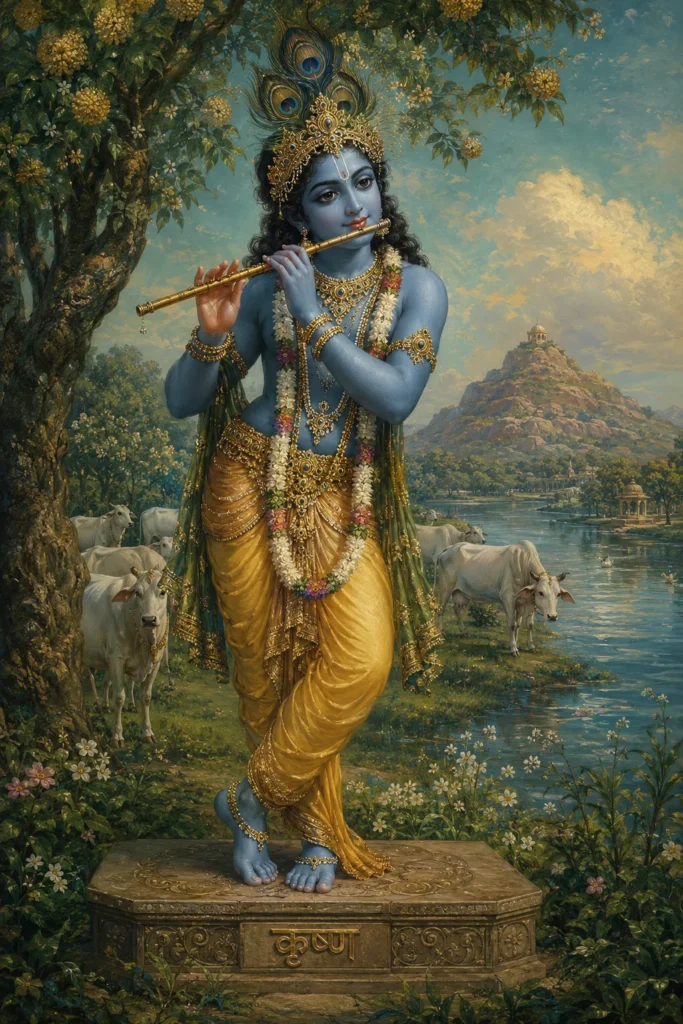
While Krishna in the Mahabharata embodies divine play and devoted love, Rama stands for the binding to duty and order, so that the two human-form avatars offer complementary images of values.
Contemporary Reception and Research
Rama is strongly present in the contemporary culture of India and Southeast Asia. The epic is repeatedly reworked in film, television, comics, and digital media.
The multi-part television adaptation of the Ramayana reached an extraordinarily large audience in the late 1980s and lastingly shaped the visual image of the figure. The Ramlila performances and the major festivals connected with Rama are a fixed part of public life.
At the same time, the figure of Rama has also become politically charged. Religious studies and historical scholarship investigate how the subject has been claimed in modern times for various social and political concerns, especially in connection with the disputes over Ayodhya.
This research examines the history of its impact critically and places it in historical context without diminishing the religious significance of the figure.
Academic engagement with the Ramayana encompasses textual history, the comparison of the numerous regional versions, iconography, and social history. Of particular interest are the diversity of versions, the gradual deification of Rama, and the ongoing ethical discussion of individual episodes, above all the treatment of Sita.
Feminist readings that place Sita at the center are today also part of the research. Rama thus remains a central subject of Indology and of comparative religious studies.
Literature (Selection)
- Gavin Flood: An Introduction to Hinduism (1996)
- Wendy Doniger: The Hindus. An Alternative History (2009)
- Klaus K. Klostermaier: A Survey of Hinduism (2007)
- Robert P. Goldman (ed.): The Ramayana of Valmiki. An Epic of Ancient India (1984 ff.)
- Paula Richman (ed.): Many Ramayanas. The Diversity of a Narrative Tradition in South Asia (1991)
Related key terms: Rama Vishnu Ramayana Sita Hanuman Ravana Ayodhya Dharma.
iWell Guard and Protective Traditions
iWell Guard draws on the cultural-historical tradition of portable protective objects, in the tradition of Hinduism and many other cultures worldwide. 41 layers, solid gold, platinum, silver, made in Germany. 30-day right of return.
Personal experiences may vary. Not a medical device. No promise of healing.