Nang Ta-khian, the woman in the hardwood tree
By Ralf Ittermann · last reviewed on
Nang Ta-khian is a spirit of Thai tradition.
The lady of the Ta-khian tree, who grants fortune and punishes wrongdoing. Nang Ta-khian is regarded as the mistress of the Ta-khian tree within Thai tradition.
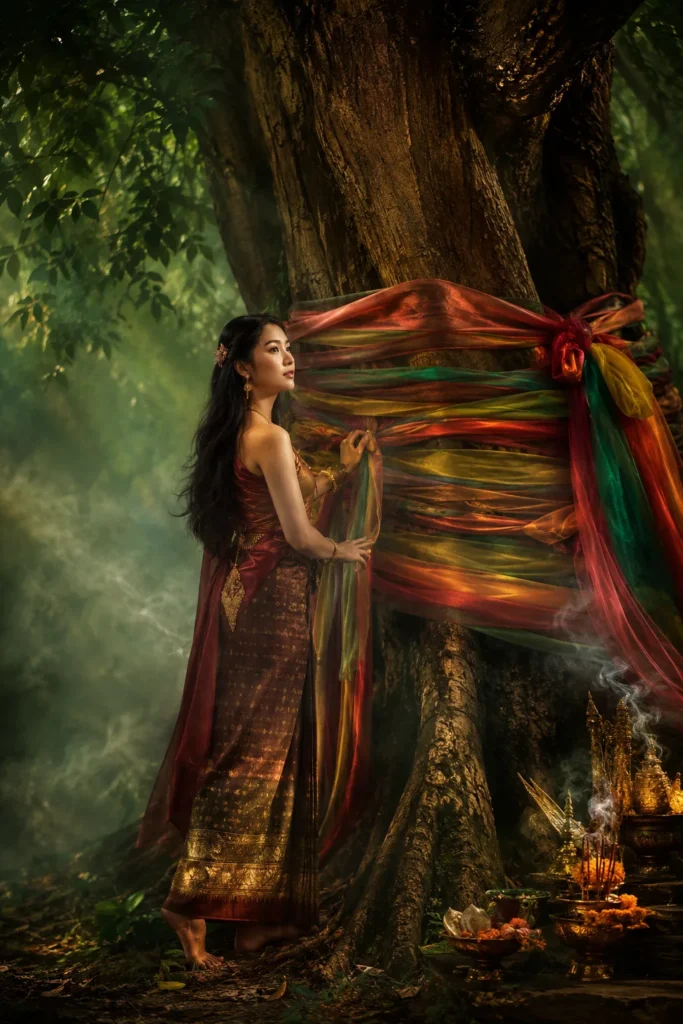
Nang Ta-khian is the tree spirit of the Ta-khian tree in Thailand, a very large hardwood species with prized timber. She appears at the tree as a beautiful woman in traditional, often reddish-brown dress, with long hair.
Her effect follows respect: if the tree is treated respectfully, she grants fortune and wealth, in popular belief even lottery numbers; if it is felled without rites, she brings misfortune. As a subtype of the Nang Mai, she belongs to the category of Thailand’s tree ladies.
Type: Tree spirit of the Ta-khian tree, subtype of the Nang Mai
Origin: Buddhist-animist syncretism and tree cult of Thailand
Texts: Oral tradition, documented by Anuman Rajadhon
Period: animist-oral to present, alive in folk custom and popular culture
Appearance: beautiful young woman in traditional Thai dress, usually reddish, with long hair
Area of origin and sources
Period of the Texts
The tradition is animist-oral, documented by Anuman Rajadhon, and remains alive today in folk custom and popular culture.
Area of Diffusion
Thailand, wherever the Ta-khian tree grows; because its prized timber is in demand, the felling taboo is especially strong here.
Sources
Well documented: the works of Anuman Rajadhon on Thai custom and McDaniel’s study of the Thai spirit world.
Name and variants
Thai: nang, lady, and Ta-khian, the tree Hopea odorata, a very large tree of up to about forty-five metres in height: the lady of the Ta-khian. Nang Ta-khian is a subtype of the Nang Mai, the Thai tree ladies.
Form and effect
Appearance
Nang Ta-khian appears as a very beautiful woman in traditional, often reddish-brown attire with long hair worn to one side. She embodies the soul of the particularly large and valuable Ta-khian tree.
Effect
If the tree is treated with respect, Nang Ta-khian can grant luck and wealth, which in popular belief extends even to lottery numbers; if it is felled or used without rites, she brings misfortune. It is a common practice to make boats or ritual objects from the wood of felled Ta-khian trees, which continue to be venerated.
Profile: Nang Ta-khian
The key aspects of the tree spirit at a glance.
Tree cult of the hamadryad type within the Buddhist-animist syncretism of Thailand; a subtype of the Nang Mai genus.
Loggers and tree users, residents near the Ta-khian and, in popular practice, lottery players seeking lucky numbers.
A very beautiful woman in traditional, often reddish-brown Thai attire with long hair worn to one side, appearing at the tree.
Luck and wealth when her tree is treated with respect, misfortune when it is felled or used without rites.
Colourful satin and silk cloths wrapped around the trunk, shrines at the tree with food offerings, small carved figures and clothing, requests for permission and monks’ blessings.
Noble wood, strong taboo
The name combines nang, lady, and Ta-khian, the tree Hopea odorata, a very large tree of up to about forty-five metres in height. Nang Ta-khian is a subtype of the Nang Mai; the background is Thailand’s Buddhist-animist syncretism and tree cult.
Because the noble wood of the Ta-khian is highly prized, the felling taboo is especially strong here: no tree is felled or used without rites. It is also common practice to make boats or ritual objects from the wood of felled Ta-khian trees, which continue to be venerated; the spirit thus remains connected to the wood beyond the felling.
Thai horror and classification
Nang Ta-khian is a fixed figure of Thai horror and appears alongside Nang Nak, Krasue and Nang Tani in films. She belongs to the classic gallery of Thai ghosts, which has been strongly popularised by cinema.
From the perspective of religious studies, Nang Ta-khian is an expression of the tree cult of the hamadryad type, in which the spirit is bound to a specific tree, within the animist-Buddhist syncretism. She is thus not a freely roaming ghostly figure, but the soul of a concrete, particularly large and valuable tree.
Cloths, shrines and monks' blessings
Well documented are colourful satin and silk cloths wrapped around the trunk, shrines at the tree with offerings of food, small carved figures and clothing, as well as requests for permission, the monks’ blessing, and the principle of never felling without rites. Dealing with the Ta-khian is thus less about warding something off than about regulated respect for the inhabitant of the tree.
Of the hamadryad type: parallels
Frequently asked questions about Nang Ta-khian
In which tree does Nang Ta-khian live?
In the Ta-khian tree, botanically Hopea odorata, a very large hardwood tree of up to about forty-five metres in height.
Does she bring luck or misfortune?
Both: luck and wealth when treated with respect, in popular belief even lottery numbers, and misfortune when felled disrespectfully.
How should one treat the tree?
It should not be felled without rites: tie cloths around it, ask for permission and obtain the monks’ blessing.
Further links
Further reading:
- Nang Mai – the genus of Thai tree ladies
- Nang Tani – the spirit of the wild banana tree
- Hamadryad – the Greek counterpart of the tree bond
- Smoke cleansing, Amulet, Protective circle – traditional protective and ritual means
- Protection Compass – protective means at a glance
Literature (selection)
Further standard works in the bibliography.
As the spirit of the Ta-khian tree, Nang Ta-khian is probably the best-known Thai tree spirit: the soul of a single, precious tree whose wood may only be touched with permission, cloth and monks’ blessing.