Green Man, the foliage-spewing face of the churches
By Ralf Ittermann · last reviewed on
The Green Man is a spirit of the pan-European tradition of church art and folk custom.
The leaf face of the churches, interpreted as a vegetation spirit.
The Green Man is a face formed of leaves or spewing foliage that appears by the hundreds on medieval churches across Western Europe. The motif has carried its present name since 1939 and is regarded by many as a vegetation spirit; research tends to see it more as an ornament with a long history of migration than as the remnant of a pagan cult.
Leaf masks are attested since the Roman imperial period, and the church sculptures span the 11th to the 16th century; no medieval written source explains the masks. Today’s Green Man is a modern synthesis of originally separate traditions, above all architectural sculpture and May Day custom.
Type: Image and folk-custom motif, interpreted in modern times as a vegetation spirit
Origin: leaf masks of Roman art, church sculpture of the 11th to 16th century
Texts: no medieval textual sources for its interpretation; the term dates from 1939
Period: Roman imperial era to the present
Appearance: a face made of foliage or a foliage-spewing countenance
Historical Classification
Period of the Texts
Leaf masks are attested since the Roman imperial period, and the church sculptures span the 11th to the 16th century; the term Green Man dates only from 1939.
Area of Diffusion
The British Isles and Western Europe; as a pictorial motif the leaf face is found across the whole of Europe.
Sources
Rich pictorial evidence, but no medieval textual sources for its interpretation; the fundamental works are by Raglan, Basford, Judge and Hutton.
Name and variants
English: Green Man, coined in 1939 by Lady Raglan in her essay The Green Man in Church Architecture. In art history the images are more soberly termed foliate heads or, following Kathleen Basford, têtes de feuilles and masques feuillus. The old inn name Green Man originally referred to the wild man of heraldry and sign painting.
Description
Appearance
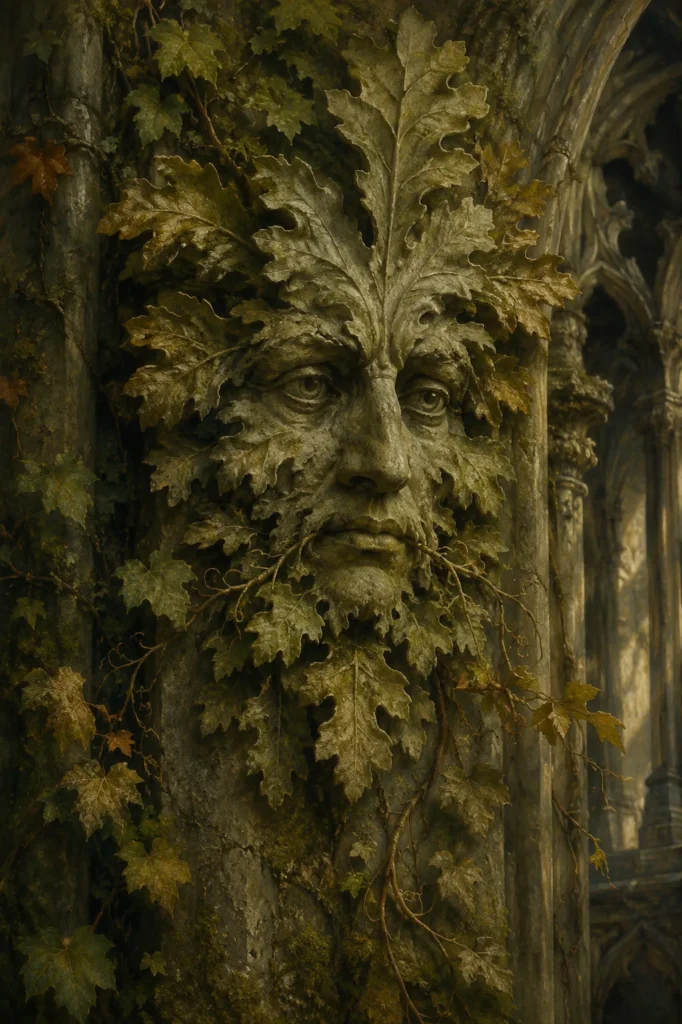
Basford distinguished basic forms of the motif: the pure leaf face, whose features are composed of foliage, and the foliage-spewing head, from whose mouth, nose or eyes tendrils grow. Common leaf types are oak, vine and acanthus. The faces are by no means always friendly; many medieval examples show grimaces, pain or being swallowed up by foliage, suggesting a reminder of transience and sin rather than a benign spring god. The motif appears on capitals, keystones, choir stalls and portals.
Effect
The Green Man does not appear as an acting being in the old tradition; there are no legends of encounters, warnings or punishments. His effect is that of a symbol: the leaf face brings home the interweaving of humanity and the plant world, the becoming and passing of the yearly cycle. It was only the modern interpretation from the 20th century onward that turned this into a vegetation spirit; in the revived May Day custom, the Jack in the Green embodies spring.
Profile: Green Man
The key aspects of the leaf face at a glance.
An ornamental motif with a long history of migration: from the leaf masks of Roman art through manuscript illumination and masons’ guilds into Romanesque and Gothic church sculpture.
A historical cult community is not attested; today neopaganism and eco-spirituality turn to the figure.
A leaf face of oak, vine or acanthus, or a foliage-spewing head; found on capitals, keystones and portals, often at the margin of the pictorial programme.
A symbol of becoming and passing in the yearly cycle; the folk-custom figure Jack in the Green embodies spring on the 1st of May.
No apotropaic tradition exists, since no threat profile has been handed down; what is documented is the blessing character of May greenery on house and stable.
The horned Cernunnos is popularly merged with the Green Man, but is a distinct Celtic deity without foliage; the Wild Man belongs to the realm of heraldry and sign painting.
Lady Raglan and the invention of a tradition
The term was coined by Lady Raglan in 1939 in her essay The Green Man in Church Architecture, published in the journal Folklore. She linked a leaf face in the church of Llangwm in Wales with folk-custom figures such as the Jack in the Green and interpreted both as remnants of a pre-Christian vegetation cult. Kathleen Basford’s monograph of 1978, by contrast, traced the motif back to the leaf masks of Roman art, from where it passed through manuscript illumination and masons’ guilds into Romanesque and Gothic church sculpture; in 2003 Mercia MacDermott additionally proposed eastern precursors reaching as far as India for discussion.
There is no textual evidence at all for a continuous pagan cult: no medieval written source explains the masks, and the May custom of the Jack in the Green proved, in Roy Judge’s study, to be an urban development of the 18th and early 19th centuries arising from the milieu of London chimney sweeps. Today’s Green Man is thus a modern synthesis of originally separate traditions.
Modern myth-making and its critique
Hardly any figure demonstrates the power of modern myth-making more clearly. Since Raglan’s essay, and increasingly since William Anderson’s illustrated volume of 1990, the Green Man has become a leading figure of neopaganism and ecological spirituality, as well as a popular motif in garden ceramics and fantasy literature. The May custom in Hastings has drawn thousands each year since its revival in the 1980s; in 2023 a Green Man appeared on the invitation to the coronation of Charles III, purportedly as an ancient British folk figure, a claim folklorists promptly corrected.
From the perspective of religious studies, the Green Man is folklore’s textbook example of an invented tradition: from an ornamental motif, a young urban custom and an inn name, a pagan vegetation spirit arose retroactively in the 20th century. The critique of Raglan’s survival thesis, from Basford through Judge to Ronald Hutton, has separated the components without devaluing the new religious practice: the modern Green Man is a real, young cult figure of contemporary spirituality that uses historical imagery as an anchor. For the protective traditions of this collection, he is a borderline case, a being that only came into existence through its interpretation.
May greenery instead of warding off
No handed-down tradition of warding off the Green Man exists, because no threat profile was ever attributed to him. Conversely, research has considered whether the leaf masks themselves were meant apotropaically, as protective threshold guardians at portals and vaults; this cannot be proven. What is well documented, however, is the blessing character of May greenery in European folk custom: green branches and May boughs on house and stable were regarded as bringing luck and protection, and it was within this milieu that the Jack in the Green also moved. Anyone encountering the motif today needs no protection; it belongs to the history of art and folk custom, not to the study of danger.
Leaf faces, wild folk and lords of the forest
Typologically related are deities of vegetative death and return such as Osiris, Dumuzi and the Slavic Jarilo; Dionysus, with his ivy and vine-leaf masks, supplies the ancient visual language from which the motif derives. The horned Cernunnos is often popularly merged with the Green Man, but is a distinct Celtic deity without foliage, and the Indian Kirtimukha is regarded by some authors as an eastern relative. From the forests of Europe stand alongside him the Wild Man of heraldry, the Scottish Ghillie Dhu and the Slavic Leshy.
Frequently asked questions about the Green Man
Is the Green Man a Celtic god?
No. The foliate faces are Christian architectural sculpture with roots in Roman art, and no Celtic source knows such a deity. The link to Celtic figures such as Cernunnos is a modern addition.
Where does the name Green Man come from?
From Lady Raglan, who named the church masks this way in 1939 and connected them to the May custom Jack in the Green. Before that, people simply spoke of foliate faces or leaf heads; as a pub name, Green Man referred to the wild man.
Can the Green Man be addressed as a protective spirit?
Contemporary nature spirituality does so, and as a present-day religious practice this is legitimate. Historically, no such invocation is recorded; anyone wishing to rely on sources will find the oldest tangible reference to blessing in May-green customs.
Further links
Further reading:
- Wild Man – the wild-folk figure behind the pub name
- Ghillie Dhu – the Scottish forest spirit clad in foliage
- Leshy – the Slavic lord of the forest
- Mugwort, Juniper, Smoke Cleansing, Talisman – traditional protective means
- Protection Compass – protective means at a glance
Literature (selection)
Further standard works in the bibliography.
Search terms such as ‘Green Man meaning’ or ‘foliate face church’ lead straight into this dual nature: historically, the Green Man is an ornament with a long migratory history; today, he is a young cult figure of nature spirituality that has found its anchor in old pictorial material.