Oonawieh Unggi, a wind spirit under scrutiny
By Ralf Ittermann · last reviewed on
Oonawieh Unggi is listed as a spirit of Cherokee tradition.
The supposedly oldest wind, probably a web artefact. Oonawieh Unggi remains under scrutiny, its status as genuine tradition or invention still debated.
Oonawieh Unggi is named in popular lists as the oldest Cherokee wind. To be honest and clear: this name is, with high probability, a modern web artefact; the only genuinely attested item is the Cherokee word for wind, unole.
This entry is therefore presented mainly as a clarification. In the authoritative ethnography, James Mooney’s Myths of the Cherokee from 1900, the name does not appear; instead, Mooney documents a colour and cardinal-direction spirit system.
Type: Alleged wind spirit, probably a modern name artefact
Origin: attributed to the Cherokee, southeastern USA
Texts: popular lists; verification and counter-source is Mooney (1900)
Period: modern, mainly digital lists
Appearance: not transmitted

Source context
Period of the Texts
Modern: the name circulates chiefly in digital lists. The genuine Cherokee wind term is documented by James Mooney in 1900.
Area of Diffusion
The figure is attributed to the Cherokee of the southeastern USA; in reality, the name is spread almost exclusively across derivative list and wiki pages.
Sources
Very weak, probably a web artefact. Mooney’s works serve as verification and counter-source; they do not contain the name.
Name and variants
Cherokee: The second part of the name derives from the genuine Cherokee word for wind, unole. Oonawieh Unggi itself is not attested or grammatically traceable as a Cherokee expression.
Description
Appearance
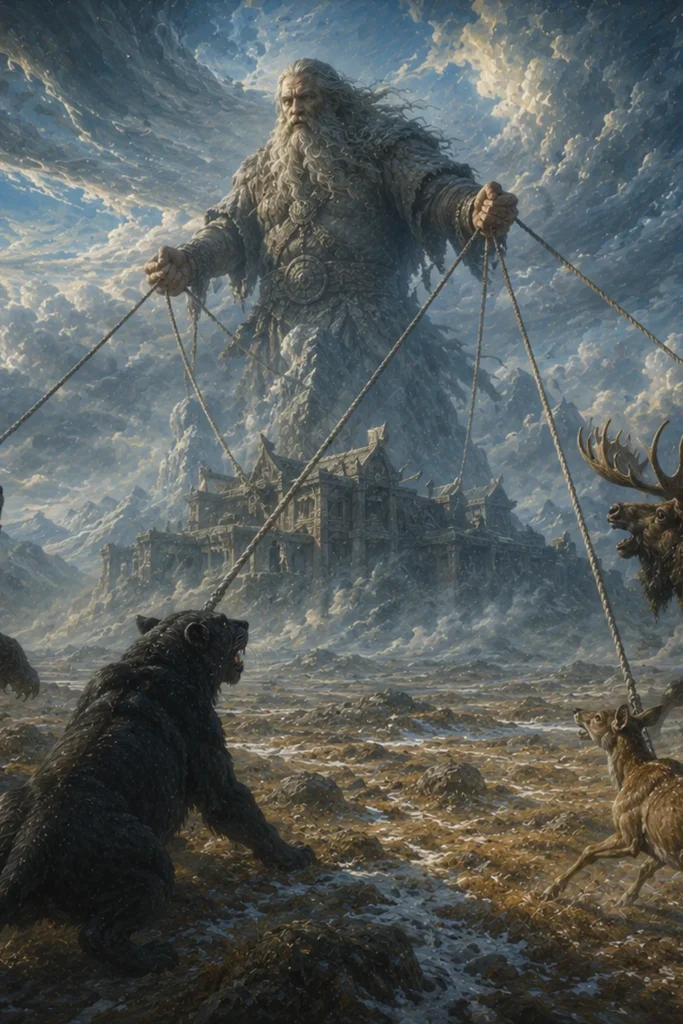
No appearance has been transmitted. Beyond the formula ‘oldest wind’, no narrative material exists; anyone who depicts this figure visually is inventing it.
Effect
Apart from the designation as oldest wind, no effect is transmitted. The genuine Cherokee wind concept lies in the colour and direction system, not in a named wind ruler.
Profile: Oonawieh Unggi
The key aspects of this verification case at a glance.
Not verified: the name lives on in popular wind-deity lists and blogs, not in Cherokee ethnography.
Popular wind-deity lists that copy the name from one another; they trace back to an old, faulty encyclopedia article.
Not transmitted: there is no narrative material and no description, only the formula of the oldest wind.
Described as the oldest wind, without any further effect; worship is not attested and stems solely from list pages.
No cult or protective forms are attested. The claim that this wind was once worshipped should honestly be marked as unverified.
The genuine Cherokee counterpart is the colour and direction spirit system found in Mooney; named wind lords such as Gaoh resemble this entry only typologically.
From encyclopedia error to alleged deity
The second part of the name derives from the genuine Cherokee word for wind, unole. The form Oonawieh Unggi itself is not a grammatically traceable, documented Cherokee expression. The name appears almost exclusively on derivative list and wiki pages that trace back to an old, faulty encyclopedia article.
In the authoritative ethnography, James Mooney’s Myths of the Cherokee from 1900, Oonawieh Unggi does not appear. Instead, Mooney documents a colour and cardinal-direction spirit system: it is there, not in a named wind ruler, that the genuine Cherokee wind concept lies.
Digital afterlife and classification
Oonawieh Unggi survives almost purely as a digital-popular figure in wind-deity lists and blogs; there is no specialist reception.
In religious studies, Oonawieh Unggi is a textbook example of how a faulty encyclopedia entry becomes an alleged deity through repeated copying. No verified Cherokee wind god is thereby attested; only unole, the word for wind, is confirmed. The circulating connection to other Cherokee figures is misleading.
Cult and protective forms: nothing attested
No cult or protective forms are attested. The claim that this wind was once worshipped stems solely from list pages and should honestly be marked as unverified. Especially with indigenous traditions, the principle applies: what ethnography does not document is neither embellished nor retold as ritual here.
Unole the wind and the genuine parallels
In the Cherokee language, unole is the wind; the genuine counterpart to the alleged wind god is the colour and direction spirit system found in Mooney. As a named wind figure, this entry typologically resembles attested wind lords such as Gaoh among the Iroquois, Hotoru among the Pawnee, or Niltsi among the Navajo, yet it lacks their tradition.
Frequently asked questions about Oonawieh Unggi
Is Oonawieh Unggi a genuine Cherokee wind god?
Based on current knowledge, no. The name is likely a modern web artefact; only the word unole, wind, is genuine.
What is unole?
The attested Cherokee word for wind, from which the second part of the name derives.
Where is the genuine Cherokee wind concept found?
In James Mooney’s work, in the form of a colour- and direction-based spirit system, not as a named wind ruler.
Further links
Further reading:
- Gaoh – an actually attested wind lord of North America
- Hotoru – the wind spirit of the Pawnee
- Niltsi – the Holy Wind of the Navajo
- Sage, Amulet, Protective Candle – traditional protective means
- Protection Compass – protective means at a glance
Literature (selection)
Further standard works in the bibliography.
Based on current knowledge, there is no confirmed Cherokee wind god behind Oonawieh Unggi, but rather a lesson in source criticism: in the Cherokee language, unole is the word for wind, and honestly, no more can be claimed.