Epona, Celtic horse goddess
By Ralf Ittermann · last reviewed on
Epona is a Gallo-Roman horse goddess whose cult is attested across the entire western Empire from the 1st to the 3rd century AD. She was venerated by Gallic equestrian tribes and spread far beyond her region of origin through the mounted auxiliary troops of the Roman army.
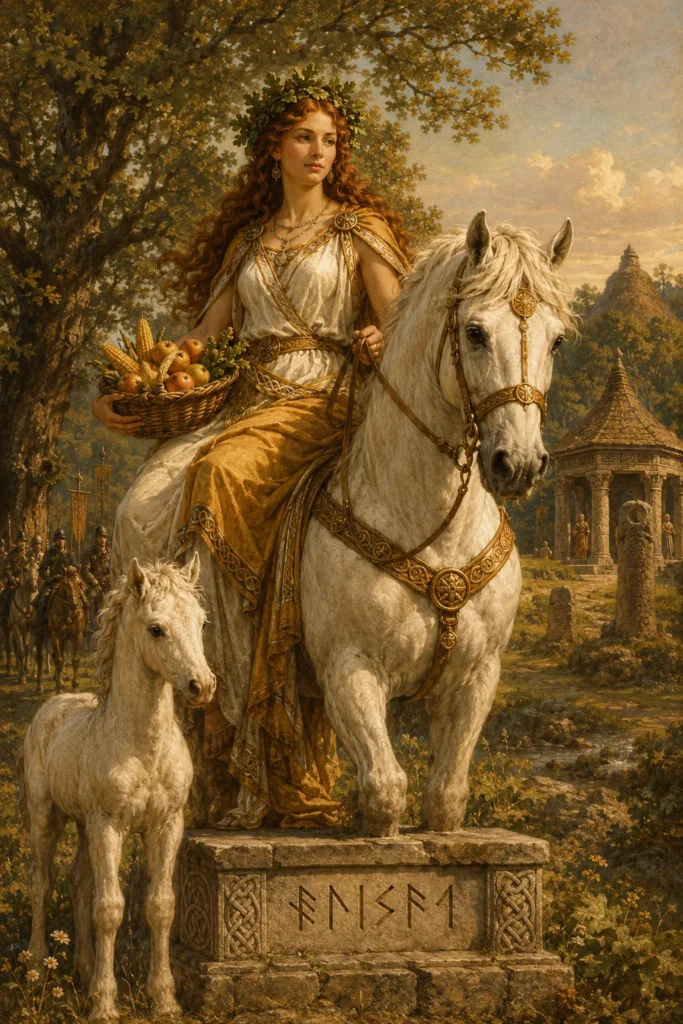
Inscriptions and votive reliefs usually depict her as a woman seated on a horse or between two horses, holding a cornucopia, basket or patera.
Profile: Epona
Epona: the most important aspects at a glance. The following fields summarise origin, function, appearance, veneration, symbols and parallels.
Gallo-Roman horse goddess whose cult is attested from the 1st to the 3rd century CE in the western empire. Gallic horse-riding tribes venerated her, and the mounted auxiliary troops of the Roman army carried the cult far beyond its region of origin.
Epona was responsible for the fertility of horses, their safe birth and their protection in the stable and on journeys. Cornucopia and basket link her at once with fertility and provision, so she was regarded as protector of farm, house and travel.
She mostly appears as a young woman seated sidesaddle on a horse or between two horses that she feeds or leads. She wears a long tunic and holds a patera, a cornucopia or a basket of fruit. One variant shows her enthroned with a foal at her feet.
About two thirds of the surviving dedications come from military personnel, above all from cavalrymen of the alae and cohortes equitatae, and also from charioteers, horse breeders, muleteers and post-station keepers. Riders called on her before battles, carters before long journeys, farmers before sowing.
Her signs include the horse, the foal, the cornucopia, the basket of fruit and the patera. Horse and cornucopia link cavalry with fertility and provision. Roman cavalry units set up small images of the goddess in their quarters.
The Welsh Rhiannon in the “Mabinogi” is regarded as heir to an old horse goddess of the Epona type, as is the Irish Macha, who runs a horse race while pregnant. Marie-Louise Sjoestedt grouped Macha, Rhiannon and Epona together as Celtic horse goddesses.
Source situation and ancient evidence
Unlike most Celtic deities, the body of evidence for Epona is exceptionally rich. Around forty securely attested inscriptions and more than 150 figurative works are documented, above all from Gaul, the Rhine and Danube regions, Britain and Italy.
Apuleius mentions her in the “Metamorphoses” (III, 27) as an example of the veneration of small divine images in stables. Juvenal mocks Roman riders in Satire VIII, 157 who “worship Epona and stinking images of horses.” Her name also appears in Tertullian’s “Apologeticum” and in Minucius Felix.
Bernhard Maier pointed out in “Die Religion der Kelten” (2001) that Epona is the only Gallo-Roman deity who gained entry into the official Roman festival calendar (Feriale Duranum), which documents the high esteem in which she was held within the military cavalry units.
Miranda Aldhouse-Green systematically recorded the iconographic material in “Symbol and Image in Celtic Religious Art” (1989) and distinguished three image types: Epona on horseback, Epona between two horses, Epona as an imperial matron with an equine reference.
Name and etymology
The name Epona is composed of the Celtic root *epo- (“horse,” cognate with Latin equus and Greek hippos) and the suffix -ona, which was frequently used in Gallo-Roman theonyms to form female goddess names, comparable to Sirona, Damona or Belisama.
The meaning can be rendered as “mistress of horses” or “horse goddess.” In works on Gallic onomastics, Wolfgang Meid described the word formation as typically Gallic and as compatible with the epigraphic distribution.
From a Celtological perspective, Epona belongs to a group of animal goddesses whose functional sphere is bound to a particular animal.
Helmut Birkhan interpreted this group in “Kelten” (1997) as a typical expression of a society shaped by livestock farming and horsemanship, in which the horse was not only economically central but also took on a spiritual mediating role.
Iconography
The most common image scheme depicts Epona as a young woman seated side-saddle on a horse striding to the right. She wears a long tunic, often has her hair pinned up and holds a patera, cornucopia or basket of fruit.
In a second variant she stands between two symmetrically arranged horses, which she feeds or leads, a composition reminiscent of the Rhenish matron iconography. A third variant shows her enthroned with a foal at her feet.
The symbolic attributes point to functions beyond mere equine competence. The cornucopia and bread basket link her to fertility and nourishment, suggesting a broader sphere of “provision.” Marie-Louise Sjoestedt emphasized this interweaving of horse breeding, wealth and fertility as early as 1940 as a typical connection within Gallic religiosity.
Recent works by Garrett Olmsted and Miranda Aldhouse-Green support this interpretation with expanded pictorial material.
Geographical distribution
The core areas of the Epona cult are eastern Gaul, the Rhine region with the large military camps of Mainz, Cologne and Bonn, the Noric Alpine foreland and the Danube provinces.
Inscriptions are also found in Britain and Hispania, often at sites of mounted auxiliary troops. In the Italic heartland Epona is rarer, but indirectly attested through her inclusion in the Roman calendar and through literary references such as that in Juvenal.
Inscriptions are written in Latin and usually name Epona with the epithet “Augusta” or “Regina,” which documents the transition from a local cult to the official imperial religion. Dedicants are frequently soldiers of the auxiliary troops, but also civilian horse breeders, charioteers and riders. The social spread is broader than for many other Gallic deities.
Functions and religious role
Epona was responsible for the fertility of horses, their safe birth, their protection in the stable and on long journeys. Riders invoked her before battles, carters before long journeys, farmers before sowing. Her combination of equine competence and general symbolism of abundance made her a protective goddess of the farmstead, the home and the journey.
A special role as a psychopomp figure, that is, as a companion of souls into the afterlife, was inferred by some researchers from the connection between horse and journey, for instance by René Magnen and Garrett Olmsted.
Bernhard Maier considers this interpretation possible, but not clearly supported by the ancient sources. Most inscriptions and images are votive and dedicatory in nature, with no reference to the afterlife.
Relationship to other horse goddesses
In Welsh mythology, Rhiannon appears in the “Mabinogi” as a high-medieval heir of an ancient horse goddess. She comes to Pwyll on a radiantly white horse, is unjustly accused of infanticide and must, as punishment, carry travelers into the castle on her back.
Many Celtologists regard this narrative as a fragmentary memory of a horse goddess of the Epona type. A linguistic line cannot be established, but the functional kinship is unmistakable.
The Irish Macha, who runs a horse race while pregnant and collapses in labor after the victory, also belongs in this context. Marie-Louise Sjoestedt grouped Macha, Rhiannon and Epona together as “Celtic horse goddesses” whose shared function lies in the connection of horse, sovereignty and land.
John Carey has differentiated this grouping in more recent works; he sees Macha primarily as a queen and sovereignty goddess whose equine aspect is an independent motif.
Christian displacement and afterlife
With the Christianization of Gaul in the 4th and 5th centuries, Epona disappears from public inscriptions. In rural areas, remnants of her cult persisted longer, as synodal acts of the 6th century show, which prohibit pagan horse cults and stable rites.
Bernhard Maier and Bernadette Filotas (“Pagan Survivals,” 2005) interpreted these prohibitions as indirect testimony to a long afterlife of the horse goddess.
From the late Middle Ages onward, no unambiguous memories of Epona can be grasped.
Later folk traditions that link the horse with protection and good fortune, such as the hanging up of horseshoes, cannot be traced directly back to the Epona cult, but are independent developments that were studied in the folklore studies of the 19th century.
Research and reception
Modern Epona research begins with the foundational collection of material by René Magnen, which Émile Thévenot published in 1953 under the title “Épona, déesse gauloise des chevaux.” It remains the central collection of sources to this day.
Miranda Aldhouse-Green presented a systematic iconographic analysis. Helmut Birkhan and Bernhard Maier deepened the religious-historical placement within the Gallo-Roman pantheon.
In modern neo-pagan reception, Epona is venerated as a goddess of horses and travel protection. Equestrian associations in France and Germany occasionally adopt her as a symbolic figure.
In fantasy literature and the role-playing field she appears regularly, for instance as the namesake in the game “The Legend of Zelda.” These popular-cultural references have little to do in substance with the ancient cult, but keep the name present in public awareness.
Social bearers of the cult
The epigraphic material allows a comparatively precise description of the social bearers of the cult. About two thirds of the surviving dedications come from members of the military, in particular from riders of the alae and cohortes equitatae stationed in the provinces along the imperial borders.
High-ranking officers such as prefects and tribunes are also attested as donors. In the civilian sphere, charioteers, horse breeders, mule drivers and postmasters stand out as donors, which underscores the goddess’s connection to the transport system. Occasionally there are dedications from women of the local elites who chose Epona as a personal protective goddess.
One peculiarity is the multiple veneration of Epona together with the “Eponabus,” that is, “the Eponas” in the plural. This rare form is attested above all in the Rhine region and points to a multiplication of the figure into a group of horse goddesses, comparable to the Matronae triads.
Miranda Aldhouse-Green interpreted this form as an indication of an older, collective veneration out of which the individual Epona developed as a figure with sharpened individual contours.
Key epigraphic evidence
The central source group for Epona’s cult is around forty securely attested inscriptions documented in the “Corpus Inscriptionum Latinarum” and in “L’Année épigraphique.” Among the most important passages are the Mainz relief dedication CIL XIII 11801, in which a soldier of the Legio XXII Primigenia dedicates a sanctuary to “Epona Augusta,” the Carnuntum inscription CIL III 4438 from the quarters of the Ala I Thracum, as well as the votive inscriptions from Antunnacum (today Andernach) and from Gallic Alesia.
A special place is held by the late Latin inscription CIL XII 1797 from Vienne, which designates Epona as “Epona Regina” and thus formulates the claim of a supra-regionally conceived protective goddess.
Manfred Clauss has refined the social bearers in the “Epigraphic Database Clauss/Slaby” and in the accompanying commentaries: the dedicating persons are predominantly male professional riders, stable staff and veterans with equestrian experience, alongside individual private donors with a rural background.
Magnen and Thevenot statistically evaluated the distribution of the inscriptions in “Épona, déesse gauloise” (Bordeaux 1953) and pointed to the concentration in the Rhine-Moselle region, in Pannonia and in northern Italy. The datings range from the late first to the early fourth century AD, with a peak under the Severans.
Notable is the small number of attestations from the heartland of the Gallic tribes in the Massif Central, which Patrice Lajoye, in his collected essays “Cultes des sources et des eaux en Gaule” (2017), takes as an indication that the archaeologically tangible Epona cult already represents a Roman-military reshaping of an older, unwritten Gallic veneration.
Ancient literary mentions
The few literary mentions of Epona in the Roman tradition are highly interesting from a source-critical standpoint, because they reveal the marginalized status of a “provincial” deity from the perspective of the urban Roman elite.
Juvenal mocks in the eighth Satire (verses 156 to 157) a man of consular rank who “iurat solam Eponam” while watering horses, that is, who knows only Epona and not the official Roman gods.
Apuleius reports in the “Metamorphoses” III 27 a niche with an image of Epona in the stable yard of a provincial estate, decorated with fresh roses.
Minucius Felix mentions in “Octavius” 28 the veneration of Epona as an example of the “animal and stable deities” of the provinces, against which he polemicizes. Tertullian (“Apologeticum” 16, “Ad nationes” I 11) takes up this polemic and cites Epona as evidence of the absurdity of pagan piety.
These literary notes reinforce the impression that Epona’s cult was above all a cult of the lower classes, of the mounted auxiliary troops and of the rural farmsteads.
In addition, the “Historia Augusta” transmits in the “Vita Veri” 6 an anecdote according to which Lucius Verus carried a horse’s head made of wood as an Epona symbol in the war against the Parthians.
In his works on Gallo-Roman religion, Bernhard Maier points out that the “Historia Augusta” is unreliable from a source-critical standpoint, but that the note reflects the actual custom of the Roman cavalry units of setting up small images of Epona in their quarters.
This practice is archaeologically confirmed by finds from the forts of Saalburg, Niederbieber and Carnuntum.
Methodological problems of research
Epona research faces several methodological difficulties. The source situation is indeed rich, but consistently shaped by the Roman-provincial context. What the pre-Roman, purely Celtic form of the cult looked like can no longer be reconstructed.
The inscriptions are in Latin, the figurative works follow Roman conventions, and literary attestations come exclusively from Roman authors. An “authentically Celtic” Epona cannot be extracted from this material.
At the same time, the identification of a pictorial composition with Epona carries risks, because similar rider and horse iconographies were also used for other deities, for instance for the Thracian riders, the Illyrian hero figures or the Rhenish Matronae with an animal team.
Garrett Olmsted demanded a precise iconographic criterion: only images that are secured by an accompanying inscription can count as depictions of Epona. Current overviews work with this stricter corpus, which is considerably smaller than the total quantity of potential images.