Igaluk: Moon God, Brother of the Sun and Guardian of the Hunt
By Ralf Ittermann · last reviewed on
In the Inuit tradition, mainly in the Bering Strait region and Alaska, Igaluk is the moon god, closely connected with his sister, the sun Malina, in an ambivalent myth. He is regarded at once as the guardian of the hunt and as the morally problematic figure of an incestuous backstory. In religious studies he is a paradigmatically ambivalent figure.
Profile: Igaluk
Igaluk: the most important aspects at a glance. The following fields summarise origin, function, appearance, veneration, symbols and parallels.
Igaluk is the moon god of the Inuit, attested above all along the Bering Strait and in Alaska, and the brother of the sun Malina. Other names are Aningat, Tatqiq, Anningan in Iglulik, Aningaaq in West Greenland and Aliq in Alaska. The name probably derives from igalu, which is related to the word for window or light opening.
Igaluk is regarded as a guardian of the hunt, who influences weather and animal stocks and to whom shamans can bring requests. In some traditions he is responsible for land animals and fertility. The lunar cycle structured the traditional calendar, whose months bore names reflecting hunting practices or climatic phenomena.
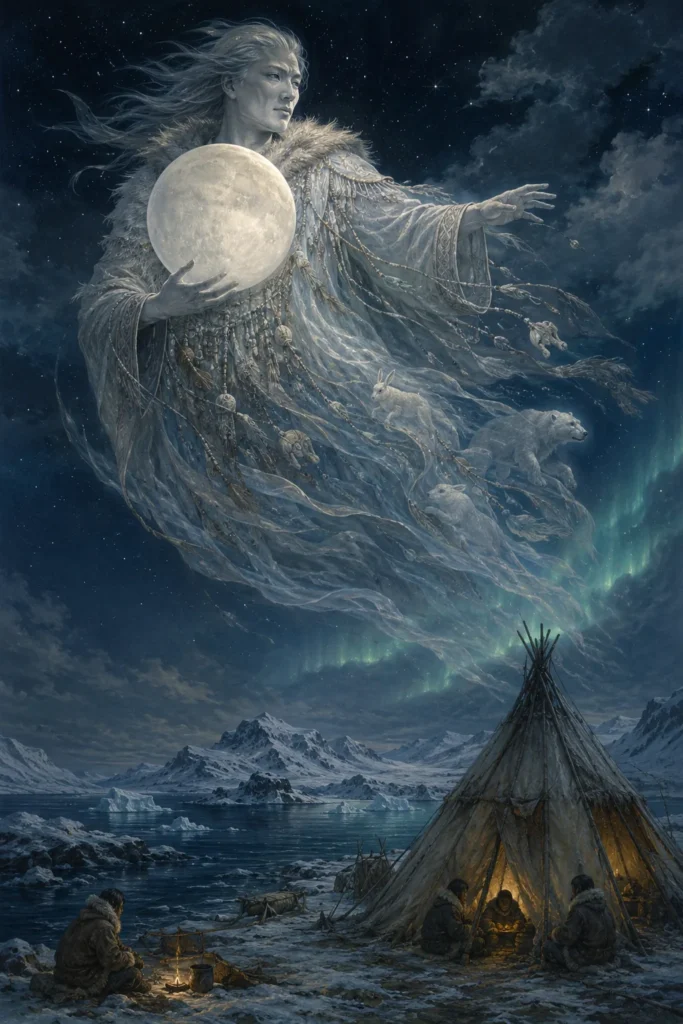
Igaluk appears as a young, strong man with a pale, often spotted face; the spots are said to be traces of soot, in other versions wounds or tears. In the traditional culture images are rare. Contemporary stonecuts show him as a young shaman or as a man with a moon disc in the background, often in a diptych with Malina.
Shamans visited Igaluk on the moon in trance to ask for hunting luck, to receive answers, to have caribou stocks regulated or to meet the deceased. Young women were not supposed to look at the moon for too long, otherwise they might become pregnant by Igaluk. The ritual significance is largely lost today; the myth lives on in storytelling and art.
Igaluk is associated with the sledge and the dog team: he drives across the sky, the moon’s orbit is regarded as his nightly journey, and the shadow in the team is sometimes interpreted as his dog. The spots on the face of the moon stand for the traces of soot from the myth. Mediterranean moon deities, by contrast, are mostly associated with a chariot or a ship.
Unlike in the Indo-European tradition with Sol and Luna or Helios and Selene, among the Inuit the sun is female and the moon male. The same distribution is shown by parts of the Germanic tradition (Sól and Máni), the Sami (Beaivi and Mánnu) and many Finno-Ugric religions. Parallels to the incest myth are found among the South American Tucano and the Oceanic Maori.
Overview and Brief Profile
In the Inuit tradition, the moon is not a neutral astronomical entity but a personalized figure with his own biography and ethical charge. Igaluk, in some regions also Aningat or Tatqiq, belongs to the male deities of the Inuit tradition attested mainly in the Bering Strait region and in Alaska and is a central figure in religious studies.
In religious studies, Igaluk is notable because he carries both positive and negative connotations. Positively as guardian of the hunt, whom shamans can visit and who influences weather and animal populations.
Negatively as the protagonist of an incestuous myth in which he unknowingly lies with his sister and thereby drives her into the position of the sun. This ambivalent dual definition is typical from the standpoint of the phenomenology of religion.
This ambivalence makes Igaluk a paradigmatic figure for the non-moralistic theology of the Inuit. Gods are neither one-sidedly good nor one-sidedly evil but bearers of complex narrative identities. This complexity resists monistic theologies and constitutes, in the phenomenology of religion, an independent phenomenon that characterizes the Inuit tradition.
The moon god Igaluk, who is attested mainly in the Bering Strait region and in Alaska, has been treated by more recent research with expanded methodological approaches that combine ethnographic precision, linguistic source criticism, and a comparative perspective.
The Inuit knowledge community now participates in this research itself and corrects older Western interpretations, some of which were shaped by colonialism.
A complementary perspective is opened by the religious-sociological question of Igaluk’s function within the social order of the traditional Inuit community.
As both a helpful guardian of the hunt and the protagonist of a morally delicate myth, he illustrates that religious structure was not separate from social practice but closely interwoven with it. This interweaving is a research field of its own in the anthropology of religion and was studied systematically in particular by Frédéric Laugrand and Jarich Oosten.
Name, Etymology, and Variants
The name Igaluk is presumably derived from the stem igalu-, which is related to the word for window or aperture of light.
This fits the conception of the moon as a nocturnal light source through which the realm of day looks into the realm of night. This choice of word is illuminating from the standpoint of the phenomenology of religion.
Alternative names are Aningat or Anningan in Iglulik and Aningaup. The term tatqiq denotes both the moon as a celestial body and the month as a unit of time.
This semantic doubling is illuminating in religious studies because it condenses into a single word the connection of celestial object, temporal rhythm, and deity, and marks the calendrical function of the moon as a religiously charged entity.
In West Greenland the form Aningaaq occurs, in East Greenland Aning’iaq, in Alaska Aliq. The regional variants reflect linguistic differences without altering the religious substance. This stability of religious function amid linguistic diversity is typical, in the phenomenology of religion, of Inuit concepts.
Description and Symbolism
In the ethnographic sources, Igaluk is described as a young, powerful man with a bright, often spotted face. According to Inuit conception, the spots on the moon’s face are traces of the deed that plays a central role in his myth. In some versions they are soot marks, in others wounds or tears.
Symbolically, Igaluk is associated with sled and dog team. According to the narratives he travels across the sky on his sled, with the moon’s orbit representing his nocturnal journey.
Sometimes the shadow in his team is also interpreted as his dog. This sled symbolism is specifically Arctic and distinguishes Igaluk from Mediterranean moon deities, which are usually associated with a chariot or a ship.
Visual depictions are rare in the traditional culture but frequent in contemporary Inuit art. Stone carvings show Igaluk as a young shaman or as a man with a moon disc in the background.
In religious studies, this modern visualization is a reappropriation, not a continuity of traditional pictorial worlds. The difference must be reflected upon methodologically.
In the broader discourse of comparative religious studies, Igaluk fits into the pattern of circumpolar religious topography. Its structural stability across thousands of kilometers is regarded, in the phenomenology of religion, as one of the most remarkable findings of the discipline and remains to this day the subject of ongoing research discussion.
The Incest Myth and Its Meaning
The core myth surrounding Igaluk and his sister Malina is one of the best-known narratives of Inuit religion. In the Iglulik variant as recorded by Rasmussen, brother and sister lived in an igloo community.
On a dark night an unknown man lay down with Malina without her being able to recognize him. She smeared her hands with soot and wiped them over the stranger’s face in order to identify him the next day.
In the morning she saw that it had been her brother Igaluk. In shame and anger she cut off her breasts, threw them at him, and fled into the sky with a torch in her hand.
Igaluk followed her with a less bright torch. Both become sun and moon. The spots on his face are the soot marks. This drastic narrative structure is illuminating in religious studies.
In religious studies, this myth is not a moral lesson in the narrower sense but an aetiological narrative about the origin of the celestial bodies and their asymmetrical brightness. The incest component is part of the aetiological structure, not primarily a moral warning. This aetiological reading differs from later moralizing interpretations.
Igaluk as Guardian of the Hunt and Shamanic Partner
Despite, or precisely because of, his ambivalent backstory, Igaluk is an important religious point of reference. He is regarded as guardian of the hunt, to whom shamans can bring requests.
In trance, shamans visited Igaluk on the moon and returned with knowledge or with animals. This journey to the moon is a topos of its own in the literature on Inuit shamanism.
Daniel Merkur documents several accounts of such moon journeys from Iglulik. The shaman travels into the sky by the power of his helping spirits, crosses the cold atmosphere, and appears before Igaluk.
There he can receive answers, have caribou populations regulated, or meet the deceased who reside on the moon. This function is independent within the phenomenology of religion.
This function of Igaluk complements those of the other great deities. Sedna controls the sea animals, Pinga the land animals, Sila the weather, Igaluk the complementary aspects of the hunt and of time. This distribution of religious functions is, in the phenomenology of religion, a structural pattern of its own within Inuit theology.
Igaluk, Fertility, and Time
In some Iglulik traditions, Igaluk is also a fertility-related figure. Young women were not to look at the moon for too long, because otherwise they could become pregnant by Igaluk.
In religious studies this notion is to be read not as a real practical instruction but as a ritual reference to Igaluk’s power at the moment of transition.
Temporally, Igaluk is connected with the lunar cycle, which structured the traditional calendar. The months had names that reflected hunting practices or climatic phenomena, and Igaluk formed the framework of this temporal structure.
In the traditional lifeworld, the lunar cycle was religiously charged and not a mere observation of nature. This entanglement of time and religion is, in the phenomenology of religion, a phenomenon of its own.
The entanglement of fertility, hunting, and time in a single figure is, in the phenomenology of religion, typical of Arctic moon gods and finds parallels in the Sámi Mánnu and the Nenets moon deities. This structural correspondence suggests an old circumpolar layer of religious concept formation.
Comparison with Other Moon Deities
Moon deities are found worldwide, yet their gender assignment varies. While in the Indo-European sphere the sun is usually male and the moon female (Sol/Luna, Helios/Selene), the Inuit tradition reverses this distribution. The sun is female (Malina), the moon is male (Igaluk).
This reversal is illuminating in religious studies. It is found in parts of the Germanic tradition (Sól female, Máni male), in parts of the conceptions among the Sámi (Beaivi female, Mánnu male), in the Baltic tradition, and in many Finno-Ugric religions.
The Inuit tradition is thus part of a broader northern gender assignment that constitutes a research field of its own in comparative religious history.
The incest myth between sun and moon has parallels in numerous mythologies, for example among the South American Tucano or the Oceanic Maori.
The scholarly discussion of a universal incest genealogy for celestial bodies is old and controversial, without having been conclusively resolved. This structural correspondence without historical connection is a finding of its own in the phenomenology of religion.
Christian Reinterpretation and Modern Reception
The mission partly regarded the incest myth as offensive and used it in sermons as an example of heathen immorality. This reinterpretation led to the narrative no longer being told publicly in many Inuit communities in the second half of the 20th century.
Religious studies research, however, documented the narrative and, in the 1990s, also brought it back into the educational and cultural discourse of Nunavut. Today it is treated with didactic distance, as a document of religious history, not as a moral model. This pedagogical reappropriation is a research field of its own in religious education.
In contemporary Inuit art, Igaluk is present, often in a diptych with Malina. The asymmetry of the two siblings, their separation and their perpetual pursuit across the sky, is made artistically productive.
In the phenomenology of religion, the myth remains alive, even though its ritual significance has largely been lost and it continues primarily in the narrative and artistic tradition.
Research and Current State
Research on Igaluk is extensive. Rasmussen’s records are the main source, supplemented by Boas, Birket-Smith, Merkur, and Laugrand. The moon-sun narrative is documented in numerous variants, which permits comparative analysis and facilitates religious studies research.
In present-day Indigenous religiosity, Igaluk is more present than some other figures, because his moon form remains visible in the sky and the narrative is anchored through daily seeing.
This is, in the phenomenology of religion, a point of its own: myths connected with visible natural phenomena are preserved better than others and constitute a topic of their own in the psychology of religion.
Lexicon Cross-References
Igaluk connects with Malina, Sedna, Sila, Pinga, Anguta, Nanook, Tornarssuk, Tupilak, and Qailertetang. The cultural hub Inuit Tradition frames the moon theology. Comparable moon deities are found in the Sámi series of entries, in particular in Mánnu.
Igaluk as Moon Man and Master of the Animals
Igaluk is a designation for the moon man attested above all from the western part of the Inuit world, namely from Alaska, that male celestial figure who in the widespread sun-moon pursuit narrative represents the brother.
In the traditions recorded from the late 19th century onward by ethnographers such as Edward Nelson in The Eskimo about Bering Strait (1899) and later by other researchers, the moon man has, beyond the cosmogonic narrative, a religious function of his own.
In some traditions the moon man is regarded as master over certain land animals or as a being that influences the game population and thereby the success of the hunt.
While the sea goddess rules over the creatures of the water, the moon man is in some regions responsible for the animals of the land or for fertility.
Shamans, the angakkuit, undertook journeys to him in trance in order to ask for hunting luck or to learn which transgressions of rules had caused the absence of the animals.
In several traditions the moon man is moreover ascribed an influence on procreation and on women. In some regions it was considered dangerous for women to look at the moon for too long, since this could trigger an unwanted pregnancy. In religious studies, a bundle of responsibilities is thus associated with Igaluk: cosmic order, the hunt, fertility, and the sanctioning of social rules. How far these functions extend differs greatly by region, and the name Igaluk itself is not in use among all Inuit groups. The eastern groups use other designations or tell of the moon man without a fixed proper name.
Regional Attachment and Colonial Source Criticism
The tradition surrounding Igaluk is an example of how strongly a single name in Inuit religion is bound to a particular region and how cautiously sweeping statements must be made. Igaluk is attested above all from the area around the Bering Strait and from parts of Alaska.
The Canadian and Greenlandic Inuit know the moon man under other names or tell the sun-moon story with differing accents. A pan-Inuit moon deity named Igaluk does not exist in this sense.
The source situation rests almost entirely on the ethnographic activity of the late 19th and early 20th centuries. Edward Nelson, who spent several years at the Bering Strait on behalf of the Smithsonian Institution, is among the most important early collectors for Alaska.
His records are rich but carry the typical problems of their time: they arose through interpreters, classified the material into foreign categories, and often did not document the narrative context.
In addition, the records fell into a phase of profound upheaval. Christian mission, trade, and new diseases changed Inuit societies considerably, and some traditions were already recorded in a form shaped by these upheavals. In religious studies it follows that statements about Igaluk must always be tied to the respective regional tradition and to the respective source. Research, for instance in Daniel Merkur and in more recent works on Arctic religious history, emphasizes that Inuit cosmology knew no fixed pantheon but a mobile web of beings whose names, gender, and function changed from community to community.
Literature (Selection)
- Knud Rasmussen: Intellectual Culture of the Iglulik Eskimos (Copenhagen 1929)
- Franz Boas: The Central Eskimo (Washington 1888)
- Daniel Merkur: Becoming Half Hidden (Stockholm 1985)
- Kaj Birket-Smith: Die Eskimos (Zurich 1948)
- Frédéric Laugrand and Jarich Oosten: Inuit Shamanism and Christianity (Montreal 2010)
- Hinrich Rink: Tales and Traditions of the Eskimo (Edinburgh 1875)
Related key terms: Igaluk Aningat Tatqiq Inuit moon god Malina lunar cycle incest myth.
iWell Guard and Traditions of Protection
iWell Guard ties in with the cultural-historical tradition of portable protective objects, in the tradition of the Inuit and many other cultures worldwide. 41 layers, solid gold, platinum, silver, made in Germany. 30-day right of return.
Personal experiences may vary. Not a medical device. No promise of healing.