Aengus: Irish god of love and youth
By Ralf Ittermann · last reviewed on
Aengus is an Irish god of love, youth and poetic inspiration who holds a firm place in the saga cycle of the Tuatha Dé Danann.
Aengus, in Old Irish spelling Óengus mac in Daghdha or Mac ind Óg («Young Son»), is a central figure of Irish mythology and is regarded as the god of youth, love and poetic inspiration.
He is the son of the Dagda and of Boann, the goddess of the river Boyne, and according to traditional localization resides in the passage tomb Brú na Bóinne, today’s Newgrange. The oldest narrative texts about Aengus date back to the 8th century.
Profile: Aengus
Aengus: the most important aspects at a glance. The following fields summarise origin, function, appearance, veneration, symbols and parallels.
Irish god of youth, love and poetic inspiration from the legend cycle of the Tuatha Dé Danann. He is the son of the Dagda and Boann, the goddess of the River Boyne. The oldest narrative texts about him go back to the 8th century.
Aengus is regarded as the god of youthful love and fidelity, of poetry, dreams and transformation. He is described as a generous host and protector of lovers and stands as a mediator between the generations and between this world and the Otherworld.
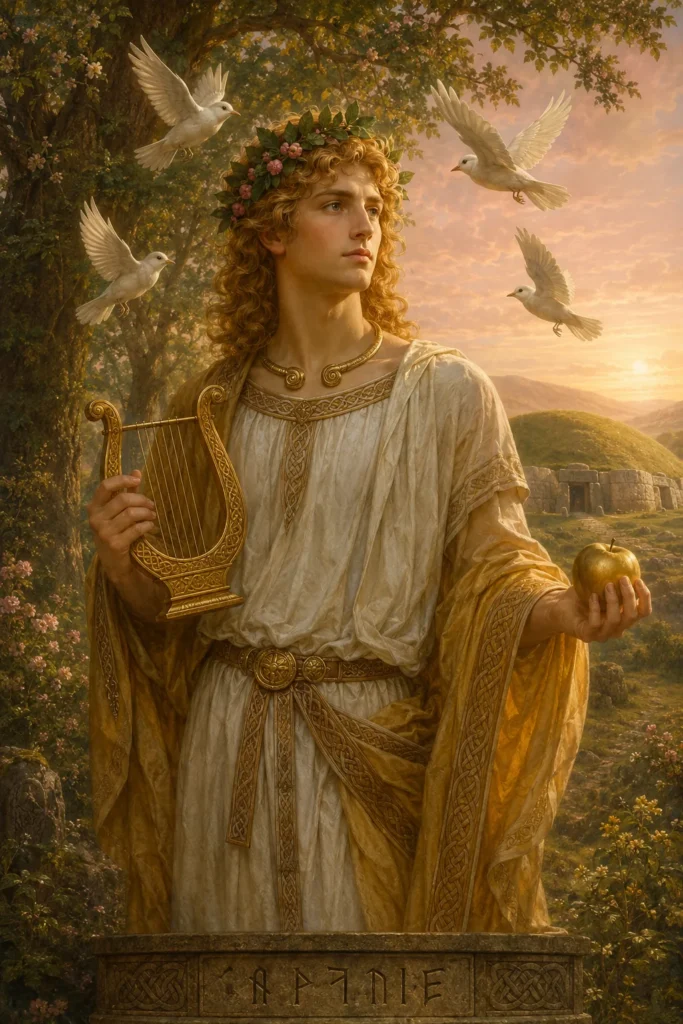
Clear ancient depictions are lacking, because Irish art of the Iron Age works predominantly without figures. In the tales he turns into a swan in order to fly away with Caer Ibormeith. Sun motifs, bird motifs and pairs of swans on bronze objects are cautiously mentioned as a possible substrate.
His dwelling Brú na Bóinne, the burial mound on the River Boyne, is regarded as a sacred place of inspiration and of encounter with the Síde. Whether Aengus was the independent recipient of a cult or above all a literary figure of medieval scribes is open.
The swan stands for his transformation and the bond with Caer. Swan transformations in Celtic and Germanic tradition are often linked with Samain and the turning of time. The burial mound Brú na Bóinne is his property and his dwelling place.
As a young deity he is compared with the Germanic Baldr, the Greek Eros and the Indian Kama, without there being any identity of function. In Welsh tradition Mabon stands close to him, the young son of Modron. On the Continent, Maponos is attested in Roman inscriptions.
Sources and Transmission
The most important texts about Aengus are the Old Irish narratives «Aislinge Óenguso» («Aengus’ Dream», 8th century), «Tochmarc Étaíne» («The Wooing of Étaín», likewise 8th to 9th century) and the genealogical material from the «Lebor Gabála Érenn».
Added to these are the «Dindshenchas», the place-name narratives, which mention Aengus several times, especially in connection with the Boyne and with Brú na Bóinne. In the Middle Irish «Acallam na Senórach» («The Colloquy of the Ancients», 12th century) Aengus appears as an old, wise king of the Síde.
In his works on Middle Irish literature («A Single Ray of the Sun», 1999) John Carey pointed to the close interweaving between the hagiographic and the pagan mythological tradition.
Aengus appears there as an example of a pre-Christian figure who, in the Christian redaction, was indeed secularized but not eliminated. Bernhard Maier places Aengus within the mythical system of the Tuatha Dé Danann, in which he represents the youngest generation and thereby the «principle of renewal».
Birth and Brú na Bóinne
The birth story of Aengus is closely connected with the passage tomb Newgrange. The Dagda falls in love with Boann, who is married to Elcmar.
In order to prolong the night of love, the Dagda makes the sun stand still for nine months, so that the conception, pregnancy and birth of Aengus all take place on a single day.
From this unusual conception derives the name «Mac ind Óg» («Young Son»). After his birth Aengus outwits Elcmar and takes possession of Brú na Bóinne himself, by demanding during the inheritance that the tomb be left to him «for a day and a night», which in Old Irish can encompass eternity.
This narrative points to an old connection of Aengus with the megalithic passage tomb on the Boyne, which was archaeologically built as early as around 3200 BC. In «Kelten» Helmut Birkhan stressed that the story shows a transition typical of the Irish tradition, from the archaeologically tangible ancestor cult to medieval narrated mythology.
The astronomical alignment of Newgrange to the winter sunrise was not made explicit in the medieval text, but has been known through the archaeological research of Michael O’Kelly since 1967.
Aengus' Dream and the Love for Caer
The most famous Aengus mytheme is «Aislinge Óenguso», his dream. In a dream Aengus sees a wonderfully beautiful young woman who vanishes after he awakes. Sick with love, he searches for her for a whole year, until his mother Boann and his father the Dagda help him.
Finally he finds Caer Ibormeith at the lake Loch Bél Dracon, where she lives as a swan among 150 swans who are transformed into birds each year at Samain. Aengus transforms himself into a swan, and the pair flies away, their song casting the listeners into sleep for three days.
Marie-Louise Sjoestedt read this story as a typical Celtic motif of the «dream messenger» («fith-fath»), in which the love between a human and an otherworldly being is realized through transformation and through the crossing of the boundary between the worlds.
John Carey pointed out that swan transformation in Celtic and Germanic tradition is frequently connected with Samain and with the turning of the year, which places Aengus within a calendrical and ritual framework.
Role in Tochmarc Étaíne
In «Tochmarc Étaíne», one of the most important narrative cycles of the Irish tradition, Aengus plays a central mediating role. His half-brother Midir falls in love with the beautiful Étaín, whom his first wife Fúamnach, out of jealousy, transforms into a pool of water.
In the course of transformations Étaín becomes a fly, then a woman who is born again. Aengus takes her into his Sídh, protects her and ensures that she eventually finds her way back to Midir. The narrative connects him with the motif of rebirth and with reliability within the family of gods.
In «The Gods of the Celts» (1986) Miranda Aldhouse-Green pointed to the structural function of Aengus as a threshold deity: he stands between the generations, between waking and dream, between animal and human form, between this world and the Otherworld. This mediating position makes him adaptable for numerous narratives in which transitions are shaped.
Areas of Function
Several areas of function can be read out of the texts. Aengus is the god of youthful love and fidelity, of poetry and inspiration, of dream and premonition, as well as of transformation.
His dwelling place, Brú na Bóinne, is regarded as a sacred place of inspiration and of encounter with the Síde. He is repeatedly described as a generous host and as a patron of lovers.
Bernhard Maier places him within the functional scheme of a «young deity», comparable to the Germanic Baldr, the Greek Eros or the Indian Kama.
A direct identity of function cannot be established, but the typological proximity clarifies the function of a love and youth deity within the Celtic pantheon. Helmut Birkhan additionally stressed the aspect of poetry and magic, which connects Aengus with Brigid and with the filid, the traditional Irish poets.
Welsh and Gaulish Parallels
A direct Welsh equivalent to Aengus cannot be clearly identified. Comparable functions are found in the figure of Mabon, the young son of Modron, who plays a role in «Culhwch and Olwen».
Mabon is comparable to the Mac ind Óg, as was worked out in the older research of Sjoestedt and in the more recent works of John T. Koch. On the continent Maponos is attested in Roman inscriptions, whose name is etymologically directly connected with the Insular Celtic *makwo-no-s («young son»).
These parallels suggest that there existed in the Celtic-speaking area a widely distributed figure of a young god with a love and inspiration function, which was made concrete in the Irish texts in the figure of Aengus. An identical narrative structure is not attested, but the structural kinship is plausible.
Reception
In literary modernism William Butler Yeats treated Aengus in several poems, most famously in «The Song of Wandering Aengus» (1899), in which he takes up the dream motif. Yeats and his circle made Aengus one of the prominent figures of the Irish Renaissance.
In modern Celtic spirituality Aengus is regarded as the patron of young lovers and as inspiration for artistic work. Caution is called for here, because the modern reception often relies more strongly on Yeats than on the medieval texts.
The scholarly research of John Carey, Tomás Ó Cathasaigh and Kim McCone has in recent decades worked out the structures internal to the texts and shown that the medieval monastic scholars understood Aengus less as a pagan god than as a heroic figure of the mythological past.
This distance between religious function and literary form shapes the present-day discussion of the question whether Aengus was an independent cult addressee or primarily a literary construction of medieval scribes.
Aengus as Patron of the Filid
A specific line of the Aengus tradition connects him with the filid, the learned poet class of Ireland. In «Acallam na Senórach» an old warrior who knew Aengus personally tells of his gift of transforming reality through word magic and music.
This motif ties in with the Old Irish notion of the imbas forosnai, the «comprehensive inspiring knowledge», which was attributed to the filid in a state of trance. Aengus appears here not primarily as a god of love, but as a guarantor of poetic inspiration.
In «Pagan Past and Christian Present» (1990) Kim McCone showed that the medieval monks who wrote down the narratives deliberately stylized Aengus as a literarily effective figure who transferred pagan poetic art into a Christian world of learning.
Thus Aengus is less a historically tangible cult addressee than an integrative figure who connects the deep past with monastic culture.
Aengus in the Finn Cycle
In the narrative cycle around Finn mac Cumhaill, Aengus appears several times as a protective foster-father and as the patron of Diarmuid Ua Duibhne, whose mother is said to have stood in a fosterage relationship with him.
In the «Tóraigheacht Dhiarmada agus Ghráinne» («The Pursuit of Diarmuid and Gráinne»), whose oldest manuscript witness dates from the 16th century, Aengus repeatedly preserves the fleeing Diarmuid from Finn’s pursuits.
After Diarmuid’s death by the tusk of the magical boar of Beann Gulbain (Ben Bulben), Aengus carries the corpse into the Brú na Bóinne, where he reactivates it through a breath of life for occasional dialogues.
In «The Wisdom of the Outlaw» (Berkeley 1985) Joseph Falaky Nagy showed that this episode actualizes the older topos of the Sídhe-dweller as protective patron of expelled youth.
In the «Macgnímartha Find» («The Boyhood Deeds of Finn») as well, whose text is transmitted in late manuscripts, Aengus appears at the margin of the narrative as a guarantor figure at whose court Finn as a boy receives part of his education.
This interweaving between the Mythological Cycle and the Finn Cycle assigns Aengus the role of a cultural mediator who remains present across the boundaries of the narrative cycles.
In «Celtic Mythology» (1970) Proinsias Mac Cana described this status as a characteristic of divine figures who appear as supporting figures in several narrative layers.
Linguistic and Iconographic References
Linguistically and historically the name Aengus is read as «óen-guss», «single force» or «one force», connected to Old Irish «guss» «force, vehemence».
This etymology was already advanced by Whitley Stokes and Kuno Meyer in the 19th century and is confirmed in the modern standard works on Old Irish onomastics, for example in Donncha Ó Corráin and Fidelma Maguire’s «Gaelic Personal Names» (Dublin 1981).
A competing reading as «one choice», «single choice», is found in marginal glosses, but is etymologically less well supported.
It is significant that, as a literary point, Aengus bears the epithet «Mac ind Óg» («Son of Youth» or «Son of the Two Young Ones»), which John Carey, in «Studia Celtica» vol. 19 (1984), read as a deliberate inversion of a usual patronymic: it is not the father who names the son, but rather the mother (Boann) and the lover-father (the Dagda) who together form the name formula.
Iconographically, clear ancient depictions are lacking for Aengus, since Irish art of the Iron Age predominantly works non-figurally.
By contrast, the connection of the late Bronze Age sun and bird motifs on the gold of Coggalbeg, as well as the swan-pair symbolism in bronze objects from the Bann river, was cautiously mentioned by Barry Raftery in «Pagan Celtic Ireland» (London 1994) as an iconographic substrate onto which later narratives such as Aengus’ transformation with Caer into a swan pair could be literarily projected back. A direct identification is not possible.
Brú na Bóinne as Cosmic Center
Brú na Bóinne, the megalithic passage tomb on the river Boyne, is the most important place of Aengus in Irish mythology. It is regarded as a gateway to the Otherworld, as a treasure chamber and as an assembly place of the Tuatha Dé Danann.
The «Dindshenchas» transmit several etymologies of the place name, all with reference to Boann or to the water. The astronomical alignment of the corridor to the winter sunrise, known since the excavations of Michael O’Kelly, is not mentioned in any medieval source, which underlines the difficulty of linking archaeological findings with textually transmitted mythology.
In modern Celtological research, Brú na Bóinne is at once a UNESCO World Heritage Site and a culmination point for investigations into the relationship between the Neolithic and Celtic mythology.
Bernhard Maier pointed out that the medieval texts probably draw on an old, continuous tradition of memory that marked certain places with divine presence, without a direct line to the religiosity of the builders being reconstructible from it.