Marena, Goddess of the Slavic Tradition
By Ralf Ittermann · last reviewed on
Marena (Морена, also Morana or Marzanna) is the Slavic goddess of winter, death, and rebirth. She embodies the dark season and death as part of the natural cycle and is venerated in rituals that connect life and dying.
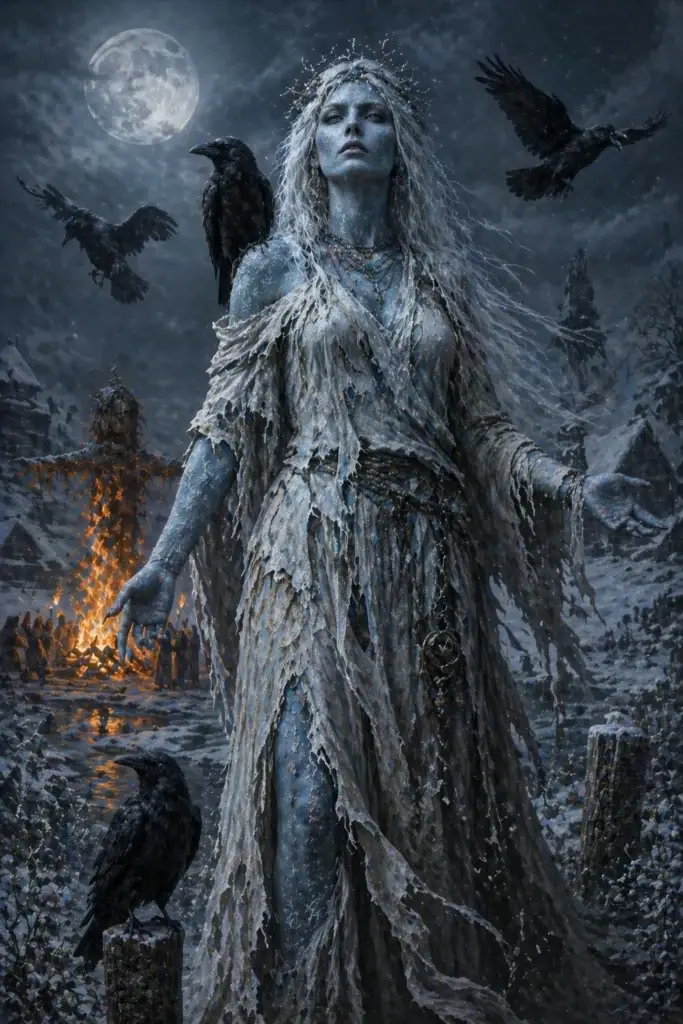
Marena
Marena is portrayed as a gaunt, old woman, often with symbols of winter (snow, ice, bare trees) and of death (bones, skulls, fire). Unlike evil demons, Marena is a cosmic goddess who embodies necessary yet feared forces.
She rules over the winter months and is venerated as the cause of snow, frost, and crop ruin. Her counterpart is Vesna (goddess of spring). Marena is ambivalent: destructive, but also regenerative, for winter kills so that spring may awaken anew.
Quick Overview: Marena
Marena is documented in ethnographic collections of Slavic folk religion (Afanasyev, Rybnikov, Séchan), though less so in early written sources. The primary texts are folklore records of the 19th and 20th centuries and ethnographic studies.
Scholars of religion such as Nora Chadwick and Mathieu-Colas document Marena cults in seasonal rituals. The figure is reconstructed within modern neopaganism.
Historical Context
Period of the Texts
The Marzanna customs remain alive to the present day, especially in Poland, the Czech Republic, Slovakia and parts of other Slavic countries. In many places today, school classes and associations carry out the procession and the burning or drowning of the effigy around 21 March as the beginning of spring.
The form has changed in the process: over time a serious seasonal ritual has become a folk custom, in part shaped by tourism. The core, however, the farewell to winter by disposing of a Marzanna figure, has been preserved and is still visible in regional festival culture.
Mythological Context
Marena is a goddess of winter cold and dying in Slavic mythology. She embodies the dark half of the year and the boundary zones between life and death. She is not an evil goddess but a necessary force within the cycle.
Area of Distribution
The veneration of Marena, or the driving-out of Marena, was widespread across the Slavic-settled regions, although the name differs from region to region: Marzanna in Poland, Morana in the Czech Republic and Slovakia, Mara or Morena in other areas.
This linguistic diversity points to a common, older foundation. Through neighbourhood, migration and exchange among the Slavic communities, the spring ritual spread over large areas, yet remained comparable across the regions in its course, the carrying and destruction of the effigy.
Source Situation
Marena is documented in folklore primary sources, especially in Slavic fairy tales and folk songs (Sbornik russkikh narodnykh pesen, collections of Russian folk songs). Direct literary primary sources are late and unsystematic.
Secondary literature: Nora Chadwick (The Slavic Peoples), Mathieu-Colas (Dictionnaire de mythology Slave), Linda J. Ivanits (Russian Folk Belief), Vladimir Toporov and Vyacheslav Ivanov (the Toporov-Ivanov school of Indo-European mythology reconstruction). The concept of Marena is reconstructed from folk customs and planting rituals, not from canonical texts like those of the Chinese gods.
Designation and Spellings
Marena is portrayed with certain iconographic elements that are symbolically encoded and carry deep meaning. These elements convey, in a central way, the functions, sources of power, domain and cosmic role of this entity. The visual system allows the initiated and the culturally educated to grasp the deeper meaning.
Marena, also called Morana or Marzanna, becomes tangible above all through the ritual of her effigy. It is woven from straw, dressed in scraps of cloth and ribbons, and fitted with white cloths or a light-colored garment, which symbolically represent death and winter. In some regions the figure wears a wreath or necklaces of eggshells.
Unlike a fixed depiction of a deity, the focus here is on the effigy made anew each year, whose appearance varies locally but recurs in its basic features. The combination of straw, light-colored cloth and wintry signs points to her role as the embodiment of the dead, cold season.
Characteristics
Marena becomes tangible mainly through the spring customs involving the straw effigy. People turned to this entity in critical situations or at particular ritual times of the year, with structured rituals, prayers, or offerings.
The continuity of these practices over many generations shows that they were regarded as effective and necessary. The functions were diverse: preventive (warding off misfortune), healing (easing suffering), transformative (accompaniment through transitions), and protective (continuous watching over).
Appearance and Symbolism
Marena appears as a gaunt, old woman, dressed in white or in funeral shrouds. She is associated with frost and snow. In some depictions she carries a scythe. White and gray are her colors.
Profile: Marena
The Profile treats Marena from six perspectives: her cosmological origin as a goddess of winter and death, the groups of her ritual veneration (peasants, seasonal), her iconography and somber appearance, her role in funeral rites and in affirming the cycle, as well as parallels in related cultures.
These dimensions show her central role in the Slavic system of the year’s wheel.
Marena is connected geographically and cosmologically with winter and the north. Her cultural origin is proto-Slavic, probably prehistoric, since winter gods occur in many Indo-European cultures. Written evidence is late and often Christianly distorted.
In terms of the history of religion, Marena is understood as a specialization of a general goddess of death and rebirth, whose function consolidated with the seasonal agricultural cycles. Her name may derive from the Slavic-Indo-European *mer (to die).
Marena was venerated primarily by peasants and herders in winter rituals, especially in transitional phases (first snowfall, winter solstice, the end of winter). Festivals and rituals such as Maslenitsa (the butter festival, a farewell-to-winter ritual) were occasions for Marena.
Women had special roles in Marena rituals: lighting bonfires or making Marena figures (dolls), which were then burned or thrown into rivers (driving Marena away). The veneration was seasonal and cyclical, not year-round like that of the Domovoi.
Marena is portrayed as a gaunt, old woman, often in funeral shrouds with white or graying hair. Her attributes are snow, ice, bones, a sickle (a reaper like the Parcae), or a fire symbol. She is sometimes shown winged, to suggest her swiftness and inevitability.
In folk art she is depicted as frightening and fascinating at once. Her colors are white (snow), black (darkness), and red (life and fire). The iconography is startling but not exaggeratedly evil, rather melancholic and sacred.
Sphere of Influence: Marena (also Morena, Mara) symbolizes winter, death, and the boundary between life and the beyond. She is the goddess of decay and rebirth, and each year her doll is burned (the burning ritual) to drive away winter and call in spring.
She rides on white horses over snow and ice. She is not malicious but necessary, the force that lets everything age and renew itself.
Marena is a cosmic goddess, neither good nor evil but necessary. Veneration takes place through seasonal rituals that acknowledge her power and ask for a mild winter or a swift spring.
The Marena doll ritual (the Shrovetide festival) was a blend of veneration and symbolic expulsion: the doll (Marena) was burned or thrown into the water to end winter and summon spring.
Protective rituals consisted of fire symbols and prayers. The veneration was cosmic and cyclical and acknowledged Marena as a necessary force in the course of the year, not as a hostile entity to be fought.
Comparable are other gods of winter and death: Hades or Persephone in the Greco-Roman tradition (gods of death), the Norse Hel (goddess of the underworld), Hecate in Greek mythology (goddess of thresholds and of death), and Kali in Hinduism (goddess of destruction and rebirth).
Common to all is the ambivalent nature between destruction and regeneration, as well as the aspect of the cycle.
Marena, Parallels in Other Cultures
Marena stands in the line of seasonal goddesses of death and renewal and compositionally parallels the Hellenistic Persephone and the Egyptian grieving Isis.
Her winter-spring cycle is concretely enacted as a ritual in Slavic custom through the burning or drowning of a straw doll, a practice that in this form has no direct counterpart in the Mediterranean region.
Jewish Tradition: In Judaism there is no direct goddess of winter or death like Marena. The God YHWH controls the seasons and death, but is not anthropomorphized as a female goddess. However, the Kabbalah knows Binah as “mother” and cosmic adversary (Gevurah/Rigor as the destructive side), which offers a distant conceptual parallel.
Greco-Roman World: Persephone as queen of the underworld and symbol of winter (half the year beneath the earth) resembles Marena. Hecate too is a goddess of darkness and thresholds.
The difference: Persephone and Hecate are more mythological figures in stable roles than cosmic cycle goddesses like Marena. Hecate is a sorceress and guardian, not a goddess of the seasons.
Mesopotamia: The goddess Ereshkigal rules over the underworld (Kur), similar to Marena’s rule over winter. But Ereshkigal is not seasonal; she is static within her underworld domain. There is no seasonal cycle aspect as with Marena.
India/Asia: Kali or Durga in Hinduism embody a destructive and regenerative femininity similar to Marena. In Taoism there is Yin (dark, cool) as a principle that corresponds to winter, but not as a personified goddess.
In Japanese shamanism there are underworld gods such as Izanami, who are connected with death. Common to all these traditions is the femininity of death and the cyclical regeneration.
The Problem of the Sources on the Slavic World of Gods
Anyone approaching Marena, also called Morana, Mara, or Marzanna, must first consider the difficult source situation regarding Slavic religion.
The pagan Slavs left behind no religious texts of their own, Christianization took place over several centuries, and what we know about their gods derives predominantly from three kinds of sources: from the reports of Christian chroniclers, from later ecclesiastical prohibitory writings against pagan customs, and from the folkloric tradition of the modern era.
For Marena the medieval attestation is thin. Unlike, for instance, the East Slavic Perun, she scarcely appears in the early chronicles as a venerated deity.
What is known about her rests above all on late sources from the West Slavic area, especially from Poland, the Czech lands, and Slovakia, as well as on the customs of the beginning of spring that survived into the modern era.
An important, often cited source is the Polish chronicler Jan Dlugosz of the fifteenth century, who in his history of Poland attempted to equate the old Slavic gods with Roman deities. Such learned constructions are to be treated with caution, since they interpret the Slavic material through an ancient lens.
The consequence for the study of religion is clear. A secure, unified picture of a goddess Marena from pagan times cannot be drawn. What is securely tangible is above all the ritualized figure of the spring custom, a straw doll called Marzanna or Morena, which is carried out and destroyed.
Whether and in what form a genuinely venerated deity of the pagan Slavs stands behind it is contested in research. This uncertainty belongs to an honest depiction of the figure.
The Carrying Out of the Marzanna as a Spring Ritual
Marena is most securely tangible in the widespread West Slavic custom of the beginning of spring, which is observed in Poland, the Czech lands, Slovakia, and neighboring areas to the present day.
At its center stands a doll made of straw, often wrapped in women’s clothes, called Marzanna, Morena, or by similar names. She embodies winter, death, and the rigidity of the cold season.
The custom is traditionally observed around the astronomical beginning of spring or on the fourth Sunday of Lent. The community, frequently children and young people, carries the doll in a procession through the village and then out of it, often singing.
At the end the Marzanna is destroyed, she is burned, thrown into a flowing body of water, or both in succession. In many places it is considered dangerous to touch the doll as it goes down or to look back at her while one is going back.
Often the carrying out of the Marzanna is contrasted with a second, opposing act, the bringing in of spring or summer, symbolized by a green branch, a decorated little tree, or another doll.
The custom is thereby a two-part ritual, death and cold winter are driven away, life and the warm season are brought in.
In folkloristic terms this custom is interpreted as a rite of transition and purification that accompanies the change of seasons and assists it as a ritual.
The medieval church fought against the carrying out of such dolls, which shows that the custom was felt to be pagan, and precisely this ecclesiastical resistance is one of the most important sources for its age.
Whether the doll originally represented a goddess or was from the beginning an embodiment of winter cannot be decided from the custom alone.
Marena as Goddess of Death and the Winter Season
From the spring custom and from linguistic indications, research has inferred the picture of a Slavic goddess of death, winter, and rigidity, although the hypothetical character of this reconstruction must always be emphasized.
The name itself gives a clue, it belongs to a word family around an Indo-European root with the meaning to die, to which also belong the Latin mors, death, and words for murder and the dead in various languages.
The connection to the nocturnal pressing being, the Slavic mara and the Germanic Mahr, is also discussed.
From this follows an interpretation of Marena as the embodiment of the forces hostile to life, of cold, of darkness, of the standstill of vegetation, and of death. In this reading she is the wintry counterpart to the forces of spring and fertility.
Some researchers, especially in the Polish and Czech tradition, have interpreted her as an ambivalent goddess who not only brings terror but also belongs to the necessary cycle, for without winter no spring, without death no renewal.
Later, especially popular-scientific and neo-pagan depictions have built Marena up into an elaborate goddess of death with a fixed biography, kinship, and function. These pictures are appealing but are not secured by source criticism, they often carry more into the figure from the modern imagination than from the medieval tradition.
The serious position within the study of religion remains cautious. There are good grounds for assuming that behind the custom and the name stands a conception of a personified wintry and deadly power.
A goddess Marena venerated in cult with an elaborate myth cannot, however, be securely demonstrated from the surviving sources. Marena is thereby a model case for the limits of our knowledge of Slavic religion.