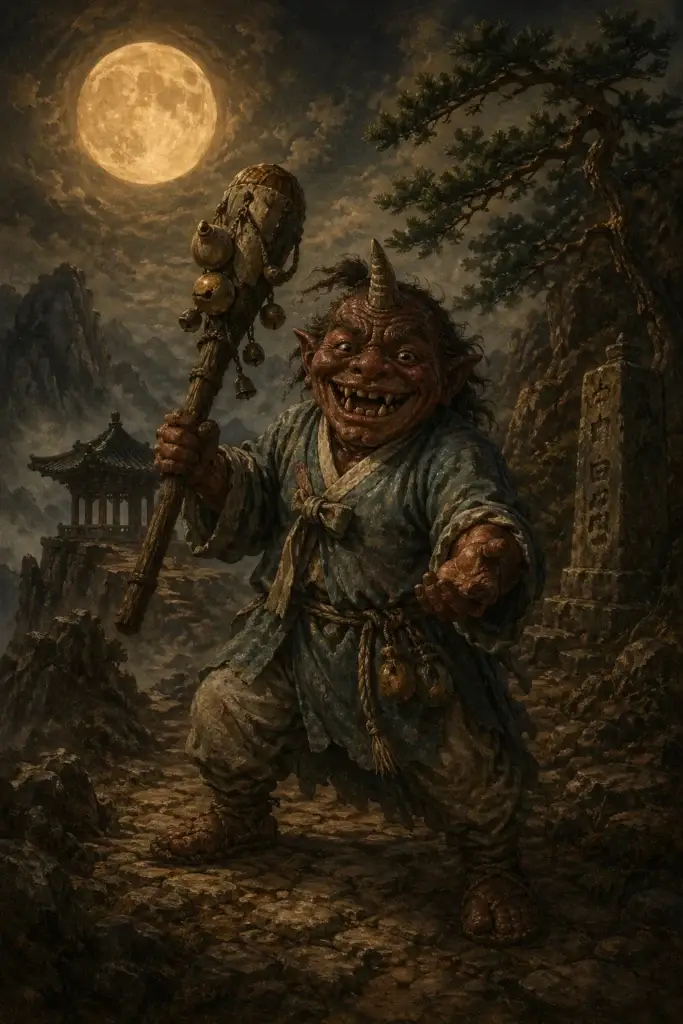
Gumiho is a spirit of Korean tradition.
Nine-tailed fox demon of Korean tradition, transformation, seduction, longing.
The Gumiho (구미호, 九尾狐, „Nine-Tailed Fox“) is one of the most iconic figures of Korean demonology. It belongs to the great East Asian tradition of nine-tailed fox beings, which are also attested in China (Húli Jīng) and Japan (Kitsune).
A fox, so it is said, that lives a thousand years develops nine tails and magical abilities.
In Korean tradition the Gumiho is usually female and can assume human form, typically that of a strikingly beautiful young woman. Depending on the account, it is dangerous and murderous or tragic and full of longing, a figure that wishes to become human and fails to do so.
The early records of the Gumiho appear in both canonical Korean historiographies: the Samguk Sagi (History of the Three Kingdoms, 12th century) and the Samguk Yusa (13th century). The Samguk Sagi records a Gumiho episode in which a nine-tailed fox deceives the king; the Samguk Yusa expands the narratives with psychological depth.
In these early texts the nine-tailed quality is already ascribed magical significance: nine tails signify age, power and acquired abilities accumulated over several cycles of reincarnation.
The sources show that the Korean Gumiho is not merely a zoomorphic entity, but a quasi-human being with long lifespans and cumulative experience. The early textual tradition emphasizes the intellectual superiority of the Gumiho over humans and their systematic seduction through shapeshifting into female human form.
Type: Animal-shaped demon, shapeshifter
Origin: Ancient East Asian fox tradition; Korean form from the Middle Ages onward
Texts: Samguk Yusa, Yongjae Chonghwa, Cheongjo gangmok
Motif: Transformation into a beautiful woman; hunting for life energy or the human liver
Warding off: Bujok amulets, mirrors, dog blood, Confucian moral strictness
Nine-tailed foxes have been attested in East Asia since Chinese antiquity, already described as ambivalent beings in the Shan Hai Jing (3rd to 1st century BC). Over the centuries the figure travels to Korea and Japan, developing its own profile in each case.
While the Chinese Húli Jīng also retains positive traits and the Japanese Kitsune often appears as a servant of the Inari deity, the Korean Gumiho develops a markedly darker profile, mostly depicted as dangerous or tragic.
Core texts: Samguk Yusa (around 1281) with fox-shape episodes; Joseon-era collections paesol and yadam. Modern media, the K-dramas „My Girlfriend Is a Gumiho“ (2010) and „Tale of the Nine Tailed“ (2020), have made the figure internationally popular.
Gumiho narratives are found across the entire Korean peninsula. Preferred settings: lonely mountain passes, cemeteries by full moon, dark forests, remote villages. The fox woman typically encounters men late in the evening, in precarious wayfaring situations, along mountain paths, at lonely temples, in abandoned buildings.
Core sources: Iryŏn, Samguk Yusa (around 1281); Yongjae Chonghwa (Sŏng Hyŏn, 15th century); Joseon-era yadam literature. The main strands of modern reception are Kwon, Yong-Hwan (2010) „Korean folklore“ as well as K-drama-related research.
Pictorial depictions of the Gumiho are rare until the late Joseon period; the modern iconography with nine visible tails behind the female figure is essentially a development of recent decades, strongly shaped by manhwa and K-drama.
Literally „Nine-Tail Fox“ from 九 („nine“), 尾 („tail“) and 狐 („fox“).
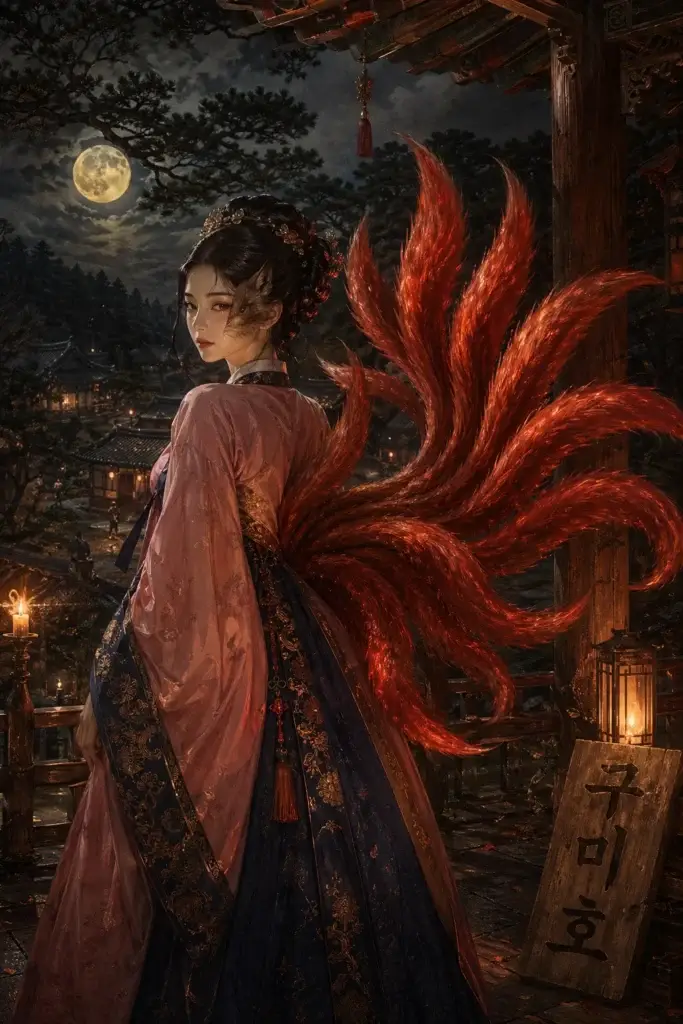
Appearance. In animal form a white or silver fox with nine tails; in human form a young, beautiful woman in traditional dress (hanbok). The shift between the forms is linked to the fox pearl, which often functions as a key motif.
Behaviour. Seduces men, in classic accounts feeds on the human liver or the life energy of the partner.
In more modern reception, and in an older narrative strand, the Gumiho wishes to become human; to do so it must fulfil a condition (a hundred days of abstinence, a hundred days of silence, a certain number of human souls).
Death. In many stories the Gumiho fails shortly before reaching humanity, because the vow of silence is broken, because the beloved does not keep his promise.
The Korean Gumiho is a direct adaptation of the older Chinese Huli-jing tradition (nine-tailed fox from Chinese mythology, documented since the Han period). The adaptation was, however, not purely imitative: Korean scholars and folk narrators integrated Huli-jing motifs with local shamanic concepts and Buddhist notions of karma.
The Korean Gumiho displays more psychological ambivalence than the Chinese prototype: while Huli-jing are often evil or amoral, the Gumiho frequently embodies tragic figures whose seductions arise from a longing for humanity.
This reflects a Korean focus on emotional complexity and inner motivation. The supernatural substance that the Gumiho requires attests to a medical-spiritual classification that differs from its Chinese predecessors.
The most important aspects of Gumiho at a glance.
An old fox that becomes nine-tailed and attains magical abilities; part of the pan-East Asian fox tradition.
Young men on lonely paths; scholars and officials in seclusion; night travellers in the mountains.
White to silver fox with nine tails; in human form a young, strikingly beautiful woman in traditional dress.
Seduction, exhaustion, death of the partner; in the tragic reading: failed attainment of humanity, grief and farewell.
Bujok amulets with red characters; mirrors that reveal the true form; dog blood and beans; Confucian steadfastness.
Chinese Húli Jīng (see Huli Jing), Japanese Kitsune; European werefox and fairy motifs.
Mirror. In many accounts a mirror held up unexpectedly reveals the Gumiho’s true fox form; the transformation breaks when the Gumiho sees its own reflection.
Bujok. Consecrated paper amulets with red characters are affixed to door frames and worn on the body.
Dog and dog blood. Dogs recognize the fox nature; dog blood is considered apotropaic. Some villages therefore deliberately kept dogs at the entrance.
Strictness of the vow. In accounts in which the Gumiho wishes to become human, the keeping of a clear vow by the human is decisive, breaking the promise condemns the Gumiho anew to fox form.
China. The Húli Jīng is the oldest tangible figure; in Chinese tradition at once an omen, a companion and a tester.
Japan. The Kitsune is in the Shintō context partly positively connoted, as a messenger of the Inari deity. The dark profile of the northern Nogitsune traditions is closest to the Gumiho.
Europe. Werefox motifs in French and Scandinavian folklore are typologically related; the motif of the fox woman who enchants people is also found in hunting tales.
India. Yakshini and certain female half-beings share the traits of the seductive and dangerous female figure.
The Gumiho tradition was intensively acculturated in Korea from the 19th century onward through dramatic adaptations. Traditional Korean theatre (pansori, later stage drama and film) adapted Gumiho narratives into moral fables, love stories and later psychological dramas.
In the late 20th century the Gumiho transformed within Korean film and television production into a prototypical supernatural female figure with her own subjectivity and moral complexity, far removed from the treacherous she-demons of early sources.
This dramatic recoding was so intense that the Gumiho became a symbol of Korean cultural distinctiveness, different from Chinese and Japanese fox narratives. Modern Korean authors and dramatists presented Gumiho as figures of border-crossing between nature and culture, femininity and danger.
The gumiho (구미호), literally the nine-tailed fox, belongs to an East Asian circle of motifs that also encompasses the Chinese huli jing and the Japanese kitsune.
In all three traditions the fox is a long-lived animal that gains magical powers through great age, can transform, and is in particular able to assume the form of a beautiful woman. Scholarship sees a shared cultural background here, but at the same time emphasizes the clear differences in the respective forms.
Characteristic of the Korean variant is that the gumiho is predominantly negatively cast. While the Japanese kitsune remains ambivalent and, in the form of the fox messengers of the deity Inari, is even venerated, the gumiho appears in Korean tradition mostly as a dangerous, often deadly being.
In numerous accounts it assumes the form of a beautiful woman in order to approach men, and kills them, a recurring motif being the devouring of the human liver or heart.
Scholarship has linked this dark colouring with the Korean conception of spirits as a whole, which is strongly shaped by the notion of violated order.
The gumiho embodies a twofold threat: the danger of the foreign that disguises itself as the familiar, and the danger that arises from union with a being that is only apparently human.
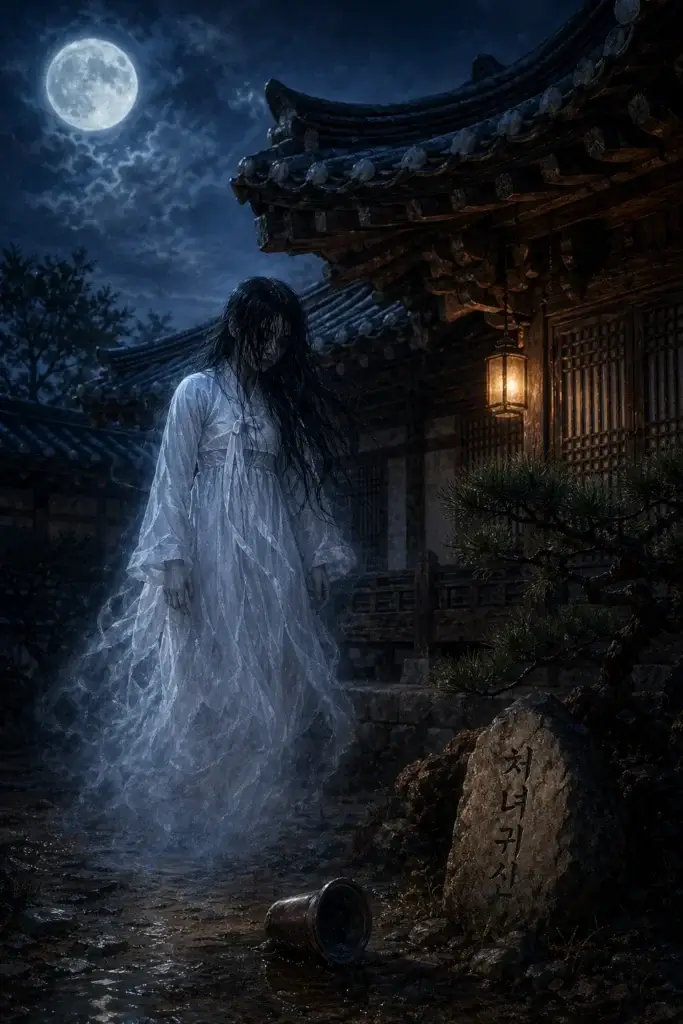
Related within the wider Korean context is the gwishin, yet unlike the latter the gumiho is not a spirit of the dead, but a transformed animal.

A central and culturally telling narrative motif of the gumiho is its wish to become fully human. Unlike a mere predatory being, the gumiho in many accounts strives to shed its fox nature and to cross over definitively into the human world.
A condition is often attached to this: it must survive a certain span of time, often given as a thousand days, without killing or without consuming human flesh, or it must win the sincere love of a human to whom it reveals its true nature, without that person betraying it.
This motif lends the gumiho a tragic dimension. The accounts often end with failure shortly before the goal: the secret is betrayed at the last moment, a temptation gives way, or a mistrust breaks the condition.
The gumiho then remains caught between the worlds, neither wholly animal nor wholly human. The folk narrative thus uses the being to reflect on trust, secrecy and the impossibility of completely casting off a fundamentally different nature.
Modern Korean popular culture has taken up precisely this motif and developed it further. Films and television series of recent decades increasingly portray the gumiho as an ambivalent, compassionate figure whose longing for humanity is foregrounded, rather than pure threat. The emphasis has thereby shifted, without the older layer having disappeared.
From the perspective of religious studies and folklore, the gumiho remains a being of the boundary, which poses the question of whether and how the line between human and non-human can be crossed, and which in the Korean tradition mostly answers it with a clear no.
Recommended internal links:
Further standard works in the literature index.
The protective practice described here is a religious-studies contextualization of historical traditions. iWell Guard ties into this cultural-historical line of wearable protective objects and represents a contemporary form of it. More about the iWell Guard →
Against its influence, cross-cultural tradition names these protective means:
Recommended protective means
The simplest protective means in this collection: 41 layers of fine gold 999, platinum, silver and silicon, manufactured in Ruhla, Thuringia. It requires no activation, is bound to no person, and is effective within a radius of around 50 meters, even without being worn.
Related Beings

Lamiae, child-killing women as a class of Roman folklore. The later afterlife of the ancient Gree...

Reptilians, the shape-shifting reptilian humanoids of modern conspiracy belief. Origins, central ...

Funayūrei, the ship spirits of drowned sailors in Japan. Origin, the ladle as a weapon and tradit...

The Dirae, often also called Furiae, are the Roman equivalent of the Greek Erinyes. They pursue b...

Hui Lu, the Chinese fire god figure with the calabash full of fire birds. Origin, his connection ...

Tuulikki, daughter of Tapio and goddess of the forest animals: in the Kalevala she drives game to...