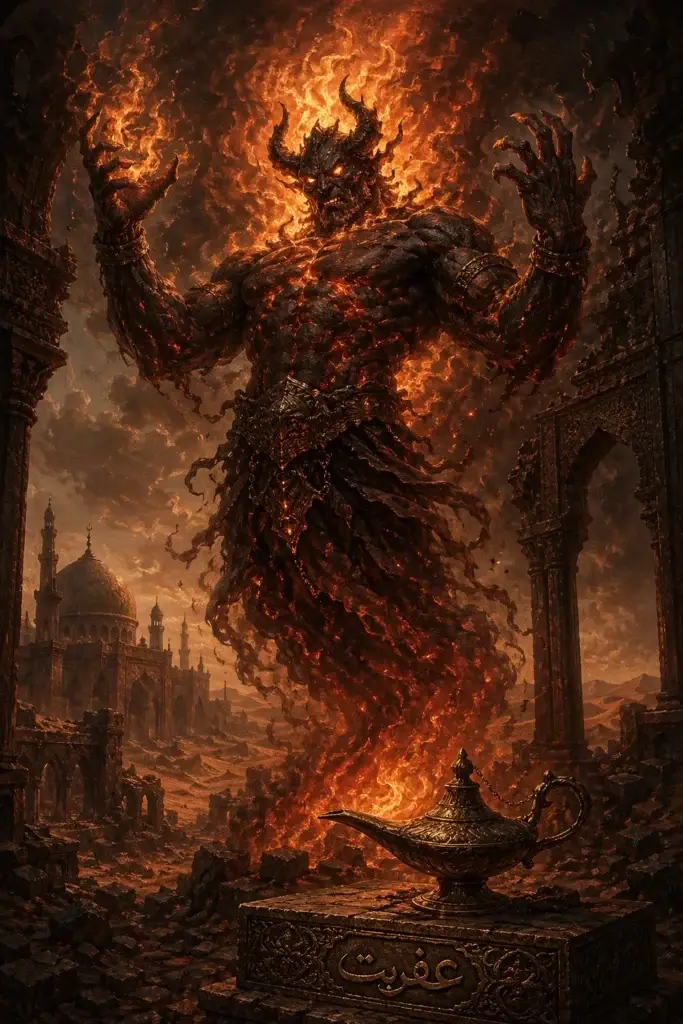
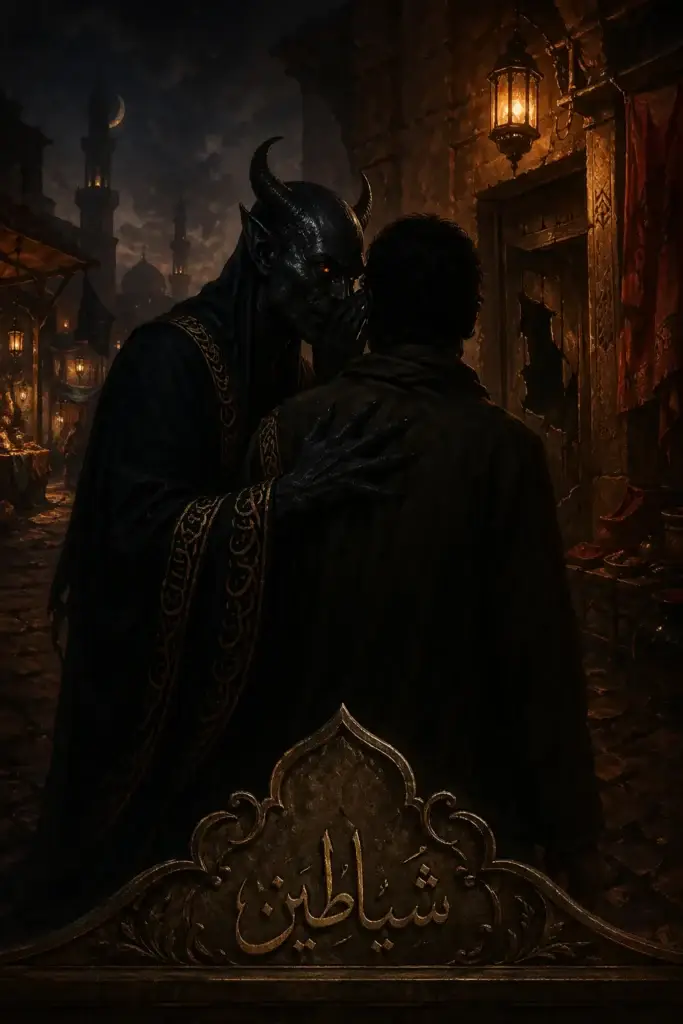
Ghul, Demon of the Islamic Tradition
By Ralf Ittermann · last reviewed on
Ghul is a demon of the Islamic tradition.
Graveyard and desert demon, origin of the modern ghoul figure.
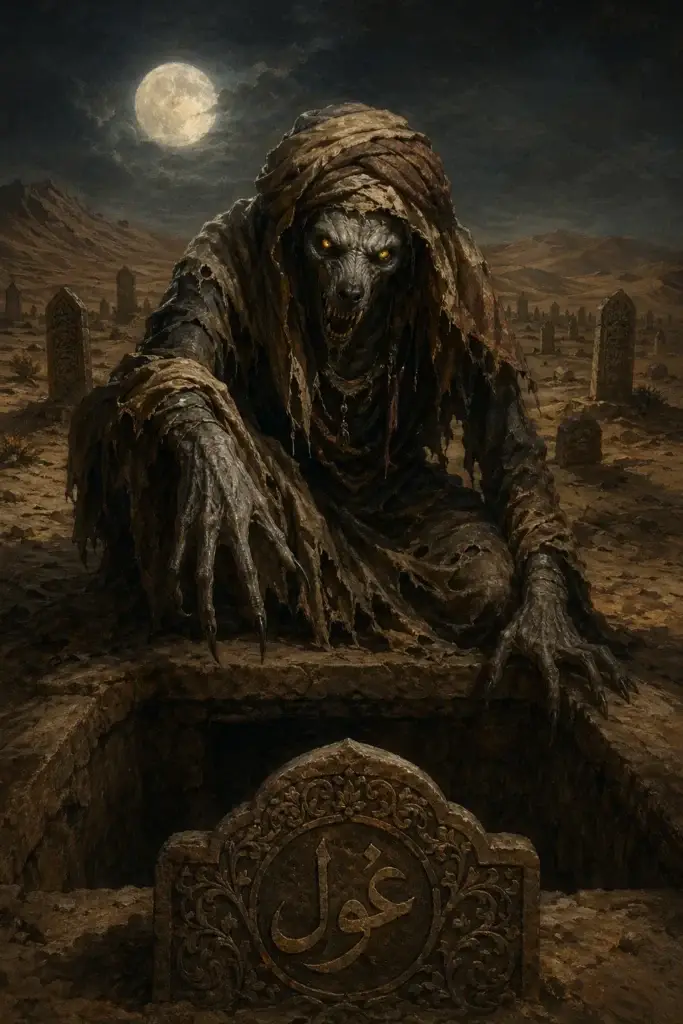
Ghul
In the Arab-Islamic tradition, the Ghul is a nocturnal demon of deserts and graveyards. Its defining trait is shape-shifting.
Ghuls lure travelers astray, devour corpses, and in more developed folk tradition, also attack the living.
Through One Thousand and One Nights, the figure entered European consciousness. The English “ghoul” in horror literature and film derives directly from the Arabic ghūl, though it loses the specifically desert- and graveyard-related aspects in the process.
In modern usage, the ghoul has become a generic term for a corpse-devouring demon, while the Arabic tradition is more precise: desert, graveyard, and transformation into female form.
Ghul at a Glance
Type: Desert and graveyard demon, corpse-devourer
Origin: A subclass of the jinn, with a specific function
Texts: Hadith, al-Damiri, One Thousand and One Nights, folk narratives
Period: Pre-Islamic to the present
Gender: masculine (Ghul), feminine (Ghula, Si’la), the latter particularly prominent
Historical Classification
Period of the Sources
Attested in pre-Islamic Arabic poetry of the Jahiliyya, then adopted into the Islamic tradition. Further developed in hadith literature, classical zoology (al-Damiri, Hayat al-Hayawan), and One Thousand and One Nights. Modern reception in literature and film.
Geographic Distribution
The Arabian Peninsula as the region of origin, spreading with Arab-Islamic culture. Modern international presence through the horror genre term “ghoul”.
State of Sources
Pre-Islamic poetry, hadith, al-Damiri, al-Qazwini, One Thousand and One Nights, and ethnographic studies on Arab and North African folk religion.
Name and Variants
Arabic: ghūl (singular), ghīlān (plural); feminine form: ghūla, more commonly siʿlā(h).
Etymology: Root gh-w-l (“to devour, to destroy”).
English/French: ghoul / goule, direct borrowings.
Related: Si’la (the feminine Ghula variant, considered especially dangerous).
The feminine form is particularly prominent in Arabic literature. The Si’la transforms into a beautiful woman, lures men to isolated places, and devours them. The masculine form more frequently appears as an animal (donkey, jackal-like creature).
Description
Appearance
Hybrid and mutable. Base form: donkey-like hooves, shaggy fur, horned. In human form: a beautiful woman (Si’la) or an enticing stranger. In animal form: jackal, hyena, or donkey.
Behavior
Lures travelers astray, especially at night. Transforms into a familiar or attractive figure. At graveyards, it digs up graves and consumes corpses. In the most severe accounts, it kills and devours the living.
Sphere of Influence
Deserts, caravan routes, graveyards, and desolate places. More active at night and on threshold days (end of Ramadan, certain festival nights). Local traditions associate Ghuls with specific locations.
Mythological Classification
According to classical tradition, a subtype of the jinn. Pre-Islamically, possibly its own distinct category, later integrated into the jinn hierarchy. Female Ghuls are associated with specific graveyard rituals.
Appearance and Symbolism
Ghuls are described as resembling grey corpses with twisted bodies and glowing eyes. They can assume human form. Female Ghuls sometimes appear seductive. A Ghul carries the smell of decay. Darkness and corruption are their signs.
Profile: Ghul
The most important aspects of the Ghul at a glance.
Subtype of the jinn; pre-Islamically possibly a distinct category. A central figure in the Arab tradition of deserts and graveyards.
Travelers alone in the desert, caravans at night, solitary men. At graveyards: mourners and grave-keepers.
Shape-shifting: donkey-like hooves in its base form, a beautiful woman (Si’la) or a stranger as a lure, and jackal, hyena, or donkey as animal forms.
Lures victims astray, devours corpses, kills the living. Sudden seizure from ambush.
Reciting the call to prayer (Adhan), advised in tradition as a defense. Avoid traveling alone at night; enter graveyards only with respect and prayer. Recite Bismillah before entering unfamiliar dwellings.
Practical Protection
The Call to Prayer (Adhan)
Tradition advises the call to prayer (Adhan) in the case of a Ghul. This practice is regarded to this day as the classic defense against the Ghul.
Behavioral Guidelines
Do not travel alone at night; enter graveyards with respect and prayer; recite the Basmala before entering unfamiliar dwellings; in situations of distress, recite the Ta’awudh. In classical poetry, the hero confronts the Ghul with courage, and refusing to flee is also described as an effective defense.
Amulets
Quranic verses in hirz amulets, especially the protective suras and Ayat al-Kursi. The Seal of Solomon as an apotropaic sign. In North Africa: the Hamsa hand and Quran-verse talismans.
Cult and Veneration
Ghuls are not venerated but feared and warded off. Quranic verses serve as protection. Travelers made noise to deter them. Incense and prayers were common. Wise men and sorcerers could banish them, though this was considered dangerous.
Parallels and Legacy
Ancient Mediterranean world: Empusa and Lamia in Greek tradition, Striga in Roman tradition, all displaying the pattern of the shape-shifting, seductive nocturnal figure that attacks travelers. Direct dependencies are not established; structural parallels are clear.
Persian and Central Asian Traditions
The Persian ghāl (a looser conceptual parallel) and Turkish variants adopt the Arabic motif, combining it with local spirits.
Western Reception: The ghoul of English horror literature (Lovecraft and others) and film derives directly from the Ghul. In Western role-playing games and popular culture, the ghoul has become a generic corpse-devourer; specific Ghul attributes (desert, transformation, defense through the call to prayer) are lost in the process.
The Ghul in Pre-Islamic and Early Islamic Tradition
The ghūl belongs among the oldest figures in Arab popular belief and is already known from pre-Islamic poetry. In ancient Arabic verse, the ghūl appears as a being of the desert and lonely roads that leads travelers astray, lies in wait for them, and devours them.
Particularly famous is the episode recounted in several traditions in which the pre-Islamic poet Taʾabbata Sharran encounters a ghūl in the night, wrestles with it, and defeats it; the poem in which he boasts of this encounter is among the most well-known attestations of the figure.
With the advent of Islam, the ghūl was not abolished but reinterpreted. In prophetic tradition, the hadith, there are statements that partly question or qualify the existence of the ghūl and partly interpret it as a manifestation of the jinn.
One well-known tradition advises reciting the call to prayer when such a being appears. Islamic scholarship thus placed the ghūl within the jinn system: it is not an independent creature but a particularly malevolent, shape-shifting jinn.
This classification is important for a religious-studies understanding of the figure. Islam adopted existing folk beings but subordinated them to its own cosmology. The ghūl lost its status as an autonomous desert being and became a type within the jinn hierarchy.
Folk tradition kept the older, more concrete conception alive alongside this, so that the ghūl continues to exist in two registers to this day: as a theologically classified jinn and as a tangible figure of terror in narrative.
Etymology and the Semantic Field of Destruction
Linguistically, ghūl belongs to a root whose basic meaning lies in the domain of seizing, grasping, and sudden destruction. The related verb denotes the act of surprising attack, of carrying off, of unexpected calamity befalling a person.
The ghūl is thus, in the literal sense, “the one who carries off,” the being that seizes the traveler without warning. This etymology fits precisely its role as an ambush creature lurking in desolate places.
From the same root derives the term ghīla, which denotes treacherous, underhand killing. The linguistic proximity between the demon and the concept of the treacherous assault is no coincidence: the ghūl embodies exactly this kind of threat, one that comes not in open combat but from ambush.
Noteworthy is the word’s history beyond Arabic. Through the reception of Oriental narrative literature, especially the collection One Thousand and One Nights, the word entered European languages in the eighteenth and nineteenth centuries. The English ghoul and its equivalents in other languages are direct borrowings.
In the process, the meaning shifted: while the Arabic ghūl is primarily a being of the desert and the roads that devours living travelers, the European ghoul narrowed to the grave-robber and corpse-devourer, a creature of cemeteries.
This narrowing of meaning is an instructive case of how borrowing reshapes a figure: the adopted word retains the sound, but the conception adjusts to the fears of the receiving culture.
The Si'lat and the Feminine Variant
The Arabic tradition recognizes alongside the ghūl a range of related and partly feminine figures that refine the picture.
Particularly important is the siʿlā (plural siʿālī), a female demoness who in some sources is regarded as the wife or a subtype of the ghūl. The siʿlā appears in stories in which she transforms into a beautiful woman, marries a man, bears him children, and lives with him until her true nature is discovered and she disappears or becomes dangerous.
This motif of the supernatural wife whose origins remain concealed is widely attested in Arabic narrative literature and connects the ghūl complex with an international tale type.
Some genealogical traditions of Arab tribes even traced certain ancestors back to a union with a siʿlā, which shows that this belief was not merely a horror story but also an element of ancestral narratives.
The feminine variant has a different emphasis than the male desert ghūl. While the latter threatens through brute force and consumption, the siʿlā operates through deception, seduction, and infiltration of the domestic and familial sphere. The danger shifts from the lonely road to the home itself.
From a religious-studies perspective, this reflects a gender-specific division of fears: the dread of the external predator on one side, and the dread of the impenetrable stranger within the family on the other. Both figures belong together and only jointly constitute the complete picture of Arab ghūl belief.
Selected Bibliography
Further standard works in the literature index.
The protective practices described here represent a religious-studies classification of historical traditions. iWell Guard draws on this cultural-historical lineage of wearable protective objects and represents a contemporary form of it. More about the iWell Guard →