Hypnos, god of the Greek tradition
By Ralf Ittermann · last reviewed on
Hypnos is a god of the Greek tradition.
Gentle god of sleep, brother of Thanatos, son of Nyx. Hypnos is the personification of sleep itself, not the act of sleeping but the power of rest and renewal.
Unlike Morpheus (who shapes dreams), Hypnos is the light, healing sleep. In the Theogony, Hesiod calls him “gentle” (meilichos). With fleeting wings he passes over the earth and breathes rest into people. This entry situates Hypnos within Greek Mythology as the gentle god of sleep who breathes rest into mortals.
Hypnos
Quick Overview: Hypnos
Type: God (personified natural phenomenon)
Tradition: Greek mythology
Class: Minor god / Titan-like
Role: God of sleep and dreams
Sources: Hesiod’s Theogony, Homer, Apollodorus, Ovid, Virgil
Domain: Sleep, dreams, mortals and gods, healing
Central conflict: Wakefulness vs. sleep, control vs. surrender
Classification
Period of the Texts
Hypnos is attested early in literature. Already in Homer’s Iliad he appears as an independent figure when, persuaded by Hera, he plunges Zeus into sleep; there he appears as the brother of Death, Thanatos.
Hesiod’s Theogony places him systematically within the genealogy of the gods around 700 BCE and names Nyx, the Night, as his mother.
In the further tradition Hypnos remains a marginal figure, but he is elaborated by Hellenistic and Roman poets, for example by Ovid in the Metamorphoses, who assigns him a dwelling in a dark cave. Pictorial depictions, usually as a winged youth, increase markedly from the Classical and Hellenistic periods onward.
Mythological Classification
Hypnos, the god of sleep, is a less prominent but profound deity of ancient origin, possibly having entered Greek religion by way of Asia Minor.
He is the son of Nyx (Night) and brother of Thanatos (Death). This genealogy is significant: sleep and death are siblings, both aspects of Nyx, both necessary respites from consciousness and from suffering.
Hypnos is not terrible like his brother, but gentle and necessary. In the Theogony (763 to 766), Hesiod called him “gentle” (meilichos). He is the ruler over that third of life spent in sleep, a domain that few other gods directly govern. His realm is that of the unconscious, of dreams, and of temporary forgetfulness.
Area of Distribution
Hypnos belongs to the panhellenic stock of myth and was known throughout the Greek world, from the Homeric epics to the vase painting of southern Italy. The Iliad places him on the island of Lemnos; later poets such as Ovid describe his cave in the land of the Cimmerians at the edge of the inhabited world. He had hardly any cult of his own with temples; Pausanias, however, mentions his veneration at Troezen together with the Muses.
State of the Sources
Primary sources:
Hesiod, Theogony 211, 225
Homer, Iliad XIV, 231, 291
Apollodorus, Bibliotheca I, 3, 1
Ovid, Metamorphoses XI, 592, 678
Virgil, Aeneid VI, 283
Secondary sources: Burkert; Nilsson; Bremmer
Name and Variants
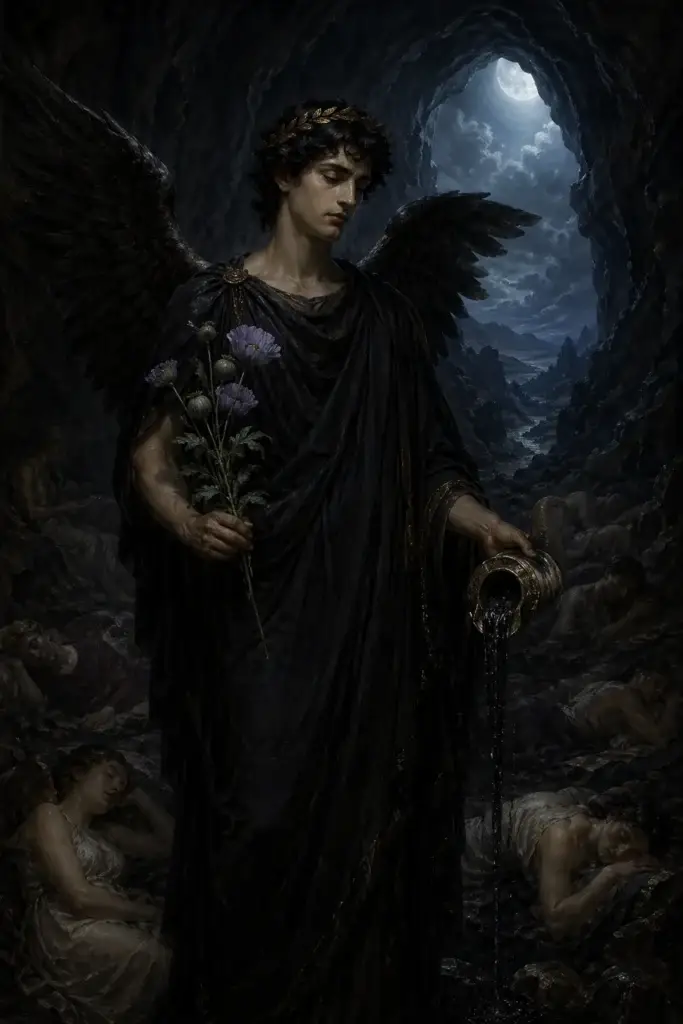
Hypnos is depicted as a youthful man with fleeting wings, similar to Thanatos but less somber. His symbols are the poppy (especially the opium poppy, source of the sleeping draught), sometimes a sleep flask, a torch (which he extinguishes), and in later depictions a staff (similar to the caduceus of Hermes).
His face is peaceful, his expression gentle. Sometimes he is depicted with wings in his hair or as a fully feathered figure.
Characteristics
Hypnos is not actively worshipped but respectfully acknowledged. Sleep is necessary, yet not the object of major cults. People pray to Hypnos when they need sleep, especially the sick and those in distress.
In literature he is often employed as a helper or mediator; he can enchant Zeus, can help heroes toward sound decisions. His sleeping draught is powerful but not immediately deadly (that is Thanatos). Hypnos symbolizes rest, healing, and regeneration, necessary for life and meaning.
Appearance and Symbolism
Hypnos is depicted as a gentle-faced, youthful man, sometimes with wings (to show the mobility of sleep). The sleep poppy is his primary attribute, a flower from which opium is obtained. Sometimes he carries a torch dipped into sleep, or a scepter.
The poppy and the silver linden were sacred to him. His color is the dark violet or black of the night. In contrast to his brother Thanatos (usually depicted as older, crueler), Hypnos is young and understanding. He symbolizes not the end but temporary dissolution, a blessing, not a punishment.
Profile: Hypnos
Hesiod calls Hypnos a son of Night (Nyx) and twin brother of Death (Thanatos), with whom he dwells in the west beyond Oceanus. In the Iliad, Homer portrays him as a god whom even Zeus must fear: at Hera’s request, Hypnos puts the father of the gods to sleep on Mount Ida and receives the Charis Pasithea as his wife in return. As father of the dream gods, above all Morpheus, later poetry links him closely with the world of dreams.
Genealogy: Son of Nyx (goddess of the night), one of the oldest beings. Brother: Thanatos (Death). Son: Morpheus (Dreams, in late versions). His mother Nyx is a primordial goddess older than Olympus. An archaic family existing before the Titans.
Function: Universal god of sleep, acting on gods and humans alike. He brings not only rest but also forgetting and the dissolution of the will.
He is venerated magically and therapeutically as a healer who brings relief to the sick.
Sphere of influence: All seek his blessing. The dead and the living meet in his realm.
Ancient art usually depicts Hypnos as a winged youth, often with wings at his temples, pouring sleep from a horn or carrying a poppy stem. On the famous Euphronios krater, he carries the fallen Sarpedon from the battlefield together with his brother Thanatos. Poppies and the water of Lethe, the river of forgetfulness, are his fixed attributes, symbolizing the gliding into sleep and oblivion.
Mythic effect: Homer, Iliad XIV: Hypnos is commissioned by Hera to lull Zeus to sleep in support of the Greeks. The all-powerful Zeus is left defenseless.
Afterward, threatened by Zeus, he flees to Nyx, the only power Zeus respects. Ovid: a detailed depiction of the palace of Hypnos with a thousand dream gods. Virgil: a border guard between the upper and the underworld.
The Greeks knew no warding off of Hypnos in the sense of a protective ritual, for sleep was considered a beneficial, even healing power. In the cult of Asclepius, temple sleep (incubation) was actually sought out deliberately, because the god was expected to appear to the sick in a dream. In the myths Hypnos becomes dangerous only as the instrument of others, for instance when Hera deploys him against Zeus; caution was therefore directed at the intention behind the sleep, not at sleep itself.
Hypnos has direct or functional parallels in numerous cultures. Somnus (Roman) is his direct identification; Ovid (Metamorphoses XI, 592-748) describes Somnus’ cave in detail, where waters of Lethe and poppies flow; Virgil (Aeneid V, 838-861) has Somnus take the helmsman Palinurus by surprise and pull him into sleep.
In the Hindu context, Nidra corresponds as the personification of sleep; she is invoked in the Devi Mahatmya as the Yoga Maya of Vishnu. In the Celtic sphere: Conn-Eda (Irish) as the “sleep-giver.” In the Germanic context, the Edda knows no direct god of sleep, but Frigg possesses sleep-giving power.
The structural constant: sleep as a divine power, often a sibling or double of the god of death (Hypnos-Thanatos, Somnus-Mors), residing in a dark, cave-like world.
Practical Means of Protection
Rituals of Veneration
In Greece, sleep sanctuaries were specialized, especially at healing centers such as Epidaurus (the Asclepius sanctuary). Patients fell asleep under ritual conditions for dream healing (incubation cult). Rituals at night altars were performed to request a blessing.
Invocations and Appeals
Orphic Hymn 84 is a formula of invocation: “Sleep, sweet father, who subdues all…” Magical papyri of Egypt: formulas “Hypnos, father of dreams, bring rest and healing.” Invocations against insomnia.
Amulets and Protective Symbols
Poppy amulet (sacred plant with opiates). Sleep stelae as apotropaic symbols. Roman rings: Hypnos with wings and a poppy stalk. Herbal sachets with valerian, lavender, poppy.
Hypnos, Parallels in Other Cultures
Gods of sleep and personifications of rest exist everywhere: Somnus (Rome), Bes (Egypt, also protection), Morpheus (later Greek). In Eastern traditions there are no comparable personifications; sleep is more a state than a power.
Hypnos differs from Thanatos through his gentleness and reversibility: sleep is temporary, death final. His closeness to Nyx and the night makes him fundamental to the cosmic order.
Hypnos in the Iliad: Sleep as an Acting Power
The most extensive narrative treatment of Hypnos in early Greek poetry stands in the Iliad (Book 14), in the so-called “Deception of Zeus.” Hera wants to influence the outcome of the battle in favor of the Greeks and must therefore put Zeus out of action.
She seeks out Hypnos and asks him to lull Zeus to sleep once she has united with him.
Hypnos hesitates. He recalls that he once before lulled Zeus to sleep at Hera’s request, that time while Heracles was returning home from Troy. The awakened Zeus had been so enraged that Hypnos escaped punishment only by fleeing to his mother Nyx.
Only when Hera promises him one of the Charites, Pasithea, as his wife does Hypnos agree. He accompanies Hera to Mount Ida, settles in the form of a bird in a tree, and waits.
After Zeus is overcome by love and sleep, Hypnos hurries to Poseidon to report the situation, so that he may intervene in the fighting.
This episode is informative for the history of religion. Here Hypnos is not a mere personification of a state but an acting, speaking figure with his own history, his own concerns, and his own demands.
At the same time, the passage shows the limits of his power: to bring sleep over Zeus is dangerous and requires special circumstances.
The close connection to Nyx, the Night, with whom Hypnos finds protection, and his significance as the brother of Death are already suggested in this narrative. Anyone wishing to pursue the related thread will find separate entries on Nyx and on Thanatos.
Brother of Death: Hypnos and Thanatos in Myth and Image
A firmly established conception of Greek religion closely links Hypnos with Thanatos, Death. In the Theogony Hesiod names both as children of Nyx and describes them as brothers who dwell together. Sleep and death were regarded as kindred powers, sleep being in a sense the milder image of death.
A well-known episode in which both appear together likewise stands in the Iliad (Book 16). After the death of Sarpedon, a son of Zeus, the father of the gods commissions Apollo to recover the corpse and hand it over to Hypnos and Thanatos.
The two brothers carry the dead hero to his homeland of Lycia so that he may receive an honorable burial there. Here sleep and death appear as gentle, caring powers that carefully escort the fallen.
This motif has a rich pictorial tradition. Especially well known is an Attic vase, the so-called Euphronios vase, on which Hypnos and Thanatos carry off the body of Sarpedon as winged male figures while Hermes oversees the scene. The winged depiction later became typical.
In the visual art of antiquity, and especially in Roman sepulchral art, Hypnos was frequently depicted as a beautiful, winged youth, often sleeping or with poppies and an inverted torch or horn motif.
This visual language, in which sleep and death can hardly be distinguished, shaped funerary art beyond antiquity and continued to influence allegory into the modern era.
The Cave of Sleep in Ovid
The most detailed literary depiction of the dwelling of Hypnos comes from the Roman poet Ovid, who in the Metamorphoses (Book 11) describes the cave of the sleep god, under his Roman name Somnus. The passage is one of the most influential texts of ancient literature on sleep.
Ovid places the cave in a distant, sunless region where neither day nor full night ever prevails, but only a dim twilight. No cock crows there, no dog barks, no bird and no animal makes a sound; even the branches do not move, and no human voice is to be heard.
From the ground wells up the river Lethe, the water of forgetting, whose trickling invites sleep. Before the entrance grow poppies and numbing herbs.
In the cave Somnus himself lies on a black bed of soft material and sleeps. Around him the countless dream figures lie scattered. Ovid singles out three of them in particular and gives them names: Morpheus, who can deceptively imitate human forms, and two others who can take on animals and inanimate things.
This description became extraordinarily influential for later European literature. It shaped the image of the realm of sleep beyond the Middle Ages and the Renaissance.
From the standpoint of religious studies it is less a testimony to lived cult, for a cult of Hypnos was only weakly developed, than a testimony to the literary and allegorical elaboration of a personification that in antiquity lived less in the temple than in poetry.