Lạc Long Quân, the dragon father of the hundred eggs
By Ralf Ittermann · last reviewed on
Lạc Long Quân is a god of Vietnamese tradition.
Dragon father of the Vietnamese and forefather of the Hùng kings. Lạc Long Quân is regarded as the dragon lord and ancestor of Vietnam, and the article explains how this origin story is built.
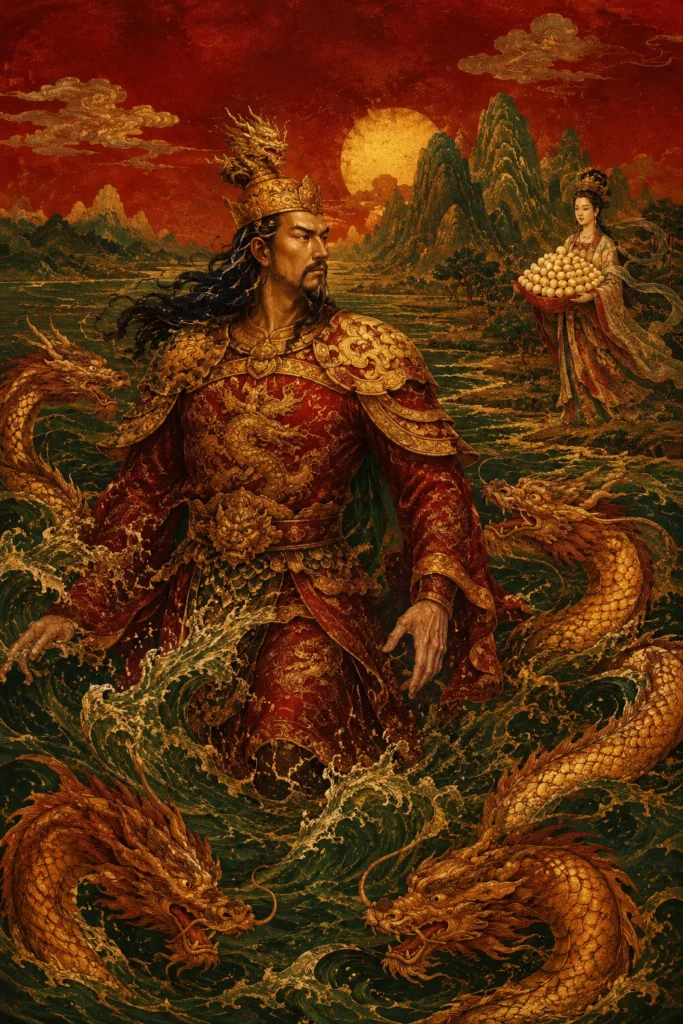
Lạc Long Quân, also transcribed as Lac Long Quan, is the Dragon Lord of Lạc, the central figure of the Vietnamese origin myth. He marries the mountain fairy Âu Cơ; from her sack of a hundred eggs the Vietnamese people arise, hence ‘children of the dragon, grandchildren of the fairy’.
Type: king of dragon lineage
Origin: oral, written down in the 14th/15th century
Texts: Lĩnh Nam chích quái, Đại Việt sử ký
Period: prehistoric to medieval
Appearance: dragon king, progenitor
Textual history
Period of the Texts
Oral tradition, written down in the 14th/15th century to establish Vietnamese sovereignty.
Area of Diffusion
Northern Vietnam, the Red River Delta with the core region of Phú Thọ.
Sources
Sparse and nationally shaped; the main sources are late chronicles.
Name and variants
Vietnamese: Lạc Long Quân means Dragon Lord of Lạc; Long Vương is the Vietnamese title Dragon King.
Nature and effect
Appearance
He embodies water, sea, dragon; Âu Cơ represents mountain and fire.
Effect
As a slayer of monsters, he kills the fish demon and the fox demon; as a culture bringer, he teaches farming.
Profile: Lạc Long Quân
The key aspects of the dragon father at a glance.
Vietnamese origin myth, written down late in the 14th/15th century.
Descent and unity of the Vietnamese people.
King of dragon lineage, depicted surrounded by dragon bodies.
Progenitor and culture bringer; his eldest son founds the Hùng dynasty.
Ancestor worship in Bình Đà, the Hùng Kings’ Festival in the third lunar month.
The Chinese Dragon King (Long Vương); to be distinguished from Phaya Naga.
The dragon, the fairy and the hundred eggs
Because dragon and fairy cannot live together permanently, the two separate: fifty children follow the father to the sea, fifty follow the mother into the mountains. The eldest son becomes the first Hùng king and founds Phong Châu. The late written record is at times considered unreliable.
From school lesson to street name
Lạc Long Quân is a cornerstone of the Vietnamese national myth and school curriculum. In religious studies, the myth explains descent and unity as the union of dragon and fairy, later transferred into ancestor worship.
Ancestor worship, not warding off
Veneration takes place through ancestor worship, not warding off: officials and the people built the Nội Temple in Bình Đà, today a national monument. Amulets serve ancestor veneration, incense the procession, bells the sacred area.
Dragon kings of East Asia compared
Lạc Long Quân belongs to the East Asian Dragon King archetype; his title Long Vương corresponds to the Dragon King. Unlike the naga cult of Phaya Naga, he remains true to the dragon.
Frequently asked questions about Lạc Long Quân
Why a hundred sons from eggs?
The marriage with Âu Cơ produced a sack of a hundred eggs, the forebears of the Vietnamese.
Is it historically documented?
No, the record was written down late and is at times dismissed as unreliable.
Further links
Internal links:
Literature (selection)
Further standard works in the bibliography.
Known internationally as Lac Long Quan Dragon, Lạc Long Quân remains the progenitor of Vietnam: his union with Âu Cơ establishes the ‘children of the dragon, grandchildren of the fairy’.