Gugurang, guardian of the sacred fire in Mayon
By Ralf Ittermann · last reviewed on
Gugurang is a god of the Philippine Bicol tradition.
Highest god of the Bicol, guardian of the sacred fire in Mayon.
Gugurang is the highest, benevolent being of the Bicol on southern Luzon and the counterpart of the evil Asuang. He is an equivalent of the Bathala of the Tagalog and watches over his people as an ordering principle.
In the widespread narrative, he keeps the sacred fire in the Mayon volcano; when the volcano erupts, this is regarded as a sign of his wrath or a theft of the fire. This fire myth, however, is a modern compilation, while the core of the figure is older.
Type: Highest benevolent god, guardian of the sacred fire
Origin: Bicol tradition, southern Luzon
Texts: Bicol tradition, core attested early, fire myth modern
Period: Core early, embellishment modern
Appearance: powerful, barely described supreme deity

Source situation and context
Period of the Texts
The core of the tradition is attested early, whereas the popular fire myth is modern; the source situation is correspondingly mixed.
Area of Diffusion
The Bicol region on southern Luzon, Philippines: there Gugurang is the highest being and Mayon his visible point of reference.
Sources
Mixed: the core as highest god is attested, the embellishment involving fire and Mayon is a modern compilation.
Name and variants
Bicol: The etymology is not certain; popularly the name is interpreted as the Old One or the Venerable One, though a reliable derivation is lacking.
Appearance and behaviour
Appearance
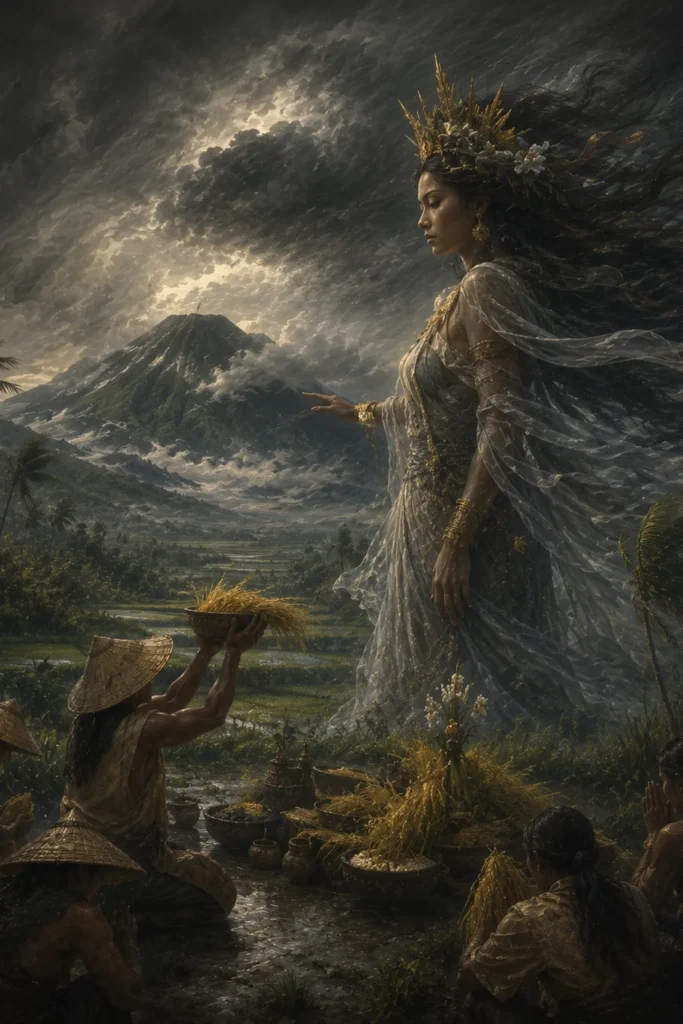
Gugurang is barely described in the sources; modern depictions as a powerful figure in Mayon are embellishment. He embodies the highest, ordering principle and the guardian of the sacred fire.
Effect
As guardian of the sacred fire, Gugurang watches over order. In the modern narrative logic, Mayon erupts when Asuang attempts to steal the fire; Gugurang then sends lightning, Linti, and thunder, Dalogdog.
Profile: Gugurang
The most important aspects of the highest god of the Bicol at a glance.
Highest benevolent being of the Bicol, equivalent of the Bathala of the Tagalog and counterpart of the evil Asuang.
The Bicol people and order: Gugurang watches over his people as the highest god and guards the sacred fire.
Barely described; the powerful figure in Mayon is modern embellishment, the sources remain reticent.
Highest benevolent god; in the modern narrative he sends lightning, Linti, and thunder, Dalogdog, when the fire is stolen.
Specific Gugurang rites are poorly attested; what is attested is the general Anito worship of the Bicol, with offerings to ancestor and nature spirits.
Kan-Laon of the Visaya and the Bathala of the Tagalog as highest gods; the fire-guardian motif resembles the Prometheus material.
Gugurang and Asuang: order against the theft of fire
What is certain is the core: Gugurang is the highest benevolent being of the Bicol, an equivalent of the Bathala of the Tagalog, and counterpart of the evil Asuang. This dualistic good-evil pair is a distinctive feature of the Bicol tradition.
The myth that Gugurang keeps the sacred fire in Mayon and Asuang steals it, however, is a modern compilation and does not appear in the Ibalong epic. In this narrative logic, the volcano erupts when the theft of fire is attempted, and Gugurang responds with lightning, Linti, and thunder, Dalogdog. Anyone who takes the figure seriously must separate the two layers: the early attested highest god and the recent fire narrative.
Modern afterlife and classification
Gugurang is a fixture of modern collections on Philippine mythology, in comics and in the Anito revival. The fire attribute is younger than his core as highest god.
From a religious-studies perspective, Gugurang shows a supreme, benevolent creator god whose fire attribute is secondary and partly modern. Three clarifications are important: the fire-in-Mayon myth is modern, not old. Gugurang is not part of the Ibalong epic. And he is primarily the highest god, with fire as a secondary attribute.
Anito worship and gap in evidence
Specific Gugurang rites are poorly attested. What is attested is the general Anito worship of the Bicol, that is, the veneration of ancestor and nature spirits with offerings; a distinct, primary-source-supported cult form for Gugurang, by contrast, is not documented. This should be honestly noted as a gap in evidence: the highest god of the Bicol is better attested than any cult that might have been devoted to him.
Highest gods of the Philippines
Gugurang, as the highest creator and protector god, is close to the Bathala of the Tagalog and the Kan-Laon of the Visaya; the volcano goddess Lalahon also belongs to this neighbourhood of Philippine mountain and volcano beings. The motif of the fire guardian from whom the fire is stolen resembles the Prometheus motif; the dualistic good-evil pair of Gugurang and Asuang is a distinctive feature of its own.
Frequently asked questions about Gugurang
Who is Gugurang?
The highest, benevolent being of the Bicol and counterpart of the evil Asuang.
Does he keep the fire in Mayon?
This narrative is a modern compilation and does not appear in the old Ibalong epic.
Who is Asuang?
His evil counterpart, who in the modern narrative attempts to steal the sacred fire.
Further links
Further reading:
- Kan-Laon – the highest god of the Visaya as a counterpart
- Lalahon – the harvest and volcano goddess of the Visaya
- Protective candle, smoke cleansing, amulet – recommended protective means
- Protection Compass – protective means at a glance
Literature (selection)
Further standard works in the bibliography.
Gugurang remains the highest god for the Bicol, however recent his fire narrative may be: as guardian of the fire in Mayon, the modern tradition has merely given the old, benevolent god of order a shining landmark.