Kamuy-Huci, the grandmother in the hearth fire
By Ralf Ittermann · last reviewed on
Kamuy-Huci is a goddess of the Ainu tradition.
The grandmother in the hearth fire, mediator to all Kamuy.
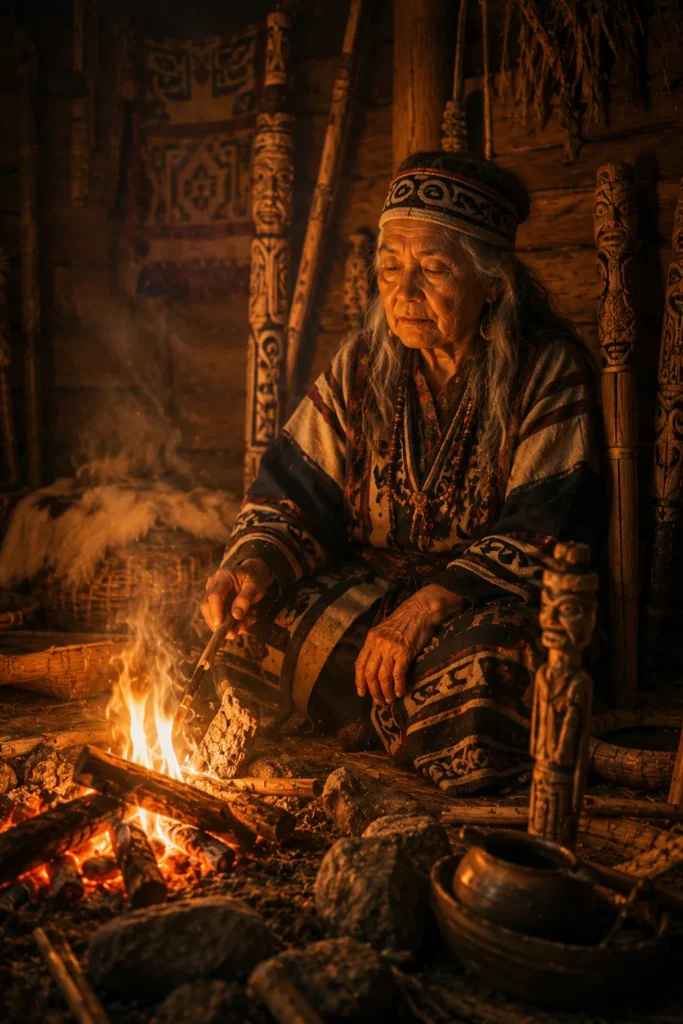
Kamuy-Huci, also known as Fuchi or Ape-huci, is the Ainu goddess of the hearth fire who dwells as grandmother in the fire of the house. She is the most important deity and the one closest to humans; every prayer and every offering to the other Kamuy passes first through her.
Her visible sign is the hearth fire that never goes out. She embodies warmth, constancy and the connection between the household and the world of the deities.
Type: Hearth fire goddess, mediator between humans and Kamuy
Origin: Ainu religion of northern Japan
Texts: oral tradition, ethnographic research
Period: living Ainu tradition
Appearance: dignified old woman, grandmother, dwelling in the hearth fire
Historical Background
Period of the Texts
The tradition is oral and rooted in the living Ainu religion; it is documented mainly through ethnography.
Area of Diffusion
The territory of the Ainu on Hokkaido, Sakhalin and the Kuril Islands; her place is the hearth of every individual dwelling.
Sources
Well documented ethnographically, from Batchelor to Munro; Ainu culture is receiving renewed attention and care today.
Name and variants
Ainu: kamuy means deity, huci grandmother, ape is fire. Kamuy-Huci is the grandmother of the hearth fire; alternative forms of the name include Fuchi and Ape-huci.
Being and effect
Appearance
Kamuy-Huci is envisioned as a dignified old woman who sits in the hearth fire. Her visible sign is the hearth fire that never goes out; she embodies warmth, constancy and the connection between the household and the world of the deities.
Effect
She watches over the household, protects against illness and evil powers, and observes the behaviour of people. Above all, she is the mediator: requests to the other Kamuy are conveyed through the hearth fire and thus through Kamuy-Huci.
Profile: Kamuy-Huci
The key aspects of the hearth goddess at a glance.
The oldest and most reliable deity of the Ainu religion, constantly present in the hearth of every Ainu dwelling.
Every household and all rites: she watches over the family and conveys every request to the other Kamuy.
A dignified old woman who sits in the hearth fire; her visible sign is the never-dying flame of the hearth.
Protection against illness and evil powers, warmth and constancy; she observes the behaviour of people in the house.
Tending the never-dying hearth fire, carved prayer sticks called inaw, and libations; she is honoured first in all household rites.
The grandmother of the hearth fire in the Ainu religion
Ainu kamuy means deity, huci grandmother; ape is fire. Kamuy-Huci is the grandmother of the hearth fire, constantly present in the hearth of every Ainu dwelling. She is considered the oldest and most reliable of the deities; the tradition is oral and rooted in the living Ainu religion.
Her special standing lies in her role as mediator: whoever wishes to turn to any deity speaks first to her, for every prayer and every gift passes through the hearth fire. Thus the hearth of the Ainu dwelling is at once the dwelling place of the nearest deity and the threshold to the entire world of the gods.
Research and Classification
Kamuy-Huci is well documented through ethnographic Ainu research and is a central example of hearth and fire veneration in Northeast Asia. Ainu culture is receiving renewed attention and care today.
From the perspective of religious studies, Kamuy-Huci is a textbook example of the hearth fire as the centre of household and ritual and as mediator between humans and the world of the gods. That all prayers pass first through her shows the religious primacy of the hearth fire in Ainu cosmology.
Hearth tending, inaw and libations
Well attested is the tending of the hearth fire, which must not go out. Prayers and offerings are made to Kamuy-Huci first, before turning to other deities; carved prayer sticks called inaw and libations are part of the rite. Keeping the fire pure and putting nothing unclean into the hearth is a rule. Kamuy-Huci takes first place in all household rites.
Hearth goddesses and mediators of offerings compared
As hearth goddess and mediator, Kamuy-Huci corresponds to the Greek Hestia, who is honoured first in offerings. Alongside her stand the Japanese hearth and kitchen deity Kojin and the Vedic Agni as the fire that carries offerings to the gods: the same basic idea, that the flame of the house is the messenger of the divine world, runs through all three traditions.
Frequently asked questions about Kamuy-Huci
Who is Kamuy-Huci?
The goddess of the hearth fire of the Ainu, who dwells as grandmother in the fire of every house. She is regarded as the oldest and most reliable of the deities.
Why is she so important?
She is the deity closest to humans and the mediator through whom all prayers and offerings reach the other Kamuy.
What is an inaw?
A carved prayer stick of the Ainu, used in rituals, including those for Kamuy-Huci.
Further links
Further reading:
- Hestia – the Greek hearth goddess as a parallel
- Kojin – the Japanese hearth and kitchen deity
- Agni – the Vedic fire as mediator of offerings
- Protective candle, smoke cleansing, amulet – traditional protective means
Literature (selection)
Further standard works in the bibliography.
As grandmother of the hearth fire, Kamuy-Huci is for the Ainu both hearth goddess and mediator: the flame in the hut’s hearth is her body, her eye watching over the family, and the path by which every prayer reaches the divine world.