Gumennik, the guardian of the threshing ground
By Ralf Ittermann · last reviewed on
The Gumennik is a spirit of the Slavic tradition.
Fire-prone guardian of the threshing floor and threshing ground. The Gumennik belongs to the folklore of the East Slavs as a guardian tied to the threshing floor.
The Gumennik is the East Slavic spirit of the threshing floor and threshing ground, a close relative of the Ovinnik. Where the two are distinguished, the rule is: the Ovinnik acts inside the kiln barn, the Gumennik outside on the threshing ground.
He guards the stored grain and carries the same fire risk as the Ovinnik; he is placated with the same offerings, a rooster and blini. His independent tradition, however, is the thinnest among the household spirits.
Type: threshing-floor and threshing-ground spirit, usually a local variant of the Ovinnik
Origin: East Slavic folk belief
Texts: folkloric collections of the 19th and early 20th centuries
Period: attested in the 19th century
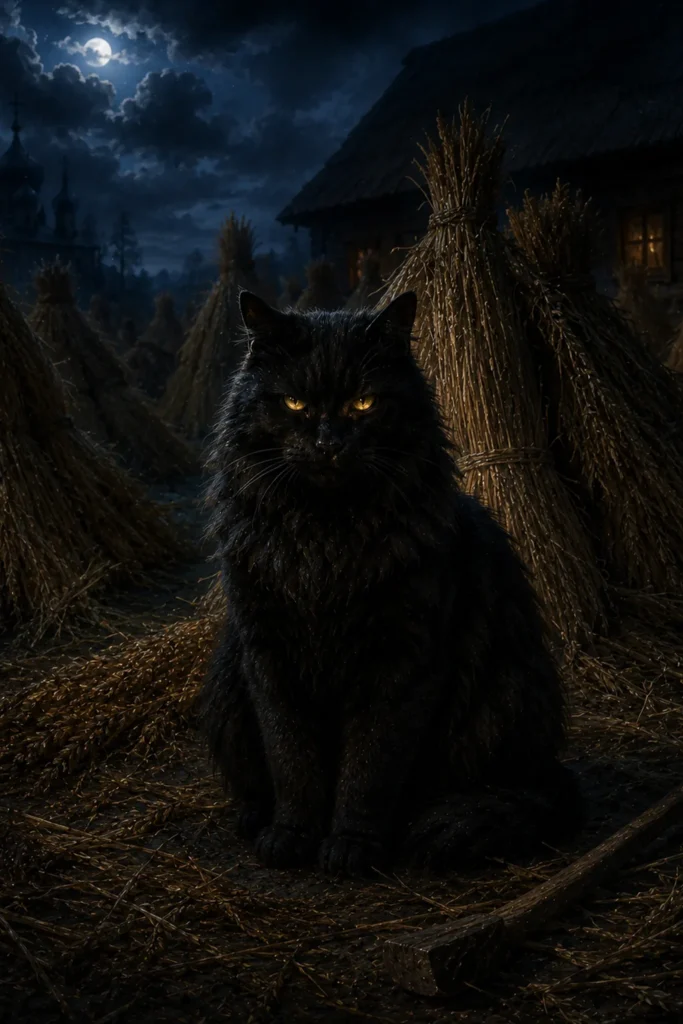
Appearance: like the Ovinnik, often a large black tomcat
Source context
Period of the Texts
East Slavic folk belief of the 19th century; attested in the same folkloric collections of the 19th and early 20th centuries as the Ovinnik.
Area of Diffusion
Russia and Belarus: the Gumennik shares the range of the Ovinnik in East Slavic villages.
Sources
Thin: the Gumennik appears in the sources mostly under the Ovinnik; in many collections it is simply stated that the Ovinnik is also called Gumennik.
Name and variants
Russian: gumennik, from gumno, threshing floor or threshing ground. A related form is rigatschnik, from riga, kiln barn. The name simply denotes the place to which the spirit is bound.
Being and effect
Appearance
The Gumennik largely resembles the Ovinnik, often appearing as a large black tomcat, and is considered a fire hazard.
Effect
He guards the threshing floor and the stored grain and carries the same fire risk as the Ovinnik. To be fair: the Gumennik has the thinnest independent tradition among the household spirits; in many sources he is simply another name for the Ovinnik.
Profile: Gumennik
The key aspects of the threshing-floor spirit at a glance.
East Slavic folk belief: spirit of the farm buildings, listed in the sources mostly as a local variant of the Ovinnik.
The threshing floor and threshing ground with the stored grain; where distinguished, the outdoor area belongs to him, the inside of the kiln barn to the Ovinnik.
Largely like the Ovinnik, often as a large black tomcat; an appearance belonging to him alone is barely attested.
Guarding the threshing ground and the grain, linked to the fire risk of drying-related farming.
Rooster offerings and blini for placation, along with observing the forbidden days for making fire, as with the Ovinnik.
A spirit with a borrowed profile
The name comes from gumno, threshing floor or threshing ground; a related form is rigatschnik, from riga, kiln barn. The Gumennik shares the range of the Ovinnik in Russia and Belarus and is attested in the same folkloric collections of the 19th and early 20th centuries.
His profile is almost entirely borrowed from the Ovinnik: appearance, offerings and fire risk match, and in many sources it is simply said that the Ovinnik is also called Gumennik. Where the tradition separates the two, it follows location: the Ovinnik inside the kiln barn, the Gumennik outside on the threshing ground.
Reception and classification
The Gumennik appears almost only in specialist accounts and overviews of Slavic house spirits, usually as an addendum to the Ovinnik.
In religious studies, he is a fire-prone threshing-floor spirit. Important clarifications: whether he is an independent being or merely a local variant of the Ovinnik depends on the source and is disputed; he shares appearance, offerings and fire risk with the Ovinnik; and the distinction follows mainly the location, inside versus outside.
Placation following the pattern of the Ovinnik
As with the Ovinnik, rooster offerings and blini served to placate the Gumennik, along with observing the forbidden days for making fire. A ritual attributed solely to the Gumennik is barely documented; the way he was dealt with follows the general pattern of the dangerous household spirits, whose goodwill was secured through offerings and rule observance.
Spirits of the farm buildings
Frequently asked questions about the Gumennik
What is a Gumennik?
The East Slavic spirit of the threshing floor and threshing ground, a close relative of the Ovinnik. He guards the stored grain.
Is he the same as the Ovinnik?
Often yes. In many sources, Gumennik is simply another name for the Ovinnik; where they are distinguished, the Gumennik acts outside, the Ovinnik in the kiln barn.
Is he dangerous?
Yes, he shares the fire risk and the malicious tendency of the Ovinnik. He was placated with rooster offerings and blini.
Further links
Further reading:
- Slavic – all beings of Slavic mythology
- Ovinnik – the kiln-barn spirit, of which the Gumennik is usually a local variant
- Bannik – the related spirit of the bathhouse
- Iron, Salt, Holy Water – traditional protective means
- Protection Compass – protective means at a glance
Literature (selection)
Further standard works in the bibliography.
As an East Slavic threshing-floor and threshing-ground spirit, the Gumennik remains the shadow of the Ovinnik: a guardian of the grain whose own face tradition has preserved only in outline.