Ragnarök: the fall and renewal of the world in Norse myth
By Ralf Ittermann · last reviewed on
Ragnarök is the eschatological myth of Norse tradition. It tells of the fall of the gods and the world in the battle against the hostile powers, and of the rise of a renewed earth from the sea. In doing so it joins end times and new beginning into a single great narrative arc.

Overview
In Norse mythology, Ragnarök denotes the events at the end of the world: the fall of the gods, the collapse of the cosmos and the subsequent renewal of the earth.
It is not a person or a being but a myth, a coherent sequence of events that the tradition describes as the predetermined fate of all powers.
Within the religion of the Germanic world, more precisely the Old Norse tradition of Scandinavia and Iceland, Ragnarök holds a special place.
It is the only fully developed end-of-the-world myth, and it is closely bound up with the idea that even the gods are subject to fate. Unlike the immortal gods of other religions, the Norse gods know of their own end and yet go to meet it.
In religious-studies terms, Ragnarök belongs to the eschatologies, the teachings of the last things. Characteristic is the linking of fall and renewal: the myth does not end with destruction but with the rise of a new, purified world.
In this it differs from a purely catastrophic conception and approaches a cyclical model in which end and beginning interlock.
Name and etymology
The Old Norse term ragnarök is compounded from ragna, the genitive plural of regin, the counselling powers or gods, and rök, fate, doom or origin. The literal meaning is therefore the fate of the gods or the doom of the powers.
Alongside this, the sources also show the form ragnarøkkr, which derives from røkkr, twilight, and interprets the events as the twilight of the gods.
This second reading is probably secondary in linguistic terms, but it has had a great influence on later reception. Through the German translation Götterdämmerung the term became known far beyond specialist scholarship, not least through the music of the nineteenth century.
Scholarship today usually prefers the form Ragnarök with the meaning fate of the gods, because it stands closer to the older tradition.
Both readings are nevertheless old and stand for two aspects of the same myth: the predetermined doom on the one hand and the extinguishing of the divine powers of light on the other.
Signs and course of the narrative
The myth describes Ragnarök as an event announced by a series of signs. It is preceded by the Fimbulwinter, a threefold, unbroken winter with no summer in between, accompanied by war, moral decay and the disintegration of human order.
Brothers slay one another, all bonds dissolve. The Völuspá casts this decay in striking verses that speak of an axe age, a sword age, a wind age and a wolf age, and understand the social chaos as a herald of the cosmic.
Cosmic signs follow: wolves devour the sun and moon, the stars fall, the earth quakes, and all fetters break apart. The hostile powers are set free.
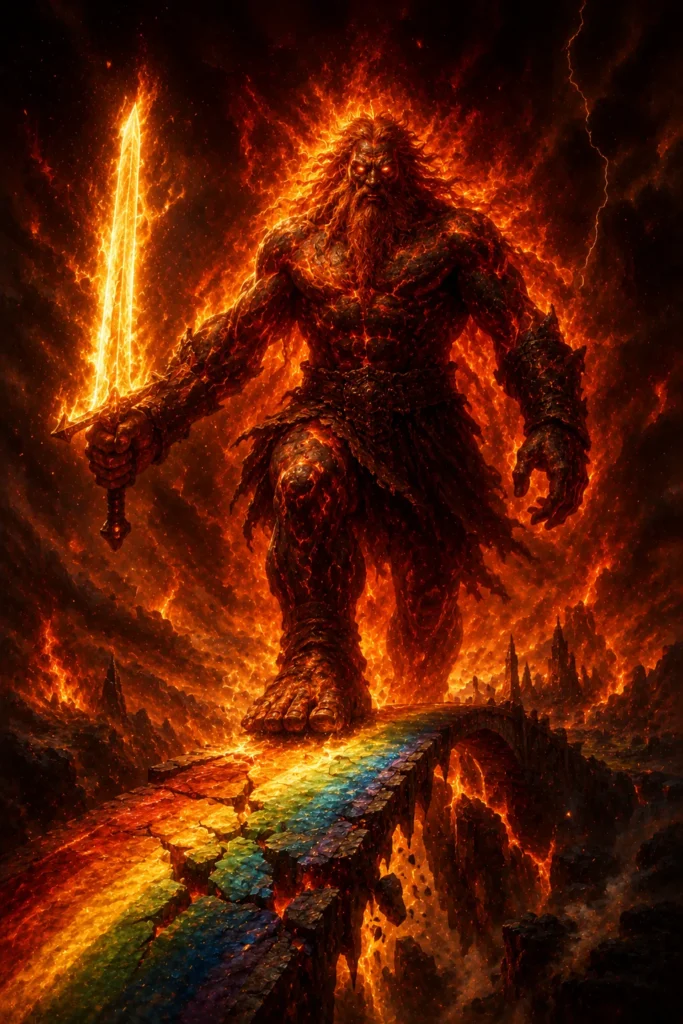
The bound wolf Fenrir breaks loose, the world serpent Jörmungandr rises from the sea, the death-ship Naglfar approaches with the powers of the deep, and the fire giants advance with their leader Surt from Muspellsheim and burn the world down.
The bound Loki too comes free and takes the side of the enemies. Heimdall, the watchman of the gods, blows the horn Gjallarhorn and calls the gods and the fallen warriors gathered in Valhalla to the final battle on the field of Vigrid.
On the great battlefield gods and enemies meet. Odin falls fighting the wolf Fenrir, who is avenged by his son Vidar. Thor slays the world serpent but, after nine steps, succumbs to its venom.
Freyr falls against Surt, the watchman Heimdall and Loki kill each other, as do the hound Garm and the war god Tyr.
Finally Surt’s fire engulfs the whole world, and the earth, consumed by the flames, sinks into the sea. The narrative arc, however, does not end here: from the water a new, green earth rises.
Gods such as Vidar, Vali and Thor’s sons survive, Balder returns from the realm of the dead, the human pair Lif and Lifthrasir have sheltered in a grove, and a new course of the world begins.
Mythology and tradition
The most important sources for Ragnarök are two thirteenth-century texts from Iceland. The Eddic poem Völuspá, the song of the seeress, depicts in dense, allusive language the whole course of the world from creation through the fall to renewal.
In his Prose Edda, Snorri Sturluson summarizes the myth systematically and cites older poems while ordering them according to his own understanding.
Further Eddic poems such as the Vafþrúðnismál supply individual building blocks, for instance on the survivors and the Fimbulwinter.
The tradition is thus neither uniform nor free of contradiction: the order of events, the figures involved and the details differ from one source to another. Much that is taken to be a fixed picture goes back to Snorri’s ordering hand.
To this is added the problem of dating. The written sources arose in Christian Iceland, more than two centuries after the official adoption of Christianity. Older scholarship saw a Christian influence in the linking of fall and renewed world, in which a higher, unnamed mighty one appears.
More recent scholarship judges more cautiously: the core of the myth, the battle of the gods against the powers of chaos and their predetermined fall, is regarded as pre-Christian, yet the surviving form is shaped in part by the Christian situation of its recording.
Place in cult and in the world of belief
Unlike a venerated being, Ragnarök was not the object of a cult of its own. There were no rites directed immediately at the end-of-the-world myth. Its significance lay in the world of belief and in the interpretation of human existence, not in a cultic practice.
Nevertheless, the thought of the predetermined end ran through the religious world of ideas. The gathering of the fallen warriors in the hall of the highest god, the preparation for the final battle described in the sources, linked the fate of the individual dead with the cosmic events.
Whoever fell honorably in battle was to stand on the side of the gods at the end. In this way the ideal of bravery gained an eschatological grounding.
In religious-studies terms, Ragnarök is often interpreted as the expression of an attitude in which the gods themselves are subject to fate and yet face it upright. This conception shaped the understanding of honor, courage and steadfastness.
Whether the people of the Viking Age understood the myth as imminent, as a distant doom or as a figurative interpretation of the order of the world cannot be determined unambiguously from the sources.
Interpretation in terms of protection and dealing with doom
Because Ragnarök was regarded as an unavoidable event fixed by fate, the tradition knew no apotropaic practice that could have averted it. The doom of the gods could not be halted by spell, offering or amulet. Protection in the narrower sense is therefore not a theme of the myth.
Dealing with doom lay instead on a different level. The gods themselves act with foresight: they bind the wolf and the other beings of chaos, they try to delay the calamity, although they know it will come.
This binding of the destructive powers holds the world together for the allotted time. In the myth it is the model of an action that preserves order without being able to deny the end.
For human beings the corresponding attitude lies in accepting fate and in honorable conduct within the set limits. In religious-studies terms, Ragnarök can thus be read as a myth that does not promise protection from the end but offers an interpretation of how to live with the certainty of the end.
The consolation lies not in defense but in the prospect of the renewed world that rises from the sea after the fall.
Pictorial and material evidence
Beyond the literary sources there is a series of pictorial witnesses that have been associated with the Ragnarök material. The Viking-Age picture stone of Ledberg in Sweden shows a figure being attacked by an animal at foot and leg, which has often been interpreted as Odin and the wolf Fenrir.
On the Gosforth Cross in Cumbria, England, a Christian monument of the tenth century, there are scenes read as the bound Loki, as Heimdall with the horn and as Vidar’s fight with the wolf.
These interpretations are not undisputed, for the images bear no inscriptions and allow several readings. They do show, however, that motifs of the end-of-the-world myth were already rendered pictorially in the Viking Age, that is, before the written recording in Völuspá and the Prose Edda.
The Gosforth Cross in particular is instructive: it joins Christian and pagan imagery on a single monument and shows that the myth remained alive in the transitional period and was reinterpreted.
In religious-studies terms such witnesses are valuable because they open an independent access to the tradition.
They support the assumption that a pre-Christian core existed, but at the same time they call for caution: image and text need not presuppose the same version of the myth, and some identifications rest more on the expectations of scholarship than on unambiguous features.
Parallels in other cultures
End-of-the-world myths are widespread in the history of religion, and Ragnarök can be compared with several of them.
In Iranian tradition there is the idea of a great confrontation between the powers of good and evil, at the end of which stands a purified, renewed world. Jewish-Christian apocalyptic likewise knows a final battle, a judgment and a new heaven and a new earth.
Striking in Ragnarök is the linking of fall and return, which brings it close to a cyclical worldview, such as is found, for example, in Indian conceptions of successive world ages.
At the same time the event remains unique and directed, which brings it closer to linear apocalyptic. Ragnarök thus stands between the cyclical and the linear model.
Within the Germanic world itself, the battle of the gods against the giants and beings of chaos is a recurring motif that finds its climax and its end in Ragnarök.
In religious-studies terms, caution is called for in all comparisons: the similarities show widespread patterns of interpretation but prove no direct dependence. The question of how much the surviving form owes to the Christian recording remains an important part of the discussion.
Present-day reception and scholarship
Ragnarök is among the most influential myths of Germanic tradition. Through the romantic enthusiasm for the Middle Ages in the nineteenth century, and especially through Richard Wagner’s stage work, whose final part bears the name Götterdämmerung, the myth became known to a broad public.
Since then it has been taken up many times in literature, visual art, film, games and popular culture, often greatly altered and removed from its source basis.
Scholarly research has concerned itself above all with two questions.
The first relates to the age and authenticity of the tradition: how much of what is preserved in the Völuspá and the Prose Edda is pre-Christian, and how strongly did the Christian situation of recording shape the myth? Rudolf Simek, Jan de Vries, Gro Steinsland and John Lindow have set different emphases here; the tendency of more recent scholarship is to assume a pre-Christian core while reading the surviving form as also shaped by the Christian period.
The second question relates to interpretation: is Ragnarök a pessimistic myth of doom or a hopeful myth of renewal? Scholarship usually stresses that the two belong together and that the myth has its distinctiveness precisely in this tension.
The modern appropriation is also treated critically, for instance when the myth is ideologically charged or misunderstood as a mere fantasy of doom. A source-based approach, by contrast, holds firm that Ragnarök joins end and beginning in a single narrative arc.
Literature (selection)
- Rudolf Simek: Lexikon der germanischen Mythologie (1984)
- Jan de Vries: Altgermanische Religionsgeschichte (1956-1957)
- Gro Steinsland: Norrøn religion. Myter, riter, samfunn (2005)
- John Lindow: Norse Mythology. A Guide to the Gods, Heroes, Rituals, and Beliefs (2001)
- Andreas Nordberg: Krigarna i Odins sal (2003)
As the end of the world of Norse tradition, Ragnarök describes the fall of the Æsir in the battle against the Jötnar, Fenrir and Surt, as well as the re-emergence of a purified world from the waters.
Related key terms: Ragnarök Götterdämmerung Fimbulwinter Völuspá Edda end-of-the-world myth eschatology regin.
iWell Guard and protective traditions
iWell Guard draws on the cultural-historical tradition of portable protective objects, in the tradition of Germanic and many other cultures worldwide. 41 layers, solid gold, platinum, silver, made in Germany. 30-day right of return.
Personal experiences may vary. Not a medical device. No promise of healing.