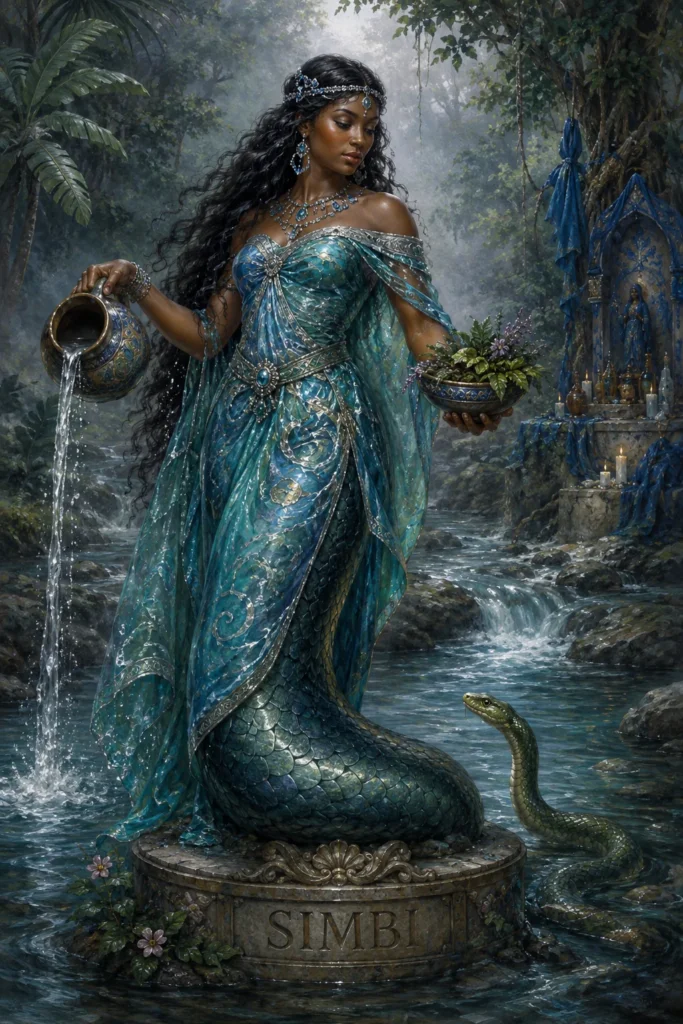
Lwa: mediator spirits between Bondye and humanity
By Ralf Ittermann · last reviewed on
The lwa are the central spirit beings of Haitian Vodou. They mediate between the distant creator god Bondye and humanity, and appear in an ordered way within the families of the Nanchon, above all Rada and Petwo. Through possession, sacrifice, and service, they remain in lasting exchange with the faithful.

Classification
The lwa, in older spelling also loa, form the religious center of Haitian Vodou. They are not gods in the sense of a closed pantheon, but mediator spirits who mediate between the creator god Bondye and the world of humans.
Bondye is regarded as almighty, yet at the same time as distant and inactive: he created the world but does not intervene directly in everyday life.
Religious practice is therefore directed almost entirely toward the lwa, who are experienced as approachable, reachable, and effective. In religious studies, this relationship is often described with the concept of the deus otiosus, the idle god, whose functions are taken over by active intermediary powers.
Vodou arose in colonial Saint-Domingue from the encounter of West African religions, above all from the area of present-day Benin, Togo, and Nigeria as well as from the Congo region, with the Catholicism of the French slaveholders.
The lwa bear the names and traits of African deities, but over the course of history they have merged with Catholic saints. This connection is not a mere mechanism of disguise, but an independent religious synthesis that persists to this day.
Within Vodou, the lwa are neither clearly good nor evil. They have character, preferences, weaknesses, and demands.
The human being stands in a relationship of mutual obligation with them: whoever inherits or accepts a lwa owes it service, and the lwa in turn owes assistance. This reciprocity clearly distinguishes Vodou from religions in which veneration is directed one-sidedly upward.
Name and etymology
The word lwa is, according to a widespread assumption, derived from a term in the Kwa languages of West Africa, in which related words mean spirit or deity.
Older scholarship also connected the term with the French loi, law, though this is now regarded as a folk etymology. The Haitian Creole spelling lwa has largely prevailed in scholarly literature over the older Frenchified form loa.
Alongside the collective term lwa, numerous further designations exist that indicate the function and origin of a spirit. The Nanchon, from French nation, denote the families or nations of the lwa and point to different African regions of origin. The most important are Rada and Petwo.
Rada lwa are regarded as cool, level-headed, and connected with the Dahomean and Yoruba-related traditions. Petwo lwa are regarded as hot, fast, and forceful; their name is often connected with a historical figure named Don Pedro and associated with the colonial experience of harshness and resistance.
Individual lwa bear proper names that indicate their domain. The title Papa or Manman frequently appears, emphasizing familial closeness, as do honorific additions such as Met, master.
The variety of names reflects the fact that Vodou knows no central teaching authority and has differentiated itself in varying ways regionally, by family, and through individual temples.
Description and forms of appearance
The lwa have no uniform form. They show themselves above all in two forms: in the symbolic signs with which they are invoked, and in bodily presence during possession.
Each lwa possesses a Veve, a complex ground sign that is strewn on the floor with flour, ash, or coffee powder during the ceremony and that, as it were, calls forth the spirit. The veve are not mere symbols but are regarded as effective lines of connection between the worlds.
Fixed attributes are assigned to each lwa: colors, foods, drinks, dances, rhythms, days of the week, and objects. These assignments allow the faithful to recognize a spirit and to serve it correctly. A lwa that demands a smoking implement, prefers a particular drink, or performs a particular dance figure thereby reveals itself.
In possession, the lwa rides the believer, which is why the human being is called chwal, horse. The spirit speaks, eats, dances, and acts through the body of the possessed person, who afterward usually has no memory of what happened.
The Catholic world of images provides a further form of appearance: on the altars of Vodou stand chromolithographs of saints, which at the same time serve as images of the respective lwa.
This double reading of a single image is characteristic of religious experience in Vodou and is not perceived by the faithful as a contradiction.
Mythology and tradition
Vodou possesses no canonical scripture and no systematically ordered mythology. The tradition lives in songs, prayers, dances, narratives, and in the practice of the temples. In them the lwa appear less in a coherent creation myth than in an abundance of individual stories that explain the character and domain of a spirit.
About Bondye, the creator god, there are hardly any narratives; it is precisely his distance that makes him narratively pale. The mythic energy concentrates on the lwa. Thus Danbala, a serpent figure, is regarded as the oldest spirit and the guardian of cosmic knowledge, and the rainbow figure Ayida Wedo as his companion.
Papa Legba watches at the crossroads and at the gate between the worlds; without his permission no other lwa can approach, which is why he is greeted first at the beginning of every ceremony.
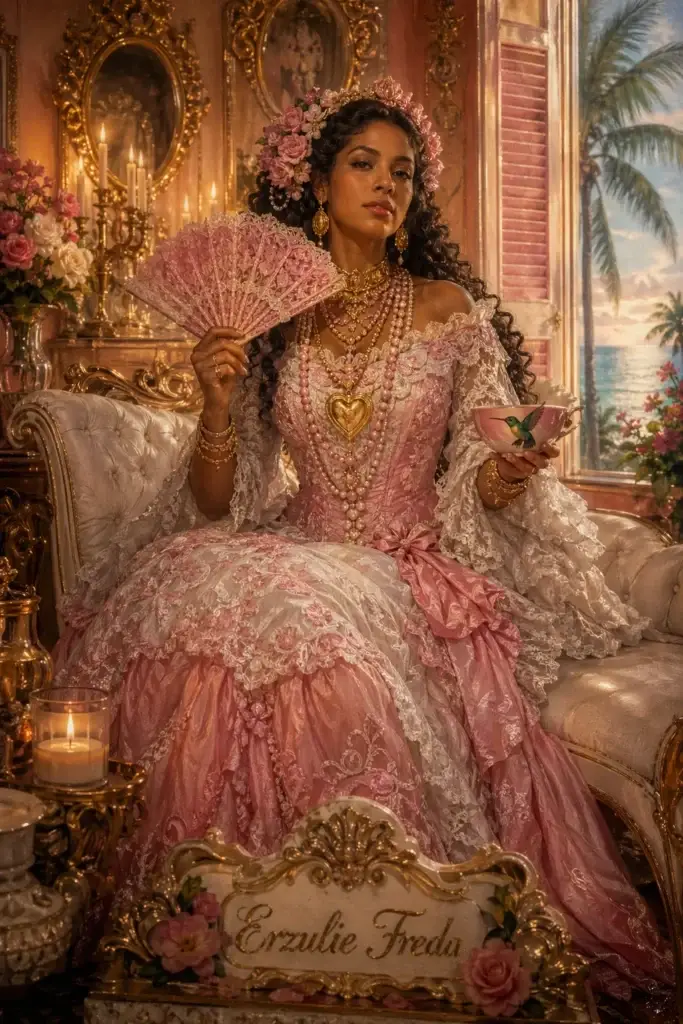
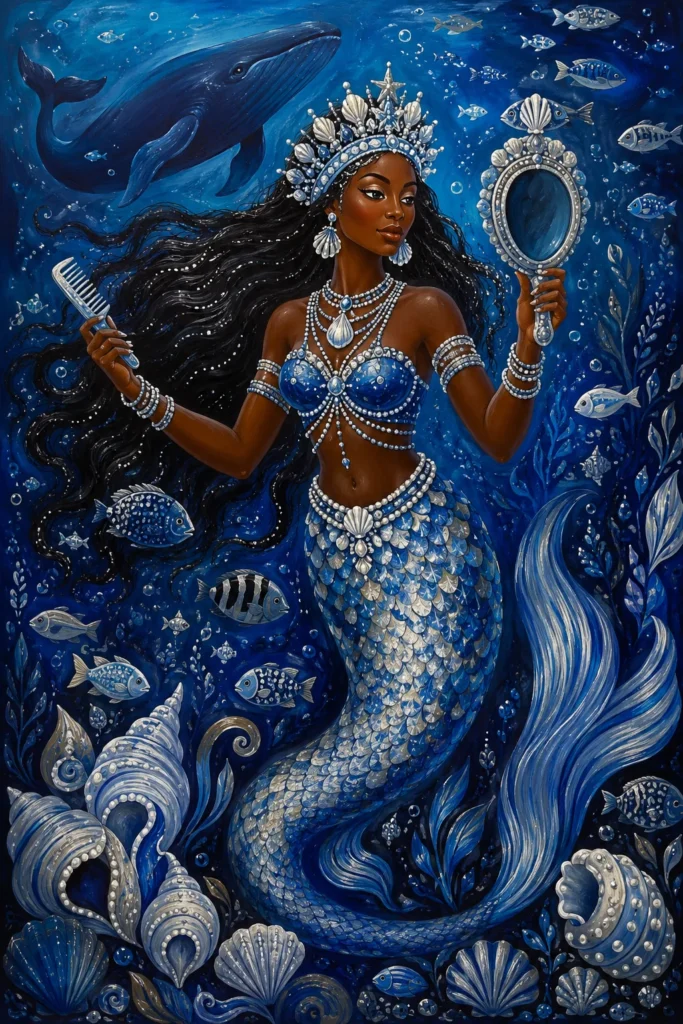
Kouzen Zaka, a lwa of agriculture, appears as a coarse peasant with a straw bag and pipe; Agwe is regarded as the lord of the sea, of ships, and of wealth; Ezili Freda, as a magnificently dressed woman, embodies love, beauty, and luxury, while the combative Ezili Dantor is reckoned to the Petwo family and stands for maternal harshness and protection.
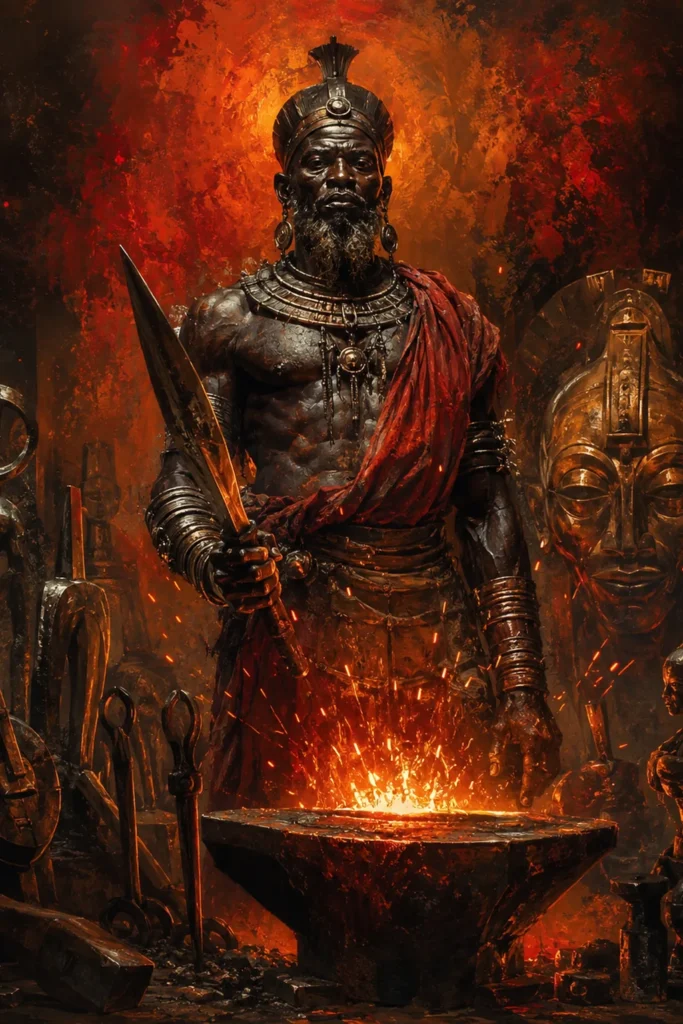
Ogou, a spirit of iron, war, and power, is frequently connected with Saint James.
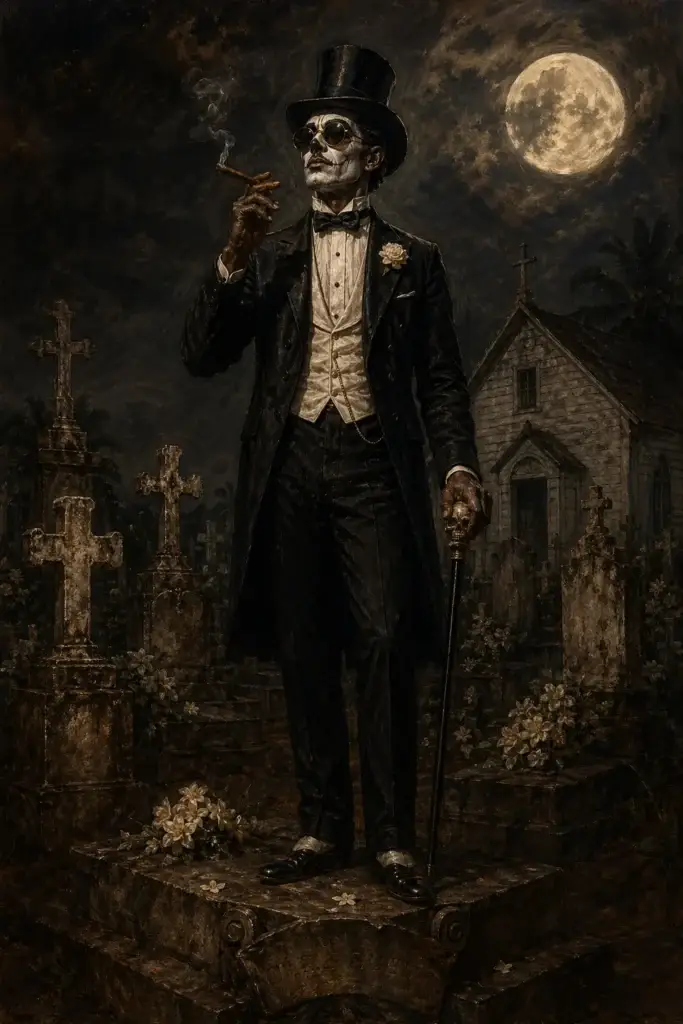
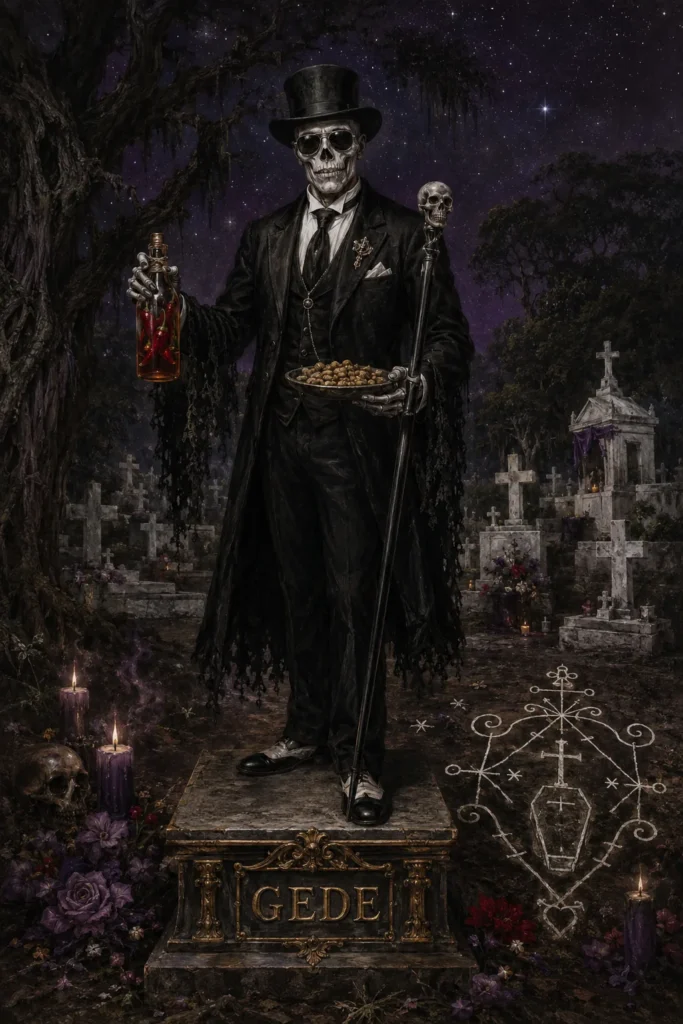
The family of the Gede, the spirits of the dead, stands for death, but also for earthy zest for life and quick-witted humor; their head, Bawon Samdi, watches over cemetery and grave in tailcoat and top hat, and is regarded at the same time as a helper in serious illness, because no one dies without his allowing it.
These stories are not closed but are made present again and again in the ceremony. The tradition is in this respect less a fixed body of text than a living process in which the lwa themselves come to speak through possession and continue writing their own history.
Cult and veneration
The cult of the lwa takes place in the Ounfo, the Vodou temple, which is led by an Oungan or a Manbo, the priest or priestess.
At the center stands the poto-mitan, the central pillar, which is regarded as the axis along which the lwa ascend and descend between their world and that of humans. Around it unfold drum music, dance, and song.
The ceremony follows a fixed order. It begins with Catholic prayers and the Priye Ginen, a long invocation that first greets the Rada lwa, then the remaining families. Drums call the spirits forth with their respective rhythms, veve are drawn, foods and animal sacrifices are offered.
The high point is possession: when a lwa seizes someone present, that person is clothed and provided with the spirit’s attributes, so that the community can speak directly with the lwa, ask it questions, and present requests.
The veneration is at the same time domestic. Many families maintain a home altar and tend lwa that are passed down over generations.
Important stages are initiation, the kanzo, by which a person is bound more closely to the lwa and admitted into temple service, as well as death rituals in which the life force of a deceased person is brought back from the water and preserved within the family group.
The calendar links the lwa with Catholic feast days, so that the veneration is embedded in the course of the year.
Protective practice and the apotropaic
In Vodou, protection is not a secondary aspect but one of the main tasks of the lwa. Whoever serves a spirit faithfully expects from it assistance against misfortune, illness, social threat, and against the interventions of malevolent forces. Protection is not thought of abstractly but concretely: through objects, actions, and bonds.
Among the widespread practices are the pwen, a concentrated point of power meant to confer protection or strength, as well as small protective pouches and amulets that are blessed and connected with a lwa.
Certain lwa are regarded as especially responsible: a spirit that watches at crossroads opens and secures the connection between the worlds; warlike spirits of the Petwo family are asked for defense in times of need. The veve themselves have a protective function, since they guarantee an ordered, controlled access of the spirits.
In religious studies it is to be emphasized that Vodou draws no sharp boundary between protective magic and harmful magic. The same means can be used according to intention, which is why, from the internal perspective, the relationship to the lwa and the moral responsibility of the one acting stand at the center.
The image of the pin doll that is widespread in films does not belong to Haitian Vodou but is an invention of popular culture. Apotropaic practice in Vodou aims at bond and relationship, not at isolated magical objects.
History and paths of transmission
The lwa are the result of a long historical process. In the colony of Saint-Domingue, people from very different African regions met one another and, under the conditions of slavery, came together in a new religious practice.
The Nanchon Rada preserves above all the heritage of the Kingdom of Dahomey and the Yoruba-related traditions, while the Nanchon Petwo carries stronger features of the Congo region and is regarded as having been shaped on Haitian soil.
The Catholic mission of the slaveholders supplied images of saints, feast days, and prayers, which were incorporated into Vodou.
The Haitian Revolution, which led to independence in 1804, is closely linked with Vodou. The tradition sees in the ceremony of Bois Caïman in 1791 a prelude to the uprising, which is discussed in scholarship as a historical memory charged with symbolism.
After independence, Vodou remained persecuted or despised over long periods, both by the Catholic Church and at times by the state. Anti-superstition campaigns in the twentieth century destroyed temples and cult objects.
The religion was nonetheless transmitted without interruption, because it is bound not to texts but to families, temples, and the chain of initiation.
The knowledge of the individual lwa, their songs, rhythms, and veve is passed on orally and practically, from the Oungan or the Manbo to the initiated. This form of tradition also explains the strong regional and familial diversity of Vodou.
Parallels in other cultures
The lwa stand within a wide web of related Afro-American religions.
In Cuban Santería, or the Regla de Ocha, they correspond to the Orisha, and in Brazilian Candomblé likewise to the Orixás. There too one finds the merging of African deities with Catholic saints, possession as a central experience, and the ordering of the spirits into families or nations.
These religions share a common West African root and a comparable colonial history of formation.
Structurally comparable is the figure of the distant creator god, whose functions active intermediary powers take over. Such a pattern is encountered in numerous West African religions, for instance among the Yoruba with Olodumare and the Orisha.
Outside Africa too, the history of religions knows the model of mediating spirit beings between a high god and humans.
Possession as an ordered, ritually induced, and socially recognized form of religious experience links Vodou with trance religions worldwide.
In comparison with the saints of Catholicism, a similarity shows itself in the function whereby specialized intermediaries attend to particular areas of life, yet the difference remains that the lwa appear as independent, demanding spirits and not as deceased exemplary humans.
Present-day reception and research
Vodou is to this day a living religion, practiced in Haiti by a large part of the population, often alongside Catholicism. In 2003 it was officially recognized as a religion in Haiti.
With the Haitian diaspora, Vodou and with it the cult of the lwa has spread to North America and Europe, where it adapts to new circumstances of life.
Scholarly research began in the twentieth century with ethnographic works. Alfred Métraux, with his study, presented a comprehensive account that remains fundamental to this day. Maya Deren combined participant observation with a literarily dense interpretation of possession.
Karen McCarthy Brown, with her investigation of a priestess in the diaspora, placed the individual religious biography at the center. Laënnec Hurbon analyzed Vodou in relation to history, power, and colonial perception.
A recurring theme of research is the correction of the distorted image that colonial literature, travel accounts, and Hollywood films have drawn of Vodou.
The popular reduction to harmful magic and images of horror misses a religion whose core is formed by the relationship between humans and lwa, the obligation to service, and the experience of the communal presence of the spirits.
Current works emphasize the independence, adaptability, and inner diversity of Vodou and take seriously the voices of the practitioners themselves.
Literature (selection)
- Alfred Métraux: Le Vaudou haïtien (1958)
- Maya Deren: Divine Horsemen. The Living Gods of Haiti (1953)
- Karen McCarthy Brown: Mama Lola. A Vodou Priestess in Brooklyn (1991)
- Laënnec Hurbon: Le barbare imaginaire (1988)
- Leslie G. Desmangles: The Faces of the Gods. Vodou and Roman Catholicism in Haiti (1992)
Related key terms: Lwa Loa Vodou Bondye Rada Petwo Nanchon Veve Ounfo Gede.
iWell Guard and protective traditions
iWell Guard ties into the cultural-historical tradition of portable protective objects, in the tradition of vodou and many other cultures worldwide. 41 layers, solid gold, platinum, silver, made in Germany. 30-day right of return.
Personal experiences may vary. Not a medical device. No healing promise.