iWell Guard

Amulet, Talisman and Protective Sign: Terms and Principles of Effect

Amulet, talisman, protective sign: these terms appear wherever people seek to guard themselves against misfortune. This page sorts out the basics, explains the recurring principles of effect and shows how closely the protective traditions of the cultures are related to one another.

Protective symbolCross-culturalBasics
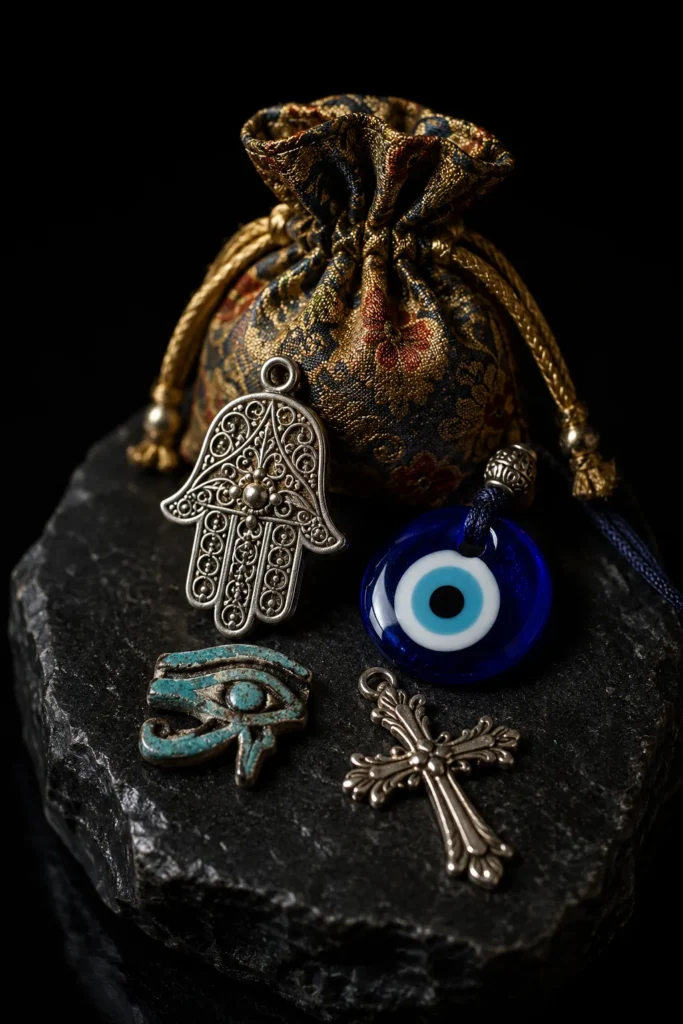
Collection of protective amulets from various cultures: Hamsa, Nazar, Eye of Horus, cross and protective pouch, on dark stone

Classification

In all known cultures there are objects and signs intended to protect against misfortune. They are worn on the body, attached to doors or hung above the cradle.

Many terms are in use for these objects. Amulet, talisman, protective sign, lucky charm and apotropaion mean something similar, yet they are not simply interchangeable.

This page offers an overview. It clarifies the most important terms and describes the principles of effect according to which protective objects function.

In doing so it becomes clear that the protective traditions of the world do not stand side by side without relation. Across the cultures, the same basic ideas recur.

The individual protective objects, from the Pazuzu amulet to the horseshoe, are treated in detail on their own pages. Here the focus is on what connects them.

Amulet, Talisman, Phylactery: the Terms

The word amulet comes from Latin. An amulet is, in the narrower sense, an object that protects against harm and averts misfortune.

The talisman, by contrast, is traditionally oriented more toward attraction. A talisman is meant to bring about strength, luck or success. The word goes back, by way of Arabic, to a Greek term for a consecrated thing.

The distinction is helpful, yet in ordinary usage it often blurs. Many objects avert and attract good at the same time, so that both terms fit them.

Another old term is the phylactery, which comes from Greek and simply denotes what protects. In religious studies the term apotropaion is also common, denoting an object for averting misfortune.

For an overview it is enough to distinguish two basic directions: the averting of harm and the attracting of good. Most protective objects combine both.

A Need of All Cultures

Protective objects are not a special case of individual cultures but a worldwide phenomenon. From Mesopotamia by way of Egypt and Europe to East Asia and the Americas, every culture knows its protective signs.

This broad finding has a simple reason. Everywhere people experience the same threats, illness, death, loss, danger to children, and everywhere the wish arises to guard against them.

The answers often resemble one another to a striking degree. The worn amulet, the sign above the door, the protection of the cradle are found in cultures far removed from one another.

In part, protective objects and ideas traveled with trade and journeys from one culture to another. In part, similar solutions arose independently of one another, because the need was the same.

The protective traditions of the world thus form a wide, mutually related field. Whoever understands a single protective object also understands something about all the others.

Protection through Deterrence

A widespread principle of effect is deterrence. The protective object shows a fearsome image meant to drive back harmful powers.

A clear example is the Pazuzu amulet from Mesopotamia. It shows the head of a feared demon, whose terror was meant to keep away an even more dangerous power.

The Gorgoneion, the head of Medusa in the Greek world, also belongs here. Its terrible face was placed on shields and house gables to avert misfortune.

Behind this principle stands the idea that terror can be met with terror. The protective object is itself frightening and so places itself between the wearer and the danger.

Menacing faces on doors and roofs, as many cultures know them, follow the same pattern. The deterrent image is one of the oldest forms of protection.

Protection through Catching and Attracting

A second principle of effect works not through deterrence but through attraction. The protective object draws the harmful force onto itself and catches it.

The clearest example is the Nazar Boncuğu, the blue glass eye of the Mediterranean region. It opposes the evil eye with an eye of its own and binds the harmful attention to itself.

The dream catcher of the indigenous peoples of North America also follows this idea. Its net catches the bad dreams before they reach the sleeper.

These protective objects work by placing themselves, as it were, in the line of fire. They take upon themselves the harm that would otherwise strike the person.

Some of these objects are considered spent once they have absorbed much harm. A cracked Nazar Boncuğu, for instance, is replaced because it has fulfilled its task.

Protection through Sacred Sign and Blessing

A third principle of effect rests on the sacred. The protective object bears a sacred sign or is blessed, and from this its protection is derived.

The cross of Christianity belongs here. According to Christian understanding it protects because it points to Christ and his victory over death.

The Christian protective medals also work in this way. They are blessed signs that recall the faith and ask for the intercession of the saints.

The Om of Hinduism and the Japanese Omamori follow a related idea. They hallow a place or a beginning and place it under a good omen.

With this group the boundary to religion is fluid. The religions mostly emphasize that it is not the object itself that works, but the faith and the sacred to which it points.

Protection through Substance and Material

A fourth principle of effect attributes a protective power to certain materials themselves. Not the image and not the sign, but the material averts misfortune.

In European folk belief, iron in particular was regarded as a protective metal. The horseshoe above the door owes its significance largely to this iron material.

Salt, too, was regarded in many places as protective. It was scattered on thresholds and used in protective customs. Certain stones and herbs were treated similarly.

This principle rests on the idea that the power dwells in the material itself. It works regardless of whether the material is shaped into an image or a sign.

Often the principles combine. The horseshoe, for instance, works through the iron and through its form, reminiscent of the crescent moon, at the same time.

Protection through the Closed Line

A fifth principle of effect rests on the form of the line. An unbroken, self-contained line is regarded as a boundary that lets nothing through.

The pentagram is the best-known example. It is drawn in a single stroke, and its line closes without a gap. In folk belief such a sign was considered impenetrable.

Related is the drawn protective circle, which marks off and secures a space. The endless knot patterns of many cultures also follow this idea.

Behind this principle often stands the notion that a harmful being must trace every line of a sign and becomes entangled in a figure without beginning or end.

The closed line thus protects not through terror, through blessing or through material, but solely through its shape. It forms a boundary that cannot be overcome.

Where Protection Is Sought

As different as the principles of effect are, so similar are the places at which protection is sought. Across the cultures the same locations recur.

The first place is the body. The worn amulet accompanies the person wherever they go. The second place is the threshold. Doors and windows are regarded as the points at which misfortune can enter the protected space.

The third place is the cradle. Strikingly often, protection is directed at the child, at birth and at sleep, for there the person is most vulnerable.

The same concerns, the care for children, for the journey, for house and health, are found in the protective traditions of all cultures. With the idea of the worn protective object that accompanies the body, iWell Guard ties in to exactly this very long line.

Whoever reads about the individual protective objects on the further pages of this section will recognize the principles described here again and again. They are the common ground of a worldwide and very old tradition.

Literature (Selection)

  • Liselotte Hansmann, Lenz Kriss-Rettenbeck: Amulett und Talisman (1966)
  • Entry Amulett in the Handwörterbuch des deutschen Aberglaubens
  • Don Skemer: Binding Words. Textual Amulets in the Middle Ages (2006)
  • Felix Marti-Ibáñez and others: studies on amulet lore
  • Hans Biedermann: Knaurs Lexikon der Symbole (1989)

Related key terms: amulet talisman protective sign apotropaion phylactery protective tradition principle of effect lucky charm.

iWell Guard and Protective Traditions

iWell Guard stands in the cultural-historical line of wearable protective objects, to which every worn protective amulet also belongs. A modern companion for people who live with protective symbols: made in Germany, 41 layers of solid gold, platinum and silver, with a 30-day right of return.

Personal experiences may vary. Not a medical device. No healing promise.