The Bagua Mirror: Chinese Protective Mirror with Eight Trigrams
By Ralf Ittermann · last reviewed on
The bagua mirror is a Chinese protective object consisting of an octagonal frame with the eight trigrams and a mirror at the center. Mounted above the door, it is intended to repel harmful influences and keep them away from the house.
Classification
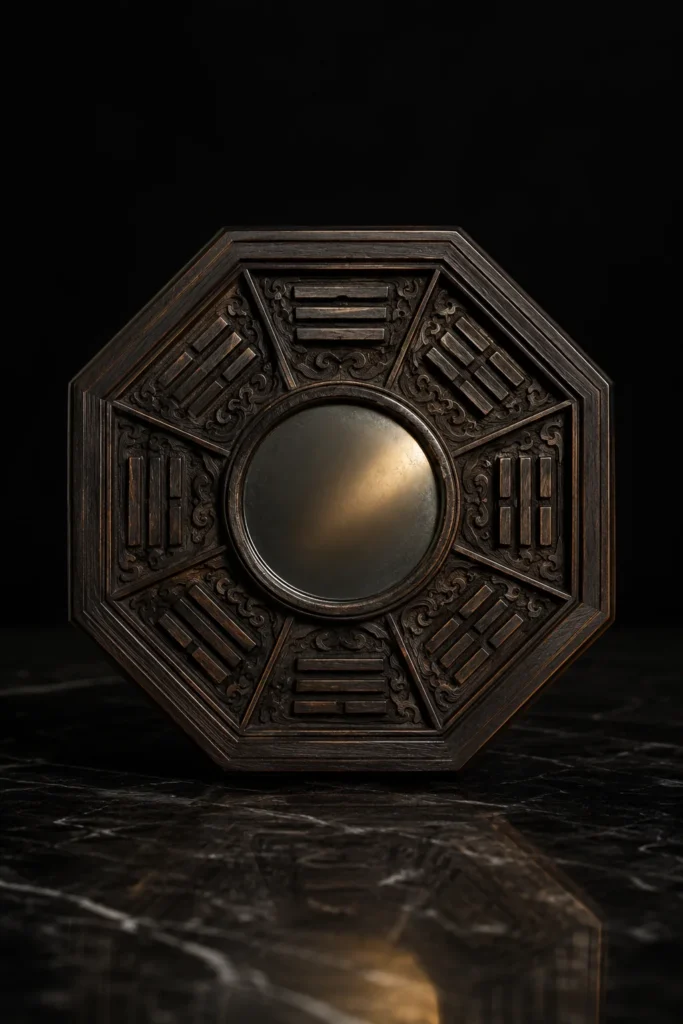
The bagua mirror is a widespread protective object from China. It consists of an octagonal frame enclosing a central mirror glass. On the frame, the eight trigrams are arranged, a set of symbols from the Chinese tradition.
The bagua mirror is not hung indoors, but on the outside of the house, usually above or beside the entrance door. From there it is meant to repel harmful influences before they reach the house. It is thus a sign of threshold protection.
The object combines two ancient protective ideas. One is the repelling power of the mirror, which reflects the harmful back. The other is the ordering power of the eight trigrams, which stand for a comprehensive, ordered worldview.
In religious studies and in the study of Chinese folk religion, the bagua mirror is a good example of a composite protective object. It is not a single symbol but combines several layers of meaning into a whole.
Today the bagua mirror is known above all in connection with the teaching on the arrangement of living spaces. This teaching is called feng shui. Within this teaching, the bagua mirror is regarded as one of the most effective means of warding off harmful influences.
The Eight Trigrams
At the core of the bagua mirror are the eight trigrams. A trigram is a symbol made up of three stacked lines. Each line is either unbroken or broken in the middle. From these two possibilities exactly eight different trigrams arise.
The eight trigrams stand for fundamental forces and phenomena of the world. They are associated with heaven and earth, as well as water, fire, thunder, wind, mountain, and lake. Together they cover the most important domains of existence.
The trigrams come from one of the oldest books of the Chinese tradition, the Book of Changes. This work serves the interpretation of life situations and guidance in decisions. The trigrams are its foundational symbols.
On the frame of the bagua mirror the eight trigrams are arranged in a circle around the central mirror glass. This arrangement in an octagon gives the object its name, since the Chinese word bagua means something like eight symbols.
The arrangement of the trigrams follows a specific order. For protective purposes, a sequence is often chosen that is regarded as the early or original order. In this order the symbols stand in a balanced relationship to one another.
The Mirror as a Ward
The second load-bearing element of the bagua mirror is the mirror itself. In many cultures, the mirror is credited with a repelling power. This idea rests on a simple observation, namely that a mirror reflects back what strikes it.
From this property arose the idea that a mirror can also reflect harmful influences back. Whatever misfortune approaches the house is to bounce off the mirror and return to its source. The mirror thus wards off by redirecting.
This idea is not confined to China. Mirrors have been used as protective objects in other cultures as well. In Siberian shamanism, for instance, the mirror plays a role, and in European customs the mirror also appears as a means of warding off harm.
The bagua mirror combines this widespread mirror concept with the Chinese trigrams. The mirror reflects the harmful back, and the trigrams surround it with the ordering power of the eight foundational symbols. Both elements reinforce each other.
An important point is the idea that the bagua mirror acts with considerable force. For this very reason it is placed outside and not in the living space. Inside the house its reflective effect is considered too strong. The bagua mirror belongs on the outer side of the threshold.
Form of the Bagua Mirror
The bagua mirror has a clear, recurring form. Its frame is octagonal, which refers directly to the eight trigrams. The octagon is the basic shape by which the object is immediately recognizable.
The frame is often made of wood, though versions in metal also exist. On the frame the eight trigrams are painted, carved, or applied as fittings. They are distributed evenly around the octagon, one trigram on each side.
At the center of the frame sits the mirror glass. It is the actual operative core of the object, reflecting the harmful back. The trigrams form the ordering frame around this core.
The bagua mirror is often additionally decorated with colors. Red, gold, and black are common, since these colors are attributed their own meanings in the Chinese tradition. Some bagua mirrors also bear additional protective symbols.
The size of bagua mirrors varies. There are small, inconspicuous pieces as well as larger, clearly visible versions. All share the octagonal frame with the trigrams and the central mirror.
Flat, Concave, and Convex
The bagua mirror comes in three different versions, distinguished by the shape of the mirror glass. These three forms have different effects and are used for different purposes.
The first form is the flat mirror. A flat mirror reflects the harmful back unchanged. It redirects an unfavorable influence in the direction from which it came. The flat bagua mirror is the most commonly used form.
The second form is the concave mirror, that is, one curved inward. It is said to absorb and gather an influence. It is used when a particular influence is not to be reflected back but rather weakened.
The third form is the convex mirror, curved outward. It disperses the incoming influence in many directions. Instead of reflecting it back in a concentrated way, it dissolves it. This form too has its specific area of application.
The distinction between these three forms shows that the bagua mirror is not a crude tool. The tradition recognizes different effects and assigns different mirror forms to them. Which form is chosen depends on the particular situation of the house.
Placement Above the Door
The typical location for the bagua mirror is the exterior of the entrance door. It is placed above the door or immediately beside it. This position is not arbitrary, since the door is the decisive threshold of the house.
The door is the point where outside and inside meet. Whatever harms the house must cross this threshold. It is precisely here that the bagua mirror comes into play. It secures the boundary before the harmful can enter.
In this way, the bagua mirror belongs to the large group of threshold protection signs. In a great many cultures, protection concentrates on doors, windows, and gates. The bagua mirror is the Chinese manifestation of this widespread idea.
When placing it, attention is paid to what the mirror faces. It is often positioned opposite a spot perceived as unfavorable, such as a sharp corner or a line running toward the door. The mirror confronts the harmful, so to speak.
The key point remains that the bagua mirror stays outside. It belongs on the side of the house facing the world. It is not hung indoors, since its effect there is considered inappropriate and too powerful.
Feng Shui and Harmful Energy
The bagua mirror is today closely associated with feng shui. Feng shui is the Chinese teaching on the arrangement of spaces and places. Its name means literally wind and water. It deals with the flow of forces through the environment.
In feng shui, the idea of a life force flowing through spaces and landscapes plays a central role. This force can flow favorably or unfavorably. An unfavorable, sharp current is considered harmful to the house and its inhabitants.
Such harmful currents are often linked to specific features of the surroundings. A sharp building corner opposite, a street running directly toward the door, or a building perceived as threatening can all be regarded as sources of unfavorable influence.
This is where the bagua mirror comes into use. It is hung facing the unfavorable spot and is meant to repel its influence. Within the framework of feng shui, it is thus a targeted means against a precisely identified burden.
Within feng shui, the bagua mirror is a comparatively powerful tool. The teaching advises thoughtful use. It should be applied where an unfavorable influence is genuinely present, not indiscriminately and not in excess.
The Book of Changes and Daoism
The roots of the bagua mirror reach deep into Chinese intellectual history. The eight trigrams belong to the Book of Changes, one of the foundational works of the Chinese tradition. This book has shaped Chinese thought over millennia.
According to tradition, the trigrams go back to a legendary figure of early Chinese history. This figure is credited with having recognized and ordered the eight symbols. This narrative connects the trigrams to the very origins of Chinese culture.
The Book of Changes is regarded as one of the Five Classics of the Confucian tradition. Later the trigrams and the Book of Changes were also taken up by Daoism. Daoism is one of the great traditions of China. It concerns itself with the Dao, the Way, and with the proper harmony of the human being with the order of the world.
In Daoist-influenced thought, the eight trigrams are an image of the ordered world. They show how the fundamental forces of existence work together. An object bearing these symbols is thus surrounded by the idea of a comprehensive order.
The bagua mirror thus stands in a long lineage. It is not merely a popular folk device without deeper grounding, but connects with the Book of Changes and also with Daoist thought. In it, an ancient, carefully considered worldview continues to live.
Contemporary Reception
The bagua mirror is today known far beyond China. With the worldwide spread of feng shui, the bagua mirror too has become familiar in many countries. It is among the best-known objects associated with this teaching.
In China and in regions shaped by Chinese culture, the bagua mirror remains in active use. It can be seen above the doors of many houses. There it belongs to the familiar image of the street and to the self-evident precautions taken for the house.
Outside the Chinese sphere, the bagua mirror is used partly as a seriously regarded protective object and partly as a decorative sign. In this use, the precise background of the trigrams often recedes. The mirror is then understood in a general sense as a protective symbol.
As a protective object, the bagua mirror is a means of threshold protection. It secures the boundary of the house and wards off what could harm it.
The bagua mirror is thus a good example of a protective object that combines ancient thinking with practical use. In it, the Book of Changes, the idea of the repelling mirror, and the concern for one’s own home come together in a single, easily recognizable object.
Selected Bibliography
Related key terms: bagua mirror trigrams feng shui protective mirror Book of Changes Daoism threshold protection China.
iWell Guard and Protective Traditions
iWell Guard stands in the cultural-historical lineage of wearable protective objects, to which the bagua mirror also belongs. A modern companion for people who live with protective symbols: made in Germany, 41 layers of genuine gold, platinum, and silver, with a 30-day return policy.
Individual experiences may vary. Not a medical device. No therapeutic claims.