Domovoi, spirit of the Slavic tradition
By Ralf Ittermann · last reviewed on
Domovoi (домовой) is the house spirit of Slavic tradition, watching over the home and its members. He is venerated as a paternal, protective figure who brings prosperity and security to a household when treated with respect.
Domovoi
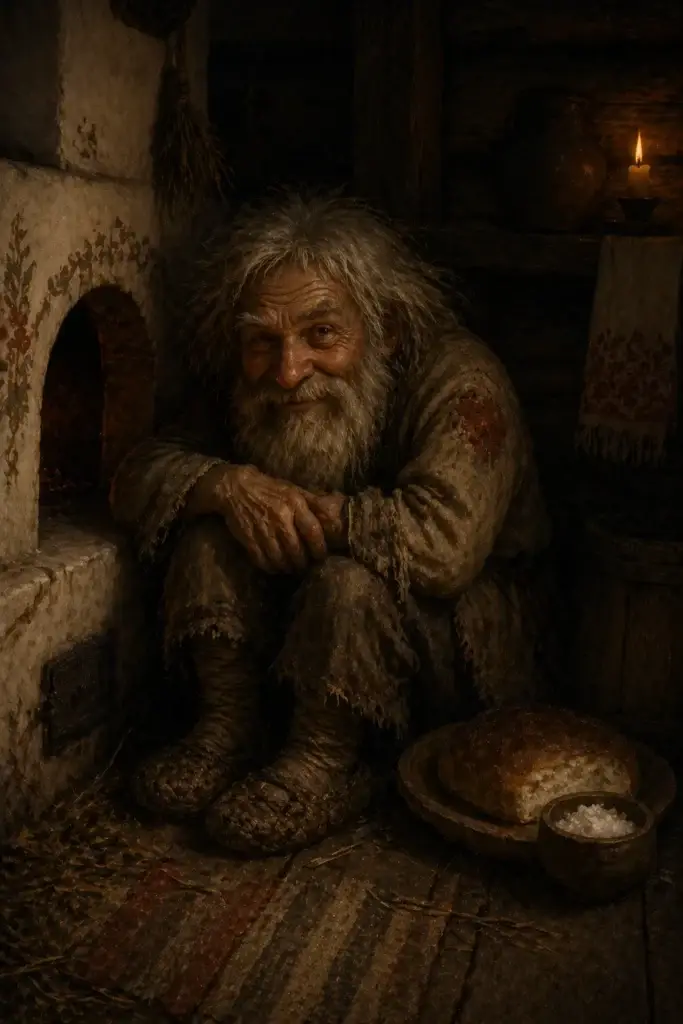
Domovoi is depicted as an old, hairy man who lives unseen in the house and watches over prosperity, livestock, and family. He can give helpful warnings (nocturnal poltergeist sounds before danger), tend to or sabotage livestock.
Unlike malevolent demons, Domovoi is a loyal household spirit: those who respect and feed him receive his protection; those who offend him suffer losses. His nature is paternalistic and conservative, he favors order, decency, and respect. Domovoi can be understood as an embodiment of the house itself.
Short Profile: Domovoi
Domovoi is well documented in Slavic folklore collections (Afanasyev, Maximov, Sechan), as well as in ethnographic studies from the 19th and 20th centuries. Distribution is pan-Slavic: Russia, Ukraine, Serbia, Poland.
Literary references appear in Russian tales and fairy stories (e.g., Pushkin’s works). Nora Chadwick and Linda J. Ivanits document Domovoi veneration up to the present day. Unlike church saints, Domovoi is a persistent pre-Christian entity in folk practice.
Classification
Domovoi has been mentioned in Slavic folk traditions since the 10th century, far more consistently than the major deities in written sources.
His continuity is remarkable: well into the 20th century women prayed to Domovoi, and in some villages this still occurs today. The roots likely lie in Indo-European house spirit traditions, but have been developed into a particularly coherent practice within Slavic culture.
Domovoi was universal across the Slavic world, from Kiev to Novgorod, from peasant huts to princely palaces. Every house had one, and every family maintained its own relationship with him. The conception varied regionally in form, dwelling place, and name, but remained recognizable as a house spirit across great distances.
Written sources are fragmentary (mentions in chronicles, polemics by Christian clergy), but the folk tradition is continuous and vital. Ethnographic collections from the 19th and 20th centuries document Domovoi practices in great detail. Archaeological evidence is sparse, but the consensus among Slavicists is that this spirit was an ancient and central figure.
Name and Variants
Domovoi is depicted as an ancient, powerful being, often with flaming eyes, long white or reddish hair, and a thick beard. Sometimes he hovers above the hearth fire, sometimes he sits invisibly in a corner of the house.
In dreams he often appears more human, sometimes as an animal (cat, dog) or as a pure stream of energy.
The sacred symbol is the hearth fire itself, the place where Domovoi resides and is at his strongest. His presence is recognized through subtle movements: a knock in the night, warm air, the feeling of an attentive presence.
Characteristics
Domovoi was the guardian and guarantor of household prosperity. Milk and bread were placed for him in the kitchen and often found empty in the morning, which was considered a good sign. He warned of fire through small night-time flames he kindled before a real catastrophe struck.
With a sharp eye one could perceive him, and those who caught sight of him often saw a bearded face with eyes of flame.
New homes required a house-blessing: the head of the household called upon Domovoi and offered him a place at the hearth. When a house was vacated, Domovoi was taken along, sometimes in the form of coal embers carried to the new home.
Profile: Domovoi
The profile presents Domovoi across six dimensions: his origin as the primary house spirit, the groups who venerated him (families, heads of household), his physical form and attributes, his protective and cautionary practices, and parallels in other cultures. These perspectives reveal his central role in the Slavic household religion system.
Domovoi is bound to the Slavic dwelling or izba and is geographically pan-Slavic. His cultural origin is proto-Slavic and likely prehistoric, since the veneration of house spirits was foundational across all Slavic cultures.
Written primary sources are late and often critically Christian. In the history of religion, Domovoi is understood as a specialization of a general veneration of ancestors or house spirits that grew in significance alongside the consolidation of family and property.
Domovoi was venerated primarily by the head of the household and the housewife, as well as by all household members. Particular occasions included new construction or moving (relocation ritual), illness in the house (asking Domovoi for recovery), misfortune (asking Domovoi for forgiveness), and thanksgiving rituals after harvests.
Veneration was practically daily: small gifts of food and milk, respect for household peace, observance of cleanliness and morality. The head of the household had a special role as intermediary between Domovoi and the home.
Domovoi is depicted as an old man with a long beard, wild or tidy hair (depending on the moral state of the household), and dark or red clothing. He is sometimes shown as bearded, like an old patriarch. His stature is small to medium.
Attributes include fire (the hearth as Domovoi’s seat), the household symbol, or the scepter. In rusalka stories and other folk tales he is often presented as a paternal, strict figure. The iconography is dignified and conservative, not fearsome like Bannik, but always commanding respect.
Sphere of influence: The Domovoi (Russian домово́й, from dom “house”) is, in East Slavic folk belief, the protective spirit of the house and family, guardian of the hearth, domestic animals, and larder. He is regarded as the ghostly embodiment of a family’s founding ancestor and is spatially bound to house and yard.
When moving to a new home, he was traditionally taken along in a solemn ritual: embers from the old hearth were carried in a pot to the new house, often accompanied by the call “Domovoj batjuška, pojdjom s nami!” (“Father Domovoj, come with us!”).
The ethnography of the 19th century (Afanasyev, Poetičeskie vozzrenija slavjan na prirodu, 1865-69) documents a differentiated hierarchy: dvorovoj (yard spirit), ovinnik (barn spirit), bannik (banja spirit) as related specialized forms. Benevolent domovois bring prosperity; angered ones rattle objects at night or harm livestock.
Domovoi is benevolent but requires respect and decency. Veneration takes the form of daily gifts (food, milk, bread) at the hearth or in a corner, respectful address, and adherence to household morality (faithfulness, diligence, cleanliness). Protective rituals consisted of prayers for prosperity and safety.
Against Domovoi’s anger there were appeasement rituals, for example through offerings and negotiation. Moving rituals were critical: the old Domovoi had to be invited to accompany the family to the new home. Veneration was integral to the household system, not optional.
Comparable figures include other house spirits: the Germanic Kobold or Wichtelmännchen (household spirit with a paternal role), the Roman Lares Familiares (family protective spirit), the Japanese Kamado kami (hearth deity), and the Baltic Kaukas (household spirit).
Common to all is the bond to the house, the expectation of respect and care, and the benevolent nature when behavior is correct.
Domovoi, Parallels in Other Cultures
Domovoi corresponds to the Roman Lar familiaris (house spirit), the Germanic household deity (less prominent), and more distantly to the Japanese Kodama (tree spirit) and other house spirit traditions worldwide. The universality of this figure, an invisible protector of the home, points to an archetypal depth.
Jewish tradition: There is no direct equivalent to Domovoi in Judaism. However, the Kabbalah does recognize protective spirits of places, and the Talmud literature occasionally mentions benevolent demons protecting domestic affairs. These are, however, less personalized and central than Domovoi. The Jewish household is primarily under God’s direct blessing, not under a spirit figure.
Greco-Roman world: The Roman Lar or Lares Familiares closely resemble Domovoi: protective spirits of the family, venerated through daily rituals, with an expectation of respect and food offerings. The difference lies in the more formal institutionalization within Roman religion. The Lares were also venerated publicly, whereas Domovoi is primarily private and domestic.
Mesopotamia: The Akkadian tradition knows house spirits (udug), but these are less elaborated than Domovoi. Mesopotamian house religion was less personalized around a named spirit. No strong functional parallels exist.
India/Asia: In Hinduism the Devata (local deities) of houses and yards are similar to Domovoi. The Japanese Ujigami (ancestral deity) and the Chinese household deity (Zao Jun, the hearth god) resemble Domovoi in their role as paternal, protective house spirits. All expect daily veneration and offer prosperity in exchange for respect.
The House Spirit in the Economic Structure of the Peasant Farmstead
The domovoi, whose name derives from the Old East Slavic word for house (dom), can only be understood when the peasant farmstead is grasped as an economic and religious unit.
The spirit was regarded not as a mere inhabitant but as an invisible co-manager who watched over the livestock, the stores, and the welfare of the family.
Russian ethnographic records of the nineteenth century, including the extensive collections that emerged under the auspices of the Russian Geographical Society, consistently describe the domovoi as bound to a specific farmstead.
His jurisdiction covered the stable above all. A well-treated domovoi cared for the livestock, braided the horses’ manes at night, and ensured the animals thrived. An angered house spirit, by contrast, tormented the livestock, rode horses to exhaustion, or caused animals to fall ill.
Peasants explained horses found sweating in the morning, or tangled manes, by the workings of the spirit. The larder and the threshing floor also fell within his domain.
Noteworthy is the belief that the domovoi could have a color preference for livestock. If the color of newly acquired animals did not match his liking, they would not prosper, and the farmer was well advised to exchange them.
This tradition shows that the house spirit was conceived as an independent personality with moods and tastes, not as an abstract protective force.
The close bond to the farmstead had a social function. It anchored the economic fate of the family within a moral order: diligence, cleanliness, and respect toward the spirit were rewarded, negligence was punished. The domovoi thus also served as an instance of self-regulation, reinforcing correct behavior in everyday economic life.
The Relocation of the House Spirit and the Rituals of Moving House
Since the domovoi was bound to house and family, moving was a delicate situation. A farmstead without a house spirit was considered unprotected and barren, and so East Slavic folk culture developed elaborate rituals to take the spirit to the new dwelling.
The ethnographic literature of the nineteenth and early twentieth centuries has recorded numerous regional variants of these customs.
A formal invitation was widespread. Before leaving the old house, the housewife or the eldest man would address the domovoi, asking him to come with the family. He was frequently transported symbolically in an object.
Glowing coals from the old stove, kindled in the new hearth, were considered the preferred vehicle, since the stove was understood as the spirit’s favored place of residence. An old felt boot, a loaf of bread, or a bundle of ashes also served as means of transport.
On arrival at the new house, a welcoming ceremony followed. Before people entered the dwelling, an animal was often sent ahead, in many regions a cat, and the spirit was addressed again, asking him to settle in and make himself at home.
Bread and salt were placed at a place of honor. Only then did the family enter the main room.
These rituals were not mere folklore but marked a transition. They transformed an empty building into an inhabited home with its own moral and protective order.
The researcher Erna Pomeranceva and other Soviet ethnographers noted that moving customs survived with particular tenacity because they met a practical need, namely managing the anxiety of an unprotected new beginning. Remnants of such customs, including the cat as the first occupant, persisted into the twentieth century.
The House Spirit as Interpreter of Omens and His Relationship to Death
An important and often overlooked function of the domovoi was that of omen-giver. In the East Slavic tradition, the house spirit announced coming events, above all the death of a family member, an impending wedding, or misfortune threatening the farmstead.
This role makes him more than an economic spirit; he was a link between the family and its fate.
The most widespread sign was nocturnal pressure. Someone who felt a weight on their chest in sleep believed the domovoi to be upon them. If he pressed with a warm or soft hand, it meant good; if the touch was cold or rough, misfortune threatened.
Some accounts report that the spirit could be asked in this moment whether what was coming was good or bad. Nocturnal weeping, moaning, or knocking by the domovoi was also taken as a death announcement. If he howled, a death was expected; if he laughed or played, joy was on its way.
This function of foretelling refers to the close connection between house spirit and ancestor cult.
Many researchers, among them the prominent Russian ethnographer Dmitri Zelenin in his influential account of East Slavic folklore studies, originally saw in the domovoi the deified founding ancestor or the first occupant of the farmstead, who after death became the protective spirit of his descendants.
The connection to the stove, the ritual center of the house, and the custom of bringing him food offerings resembles ancestor veneration.
This interpretation explains the dual nature of the spirit. He is protector and at the same time uncanny, familiar yet strange.
As one of the dead who remained in the house, he still belongs to the family while knowing things hidden from the living. The domovoi was thus the domestic form of a much older belief: that the deceased watch over the living.
Manifestations and the Prohibition Against Seeing the House Spirit
Unlike many other Slavic spirit beings, the domovoi had no fixed form. The tradition most often describes him as a small old man, frequently covered in hair all over his body, with a long beard, dressed like a peasant.
He often bore a striking resemblance to the current or deceased head of the household, which supports the interpretation as an ancestral spirit. In other regions he appeared as an animal, as a cat, dog, snake, or weasel; in still others as a shadow, a glimmer of light, or simply a perceptible presence.
A widespread taboo surrounded his appearance. To see the domovoi with one’s own eyes was considered ill-omened in many areas and could foretell death.
Those who nonetheless wished to catch a glimpse of him had to proceed secretly and in accordance with specific prescriptions, in some accounts by looking through a horse collar or by going to the stable at particular times in the church year.
These viewing customs show that the spirit was conceived as genuinely present but deliberately withdrawn from direct perception.
His place of residence varied by region. Most widespread was the belief that he lived behind or under the stove, the warm heart of the house. Other accounts placed him beneath the threshold, in the stable, in the attic, or in the cellar.
Where the spirit dwelt in the stable, he sometimes carried his own name, for example as yard spirit, raising the question of whether this was the same spirit or a related one.
Linguistically, the reluctance toward the being is mirrored in the multitude of circumlocutory names. Rather than addressing him directly, people referred to him as the grandfather, the householder, the benefactor, or simply as He himself.
This avoidance of the taboo name is a pan-European pattern in dealings with spirits and underscores that the domovoi, despite his protective role, was a power approached with caution.
The House Spirit in Russian Literature and in Modern Consciousness
With Romanticism’s interest in folk poetry, the domovoi moved from peasant life into written literature. Russian poets of the early nineteenth century already took up the figure.
Alexander Pushkin composed a short poem with an invocation of the house spirit, addressing him as guardian of a familiar place. In this way the domovoi became a literary symbol for home, shelter, and the bond to a place.
The great collectors of the nineteenth century preserved the oral tradition. Alexander Afanasyev included numerous narratives about the house spirit in his studies of the Slavic view of nature, and later ethnographers such as Zelenin and Pomeranceva organized the material systematically.
These collections remain the foundation of any serious engagement with the figure today, because they document regional variety before industrialization and Soviet modernization transformed rural life.
In the twentieth century the belief in the domovoi lost its economic foundation; the peasant farmstead with its stove and stable disappeared for most people.
The figure survived nonetheless, now as an element of children’s culture, animated films, and popular fantasy. In numerous Soviet and Russian animated films and children’s books, the domovoi appears as a good-natured, somewhat gruff little house dweller.
Noteworthy is the persistence of small everyday customs. Even where no one any longer believes in a physical spirit, the habit has survived in Russian-speaking regions of letting the cat enter the new apartment first or speaking kindly to the invisible householder.
Such remnants show that the domovoi persists less as a belief than as a cultural gesture, an expression of the wish that a home be more than a mere space.