


Papa Legba, god of the Haitian tradition
Papa Legba is a god of the Haitian tradition.
Guardian of thresholds, director of paths, gate between worlds. Papa Legba stands at every crossroads, at every door, at every boundary, visible and invisible. Before any other loa can be invoked, Legba must be honored first.
His ancient voice, his crooked staff, his pipe: they are the keys to everything. Without Legba there is no connection to the spirits, no healing, no magic. He is the first guardian and the last mediator.
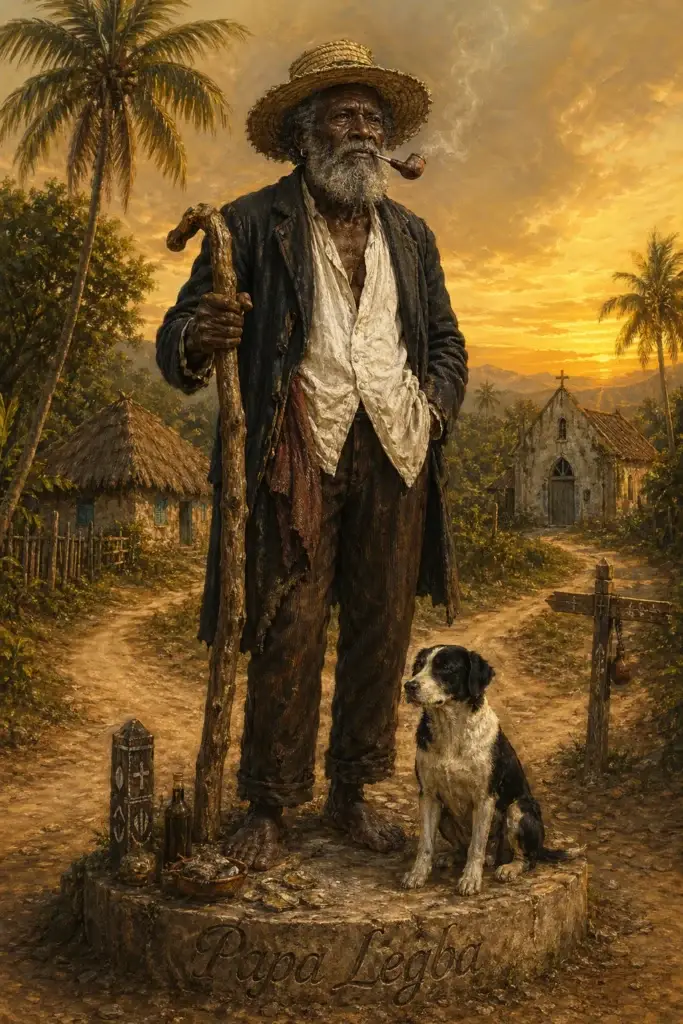
Type: Vodou loa of the threshold and the opening of the gate (Rada family)
Pantheon: Vodou (Haiti), Louisiana Vodou, Vodun (Benin/Togo)
Function: opens the gate to the spirit world; without him no Vodou ceremony
Main attributes: wooden crutch, large straw hat, worn suit, pipe
Main places of worship: hounfor temples (entrance area), crossroads, house entrances
Syncretism with St. Peter or St. Lazarus
Classification
Papa Legba (Creole Papa Legba) develops from the West African Vodun threshold god Legba of the Fon tradition (Dahomey, today Benin/Togo). In the Haitian synthesis he becomes the first deity to be invoked in every Vodou ceremony; without his opening of the gate no other loa arrive.
The syncretic identification with St. Peter (keeper of the keys of heaven) or St. Lazarus (on crutches) has been established since the colonial era.
Worshipped in every Haitian hounfor temple: at the entrance area the poteau-mitan (central post) with Legba symbols traditionally stands. House entrances bear Legba protective signs. Crossroads are his home. He is present throughout the West African diaspora (New Orleans, Louisiana, Brazil as Exu syncretism). His feast day is Monday.
Central sources: Maya Deren’s Divine Horsemen (1953, classic observation of the opening of Vodou ceremonies), Métraux’s Le Vaudou haïtien (1958), McCarthy Brown’s Mama Lola (1991), Suzanne Preston Blier’s African Vodun. Art, Psychology, and Power (1995, study of the roots). West African: Bernard Maupoil’s La géomancie à l’ancienne Côte des Esclaves.
Designation and Spellings
Papa Legba is depicted as an old man, sometimes bent, with a crooked staff or walking stick, a straw hat, simple clothing and a pipe in his mouth. His hair is gray or white; his gaze is penetrating and wise.
He is often accompanied by a dog. His veve (loa symbol) consists of crosses, arrows and keys. The traditional color is red and white, red for Legba the Good (Ati-Bon), white for Legba the Just. Candles, cornmeal and corn syrup are offerings.
Characteristics
In every Vodou ritual, before the priest or priestess (Houngan/Mambo) invokes another loa, Papa Legba is asked to open the gate, the barrière, the invisible boundary. This «ouverture» lasts minutes to hours.
Legba is addressed with words such as: «Papa, open the ways, let the others come.» Whoever insults or ignores Legba is denied the way, all magic fails, all spirits remain silent.
Legba is thus not powerful because of dramatic forces, but because he controls communication itself. This also made him, in the African diaspora, the god of language, of trade, of cunning, everywhere boundaries and transitions exist.
Appearance and Symbolism
Papa Legba is depicted as an old man with a staff or crutch, often in a straw hat and old clothing. He stands at crossroads and boundaries, symbolically and literally. His colors are red and black. He is often associated with a pipe and rum. In modern depictions he often also wears contemporary clothing.
The most important aspects of Papa Legba at a glance. The following fields summarize origin, function, appearance, worship, symbols and parallels.
Papa Legba derives from the West African Legba of the Fon tradition, there the youngest son of the supreme goddess Mawu. A related god in the Yoruba pantheon is Eshu/Elegba, though with a more strongly trickster-like, ambiguous character.
In Haiti the figure is transformed into the aged, wise opener of the gate. Syncretically identified with St. Peter or St. Lazarus.
Opener of the gate to the spirit world. Every Vodou ceremony begins with an invocation of Papa Legba (Papa Legba ouvri baryè pou mwen, Papa Legba, open the gate for me).
Messenger between the worlds: concerns are entrusted to him, and he passes them on to the other loa. Patron of language and of mediation; whoever stands in communication with the spirit world gives thanks to Legba.
Aged, bent male figure with dark skin. Characteristic: wooden crutch (hence the syncretism with St. Lazarus), large straw hat, old worn suit or rags, a pipe (often a tobacco pipe).
Frequently with a basket or a bag with gifts from the spirit world. Dark beard, gaunt features. During the possession of his hounsi, the possessed moves bent over with an imaginary crutch.
Sphere of influence: Every Vodou ceremony begins with the Legba invocation, otherwise the other loa do not come. House entrances bear his symbols. Whoever travels invokes him before departure.
In matters of love and relationships he is invoked as the mediator of the message to the spirit world. Personal offerings: tobacco, coffee, black rooster, peanuts, corn. His feast day is Monday.
Wooden crutch, large straw hat, tobacco pipe, old suit, basket with gifts, red or red-and-black headscarf, key (syncretically from St. Peter), threshold symbols. Sacred animals: black rooster, black dog. Sacred plants: tobacco, corn, bamboo.
Papa Legba shares structural functions with related door-opener beings of other cultures. Eshu (Yoruba tradition, Nigeria/Brazil) is the original threshold god from whom Legba descends. Hermes (Greek) as messenger of the gods and protector of crossroads with the kerykeion staff. Mercurius (Roman). Heimdall (Germanic) as guardian of the Bifröst bridge between worlds.
In the Celtic context, Manannan mac Lir partly corresponds as a mediator to the Otherworld. The structural constant: an older threshold god with power over keys, power over language and an ambivalent character (cf. Métraux, Voodoo in Haiti; Hurbon, Voodoo: Search for the Spirit).
Protective Practice
Rituals of Worship
Papa Legba (Haitian Creole Papa Legba) is the threshold god and door-opener to all other loa in Haitian Vodou; no Vodou ceremony can begin without Legba being invoked first. Syncretically identified with Saint Peter (bearer of the keys) or Saint Lazarus (old man with a staff).
His day is Monday. Devotees offer cornmeal, dried tobacco leaves, rum and rice. His vèvè diagram (crossroads with a cross in the center) is drawn with cornmeal on the temple floor at the start of every Vodou celebration (cf. Deren, Divine Horsemen; Métraux).
Invocations
The houngan (Vodou priest) opens the ceremony with the Creole invocation „Papa Legba ouvri baryè pou mwen” (Papa Legba, open the gate for me!). His Yanvalou rhythm on the drums marks his entrance. Possession by Papa Legba is marked by a limping gait, a bent posture, leaning on a walking stick and smoking a pipe.
Amulets and Protective Symbols
Vèvè diagram: stylized crossroads with a cross, drawn on the floor with cornmeal. Key pendant as a Legba symbol. Saint Peter devotional images on the domestic altar.
Straw hat, walking stick and pipe as homage offerings. Threshold apotropaia: small mounds of cornmeal with an embedded coin under the door frame for protection upon entering and leaving.
Papa Legba, Parallels in Other Cultures
Papa Legba goes back to the West African trickster and messenger god Legba of the Fon and Eshu-Elegba of the Yoruba, who are likewise venerated at crossroads and mediate between humans and gods. In Cuban Santería his counterpart is Elegguá, who is there also invoked first in every ceremony; in Brazil it is the Exu of Candomblé. Outside the Afro-Atlantic religions as well, parallels can be found in threshold and messenger gods such as the Greek Hermes or the Roman Janus, who guard doors, roads, and transitions.
The West African Roots and the Journey Across the Atlantic
Papa Legba cannot be understood without looking at his origin in the religious traditions of West Africa. His immediate predecessor is the Legba of the Fon in the kingdom of Dahomey, today’s Benin, and closely related is the figure of Esu or Eshu of the Yoruba in present-day Nigeria.
In both traditions this deity is the mediator between humans and the higher powers, the keeper of the crossroads, the thresholds and the gates.
Through the transatlantic slave trade, people from these regions were deported to Saint-Domingue, later Haiti. Under the conditions of slavery and imposed Catholicism, the traditions brought along by various peoples, above all the Fon and the Yoruba as well as Congolese groups, merged into what is today called Haitian Vodou.
From the West African Legba the Haitian Papa Legba thus emerged, one of the most important lwa, the spirit beings of this religion.
In this transfer the core function was preserved, the mediator and door-opener, yet the image of the figure changed.
While the African Legba often appears as a powerful figure associated with sexuality and impetuous energy, Papa Legba is more frequently depicted in the Haitian context as an old, frail man at the crossroads, supported by a staff.
This migration is a model case of religious creolization. A deity crosses the ocean with deported people, merges with traditions of other origins, adapts to new conditions of life and yet retains its fundamental task.
Papa Legba thus carries within himself an African history of religion that was transplanted through violence and reshaped under the conditions of the Caribbean.
The Door-Opener at the Beginning of Every Ceremony
In the course of a Vodou ceremony Papa Legba holds a prominent position; he is almost always invoked first. The reason lies in his function as keeper of the gates between the visible world of humans and the invisible world of the lwa.
Unless Papa Legba opens the gate, the other spirit beings cannot approach and cannot be addressed. He is thus the indispensable first stage of every ritual.
The invocation is often joined with a fixed request, that Papa Legba may open the barrier, unlock the gate, clear the way. Only after this opening does the ceremony turn to the other lwa. At the end Papa Legba may play a role again, when the gate is closed once more.
This position makes him the key figure of all communication with the spirit world. Whoever, in Vodou, asks the lwa for counsel, healing or support depends on Papa Legba’s willingness to grant access.
This also explains his great importance in practice, although he is not the most powerful of the lwa in the sense of natural force or war.
His place is consequently the crossroads, the poto mitan, the central post of the ceremonial space, and in general every threshold. At the crossroads the ways meet, here the worlds touch, and here it is decided which way is taken.
Papa Legba stands at this point and determines whether he grants passage. This spatial symbolism of transition is the core of his nature and explains why one cannot reach the sacred without him.
The Catholic Overlay and the Double Face
Under the pressure of enforced Christianization, Vodou practitioners developed a strategy of linking their lwa with Catholic saints. This overlay made it possible to continue worshipping the African spirit beings under the protection of a permitted image. Papa Legba was thereby associated with several saintly figures.
Widespread is the equation with Saint Peter, which is explained by his attribute of the keys to the kingdom of heaven; the saint who guards the gates corresponds to the lwa who opens the gates.
In other regions and family traditions Papa Legba is linked with Saint Lazarus or with a saint depicted as an old, begging man with crutches and dogs, which fits his image as a frail old man.
This multiple assignment is typical of Vodou, in which a lwa can have different Catholic equivalents depending on region and rite.
It is important that these connections do not signify a genuine merging of the theologies. Scholarship speaks of a masking or correspondence, not of an identity. The Catholic saint provides a permitted image and a feast day; the lwa retains his own nature, his own songs, foods and behaviors.
From this history the double face of Papa Legba is explained. Outwardly, in the public space of colonial society, he could appear as a Christian saint. In the inner space of the Vodou community he remained the African-descended door-opener.
This ability to bear two faces was, under the conditions of slavery and oppression, a survival strategy and is at the same time a symbol of his basic function as a being of the threshold who mediates between the worlds.
Further Links
Sources and Literature
Further standard works in the literature index.
Frequently Asked Questions about Papa Legba
Who is Papa Legba in Vodou?
In Haitian Vodou, Papa Legba is the loa of the crossroads and the doors and thus the mediator between the human world and the world of the spirits.
He is often depicted as an old man with a straw hat, walking stick and pipe, sometimes accompanied by a dog. Despite his frail appearance, Papa Legba is one of the most important loa, for without him no connection to the spirit world is possible.
Why is Papa Legba called first in every Vodou ceremony?
Papa Legba holds the key to the gate between the worlds. At the beginning of every Vodou ceremony he is invoked first and asked to open the gate, so that the other loa can descend at all and communicate with humans.
Only when Legba has opened the gate can the ritual continue; at the end he is asked to close it again. His African root is Legba or Elegba from the religion of the Fon and Yoruba in West Africa.