Cernunnos, God of the Celtic Tradition
By Ralf Ittermann · last reviewed on
Cernunnos is the god of the Celtic tradition, whose attributes encompass the wilderness, animals, wealth and fertility. In terms of religious history he stands for a rare, continuous iconography across coins, artworks and inscriptions, which documents a “Lord of the Animals” type of the Indo-European world.
Cernunnos
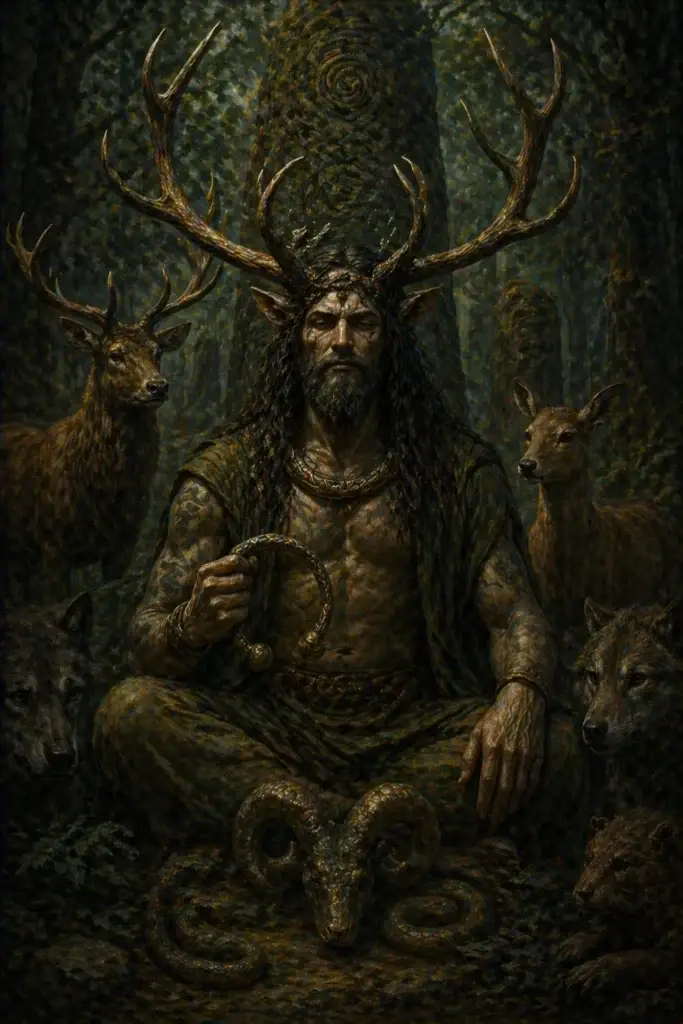
Cernunnos is the lord of wild animals and of the forest, depicted with antlers or horns, often surrounded by animals or in a seated pose. His function encompasses control over the animals of the hunt and care over fertility and prosperity.
In Celtic myths he appears as a god of life’s abundance and of transformation. His name is attested only in a single inscription on the Paris Boatmen’s Pillar; the Cauldron of Gundestrup bears no inscription.
Cernunnos at a Glance
The evidence comes from archaeological finds, in particular from the Cauldron of Gundestrup (2nd to 1st century BC), from Celtic coin series with horned figures, and from Roman written sources such as Caesar and Pliny, who mention Celtic deities.
Literary transmission is fragmentary. Modern scholarship (Maier, Green) seeks to connect the archaeological depictions with literary reconstructions.
Context
Period of the Texts
The continuity of the transmission across these long spans of time is remarkable and shows a deep, stable cultural rootedness. Even in modern times the memory, and sometimes also active veneration, remains alive, at times transformed but still recognizable in its essential features.
Mythological Classification
Cernunnos is a Celtic god of the wilderness, the forest and the animal world. He is often depicted horned or with antlers. Although few written sources survive, he is understood as an archetype of natural wildness. His role was that of ruler over wild animals.
Area of Distribution
Archaeologically, Cernunnos is attested primarily in Gaul, Belgium and southern regions; traces in Irish and Welsh sources are regarded as indirect and disputed.
This clearly indicates a central role in the self-understanding of the entire people. Trade, migration and cultural exchange contributed to the geographic spread and to the stable uniformity of the veneration.
State of the Sources
Primary sources: the Cauldron of Gundestrup (Southern Gaulish and Scythian, 2nd to 1st century BC), coin series with horned gods from Belgium and Gaul, Roman historians (Caesar: De bello Gallico; Pliny: Naturalis historia). Period: the archaeological testimony ranges from the La Tène era (500 to 50 BC) into the Roman imperial period. Scholars such as Bernhard Maier and Miranda Green (The Gods of the Celts) seek to harmonize iconography and myth.
Name and Variants
Cernunnos is depicted in the various sources and artistic traditions with certain recurring iconographic elements that remain relatively constant across decades and across different geographic regions.
These elements are not purely decorative or randomly chosen but are deeply symbolically encoded and carry great significance. They centrally convey the functions, sources of power, areas of responsibility and cosmic role of the being.
The overall system is like a sacred script or an encoded image; it allows the initiated or the culturally educated to grasp and correctly understand its essential deeper meaning. Colors, sacred objects or weapons, physical attributes, specific accessories, everything is significant and traditionally handed down.
Description
Cernunnos was central to the religious practice, the everyday rituals and the daily understanding of the Celts. People turned to this being in critical or specific life situations or at particular ritual seasons of the year.
Information about the cult of Cernunnos comes above all from consecrated images and sculptures: the Pillar of the Boatmen (Nautae Parisiaci) was donated under Emperor Tiberius by the guild of Parisian boatmen, that is, by an organized corporation that furnished its dedication with an inscription according to Roman custom. Such donations followed established forms of Gallo-Roman religious practice and were no private improvisation, even though hardly any written sources survive concerning the rites themselves.
The range of evidence, from the rock carving in Val Camonica via the Gundestrup Cauldron to the Paris pillar of the Tiberian period, shows that the horned figure was regarded as worthy of veneration over centuries. What concerns people brought before him can only be inferred from the images: the coins and fruits poured out in some depictions suggest wishes for yield and livelihood, the surrounding animals a responsibility for game and herds, on whose thriving people depended.
Appearance and Symbolism
Cernunnos is depicted iconographically with large antlers, often in a yoga posture. He is a friend of the animals; deer and snakes surround him. Sometimes he wears torcs (Celtic neck rings). The forest and the animal world are his realms.
The torc in Cernunnos’ hand leads straight into Celtic protective thinking. More about neck rings, threshold rituals and tree cults in everyday life can be found in the article on Celtic protection traditions on ittermann.de.
Profile: Cernunnos
The Profile captures Cernunnos in six aspects: his geographic and cultural origin, his circles of veneration, iconography and attributes, ascribed powers, as well as ways of showing respect and invoking him, and cross-cultural parallels. This traces a consistent profile of this enigmatic forest god.
Cernunnos belongs to the layer of the Celtic pantheon that is probably of Indo-European origin. Archaeologically he is attested primarily in Gaul, Belgium and southern cultural regions (1st to 2nd century AD).
The Cauldron of Gundestrup, possibly made in Thrace or Southern Gaul, shows him in a central position, which points to his importance. Literary traces in Irish and Welsh sources are indirect and disputed.
Cernunnos was invoked by hunters, herders and cattle breeders to secure success in the hunt and abundance for the herds. His veneration was presumably concentrated among the rural, non-urban population. His iconography on luxury objects also points to aristocratic veneration.
Cernunnos is depicted iconographically as a seated or standing man with antlers, horns or snakes, often naked or in animal skins, surrounded by deer, boars, snakes and other animals. The cauldron shows him amid an animal cosmos. Sometimes he wears an arm ring or torque, signs of Celtic authority. The pose appears majestic and lordly.
Cernunnos is ascribed power over the animal world and luck in the hunt, the blessing of wealth and fertility, as well as powers of transformation. He stands for the primal and the untamed in nature.
His sign of money or value also makes him a guarantor of prosperity.
Cernunnos is not regarded as dangerous but as a benevolent lord of the wilderness. Hunters and herders invoked him to ask for respect toward the animal world and for success in the hunt.
Modern affinity with nature sees him as a patron of ecological harmony. Practices of warding-off are not transmitted.
Comparable figures are the Indian Pashupati (“Lord of the Cattle Herds”), depicted with horns and surrounded by animals on seals of the Indus Valley (interpretation disputed), and Artemis/Diana in her role as mistress of the hunt. The horned forest-god type is a regional feature of a Euro-Asian religious layer.
Cernunnos, Parallels in Other Cultures
Horned lord-of-the-animals figures as mediators between the wilderness and human beings appear in many mythologies: in India as the Pashupati aspect of Shiva, in Siberia as a shamanic animal spirit, in Greece as Pan; the Celtic reading emphasizes fertility and wealth.
Jewish tradition: No direct equivalent. Distantly related is the figure of the hunter Nimrod (Gen. 10) or the hunting motif in the David narratives. There are no deities here.
Greco-Roman world: Artemis/Diana as mistress of the hunt and protector of the wild fauna. Pan as a herdsman god and forest being with horns and an animal nature. The Roman Silvanus (forest god) and Faunus share Cernunnos’s aspect of lord of the forest.
Mesopotamia: Shamash in his manifestation as a force controlling the wild shows similarities.
India/Asia: On Indus Valley seals, a horned human figure surrounded by animals is interpreted as Pashupati (Pashupatinath); the interpretation is disputed, and a continuity with Cernunnos is not established. In Tibet, Mahakala is similarly depicted as a lord of wild forces.
The Name Cernunnos and Its Single Inscription
Cernunnos is one of the best-known figures of Celtic religion and at the same time one of the most poorly attested. The name itself is reliably transmitted only a single time.
It appears on the so-called Pillar of the Boatmen in Paris, a monument that Gallo-Roman boatmen erected in the first half of the first century AD in Lutetia, present-day Paris, and which is dated to the reign of the Roman emperor Tiberius.
On one block of this pillar a figure with antlers is depicted, from which two rings hang. Above the image stands the inscription, usually read as Cernunnos, although the first letter is damaged and the reading is therefore not entirely certain.
The usual interpretation of the name connects it with a Celtic word for horn or antler, so that Cernunnos means roughly “the horned one” or “the one with the antlers.”
This thin state of the sources is fundamental to understanding Cernunnos. There is no ancient text that tells a myth about Cernunnos, no description of his cult, no prayers. Everything that can be said about him rests on the pictorial transmission and on cautious inferences.
Scholarship today uses the name Cernunnos in a sense as an auxiliary designation for an entire type of horned god depictions that are distributed across the Celtic area.
Whether all these depictions actually refer to the same god, or whether several related deities are involved, cannot be decided. Any serious engagement with Cernunnos must openly state this uncertainty.
Cernunnos on the Cauldron of Gundestrup
The most famous pictorial depiction associated with Cernunnos is found on the Cauldron of Gundestrup, a richly decorated silver vessel discovered in 1891 in a bog in Denmark and usually dated to the last or second-to-last century BC.
On one of the inner plates of the cauldron a figure is depicted sitting cross-legged, wearing antlers. In one hand it holds a neck ring, in the other a horned snake.
Around the figure various animals are arranged, including a stag whose antlers resemble those of the figure. Many scholars regard this depiction as the most vivid embodiment of the Cernunnos type: the horned god as lord of the animals.
However, the Cauldron of Gundestrup in particular is a many-layered object. Its visual language combines Celtic with Thracian and other elements, and its manufacture is partly located not in the Celtic core area but in the southeastern European region.
Scholarship therefore debates how far the Gundestrup figure actually reflects a purely Celtic conception of the god.
Despite these reservations, the Gundestrup image has shaped the modern picture of Cernunnos more strongly than any other source. The combination of antlers, cross-legged seat, neck ring and horned snake has become the standard conception.
In terms of religious studies, what is important here is that a single, in many respects unusual object carries an entire interpretation of a god. This is an indication of how narrow the basis is on which the religious history of the Celts must work.
Iconography and the Question of Function
Beyond the Pillar of the Boatmen in Paris and the Cauldron of Gundestrup, there is a larger number of depictions that scholarship assigns to the Cernunnos type. Horned figures are common on reliefs, statuettes and votive stones, above all from Gaul, but also from the British region and from neighboring areas.
Recurring pictorial elements are the antlers, the seat with crossed legs, the neck ring or torque, frequently also a cornucopia or coins, as well as the horned snake.
In some Gallo-Roman depictions the figure appears with coins or with poured-out grain, which points to an aspect of wealth and abundance. The accompaniment by wild animals, especially the stag, has led to the widespread interpretation that Cernunnos is a lord of the animals and of the wilderness.
From this, scholars have derived various attributions of function: god of nature, of fertility, of wealth, of the passage between worlds.
It is important to emphasize, however, that all these interpretations are inferred from the images and are not supported by texts. The horned snake, for example, is an enigmatic motif whose meaning is not reliably known.
Scholarship is largely in agreement that Cernunnos was a significant deity, because his depictions are distributed over a wide area and were incorporated into impressive monuments.
About the precise nature of his being, however, one can only speak in conjectures. This discrepancy between obvious significance and missing textual transmission is the actual hallmark of the figure.
Cernunnos in Modern Reception and in Neopaganism
Despite, or precisely because of, the thin historical state of the sources, Cernunnos has unfolded a remarkable effect in the modern era. In the 19th and early 20th centuries, the emerging field of Celtic studies and religious studies engaged with the horned depictions and established the name Cernunnos as a collective term.
A particularly consequential but problematic role was played by the hypothesis of the folklorist Margaret Murray, who in the first half of the 20th century claimed that behind the witch trials of the early modern period stood a surviving pagan cult of a horned god.
Murray’s thesis has long been regarded as refuted in scholarship, but it had a great influence on the emergence of modern pagan movements.
In modern Neopaganism, especially in Wicca and in Celtic-oriented currents, a horned god figure has become one of the central figures, frequently under the name Cernunnos or simply as the horned god.
This modern figure combines elements of the historical Cernunnos with conceptions of other origins, such as the Greek Pan, and with the needs of contemporary nature religiosity.
In terms of religious studies, a sharp distinction must be drawn between the ancient Cernunnos, about whom we know almost nothing, and the modern horned god, who is a creation of the 20th century.
Cernunnos is an instructive example of how a barely attested historical figure can gain, through scholarly hypotheses, through their popular dissemination and through religious re-creation, a second, living existence that is only loosely connected with the historical record.
Further Links
Further reading:
- Celtic (parent culture page)
- Brigid (parallel deity in the Celtic pantheon)
- Dullahan (shapeshifter of the same tradition)
- High Deities (class overview)
Sources and Literature
Further standard works in the literature index.