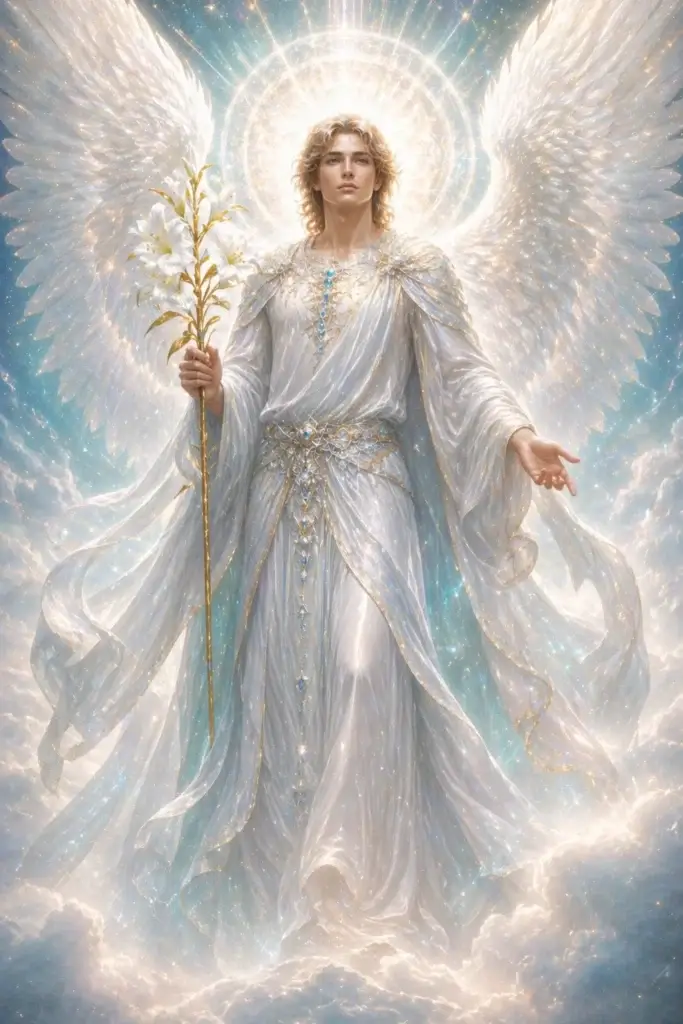
Archangel Uriel, Light Being
By Ralf Ittermann · last reviewed on
Angel of wisdom and divine light in the Jewish mystical and apocryphal tradition.
Profile: Uriel
Uriel: the most important aspects at a glance. The following fields summarise origin, function, appearance, veneration, symbols and parallels.
Uriel is not named in the canon of the Hebrew Bible or the New Testament. His significance derives from the apocryphal literature of ancient Judaism, above all the Ethiopic Book of Enoch and the Fourth Book of Ezra. His name is interpreted as light of God or fire of God.
In the First Book of Enoch, Uriel leads Enoch through the cosmic regions and explains to him the heavenly bodies, the sun, the moon and the seasons. In the Fourth Book of Ezra he instructs the seer Ezra about the limits of human knowledge. Esoterically he is regarded as the angel of wisdom, enlightenment and truth.
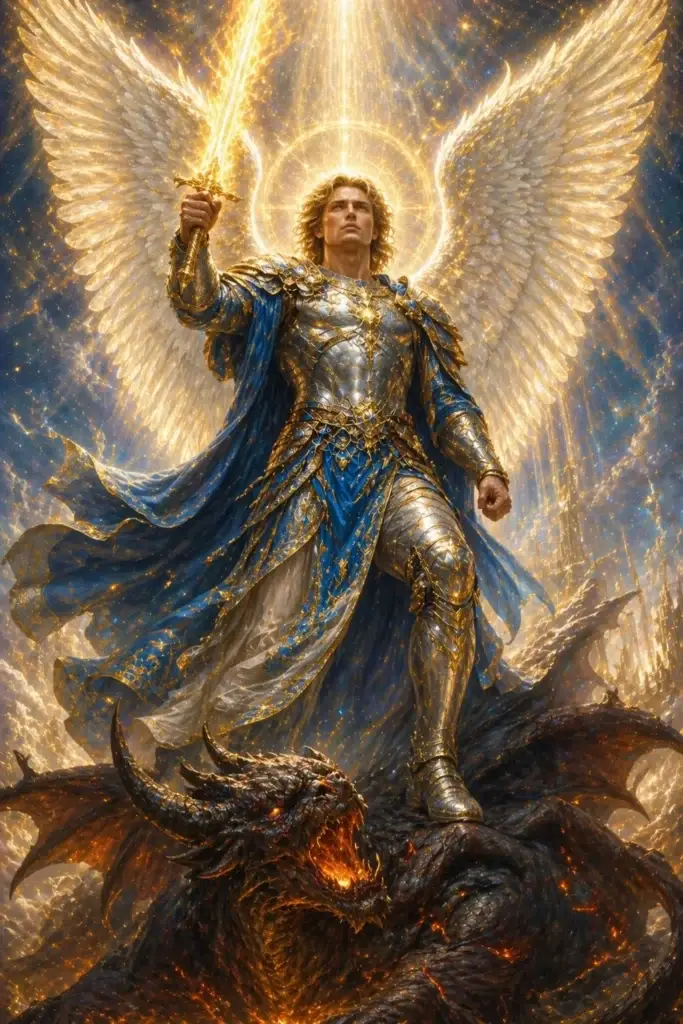
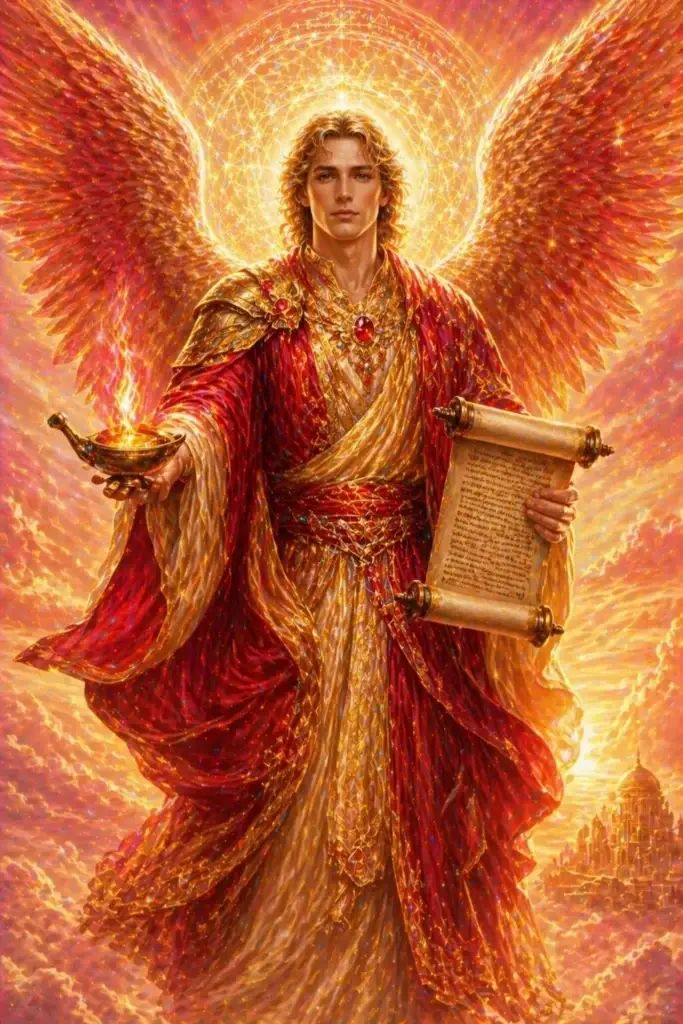
In art Uriel is hard to recognise, since no fixed attributes are assigned to him. Usually he carries a flame, a book or a scroll, occasionally a sword. Esoterically he appears as a radiant being of light in golden robes with a chalice.
Veneration was inconsistent. A Roman synod under Pope Zachary in 745 rejected angels not named in Scripture, among them Uriel. He remained alive in popular piety, and the Ethiopian Church and the Coptic tradition include him. In iWell Guard he is invoked with a golden or red candle.
Fire and light in gold and red, the flaming sword, the chalice of wisdom, as well as the book, scroll and tablets are regarded as symbols. His name connects him with light and fire.
Figures of fire and wisdom are Agni, Prometheus, Odin, Hephaestus and Bel in the Babylonian tradition. Within angelology Uriel, together with Michael, Gabriel and Raphael, counts among the four highest archangels.
Quick Overview: Archangel Uriel
Type: Archangel, keeper of fire, sage and seer Tradition: Judaism (Apocalypse of Enoch, Sefer Hekhalot), Christianity (4 Ezra), Western angelology Function: wisdom, enlightenment, illumination of delusion, transformative fire Main attributes/symbols: golden or red fire, flaming sword, chalice of wisdom Distribution: especially in apocryphal texts, Jewish mysticism, Western esoteric schools
Classification
Tradition
Uriel (Uriyel, „God is my fire“ or „God is my light“) appears in apocryphal writings and pseudepigraphic texts such as the Apocalypse of Enoch and 4 Ezra. In the Apocalypse of Enoch, Uriel is the angel who rules over hell and shows people God’s scales of justice.
In kabbalistic systems, Uriel is often assigned to the Sephirah Chokmah (wisdom) or Gevurah (power/severity). Western angelology raised Uriel to the rank of the four highest archangels (together with Michael, Gabriel and Raphael). Theosophical and esoteric schools emphasize Uriel’s role as the one who opens the third eye and brings enlightenment.
Source Situation
Apocryphal sources: Book of Enoch (1 Enoch), 4 Ezra, Pseudo-Dionysius the Areopagite (Christian angelology). The Talmud and the Sefer Hekhalot name Uriel among the archangels of Merkabah mysticism.
Christian artistic tradition depicted Uriel less frequently than Michael or Gabriel, but recognizably with fire or a chalice. Modern esoteric literature, especially in Western spirituality, has rediscovered Uriel as the archangel of wisdom and inner enlightenment.
Source Situation Outside the Biblical Canon
Uriel (Hebrew Uri’el, „God is my light“) does not appear in the Protestant or Jewish biblical canon, but he does appear in intertestamental apocalyptic literature.
In the Fourth Book of Ezra (Apocrypha) he is the angel who reveals coming events to Ezra; in the First Book of Enoch he is one of the four or seven archangels and a watcher over the firmament and the stars.
The Eastern Orthodox and Coptic traditions count him among the four or seven archangels; the Catholic tradition excluded him as non-canonical at a Roman synod in 745, yet never wholly abandoned him in popular piety.
Appearance and Symbols
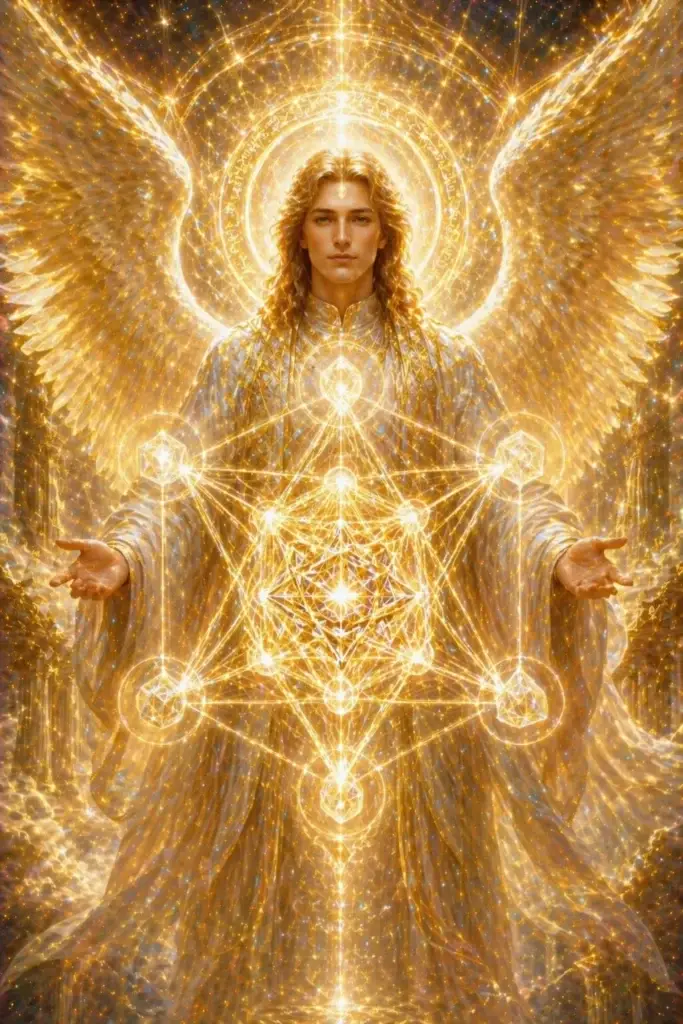
Uriel is depicted as a radiant, intense light being in golden or red-gold robes or in flame-light substance. His color is gleaming gold or glowing red-gold, sometimes interwoven with white, clear light. He carries a chalice (of wisdom) or a flaming sword.
Sometimes he is shown with a book or with tablets of writing, the book of wisdom. Wings of golden flame surround him. Energetically, Uriel acts intensely, penetratingly and clarifyingly, like direct sunlight on fog or alchemical fire. His presence burns away what is not true and reveals the essential.
Function and Meaning
Uriel is the angel of enlightenment and truth. Where Michael fights with the sword, Raphael heals and Gabriel proclaims, Uriel shows truth itself. He illuminates delusion, self-deception and unconscious patterns.
Uriel symbolizes the inner fire of insight, not cold intellect, but the living, transformative wisdom that burns. In psychological terms, Uriel embodies the highest consciousness and the ability to see reality as it is. His golden energy kindles the inner light body and activates the third eye.
Function and Symbolism
In Jewish angel magic, Uriel is the angel of the southern direction (in some schools, the reverse of Michael in others), of the earth and of the sphere Malkuth or Geburah. In the modern lightworker tradition he is often associated with wisdom, spiritual clarity and the element of earth.
In the Western ritual magic of the Golden Dawn he is the archangel of the north and of the earth. The iconographic tradition often shows him with a scroll or book, as a messenger of divine wisdom and the enlightenment of the mind.
Practice / Invocation / Meaning in the iWell Guard Context
In iWell Guard, Uriel is invoked to receive deep wisdom and to reveal blind spots. One practice is to light a golden or red candle and ask Uriel to open the eyes of the heart. Uriel’s fire is visualized to burn away old, blocking patterns and to make room for new insight.
Uriel helps especially when one is „stuck“ or paralyzed by confusion. His flame brings clarity without pain, a transformative fire that builds up rather than destroys. Uriel is the guardian of the deeper truth of the iWell Guard field itself.
iWell Guard Position
Like Raphael, Uriel is not explicitly named in the iWell Guard mantra, but is implicitly included as one of the four Western archangels of the cross-of-light tradition.
In the extended protection visualization he can be invoked as a northern protective force (in the Golden Dawn assignment) or as a protective instance of the earth layer. The four-archangel constellation Michael, Gabriel, Raphael and Uriel forms the standard ritual-magic form of angel invocation in the Western esoteric corpus.
Parallels
Uriel in the Apocryphal and Pseudepigraphic Tradition
Unlike Michael and Gabriel, Uriel is not mentioned by name in the canon of the Hebrew Bible and the New Testament. His significance is owed almost entirely to the apocryphal and pseudepigraphic literature of ancient Judaism.
The most important source is the Ethiopic Book of Enoch, which arose in several layers between the third century BCE and the first century CE.
In the First Book of Enoch, Uriel is one of the four or seven archangels who stand before the throne of God.
There he appears as the angel who leads Enoch through the cosmic regions and explains to him the laws of the celestial bodies, the course of the sun and the moon, and the order of the seasons.
In the astronomical chapters of the Book of Enoch, Uriel is the teacher of the calendar. This connection to light, celestial mechanics and the imparting of knowledge shapes his profile lastingly.
The Fourth Book of Ezra, a Jewish apocalypse from the late first century, gives Uriel another characteristic role. There he is the angel who answers the seer Ezra and instructs him about the limits of human knowledge.
Uriel poses unsolvable riddles to Ezra in order to make clear to him that humanity cannot fathom the ways of God.
Scholarship emphasizes that Uriel’s name, which can be interpreted as light of God or fire of God, fits well with these functions.
In the various angel lists of the pseudepigraphic literature, however, the order and even the composition of the archangel group fluctuates. Uriel is not present in all lists, which shows that the angelic hierarchy of ancient Judaism was not a fixed system.
Uriel's Contested Position in the Christian Church
The veneration of Uriel in the Christian tradition proceeded inconsistently. While Michael, Gabriel and Raphael could rely on biblical attestation, Uriel lacked this canonical basis. This led to ecclesiastical disputes over the question of which angel names could be named in worship at all.
A Roman synod under Pope Zacharias in the year 745 dealt with the veneration of angels not named in scripture. It is recorded that only the three biblically attested archangels were confirmed as permissible.
Uriel and further angel names that circulated in apocryphal writings were rejected, because, in the view of the synod, some of these names might conceal not real angels but possibly demons. This caution shaped the Western church for a long time.
Nevertheless, Uriel’s veneration survived in various currents. In the Ethiopian Orthodox Church, whose canon includes the Book of Enoch, Uriel has a firm place.
He is also named in the Coptic and in parts of the Eastern church tradition. In Western popular piety Uriel likewise persisted, for example in prayers and in iconography, without his receiving official liturgical rank.
In the Anglican sphere and in the esoteric tradition of the early modern period, Uriel gained additional importance. John Dee, the scholar and adviser at the court of Elizabeth I, named Uriel as one of the angels of his visions.
With this, Uriel partly migrated from theology into magic and into hermetic literature. Religious studies scholarship sees in this migration an example of how a figure not fully recognized by the church lives on precisely in the marginal areas of piety.
Uriel in Art, Literature and Modern Esotericism
In the visual arts, Uriel is hard to identify unambiguously, because no fixed attributes are assigned to him. Where he appears named, he often carries a flame, a book or a scroll, which points to his functions as an angel of light and knowledge.
Occasionally a sword is assigned to him, because one tradition identifies him with the cherub who, according to the Book of Genesis, guards the entrance to the Garden of Eden. This equation, however, is a later interpretation and is not laid out in the biblical text itself.
In literature, Uriel received his probably most influential form through John Milton’s epic poem Paradise Lost of 1667. Milton makes Uriel the regent of the sun and the sharpest eye in heaven, who is nevertheless deceived by Satan when the latter, disguised as an innocent angel, descends to earth.
Milton’s Uriel combined the older astronomical tradition of the Book of Enoch with a literary characterization that strongly influenced the later image.
In modern esotericism, especially in the tradition of the Hermetic Order of the Golden Dawn in the late nineteenth century, Uriel was assigned to one of the four directions and one of the four elements, usually the north and the earth.
This systematization is a modern construct and has no basis in the ancient sources, in which Uriel is precisely not connected with the earth but with light and heaven.
Contemporary angel literature and currents of religious self-interpretation frequently take up Uriel as the angel of wisdom or of inner enlightenment.
From the standpoint of religious studies, it should be noted that these attributions arise from modern needs and depart markedly from the historical sources. Those who wish to compare conceptions of angels will find at Michael and Archangel Gabriel the more securely canonically attested counterparts.
Etymology and the Meaning of the Name
The name Uriel is a theophoric formation, that is, a name that contains an element of God.
It is composed of the Hebrew component for light or fire and the common ending that designates God and also appears in names such as Michael, Gabriel and Raphael. The usual translation is light of God or fire of God.
This dual meaning between light and fire is no coincidence, but corresponds to the range of the underlying Hebrew word, which can carry both meanings.
Scholarship sees in this a reason why Uriel appears in the sources both as a bringer of light and teacher of the celestial order and occasionally as a punishing, fiery angel.
In the various manuscripts and translations, the spelling of the name varies considerably. In the Greek and Latin sphere, forms such as Ouriel occur, and in Slavic Enoch traditions further variants appear.
In some angel lists, Uriel is confused with other angel names or equated with them, for example with Phanuel or Sariel. This uncertainty shows that the names of the non-canonical angels were not strictly fixed but migrated within the tradition.
It is notable that the kabbalistic tradition of medieval Judaism in part carried Uriel forward and gave him a place in its complex angel systems, again with a fluctuating position.
The religious studies assessment is that the name Uriel denotes less a clearly defined person than a bundle of functions that groups itself around the idea of divine light and heavenly knowledge.
Frequently Asked Questions about Archangel Uriel
Who is the Archangel Uriel?
Uriel (Hebrew Ori-el, light of God or God’s light) is one of the four (sometimes seven) archangels of the Jewish-Christian tradition, alongside Michael, Gabriel and Raphael.
Unlike Michael and Gabriel, Uriel is not mentioned by name in the Hebrew biblical canon; he appears first in the apocryphal Fourth Book of Ezra and in the Ethiopic Book of Enoch. In the Orthodox tradition he is one of the seven archangels, patron of light, wisdom, enlightenment and prophetic vision.
Which symbols and aspects are assigned to Uriel?
In Western angel esotericism, Uriel is the archangel of enlightenment and wisdom, usually depicted with a flame or an open book. He is assigned the element of earth (fire in other traditions), the color gold or ruby, and the north as direction.
Uriel is regarded as the patron of prophetic inspiration, of the natural sciences and of practical wisdom. In Jewish mysticism, Uriel is one of the four angels of the Shekhinah (divine presence) who guard the eternal light.