Dakini, Spirit of the Buddhist Tradition
By Ralf Ittermann · last reviewed on
Dakini is a spirit of the Buddhist tradition.
Sky-dancer and form of energy, an ambivalent key figure of Vajrayana.
The Dakini (Tibetan: Khandro, “sky-dancer”) is one of the central figures of Vajrayana Buddhism. Her ambivalence is programmatic: in her early Indian form she appears as a dangerous female being at cremation grounds, hungry, wrathful, and possessed of occult knowledge.
In the tantric adoption she becomes the bearer of the highest teachings and the key to tantric realisation, wisdom itself in a female, dynamic form.
Three dimensions have become established in the Tibetan tradition: the “worldly” Dakini (an encounter-figure at specific places), the “wisdom Dakini” (a transcendent form, the yidam of meditation), and the “secret Dakini” (the inner energy of the practitioner).
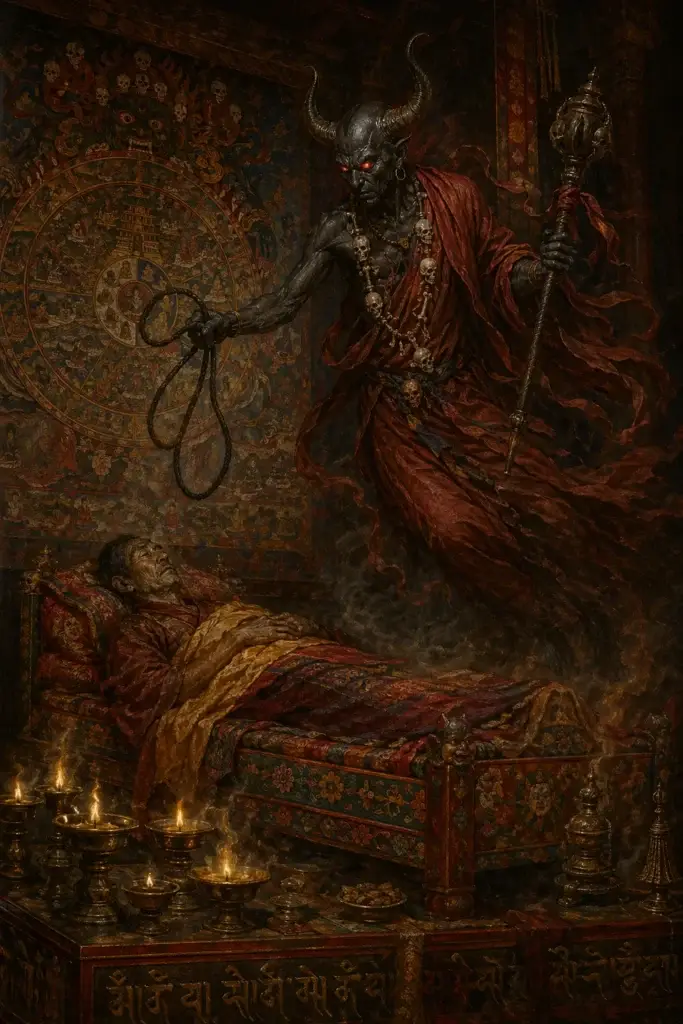
The boundary with the “demonic” is fluid: a Dakini can be terrifying before she is recognised as a teacher. It is precisely this ambivalence that makes her classification within a demonology meaningful; she represents a force that is threatening in the unrealised state and awakening in the understood state.
Hindu Dakini and the Wild Goddesses
The Dakini figure has its origins in ancient Indian Hindu texts, where she appears as a demonic or wild goddess, often associated with the consumption of flesh and impure sacrificial rites.
In early Puranic texts such as the Markandeya Purana, dakinis are described as attendants of Kali or as independent wild-feminine powers wandering at slaughterplaces and cremation grounds.
These Hindu dakinis are originally related to bhuta (spirits) but are elevated through repeated textual categorisation into autonomous supernatural classes. The etymology of dakini is disputed, possibly deriving from daka (magical practitioner).
In Hindu ritual texts, dakinis are conceptualised as guardians and intermediaries between the divine and human spheres. This early Hindu iconography already established the connection between female supernaturalism, tantric knowledge and the transgression of boundaries, motifs that were later elaborated in Tibetan Buddhism.
Quick Overview: Dakini
Type: Tantric energy figure, “sky-dancer”
Origin: Indian cremation-ground demonology, transformed in Vajrayana
Three dimensions: worldly, wisdom, secret
Texts: Vajrayana tantras, Tibetan hagiographies (Yeshe Tsogyal, Machig Labdron)
Period: 6th to 8th century in India; from the 8th century in Tibet; through to the present
Context
Early Indian attestations in the Puranas and tantric texts (6th to 8th century). Buddhist-tantric adoption in Vajrayana literature from the 7th and 8th century onward. Central in Tibet with Padmasambhava‘s mission (8th century). Medieval Tibetan hagiographies of Machig Labdron in the 11th and 12th century; the life story of Yeshe Tsogyal is regarded as a terma text first written down in the 17th century by Taksham Nuden Dorje. Modern Western reception from the 1970s onward.
India as the place of origin. Tibet, Ladakh, Bhutan and Mongolia as the Vajrayana heartland. Japan with its own Dakini tradition (Dakini-ten, as a fox-riding deity). Modern Western Dharma centres as a new area of dissemination.
Vajrayana tantras (Hevajra Tantra, Chakrasamvara Tantra, Vajrayogini Sadhana), biographies of Yeshe Tsogyal and Machig Labdron, Nyingma terma literature, modern Tibetan teacher commentaries (Dilgo Khyentse, Chogyam Trungpa).
Names and Spellings
Sanskrit: ḍākinī; male counterpart ḍāka.
Tibetan: Khandroma (mkha’-‘gro-ma), “sky-dancer”; male form Khandro.
Japanese: Dakini-ten, frequently associated with the kitsune (fox).
Etymology: unclear; possibly related to ḍī, meaning “to fly”.
Important individual figures: Vajrayogini, Vajravarahi, Kurukulla, Yeshe Tsogyal, Machig Labdron.
The “sky-dancer” emphasises freedom and mobility. In the Tantra context, the Dakini is not bound to a fixed form; she traverses spaces and states. This makes her the ideal figure for meditation practices in which rigid identifications are dissolved.
Characteristics
Appearance
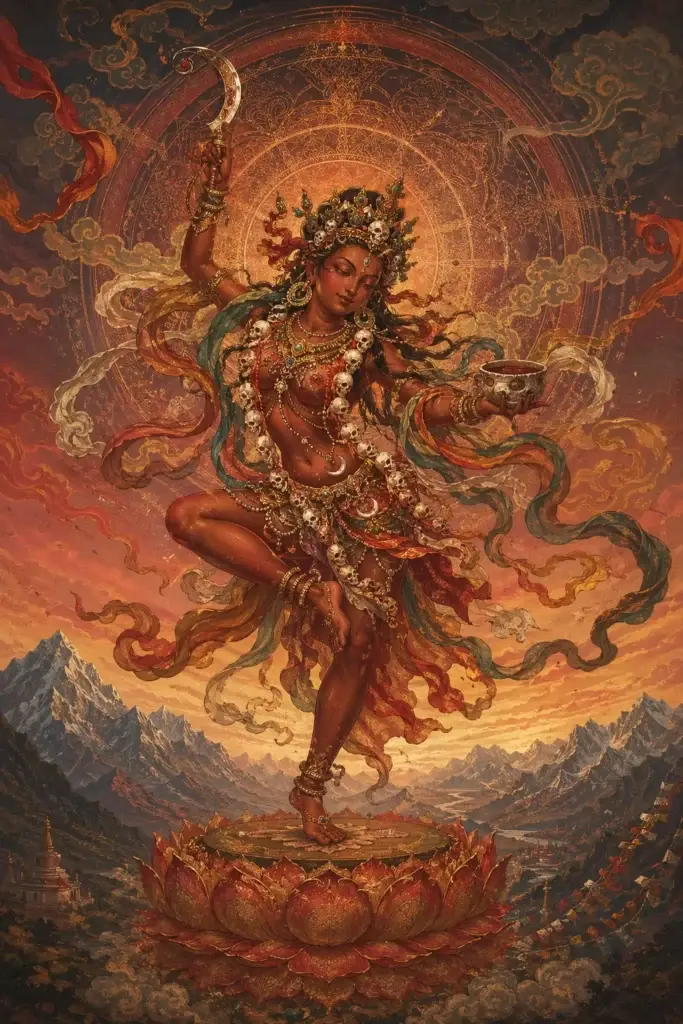
Young, dynamic, dancing. With a fur skirt, skull cup (kapala), curved knife (kartika) and khatvanga staff. Hair flowing freely. Colours are symbolic: red for the active transformation of passion, black for fundamental nature, blue for transcendent wisdom.
Behaviour
Worldly: appears at shmashana, gives cryptic advice, tests the seeker. Wisdom Dakini: conveys hidden teachings (terma), appears in visions and dreams. Secret Dakini: the inner energy of the practitioner, recognised through meditation.
Sphere of Activity
Cremation grounds, sacred places, retreat sites, dreams and visions of practitioners, the yogic body in the tantric interior. Not bound to place in the ordinary sense; as “sky-dancer” she crosses boundaries.
Mythological Classification
In Hinduism originally demonic (Pishacha-nah, Shaiva Tantra). Transformed in Vajrayana: the wrathful wisdom form of the highest bodhisattvi. Historical women such as Yeshe Tsogyal (8th century, Tibet) and Machig Labdron (11th century) are regarded as human manifestations.
Tibetan-Buddhist Khandroma and Vajrayana Practice
Tibetan Buddhism defines dakinis as Khandroma (sky-walkers), spiritual beings that play central roles in tantric Vajrayana Buddhism. Khandroma are not primarily demonic; rather, they are manifestations of supernatural femininity in service of enlightenment.
In Tibetan liturgies and meditation practices, khandroma are depicted as the energetic embodiments of prajna (transcendent knowledge). The most renowned khandroma is Vajrayogini, a central meditation deity in several Tibetan Buddhist schools.
The Tibetan classification distinguishes between karmic dakinis (karmically conditioned manifestations) and wisdom dakinis (wisdom-essential). This differentiation made it possible to understand wild, dancing Dakini figures as spiritual methods rather than morally problematic beings.
Tibetan practitioners work with Dakini visualisations as self-initiation techniques for generating transcendent awareness. The practice integrates the earlier Hindu wildness into controlled tantric transformations.
Profile: Dakini
The most important aspects of the Dakini at a glance.
Indian cremation-ground demonology, transformed by Vajrayana. Three dimensions: worldly, wisdom, secret. Historically manifest in Yeshe Tsogyal and Machig Labdron.
Tantric practitioners on an advanced path. Seekers at specific retreat sites. Dreamers and visionaries.
Young, dancing, with a fur skirt, skull cup and curved knife. Hair flowing. Colours: red, black, blue, depending on aspect.
Ambivalent: she terrifies, tests and imparts teachings. Her effect can be madness or awakening, depending on the degree of realisation of the beholder.
Not warding off, but entering into relationship. Vajrayana practice under a qualified guru. Mantra recitation (Vajrayogini, Vajravarahi), Sadhana cycles, tsok rituals.
Yakshini (positive aspect), Kali (Hindu parallel form), Baba Yaga (ambivalent primordial figure), Japanese Kitsune-Dakini-ten.
Tantric Practice
Sadhana Cycles
The Vajrayogini Sadhana and the Vajravarahi Sadhana are among the most important tantric practices. The practitioner meditatively identifies with the Dakini, internalises her qualities and undergoes the tantric transformation. Prerequisite: initiation by a qualified lama.
Terma Tradition
Dakinis are the traditional guardians of hidden teachings (terma). Padmasambhava concealed teachings, according to the Tibetan tradition, in the landscape, in texts and in the body of Tsogyal; dakinis preserve them until the right disciples (tertons) find them.
Tsok and Offering Rituals
The tsok ritual (ganachakra), with shared offerings to all living beings, is frequently dedicated to dakinis. It connects the inner Dakini practice with communal celebration and karmic purification.
Modern Reception
Tibetan Buddhism in the West
The Dakini teaching has become particularly well known in the West through Chogyam Trungpa, Dilgo Khyentse and Tsultrim Allione. Allione’s Feeding Your Demons (2008) adapts Machig Labdron’s Chod practice for Western contexts.
Feminist Readings: Judith Simmer-Brown, Miranda Shaw and others read the Dakini as a paradigmatic female wisdom figure. The debate about women in Buddhist teaching tradition draws on Tsogyal and Labdron as historical role models.
Art and Popular Culture: Tibetan thangka painting featuring dakinis is present in international exhibitions. Modern fantasy literature and role-playing games adapt Dakini figures; in Japanese animation, Dakini-ten appears as a fox deity.
The Padmasambhava Tradition and the Dakini in Tibetan Mythology
Tibetan Buddhism codified Dakini veneration through the legend of Padmasambhava (8th century CE), the legendary transmitter of Buddhism to Tibet. According to the Padmasambhava biography, Padmasambhava was accompanied and supported by Yeshe Tsogyal, a supreme Dakini. This mythic relationship established the Dakini as teacher and enlightenment companion, not as an obstacle to be overcome.
Padmasambhava’s biography presents dakinis as integral agents in spiritual history: they give instructions, reveal hidden knowledge and accelerate enlightenment. This narrativisation had practical consequences: Tibetan practitioners began to visualise and invoke dakinis as assistants.
In the modern Nyingma school (the ancient school of Tibetan Buddhism), Dakini practice remains central, often in tantric rites such as Chod (ego-offering practice), in which the practitioner works with Dakini energies to transcend attachment.
From the Indian Figure of Terror to the Tantric Figure of Enlightenment
The term Ḍākinī has a semantic history that leads from a dark to a highly esteemed figure.
In early Indian sources, such as Puranic literature and medical texts, ḍākinī denotes frightening female beings associated with charnel fields, with the goddess Kali and with the consumption of flesh. They belong to the sphere of dangerous powers located at the margins of the ordered world.
With the rise of the tantric currents in Buddhism, from approximately the 7th and 8th century onward, a reinterpretation took place. The ḍākinī was integrated into the tantric system and became there an embodiment of awakened consciousness.
In Tibetan the term is rendered as khandroma (mkha’ ‘gro ma), literally “she who walks in space” or “sky-goer”. This translation reframes the figure in spiritual terms: the space through which she moves is emptiness, the central concept of Mahayana philosophy.
Scholarship, including the work of Judith Simmer-Brown, has emphasised that this transformation was not a mere forgetting of the older meaning. The terrifying features were retained and reinterpreted: the frightening quality of the Dakini stands for the disruption that the path to insight entails.
She destroys the practitioner’s attachment. The figure thus combines two strata: the older conception of a dangerous spirit-being and the more recent one of a teacher of liberation. It is precisely this double-layeredness that makes her illuminating for an understanding of tantric Buddhism.
The Three Levels of the Dakini in Tibetan Teaching
The Tibetan tradition distinguishes the Dakini on several levels, and this distinction is important for a correct understanding. Teaching texts speak of the worldly Dakini, the wisdom Dakini and, occasionally, of intermediate stages.
The worldly Dakini (jigten khandro) still belongs to the sphere of unenlightened beings; she can be helpful or obstructive and stands close to the older Indian conceptions.
The wisdom Dakini (yeshe khandro), by contrast, is a fully awakened figure, a manifestation of enlightened reality in female form.
To her belong figures such as Vajrayogini and Vajravarahi, who stand at the centre of their own meditation practices. In this function the Dakini is a yidam, a meditation deity with whom the practitioner identifies.
At the same time the Dakini can appear in the life-stories of Tibetan masters as a figure encountered in reality, one who imparts instructions, transmits hidden texts (terma) or puts the practitioner to the test. The biographies of Padmasambhava and his companion Yeshe Tsogyal are filled with such encounters.
Yeshe Tsogyal herself is understood in the tradition simultaneously as a historical woman and as a Dakini. This interweaving of symbolic figure, object of meditation and lived experience cannot be pressed into a single category.
The study of religion therefore describes the Dakini as a multidimensional concept that foregrounds a different layer of meaning depending on context, whether philosophical text, ritual manual or hagiography.
Iconography: the Terrifying as a Didactic Device
The pictorial representation of the Dakini, as found in Tibetan scroll paintings (thangka) and bronzes, follows an iconography that initially unsettles Western observers, and this unsettling is precisely the point.
Dakinis such as Vajrayogini are usually depicted naked or clad only in bone ornaments, in a dancing posture, often standing on a corpse or a prostrate being. They hold a skull cup (kapala) filled with blood, a curved knife (kartrika or karttrika) and a staff-club (khatvanga).
Each of these attributes is symbolically coded. The skull cup, filled with blood, stands for great bliss and for impermanence. The curved knife cuts through delusion and attachment. The nakedness signifies freedom from concealment, that is, immediate reality without conceptual overlay. The prostrate figure beneath her feet embodies the ego-grasping that has been overcome.
The bone ornaments and the presence at the charnel field refer back to the older Indian strata but are integrated into the tantric symbolic system. The apparent terrifying quality is therefore not an end in itself and not a glorification of violence; it is a didactic device.
Tantra proceeds from the assumption that powerful images can break open habitual perception. Anyone viewing the Dakini’s iconography without this interpretive framework misunderstands it. The images are meditation instructions in visual form, and their frightening elements are intended to jolt the practitioner out of habit, not to frighten.
Further reading:
- Buddhism
- Mara, Preta, Yamaduta, Naraka Guardian
- Yakshini (positive ambivalent female figure)
Sources and Literature
The protective practice described here represents a scholarly classification of historical traditions. iWell Guard draws on this cultural-historical lineage of wearable protective objects and constitutes a contemporary form of it. More about iWell Guard