Genius Roman, spirit of the Roman tradition
By Ralf Ittermann · last reviewed on
Genius is the tutelary spirit of a person, a family, or a place in the Roman tradition. The name literally means “the begetter” and points to the force that generates and sustains life.
From a religious-studies perspective, the Genius is an example of animism within polytheism: not all beings are gods, yet all have their protective spirit.
Genius Roman
The Genius is a personal or collective tutelary spirit, not independently acting like the gods, yet effective in protection and regeneration. Every person has their Genius (lat. tutelaris), every family its household Genius, every city its city Genius.
The central aspects are physical well-being, procreation, abundance, and continuity. The Genius of the emperor was venerated in the state cult, but was regarded precisely as a way to avoid venerating the living emperor himself as a god.
At a Glance: Genius Roman
Sources: Cicero De Natura Deorum, Seneca, Martial, Pliny Naturalis Historia, Valerius Maximus, Latin Inscriptiones, and household altars (lararium reliefs). Secondary: Georg Wissowa, Rudolf Simek (for Germanic parallels), Hubert Cancik, Kurt Latte. Belief in the Genius was widespread across all social classes and is documented extensively in archaeological finds from Pompeii, Herculaneum, and Gaul.
Context
Period of the Texts
The tradition of Genius reaches deep into the history of Rome, with documentation from the 3rd century BC onwards and probably even older oral traditions. The written sources are fragmentary but consistent, presenting a stable picture of this entity over long periods.
Cultural continuity was remarkable: traditions and practices were passed down across generations, often orally, often in the form of everyday rituals. The Romans integrated this figure or concept deeply into their spiritual systems, so that it endured into modern times.
Area of Distribution
Genius was widespread throughout the Roman world, not regionally limited but universal. Whether in urban centres or rural villages, veneration or understanding of this entity was consistent. This points to a central role in the cultural and spiritual life of Rome. The geographic uniformity of the practice is remarkable and indicates deep cultural roots.
State of the Sources
The primary sources are ancient texts, literary works, and religious canons of Rome. Secondary sources include ethnographic records, folk traditions, and archaeological findings. Oral traditions that remain alive today offer additional perspectives. The overall constellation of sources allows a coherent picture of Genius and its significance.
Designation and Variants
Genius is depicted across various traditions with certain iconographic elements that remain relatively consistent across time and space. These elements are not arbitrary but carry symbolic meaning.
They express functions, powers, and areas of responsibility. Colours, objects, physical attributes: all carry weight. The visual system is coded and can be read by initiates like a text.
Characteristics
The function of Genius in the religious and social life of Rome was central. People turned to this entity in specific life situations, with particular prayers or rituals.
The practice was not arbitrary but structured and transmitted. Generations of people cultivated these forms of veneration, passed them on, and adapted them. The continuity shows that the practice was effective, or at least regarded as effective.
Profile: Genius Roman
The Profile unfolds the Genius across six perspectives: its intellectual-historical and cultural origins, the lived practice of its veneration in private and state contexts, its typical depiction on household altars and in art, the significance of invocation and protective practices, comparable tutelary spirit figures in other cultures, and a concluding overall interpretation of its role in the cosmos.
Tradition
The Genius is a genuinely Roman creation without direct Greek or Etruscan predecessors. Its roots lie in Italic fertility daemons and in Indo-European concepts of personal tutelary spirits. The earliest attestations date to the 3rd century BC but intensify under Augustus.
The Genius cult was particularly anchored in Latium and spread with the expansion of Rome. It reached its highest development under the emperors, when the Genius Caesaris (imperial tutelary spirit) was officially venerated.
Audience of Genius Roman
The Genius was invoked by every citizen, every family, and the state. In private homes, people prayed daily to the Genius and the Lares (house spirits) at the lararium (household shrine). A person’s birthday was the feast day of their own Genius.
Farmers prayed to the Genius agri (field Genius), craftsmen to the Genius of their guild, soldiers to the Genius of the legion. The emperor offered public sacrifice to the Genius Caesaris, a practice that shaped the later imperial cult.
Depiction
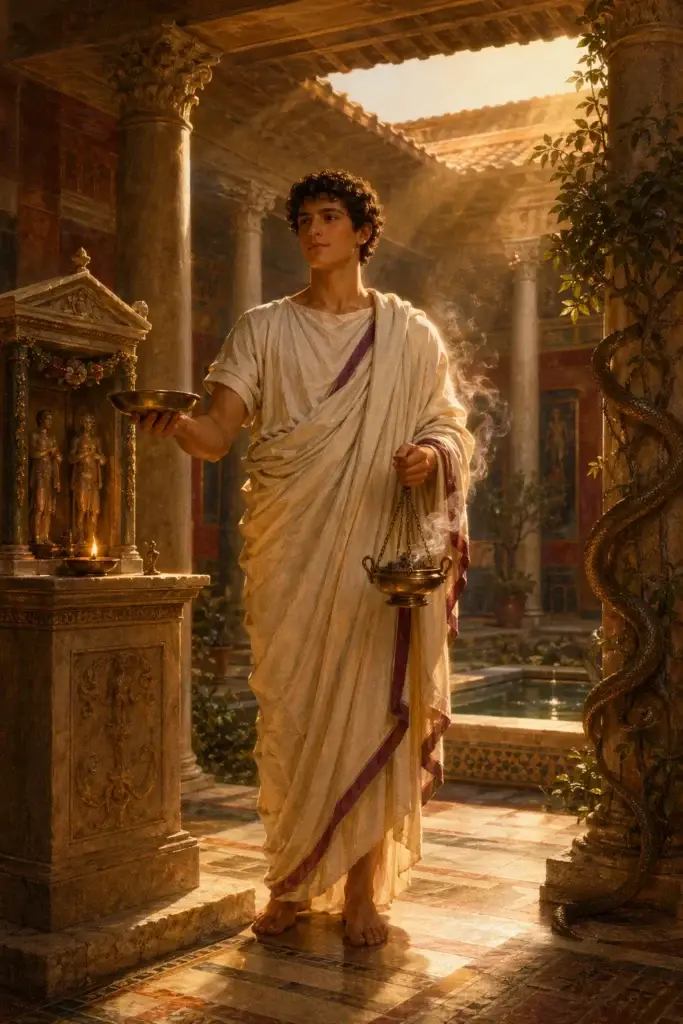
The Genius was depicted as a youth or man holding a dish (patella) for sacrifice, often alongside Lares or on household altars. On coins he sometimes bears a modius (grain measure), a symbol of blessing.
In relief carvings on household altars he sits among the household gods. The iconography is more abstract and variable than that of the gods. He was frequently depicted as a serpentine being, with the snake symbolising the regenerative, chthonic force.
Function
Sphere of Influence: The Genius in the Roman understanding of religion is the creative-vital life spirit of a man, his divine double, born with him and passing away on the day of his death. Every paterfamilias had his Genius, every woman her Iuno (the female parallel).
Beyond the personal, the term developed into the collective protective power of places (Genius loci), corporations (Genius collegii), the Senate (Genius Senatus), and, from Augustus onwards, the emperor (Genius Augusti).
Pliny the Elder (Naturalis Historia II, 16) and Servius (comm. on Virgil, Aen. V, 95) attest the domestic dimension. Ovid (Tristia III, 13) describes the birthday (dies natalis) as the central feast of the Genius, with wine, incense, and honey cakes at the Lararium.
Means of Protection
The Genius was approached with reverent invocation and sacrifice, not to avert harm but to secure prosperity and continuity. Offerings consisted of bloodless sacrifices such as wine, honey, and first fruits of the harvest.
On birthdays, cake gifts were presented. Wives offered sacrifice on their wedding day. An oath sworn by one’s own Genius was considered absolutely binding. Defaming the imperial Genius was a crime of lèse-majesté.
Parallels
In the Germanic tradition, the Fylgja and the Hamingja (Norse) correspond to the concept of a personal tutelary spirit. The Egyptian Ka is similar: a life force belonging to every person.
In the Greek world, the daimon (daimonion) serves as a personal tutelary spirit, as in Plato and Socrates, though less institutionalised than the Roman Genius. The Jewish concept of the guardian angel shows structural parallels but is theologically anchored differently.
Genius Roman, Parallels in Other Cultures
In other cultures, similar archetypes appear, often with comparable functions and attributes but localised and adapted to the respective culture. The universality of these patterns points to deep archetypal structures in human psychology and spirituality: various manifestations of a shared underlying theme.
Jewish Tradition: The guardian angel in later Jewish angelology (especially in Apocrypha and Kabbalah) is not directly derived from the Genius but shows a similar function: personal protection and intercession. In the Tanakh there are hints of tutelary spirits, but no systematic theology comparable to the Genius.
Greco-Roman World: The Greek daimonion (personal daemon, as in Plato and Socrates) is similar to the Genius but grounded more in philosophy than in cult. The synthesis in later Neoplatonists united both concepts into a cosmic ordering principle.
Mesopotamia: The protective spirit (ilu concept) in Mesopotamia is functionally similar to the Genius but less focused on individual persons than on lands and craft guilds. No direct parallel in cult and rank.
India/Asia: No direct parallel in Hinduism or Buddhism. The concept of a personal spirit of destiny (Dharma/Karma association) is thematically related but lacks a dedicated cult like the Genius.
Genius and Iuno: The Tutelary Spirit of Man and Woman
The Roman notion of the Genius was originally gender-bound. The Genius was the generative, life-accompanying spirit of the man; its female counterpart was the Iuno, which belonged to every woman. Just as every man had his Genius, every woman had her Iuno, and both accompanied the person from birth to death.
The name Genius is linguistically connected to the verb gignere, meaning to beget or to bring forth. This etymology points to the core of the notion: the Genius is the force that embodies life and, above all, the reproductive capacity of the man.
He was closely associated with the marriage bed, which was therefore called the lectus genialis. Exuberant, joyful celebration was described as indulgere genio, that is, yielding to one’s own Genius, an expression that echoes in the German loanword genial (ingenious).
The close connection with the individual person is also evident in the most important festival: the birthday, the dies natalis, was at the same time the feast day of the personal Genius.
On this day, one offered bloodless sacrifices to one’s own Genius, above all wine, incense, and flowers, and adorned oneself. The Genius was thus the religious reference point for the identity and well-being of the individual.
Scholarship debates whether the Genius was originally conceived more as an external tutelary spirit or as a part of the person itself. The sources show both views alongside each other. In any case, the Genius does not stand beyond the human being but is most intimately connected with their life force.
The Genius of Places and Communities
Beyond the personal tutelary spirit, the notion developed that places, groups, and institutions also possessed their own Genius. This extension is particularly instructive from a history-of-religions perspective, as it shows how flexibly Roman thinking engaged with the concept.
Well known is the Genius loci, the spirit of a place. A house, a grove, a spring, a city could all have a Genius watching over the flourishing of the place.
In household shrines, the Lararia, the Genius of the householder frequently appears together with the Lares and the Penates; in Pompeian wall paintings he is often depicted as a sacrificing, toga-clad figure, sometimes flanked by two Lares and a snake embodying the Genius of the house.
Collectives too had their Genius. There was the Genius populi Romani, the Genius of the Roman people, the Genius of military units such as legions and cohorts, of professional associations, of markets, and even of theatres.
Soldiers erected dedicatory inscriptions to the Genius of their unit; such inscriptions are scattered across the entire empire and rank among the most important witnesses to the spread of the cult.
This multiplication of the Genius concept made it one of the most broadly attested religious concepts of Roman daily life. It allowed almost any social or spatial unit to be assigned its own protective power, without the need to invent a new named deity for each one.
The Genius of the Emperor and Political Religion
A particularly consequential development was the connection of the Genius cult with the imperial office.
In the official Roman understanding, the living emperor could not simply be venerated as a god; that would have been felt as presumption and was formally reserved for deceased rulers elevated to divinity by the Senate. The Genius of the emperor offered a way out.
Not the emperor himself, but his Genius, that is, his personal protective and vital force, could be venerated. This distinction allowed for an imperial cult that formally preserved religious tradition.
Augustus promoted this form: in the reorganisation of the Roman city cults around 7 BC, the Genius of Augustus was associated with the Lares of the crossroads, the Lares Compitales, so that the Genius of the Princeps was venerated at every street crossing.
The oath by the Genius of the emperor became one of the most binding formulas in public life. To break or refuse it carried political significance.
In the persecution of Christians, the question of whether someone was willing to offer sacrifice to the Genius of the emperor played a concrete role, since refusal was interpreted as disloyalty.
The Genius cult thus illustrates how a belief originally private and centred on the individual man could become an instrument of imperial integration.
Scholarship in the history of religions, such as Duncan Fishwick’s studies on the imperial cult, has traced this development in detail and emphasises that the Genius cult found such wide distribution precisely because of its adaptability.
Genius in Art, Inscription, and Afterlife
The material tradition concerning the Genius is rich. On reliefs, coins, wall paintings, and statuettes, the Genius appears most commonly as a man in a toga, often with veiled head in the gesture of the sacrificer, holding a cornucopia or an offering dish.
The Genius of a community could also be depicted as a youth with a mural crown, similar to a city goddess. The snake that appears in the Lararia alongside or beneath the Genius image is regarded as the embodiment of the protective spirit of the house and is preserved in numerous Pompeian wall paintings.
Dedicatory inscriptions to the Genius number in the thousands. They range from the Genius of an individual person to the Genius of associations, workshops, and military units, and to the Genius loci of entire provincial cities.
These inscriptions are a central source because they show how naturally the Genius was anchored in the everyday life of all social strata, including slaves and freedmen who venerated the Genii of their own associations.
The afterlife of the term is considerable. In Latin late antiquity and in the Middle Ages, the Genius partly merged with the Christian notion of the guardian angel, and partly survived as a learned term.
In the Italian Renaissance and the early modern period, its meaning shifted: from tutelary spirit to innate intellectual gift, and ultimately the modern concept of genius as a person of extraordinary creative ability emerged.
This semantic shift is an example of how a religious concept of antiquity continues to act in European intellectual history without preserving its cultic origin.
Research Literature
The Genius in the Roman understanding designates the personal tutelary spirit of a man, which comes into being at his birth and was venerated in the household cult through votive offerings on his birthday and at the Lares altars.