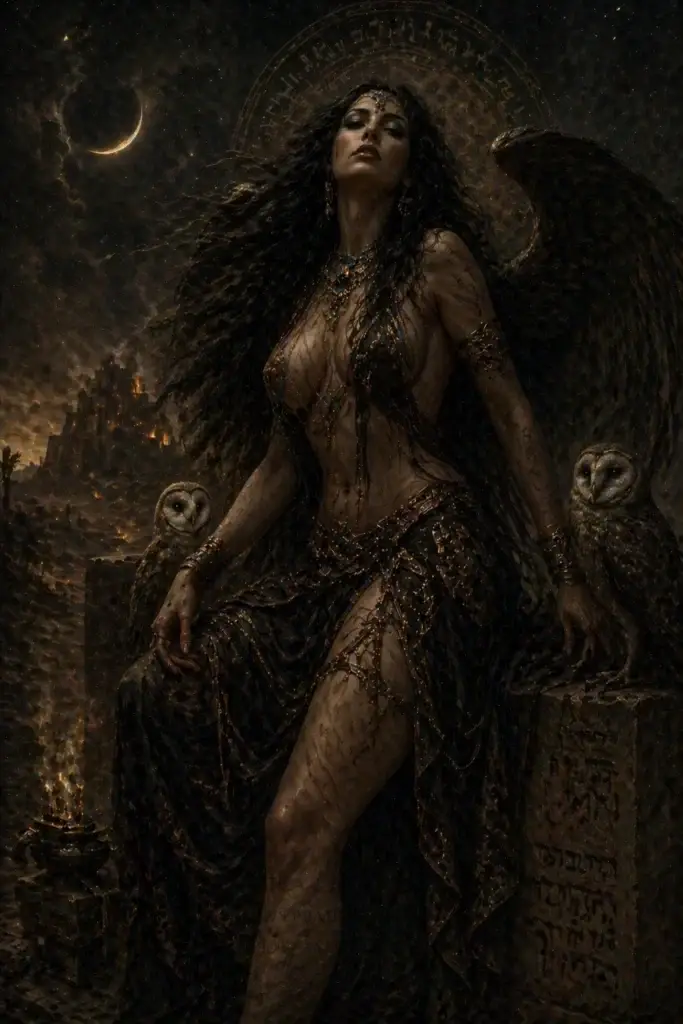
Golem, Spirit of Jewish Tradition
By Ralf Ittermann · last reviewed on
The Golem is, in Jewish tradition, an artificially created humanoid being made of clay or earth, animated through magic or the divine word. From the perspective of religious studies, it represents Jewish creation mysticism, the transgression of the boundary between human and God, and the late-medieval practicalism of rabbinic mysticism (Kabbalah). This entry presents the Golem as a Spirit of Jewish tradition, born of clay and the transgressive power of sacred speech.

Golem
The Golem is a figure of clay or earth brought to life through the name of God or magico-linguistic practices. In the most famous legend, the Prague Maharal, Rabbi Judah Loew created a Golem to protect the Jewish community.
The Golem is obedient, endowed with superhuman strength, yet also dangerous and ultimately destroyed. Central narratives include: the biblical creation of Adam as the model, medieval Golems as protective beings, and later symbolic-psychological interpretations.
Profile: Golem
The Golem narrative emerged in medieval and early modern Jewish Kabbalah (approximately 12th to 16th century). Central sources: the Sefer Yetzirah (Book of Creation, 3rd to 6th century, though Golem references appear later), the Prague Maharal legend (18th to 19th century), Scholem’s Kabbalah and mythology.
Distribution: Central Europe (Bohemia, Poland, Germany), later globally through literature. Research: Gershom Scholem (Major Trends in Jewish Mysticism), Daniel Abrams (Kabbalah and Luria), Yehuda Liebes (The Sinai Revelation), Elliot Wolfson (Language, Eros, Being).
Context
Period of Textual Sources
The continuity of transmission across these long spans is remarkable and reflects deep, stable cultural rootedness. In modern times, the memory and sometimes active veneration remain alive, sometimes transformed, but recognizable in its essential features.
Mythological Classification
The Golem belongs to Jewish mysticism and, later, European occultism: an artificially created, animated being made of clay. The most famous is Rabbi Loew’s Golem of Prague. It is not a natural being but a magical construct, a manifestation of human creative power and a cautionary symbol.
Geographic Distribution
The Golem story travelled with the Jewish communities across Europe and remained the same in its basic features: clay figure, animating inscription, learned creator. That the best-known version attached itself precisely to Prague and Rabbi Löw shows how closely the material was bound up with the self-understanding of the community there, which saw in the Golem a protector in times of distress. Through printed works and oral transmission the Prague version spread far beyond Bohemia.
State of Sources
Primary sources include the Sefer Yetzirah (ancient text, Golem interpretations 12th to 16th century), Kabbalah writings (Abulafia, Luria, Vital, 13th to 16th century). Period: 3rd to 16th century (conceptual layering). Languages: Hebrew, later German and Yiddish. Geographically: Central Europe (Bohemia, Poland), later globally through literature. Scholars: Gershom Scholem (Major Trends), Moshe Idel (The Golem: Jewish Magical Traditions), Yehuda Liebes, Elliot Wolfson.
Names and Spelling Variants
The Golem is depicted across various sources and artistic traditions with certain recurring iconographic elements that remain relatively constant over decades and across different geographic regions. These elements are not purely decorative or arbitrarily chosen; they are deeply symbolically encoded and carry substantial meaning.
They convey central functions, sources of power, areas of responsibility, and the cosmic role of the being.
The overall system functions like a sacred text or coded image, allowing initiates or the culturally informed to grasp and correctly interpret its essential deeper significance. Colors, sacred objects or weapons, physical attributes, and specific accessories are all significant and traditionally transmitted.
Characteristics
The practice was not arbitrary but precisely transmitted and often guided by trained rabbis or other qualified persons. The continuity of these practices across many generations shows clearly that they were regarded as effective and necessary.
Functions were varied: some preventive (warding off potential harm), some restorative (alleviating illness or suffering), some transformative (accompanying transitions between life stages).
Appearance and Symbolism
The Golem is depicted as massive and disproportionate, formed from earth or clay, humanoid yet imperfect. Sometimes God’s name is inscribed upon it. Its face is expressionless. By erasing one letter, emet (truth) becomes met (death). Strength and immobility are its defining marks.
Fact Sheet: Golem
The profile of the Golem examines its cosmic origins (creation mysticism), its function as a magical protective being, its morphology (clay figure, often mute), the practices of its animation (letter magic, Sefer Yetzirah), the social groups that created Golems, and cultural parallels to the homunculus and artificial life in other traditions.
The Golem emerged historically within the Kabbalistic mysticism of the 12th and 13th centuries, with later flourishing in the 18th and 19th centuries (the Maharal legend).
Geographic origin: Central Europe, particularly Bohemia (Prague), Poland, and the German Rhine region. Cultural origins: Jewish Kabbalah, Platonic ideas of creation (the Demiurge), practical mysticism from the use of the Sefer Yetzirah, and rabbinic practical magic.
Earliest datable evidence: Sefer Hasidim (Book of the Pious, approximately 1200), followed by Maharal stories (documented in literary form from the 19th century onward). Historical development: from abstraction (early Kabbalah: the cosmic Golem) to legend (the Prague Golem as a concrete figure).
Golem creation was the practice of rabbis, kabbalists, and scholarly magicians, an elite undertaking rather than a lay one. Occasions included community defense (legend: antisemitic pogroms), demonstration of miraculous capacity, mystical initiation (mastering the Sefer Yetzirah as a prerequisite for animation), and as a sign of spiritual maturity.
Social context: persecution and the search for protection, rabbinic culture of demonstrable authority, Jewish suffering as mystical problem (theodicy). Psychologically, the Golem represented a fantasy of superhuman protection in an unjust world.
The Golem is described as humanoid, formed from clay or earth, often mute or expressionless, with large, fixed eyes or an unmarked forehead. Attributes: sometimes the inscription “emet” (truth) on the forehead or a seal bearing the name of God.
The Prague Golem is described in legend as dark brown, enormous (superhuman in scale), motionless until animated, then mechanically obedient.
Colors: brown, gray, earth tones. No supernatural aura, rather an impression of blunt materiality.
The Golem functions primarily as a protective figure and magical instrument. Golems as bodyguards in 16th-century Prague under Rabbi Jehuda Loew ben Bezalel are transmitted in legend, in particular for warding off pogroms.
The Sefer Yetzirah tradition describes creation through letters and divine names as a cosmogonic principle: the Golem embodies the shaping of matter through language. In later Kabbalistic systems, the Golem symbolizes the boundary between creator and created, a conscious thing without free will, an automaton of clay and script.
The Golem cannot be banished like demons, as it is not an evil being but a tool.
Protection against Golem misuse involves rabbinic oversight and discernment (correct intent, correct word magic), ethical limitation (the destruction of the Golem on the Sabbath or upon completion of its task), and awareness of the risk that the Golem becomes an instrument of chaos if control is lost.
Practically: removing the inscription or dissolving the name-binding. Theologically: respect for the boundary of creation, since only God truly creates and the human being only imitates.
Comparable figures include the homunculus of European alchemy (Paracelsus, the Faust legend), golem-like figures in Hindu mythology (Shakti creations), Chinese clay warriors (Qin terracotta), the biblical Adam (clay and the divine word), and modern science-fiction Golems (Frankenstein as literary heir).
All share common features: artificial animation, creation by magical or scientific means, moral ambivalence, and superhuman strength.
Golem: Parallels in Other Cultures
Rituals of Evocation and Binding
The Sefer Yetzirah method requires combinations of the 22 Hebrew letters and permutative meditations on the divine names. The Maharal’s procedure used letter combinations and the Shem ha-Meforasch (the 72-name magic).
Erasing the first aleph from “emet” (truth) to produce “met” (death) was the deactivation mechanism. The Prague legend records orally transmitted formulas; historical written sources are fragmentary.
Script and Name Magic
The inscription on the Golem’s forehead, conventionally “emet” (truth), is grounded in Kabbalistic letter mysticism. Rabbinic sources point to permutative techniques that also appear in the Bahir and the Zohar. The ritual belongs to practical Kabbalah, documented by Gedaliah ibn Yahya in the 16th century.
Protective Symbols and Amulets
The Golem itself is a walking amulet: its body bears the operative sign. As an object of magic, the Golem appears in Kabbalistic notebooks as a model for material manifestation. Parallel protective practices include the use of serfen (binding formulas) and yichudim (name combinations) on parchment.
Jewish Tradition: The Golem is entirely Jewish in origin; no other Jewish tradition exists without it. The biblical Adam is its direct predecessor: “God formed Adam from dust and breathed life into him” (Genesis 2:7). The mystics interpreted this as a creative model for Golems.
Kabbalah emphasizes the power of letters, especially the three letters of the divine name, as the animating principle. Rabbinic ethics hold that the Golem is a tool, not a person, but one that carries strong implications of responsibility.
Greco-Roman World: Plato’s Demiurge (the craftsman-god) fashions the material world, analogous to Golem creation. Prometheus shapes humans from clay (a Greek echo of the clay-creation myth). Hephaestus creates mechanical humans (the golden automatons). There is no direct continuity, but a structural similarity: human-made entities, imitation of the divine.
Mesopotamia: In the Enuma Elish, Marduk creates humans from the blood of the defeated demon, a magical creation from primordial substance. There are no clay Golems here, but a comparable notion of magically induced artificial life. Similar theology applies: human life as a magical instrument of the gods.
India and Asia: Hindu mythology: Durga or Shiva create Shakti manifestations through will or energy, comparable to the Golem’s animation. Kali figures are self-animated without external creation.
Buddhist yidams are visualized deities, not physically materialized like Golems. In Tibetan practice, tulpas (mental thought-forms animated through concentration) are perhaps the closest parallel, though they are immaterial rather than made of clay.
The Word Golem: From the Bible to the Clay Form
The Hebrew word golem appears only once in the Hebrew Bible, in the Book of Psalms, where it denotes an unformed mass or an incomplete state, referring there to a body not yet fully developed.
From this basic meaning of the unfinished, the raw, the not yet fully shaped, the later usage of the word evolved.
In rabbinic literature, golem is used in various ways: for an uneducated or mentally unformed person, or for an object that has not yet reached its final form.
In a much-discussed passage of the Babylonian Talmud, a scholar is said to have created a human being and sent it to another scholar, who spoke to the creature but received no reply and therefore returned it to dust.
The same passage records that two scholars regularly occupied themselves with the creation of a calf. These brief notes are the earliest evidence for the idea that wise men could bring forth living beings through their knowledge.
The transition from these brief Talmudic hints to the developed conception of a being formed from clay and animated through letters or a divine name took place only in the Middle Ages.
The concept was therefore not present from the outset as a complete narrative but grew over centuries from scattered components. For a proper understanding of the Golem it is important to keep this development in view, rather than assuming a unified, ancient tradition.
The Sefer Yetzirah and Medieval Creation Practice
A key role in the history of the Golem concept is played by the Sefer Yetzirah, the Book of Creation, a brief and difficult-to-date text that connects the emergence of the world with the letters of the Hebrew alphabet and with numbers.
Medieval Jewish scholars, especially in the Ashkenazic sphere, also read this work as a practical guide. The idea was that one who had mastered the combinations of the letters could participate in the creative power inherent in language.
From this context come the first more detailed descriptions of how a Golem is to be made, involving the shaping of a humanoid figure from earth, circumambulation, the recitation or writing of letter combinations and names.
These accounts often exist in a state of tension: they describe a possible practice while simultaneously emphasizing its dangers or the humility such an act demands. The person who creates a Golem imitates the act of creation and thereby approaches a boundary.
Research, and here the foundational study by Gershom Scholem on the idea of the Golem deserves particular mention, has shown that in these texts the Golem is initially less a useful servant than an object of knowledge and contemplation.
Creation served the purpose of mystical study and the re-enactment of the act of creation, not practical ends. The Golem as a working helper and as a protector of a community is a later development of the material.
The Prague Golem and Rabbi Loew: The Formation of a Legend
The best-known Golem narrative today is that of the Golem of Prague, said to have been created by the scholar Jehuda Loew ben Bezalel, known as the Maharal of Prague, in the sixteenth century to protect the Jewish community.
Notably, the connection of the Golem material with the historical person of the Maharal cannot be traced in sources from the sixteenth and seventeenth centuries. The Maharal was a distinguished scholar, yet contemporary witnesses do not associate him with a Golem.
Scholarship dates the formation of the Prague legend to the late eighteenth century and, above all, to the nineteenth century.
During this period, collections and literary reworkings emerged that firmly linked the Golem with Prague and with Rabbi Loew, furnishing the narrative with motifs such as the animating note placed in the Golem’s mouth, the weekly deactivation on the Sabbath, and the creature finally escaping all control.
A particularly influential collection, published in the early twentieth century, gave the legend the form in which it is known today.
The Prague Golem is thus an example of a tradition that is younger than it presents itself to be. It connects a medieval mystical subject with a historical figure from the early modern period, yet the connection itself belongs to modernity.
This does not diminish its cultural impact. On the contrary: it is precisely in this later, literarily refined form that the Golem has become a permanent part of European narrative culture.
Reception: From Gothic Novel to Symbol of Technology
In the twentieth century, the Golem became a widely treated subject in literature, film, and art. The novel Der Golem by Gustav Meyrink, published in 1915, uses the figure less as an active being than as an atmospheric and psychological motif set in the Jewish quarter of Prague.
A few years later, several silent films appeared, of which Paul Wegener’s version from 1920 is the best known and has lastingly shaped the visual image of the Golem as a heavy, clay-colored form.
Beyond these works, the Golem became a symbol reaching far beyond its religious origins. It is frequently interpreted as a precursor to modern conceptions of artificial humans: from the mechanical figure through the monster in Mary Shelley’s Frankenstein to the robot and artificial intelligence.
In this reading, the Golem represents the question of what happens when a human being creates something living or capable of action that then escapes control. The motif of the creature that becomes dangerous because it takes its task too literally or can no longer be switched off is central here.
Religious studies counsels a distinction here. The popular Golem as a warning figure about technology is a modern interpretation that has largely left behind the older mystical meaning, which was the re-enactment of creation as an act of study and devotion.
Both layers belong to the history of the material, but they should not be conflated. Related ideas about beings created through knowledge are also found in other traditions within Judaism.