Ascended Masters, light-beings, New Age
By Ralf Ittermann · last reviewed on
“Ascended Masters” is a collective term used in theosophical and modern esoteric traditions for post-human or transhuman beings who have attained cosmic wisdom and offer occult guidance. From a religious-studies perspective, the concept represents a modern transformation of Eastern guru and Bodhisattva concepts into Western New Age spirituality.
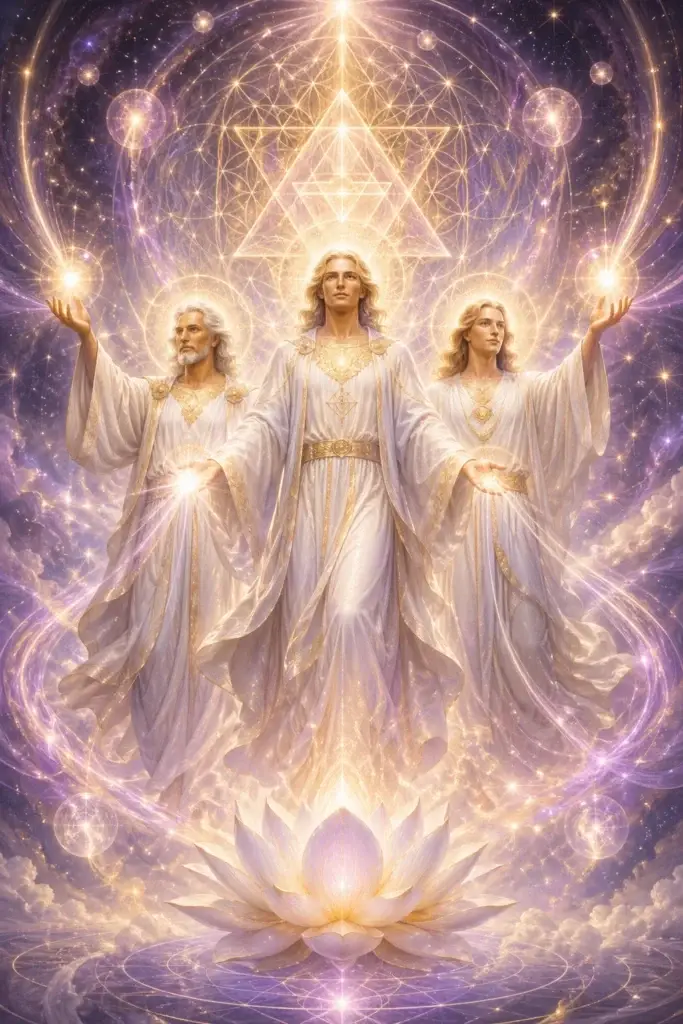
Ascended Masters
Ascended Masters are post-mortal or transient entities, often formerly human, who have attained cosmic initiation and now transmit occult teachings. They embody ideal wisdom, magical abilities, and spiritual guidance.
Central figures in Theosophy include Maitreya (the future Buddha), Sanat Kumara (Lord of the Flame), Kuthumi, and Morya (the Mahatmas). New Age versions add Saint Germain, Ashtar, and Sananda. Functionally, they replace gurus or holy spirits within secular spirituality systems.
Classification within Religious History
Ascended Masters are a modern theosophical category of beings with a clearly identifiable origin date. Helena Petrovna Blavatsky introduced the concept in Isis Unveiled (1877) and The Secret Doctrine (1888), describing the teacher-figures Kuthumi and Morya, who appeared in the so-called Mahatma Letters (between 1880 and 1885), as representatives of a brotherhood of transcendent teachers.
Charles Webster Leadbeater systematized the teaching in The Masters and the Path (1925) into a hierarchy with defined ray-assignments and areas of responsibility.
In the 20th century, Guy and Edna Ballard with the I AM Movement (from 1934) and Mark and Elizabeth Clare Prophet with the Summit Lighthouse (from 1958) developed independent religious movements with their own liturgies and decree practices.
Profile: Ascended Masters
The concept originated in the Theosophical Society (founded 1875, Helena Petrovna Blavatsky). Key texts: The Secret Doctrine (1888), The Voice of the Silence (1889); later Alice A. Bailey (The Externalization of the Hierarchy, 1957) and Elizabeth Clare Prophet (Ascended Masters Teaching).
Distribution: global, particularly North America and Western Europe. Research overview: Helmut Zander (Anthroposophy, Theosophy, New Age), Wouter Hanegraaff (New Age Religion and Western Culture), Mikael Rothstein (New Age Religion). The teaching amalgamates Buddhist Bodhisattvas, Hindu Rishis, Christian archangels, and occult traditions.
Distinction from the New Age movement: Ascended Masters are a specific category of beings within modern esotericism, historical figures or light-beings regarded in Theosophy and the New Age as spiritual teachers. They are not identical with the movement itself, but rather one of its mythological figures.
Historical Classification
Period of the Texts
The continuity of transmission across these long stretches is remarkable and reflects deep, stable cultural roots. Even in modern times, remembrance and sometimes active veneration remain alive, occasionally transformed but recognizable in its essential features.
Comparative Structures
Religiously related figures include the Buddhist Bodhisattvas, understood in the Mahayana tradition as realized beings of enlightenment who defer their own liberation for the benefit of teaching others. The structural parallel to the Ascended Masters is evident, though the historical-religious connection remains disputed.
Blavatsky herself claimed that her teaching stood in direct continuity with the Eastern wisdom tradition; academic Theosophy research (Joscelyn Godwin, K. Paul Johnson) has largely deconstructed this claim, identifying the Ascended Masters teaching as a Western synthesis with Eastern-influenced elements.
Geographic Distribution
Ascended Masters were not confined to any particular region or location, but were known and revered, or respectfully regarded with awe, across the entire New Age world.
Whether in large urban centers or peripheral rural areas, whether among social elites or ordinary people, the spiritual and cultural significance of this concept was consistently recognized and universal.
This points clearly to a central role in the collective identity of its communities. Trade, migration, and cultural exchange contributed to the geographic spread and the stable uniformity of veneration.
State of Sources
Primary sources are Blavatsky’s Isis Unveiled (1877) and The Secret Doctrine (1888), along with the Mahatma Letters (collections of alleged letters from the Masters, 1880 to 1885), Bailey’s A Treatise on White Magic (1934), and Elizabeth C. Prophet’s Summit University courses (from the 1970s onward). Time frame: 1875 to the present. Languages: English (primary), later German and French. Geographic origin: New York, India (Adyar headquarters), later Los Angeles, California. Researchers: Helmut Zander (Anthroposophy), Wouter Hanegraaff (Esotericism), Reza Aslan (Zealot, sociology of religion), Mikael Rothstein.
Source Corpus in Detail
The Ascended Masters corpus today comprises several tens of thousands of pages of primary texts. The oldest are the Mahatma Letters (edition by A. Trevor Barker, 1923), Isis Unveiled (1877), and The Secret Doctrine (1888).
The 20th century adds the I AM Discourses of the Ballards (from 1934, purportedly dictated by Saint Germain), Alice Bailey’s 24-volume work (1919, 1949, dictated by Djwhal Khul), and the Pearls of Wisdom of the Prophets (from 1958).
Academic engagement with this corpus remains limited but is growing; standard references are Bruce F. Campbell, Ancient Wisdom Revived (1980), and James Santucci, Theosophy and the Theosophical Society (in Cambridge Companion to New Religious Movements, 2012).
Name and Variants
Ascended Masters are depicted in various sources and artistic traditions with certain recurring iconographic elements that remain relatively constant across decades and different geographic contexts. These elements are neither purely decorative nor arbitrarily chosen; they are deeply coded symbolically and carry significant meaning.
They convey the entity’s central functions, sources of power, areas of responsibility, and cosmic role.
The overall system functions like a sacred text or a coded image, allowing initiates or culturally literate observers to grasp and correctly interpret the essential deeper meaning. Colors, sacred objects or weapons, physical attributes, specific accessories: all are significant and traditionally transmitted.
iWell Guard Position on the Ascended Masters Tradition
On iWell Guard, the Ascended Masters tradition is documented as a distinct category of beings within the light-beings corpus. The individual documented Ascended Masters (Saint Germain, Kuthumi, El Morya, Maitreya, Sananda, and others) each have their own detail pages with sources, hierarchical position, and classification within religious history.
The iWell Guard position is methodologically agnostic: we document the tradition without making any statement about the ontological reality of the Ascended Masters. In the protection mantra, Ascended Masters are implicitly covered through the light-beings clause (layer 8), without adopting theosophical-specific invocation practice.
Characteristics
Ascended Masters held a central place in the religious practice, everyday rituals, and daily understanding of New Age communities. People turned to this entity in critical or specific life situations, with invocations and decrees.
Dealings with the Ascended Masters were regulated from the start, though by modern standards: in the Theosophical Society, Helena Blavatsky and later Charles Leadbeater and Annie Besant claimed to be authorized intermediaries of the Masters, and in the I AM movement of the 1930s, Guy and Edna Ballard were regarded as the only accredited messengers of Saint Germain. Who counted as a legitimate channel and who did not was a central point of dispute in these movements.
Functions varied: some were preventive (warding off potential harm), some healing (relieving illness or suffering), and some transformative (guiding transitions between stages of life).
Fact Sheet: Ascended Masters
The profile of Ascended Masters examines their theosophical origins, their role in initiatory practices and channeling systems, their typical representation in works of art, protective practices against magical influence, and cultural parallels to Eastern guru and Bodhisattva traditions.
The Ascended Masters teaching originated in the milieu of the Theosophical Society, founded in New York in 1875, through Blavatsky, with strong roots in Indian and Tibetan mystical traditions (particularly Tibetan Buddhism and Himalayan yoga). Geographic and cultural origin: syncretic (Western-Eastern hybrid), with primary anchors in India, Tibet, and Egypt (according to Blavatsky).
The “earliest evidence” consists of Blavatsky’s claims regarding Mahatma Letters (allegedly 1880 to 1885), which have not been historically verified. Modern documentation begins from 1875 onward; the psychological and literary genesis is discussed in Blavatsky’s biographies (Peter Washington).
Ascended Masters teachings were initially directed at theosophical circle movements: intellectual elites, artists, occultists, followers of Eastern philosophy (particularly Indophiles). Later, from the 1950s onward, New Age interpretations shifted the target audience to New Age seekers, spiritual seekers, channeling practitioners, believers in reincarnation, and anti-establishment movements.
Occasions: search for meaning, occult initiation, world improvement, personal transformation. The social context was estrangement from mainstream religion, technological anxiety, and the utopian impulses of the 20th century.
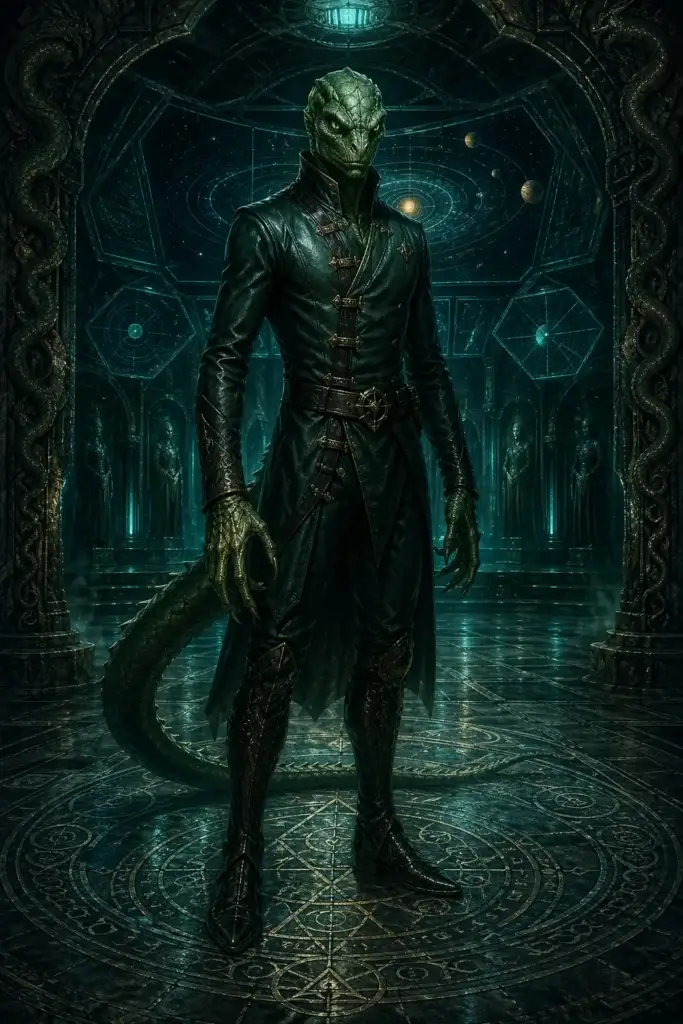
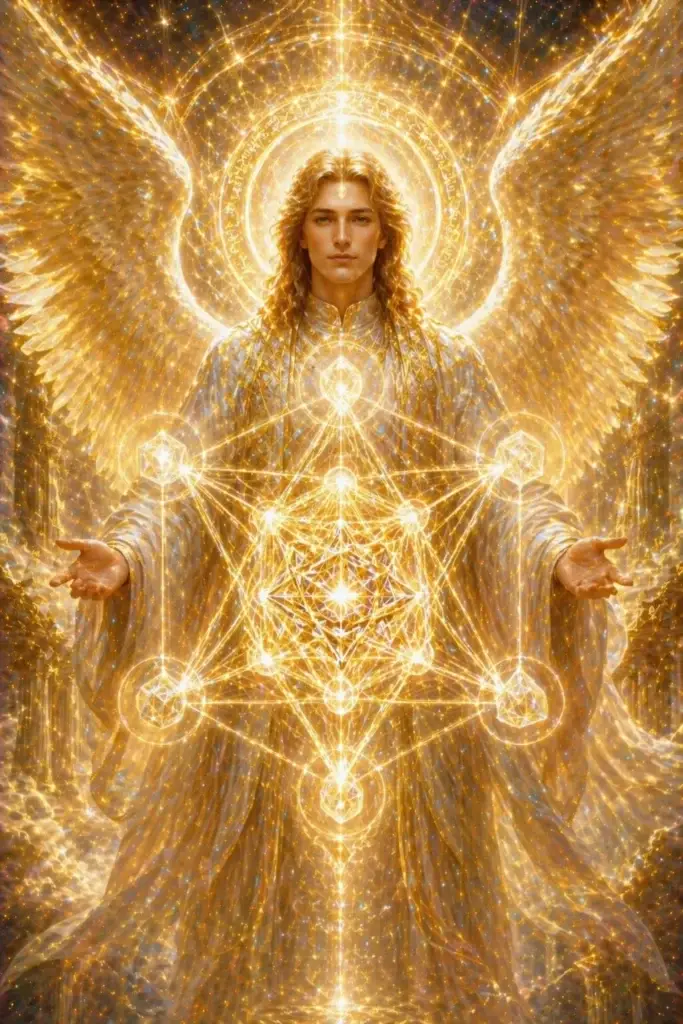
Ascended Masters are often depicted as humanoid-sublime: luminous, astrally transcendent, sometimes bearing Eastern symbols (mala, turban, robes). In Theosophy and New Age art, they appear in golden or silver light, often against celestial backgrounds or mandala structures.
Popular iconography (Rolf Linnemann, Diana Cooper) shows them as radiant mentors with archaic-mystical attributes. Modern channeling descriptions specify names, light-body colors, and particular historical roles (e.g. Saint Germain as French nobleman, Ashtar as Galactic Commander).
Ascended Masters are, in theosophical and New Age systems, light-being-like entities who were once human.
Theosophical practice emphasizes reverence and intuitive receptivity toward the Masters (telepathic contact, meditation on their names). New Age practice uses channeling, Ouija, astral projection, and light-body visualization.
Protective measures against manipulation or trickster spirits include discernment (distinguishing the spirits, after Johannes Greber), invocation of one’s own higher self, and critical questioning of received messages. Historically, Blavatsky emphasizes self-cultivation over mere invocation.
Comparable figures include Buddhist Bodhisattvas (Avalokiteshvara, Manjushri, Ksitigarbha: enlightened yet still cosmically active); Hindu Rishis and Mahatmas (Ramakrishna, Vivekananda); Christian archangels (Michael, Gabriel, Raphael: light guides); Islamic Awlia (saints, mystical masters). Common to all: superhuman moral authority, active soteriological intervention, and mediation between transcendence and immanence.
Ascended Masters: Parallels in Other Cultures
Veneration and Ritual Invocation
Veneration takes the form of invocations: rhythmic, repeated mantras calling upon the name of the Master.
The Master Light Rays and Names
The Seven Ascended Masters were systematized by Alice Bailey and Elizabeth Clare Prophet.
Amulets and Energetic Signs
The central amulet is the Violet Flame itself, imagined visually and meditatively as violet light.
Jewish Tradition: Jewish mysticism recognizes Tzaddikim (the Righteous), particularly in Hasidism, regarded as possessing superhuman ethical stature and performing miraculous signs. Kabbalistic thought treats the Sefirot as intelligible emanations, structurally similar to theosophical-occult hierarchical thinking.
The Golem tradition (magical creation) casts adepts as creators rather than mere mediators. No direct parallel to Ascended Masters exists here; the resemblance is rather structural, in hierarchy and occult authority.
Greco-Roman World: Platonic daimones (celestial intelligences) and Neoplatonic henosis mysticism describe intellectuals who approach the divine through philosophy (analogous to Ascended Masters through occult initiation).
Hermes Trismegistos, the mythical culture-bringer, is a structural parallel to theosophical master concepts. Pythagoras and Apollonius of Tyana are regarded as historical wonder-workers whose biographies were cited in Blavatskian circles as prototypes for Ascended Masters.
Mesopotamia: Mesopotamian wisdom deities (Enki, Nabu) serve as primary cultural reference points for Blavatsky, who interpreted Mesopotamian priest-magicians as Ascended figures. No direct continuous tradition exists here; the connection is rather a romantic-eclectic reconstruction.
India and Asia: This is the core region for Ascended Masters analogies. Yogis, Rishis, Mahatmas (Great Souls), Bodhisattvas, and Arhats are the East Asian prototypes.
Blavatsky claimed direct contact with Masters in Tibet; later, Bailey and Prophet located Masters in Shambhala, in the Himalayas, and in specific ashrams.
Theosophical Roots of the Masters Teaching
The teaching of the Ascended Masters has its starting point in the Theosophy of the late 19th century.
Helena Petrovna Blavatsky and the Theosophical Society, founded in 1875, spread the idea of a hidden brotherhood of highly developed spiritual teachers guiding humanity from the background. Among the best-known of these figures were Kuthumi and the Master Morya.
In the early theosophical period, these teachers were still sometimes portrayed as living, if reclusive, human beings in Asia. Important sources are the Mahatma Letters of the 1880s and works such as Alfred Percy Sinnett’s Esoteric Buddhism (1883). The authenticity of these letters remains disputed to this day.
Later theosophical authors, including Charles Webster Leadbeater and Annie Besant, further developed and systematized the concept of the Masters. This laid the groundwork for a teaching that was taken up and modified in numerous successor movements. In religious-studies terms, Theosophy is therefore regarded as the central root of this concept.
Development in the I AM Movement and Church Universal and Triumphant
The term Ascended Masters in the stricter sense was shaped above all by the I AM Movement of the 1930s. Guy and Edna Ballard placed a group of Masters at the center of their teaching, with Saint Germain in a prominent role.
Unlike in early Theosophy, the Masters were now understood more strongly as timeless beings no longer bound to a physical body.
A broad impact was achieved by the later Church Universal and Triumphant, founded by Mark Prophet and Elizabeth Clare Prophet. It systematized the Masters teaching, linked it to practices such as the Violet Flame, and published extensive writings. Through this and related groups, the concept entered the general New Age market.
Characteristic of this tradition is that the number, names, and areas of responsibility of the Masters vary by source. No unified, binding canon exists. Religious studies and esoteric research therefore describe the Ascended Masters as a flexible teaching tradition, continuously rewritten by many different actors.
Reception, Criticism, and Demarcation
Since the second half of the 20th century, the concept of Ascended Masters has become a fixed element of the New Age spectrum.
It is taken up in channeling texts, books, and seminars, and is sometimes linked with further concepts such as angelic hierarchies or extraterrestrial teachers. These connections are doctrinal statements of the respective sources and are not historically grounded.
It should be noted critically that popular presentations frequently present the Masters teaching as ancient, cross-cultural wisdom. The traceable conceptual and doctrinal history, however, begins only with Theosophy and the I AM Movement, that is, in the 19th and 20th centuries.
Appeals to individual historical figures such as Saint Germain do not change this, since their reinterpretation as Masters is itself part of this more recent history.
iWell Guard describes the Ascended Masters as a teaching tradition of modern esotericism and makes no statement about the existence of such beings. A useful distinction can be drawn from historical religious figures whose tradition rests on ancient sources. Related entries are available on Saint Germain, Kuthumi, and the Violet Flame.
Further Links
Research Literature
- Helena Petrovna Blavatsky: The Secret Doctrine. The Theosophical Publishing Company, London, 1888.