Angelica – Protective Herb for House and Home
By Ralf Ittermann · last reviewed on
Angelica (Angelica archangelica), popularly also called garden angelica, is regarded as an important protective plant of the Northern European region. According to tradition, it protects house and home from evil spirits and slander, two threats that were considered closely related in rural everyday life.
The botanical name Angelica archangelica, ‘archangelic angelica’, goes back to a legend according to which an archangel is said to have shown the plant as a means of rescue during times of plague, an origin myth that explains the plant’s special standing in folk belief.
In folk belief, angelica is regarded as a protective herb for house and home.
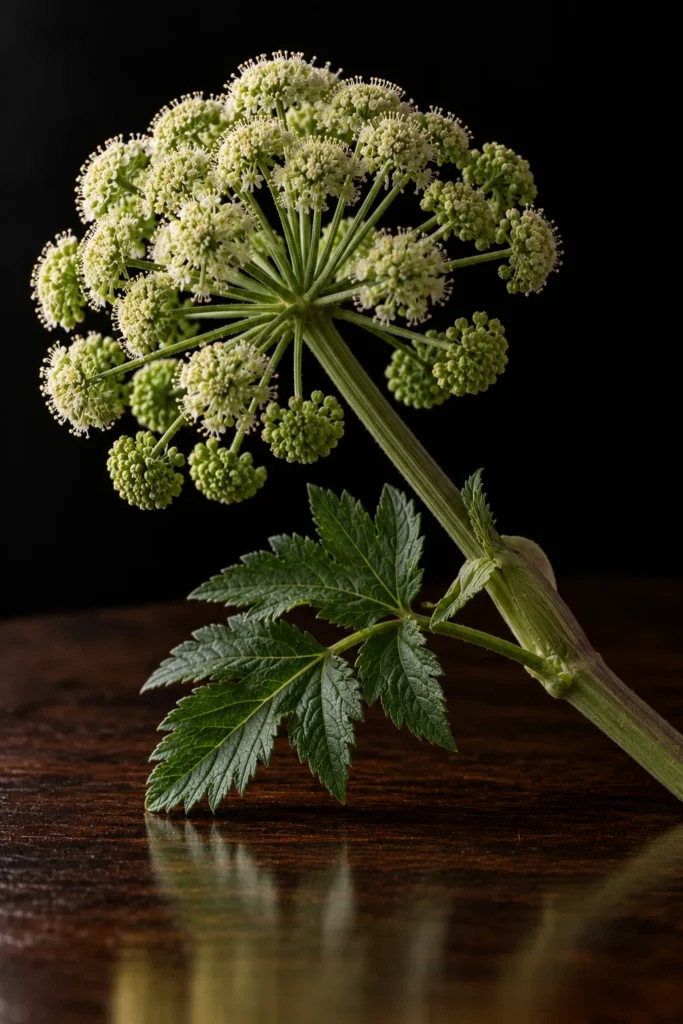
Quick Overview
Angelica (Angelica archangelica) is a tall-growing, strongly aromatic member of the carrot family, native mainly to Northern and Central Europe. Its sturdy root and pungent smell shaped its reputation as an important medicinal and protective plant of the Nordic region.
Folk names such as Angstwurz, Brustwurz and Zauberwurz (fear root, chest root, magic root) point to the range of powers attributed to it, from protective effect to folk-medicinal use.
Origin and Tradition
The legend concerning its name tells that during a severe plague epidemic, an archangel showed a monk or healer in a dream the angelica plant as a means of salvation. Physicians and healers are said thereafter to have worn the root around their necks and chewed it to protect themselves from infection.
On the Faroe Islands, angelica was cultivated in large numbers during plague epidemics and later planted in cemeteries, a practice that documents the close connection between death, protection and this plant in Nordic tradition.
In German-speaking regions, angelica is documented as a component of monastery gardens since the Middle Ages, from where it also spread into rural protective tradition.
Operating Principle According to Tradition
According to tradition, angelica provides protection through its close connection to the heavenly, angelic sphere, already suggested in its name. As a plant that owes its discovery to an archangel, it was attributed a power that opposes evil from the outset.
Placed on the house or kept as a piece of root in the household, angelica was meant to ward off not only evil spirits but also malicious gossip and discord, an attribution that situates the plant within the wider context of social protection: protection from discord was considered just as important as protection from unseen powers.
Cross-Cultural Distribution
Angelica is deeply rooted in folk tradition above all in the northern European region, in Scandinavia, on Iceland and the Faroe Islands. There it was valued not only as a medicinal plant but also as a food plant, whose stalks were eaten raw.
In German-speaking regions, the plant spread through monastery gardens and became part of the general tradition of protective herbs, finding its place alongside herbs such as St John’s Wort and mullein. Angelica water, obtained from the root, was used in several European regions to cleanse rooms and objects, following practices similar to those with other herbal waters.
What It Is Used Against
Tradition employs angelica above all against evil spirits believed to haunt house and home, placing it within the wider field of household protection. Alongside this, it is regarded as protection against slander, defamation and discord within the household, a rather unusual, socially oriented attribution for a protective herb.
In connection with the plague legend, angelica is also mentioned as protection against epidemics and contagion, a notion that stems from tradition and carries no medical claim. The Protection Compass lists these threat scenarios in detail.
Application and Limits
According to traditional practice, a piece of the dried root was kept in the house or attached at the entrance to protect house and home from evil spirits and slander. Carrying a small piece of root on the body is also documented.
Angelica water, distilled from root and seeds, was used for sprinkling rooms, similar to how vervain water was used with other protective herbs. Angelica was also occasionally combined with St John’s Wort to strengthen the household’s protective effect.
A limitation of the tradition lies in the fact that angelica belongs to the more bitter umbellifers containing essential oils, which within folk tradition itself prompted caution regarding quantity and use.
Literature (selection)
Related key terms: angelica, angelica archangelica legend, household protection.
iWell Guard and Protective Traditions
That an archangel of all figures is regarded as the origin of angelica’s protective power shows how closely folk protective beliefs and the Christian world of faith were interwoven in the northern European region. Protection against slander, moreover, points beyond the mere warding off of invisible powers towards a social need for protection.
This need to draw boundaries against both invisible and interpersonal threats is taken up by the iWell Guard in its symbolic function, as a carried sign of a personal boundary.
Personal experiences may vary. Not a medical device. No promise of healing.