Brigid is the goddess of the Celtic tradition who embodies fire, the healing arts, poetry and craft.
She represents one of the few Christian, pagan forms of syncretism in the early medieval island culture and is, in terms of religious history, a key witness to the continuity of pre-Celtic forms of veneration within a nominally Christianized society.
Brigid is described in the literature as a goddess of three aspects: the healing arts, poetry and craft. She belongs to the Tuatha Dé Danann, the divine race of the Celtic tradition, and is recorded as the wife of Bres or of other significant figures.
After Christianization she was carried forward as Saint Brigid, patron saint of Ireland. Central to her is the festival of Imbolc, the first of February, the day of transition to spring, associated with fertility and new life.
The evidence derives primarily from medieval Irish manuscripts such as the Metrical Dindshenchas, which collects place legends, and from hagiographic texts on Saint Brigid that originated from the 7th century onward.
Bernhard Maier and Birkhan have shown that the continuity of this figure between pagan goddess and Christian saint remains unresolved, yet is textually unavoidable. The Irish island church preserved Celtic traditions more intensively than continental Christendom.
The written tradition concerning Brigid reaches back several centuries into the past, in all likelihood drawing on even older oral traditions that existed beforehand. The Celts preserved this entity or concept over extraordinarily long periods and passed it on carefully from generation to generation, which points to central religious and cultural significance.
The continuity of the tradition across these long spans of time is remarkable and reveals a deep, stable cultural rootedness. In modern times as well, the memory and sometimes also active veneration remain alive, sometimes transformed, but still recognizable in its basic features.
Brigid is one of the most important goddesses of the Irish and British Celtic tradition. She is goddess of fire, the healing arts, poetry and the smith’s craft. She is threefold or ninefold in genealogy. Brigid was so significant that she was taken up into Christian veneration of the saints.
Brigid was not confined to a particular region or locations but was universally known and venerated, or respectfully feared, throughout the entire Celtic world.
Brigid was carried by two distinct milieus. In the learned sphere, the monastic community of Kildare maintained the cult of the saint, kept the perpetual fire that Gerald of Wales still described in the twelfth century, and produced hagiographies such as Cogitosus’s Life of Brigid; Cormac’s Glossary records that the poets of Ireland venerated the goddess of the same name. In the rural sphere, households marked Imbolc on February 1 with rush crosses, the Brat Bríde cloth left out overnight, and blessings for livestock and dairy work. These domestic customs survived in Ireland and Scotland into the modern era.
Cormac’s Glossary calls Brigid the goddess whom all the Irish poets venerated, which attests to her rank within the learned orders of Ireland. Her name also appears in Britain and Gaul in related forms such as Brigantia, the tribal goddess of the Brigantes. This spread across Celtic-influenced regions is explained by shared linguistic roots and by the connections between the Celtic groups of the islands and the mainland.
Primary sources: the Metrical Dindshenchas (medieval, gathering pre-Christian material), the lives of Saint Brigid (7th to 9th c.), and fragmentary lists of gods in the Yellow Book of Lecan. Time periods: the mythological narratives reconstruct Iron Age and Roman conditions (ca. 500 BC to 400 AD), yet the records originated in the 8th to 12th c. Researchers: Proinsias Mac Cana (Celtic Mythology), Bernhard Maier (Die Religion der Kelten), Helmut Birkhan (Kelten) analyze the phenomena of syncretism.
Brigid is represented in the various sources and artistic traditions with certain recurring iconographic elements that remain relatively constant across decades and across different geographical regions.
These elements are not purely decorative or chosen at random, but are deeply coded symbolically and carry great significance. They centrally convey the functions, sources of power, areas of responsibility and cosmic role of the being.
The overall system is like a sacred script or a coded image; it allows the initiated or the culturally educated to grasp the essential deeper meaning and to understand it correctly. Colors, sacred objects or weapons, physical attributes, specific accessories, all of it is significant and traditionally handed down.
Brigid was central to religious practice, to everyday rituals and to the everyday understanding of the Celts. People turned to this entity in critical or particular life situations or at certain ritual times of the year, with structured, often elaborate rituals, prayers or offerings.
The veneration of Brigid moved along fixed tracks: the festival of Imbolc on February 1 marked a clearly defined date in the course of the year, and the customs surrounding Brigid’s crosses woven from rushes or the laying out of cloths on the eve of the festival were passed on in regulated form. After the merging with Saint Brigid of Kildare, the care of the cult there lay in the hands of an ordered monastic community whose women tended the transmitted fire.
The continuity of these practices across many generations clearly shows that the practice was regarded as effective and necessary. Functions were varied: some were preventive (warding off potential misfortune), some healing (relief of illness or suffering), some transformative (accompaniment through transitions between stages of life).
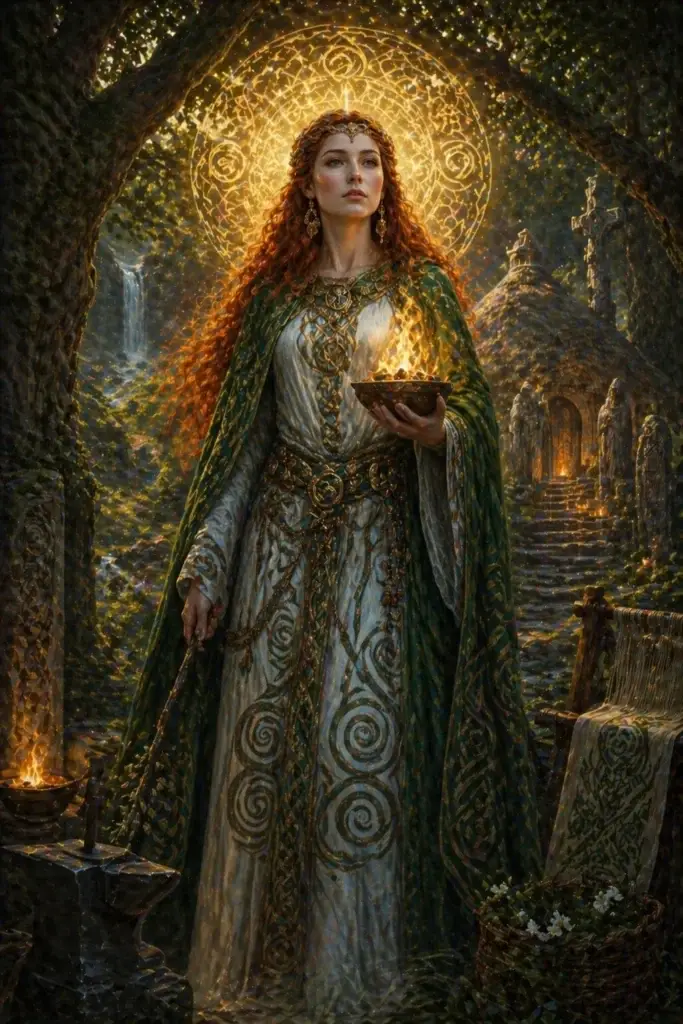
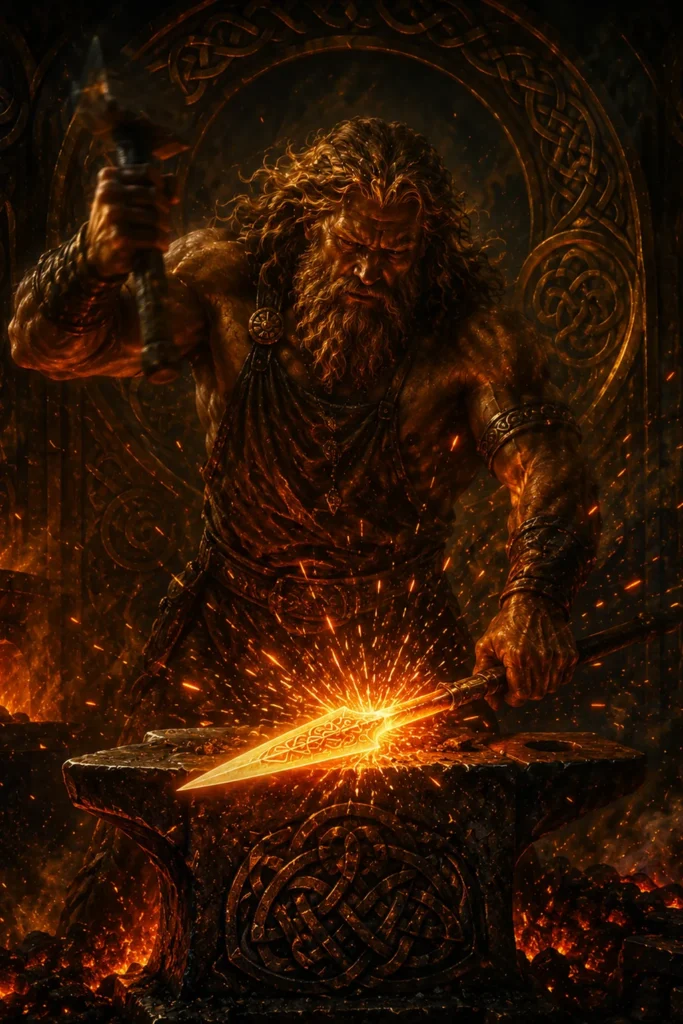
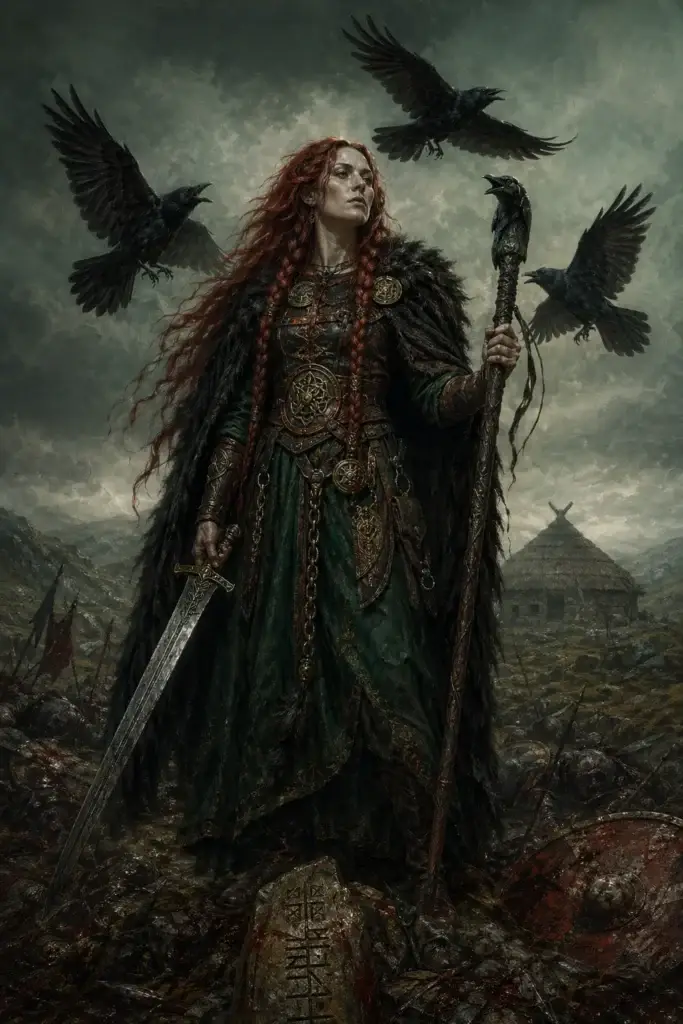
Brigid is depicted as a radiantly beautiful woman with red or golden hair, often enveloped in fire. A crown surrounds her. Her attributes are a torch, an anvil and hammer, healing herbs, a harp. Wells and springs are sacred. The Brigid’s cross is her symbol.
The Profile presents Brigid across six dimensions: her cultural origin, her circles of veneration, her iconography, the powers attributed to her, modes of respect and invocation, as well as correspondences in neighboring cultures. This allows a systematic overview of this multifaceted goddess.
Brigid derives from the pre-Celtic or early Indo-European stratum of the Irish tradition, as indicated by the divine council Tuatha Dé Danann. Her first literary mention is found in the Metrical Dindshenchas and in genealogies of the 9th to 10th c. Geographically she is centered on Ireland, with secondary evidence from the Scottish Highlands.
The figure of Saint Brigid, attested from the 7th c. onward, overlays the divine figure and shows cult continuity across the threshold of Christianization.
Brigid was invoked by families of poets (Filí), healers, smiths and craftswomen. Her festival of Imbolc was the occasion for purification rituals and fertility celebrations. In Christian times, women turned to Saint Brigid in difficult childbirths and in matters of illness.
Monasteries in particular devoted themselves to her veneration, such as that of Kildare, which cultivated the Brigid tradition and formed economic as well as intellectual centers.
Brigid is associated in craft and in literary descriptions with fire, as a flame of inspiration, of healing and of the smith’s craft. A fire at Kildare is said to have been consecrated to her, tended by nuns.
She at times bears the attributes of midwife and physician. In medieval manuscripts she appears dignified and surrounded by radiance, often accompanied by flames or healing waters.
Brigid acted as patroness across an unusually broad range of functions: as healer, as guardian of the smith’s craft, as protector of poets and as grantor of fertility for livestock and people.
In Cath Maige Tuired she appears as a culture-founding figure whose lament for her fallen son Ruadán established the first such song of the Irish tradition.
Later hagiographic texts, such as Bethu Brigte (9th c.), transfer her efficacy to the Christian Saint Brigid of Kildare and attribute to her the healing of the sick, the multiplication of food and the protection of herds.
Brigid is considered benevolent and supportive. Women and craftspeople called upon her to gain skill and protection in their work. In hagiographic texts she helps those in need through miracles.
Today she is a figure of invocation for artistic creation, healing and the protection of the homeland. There are no defensive practices, since Brigid is not regarded as harmful or dangerous.
Comparable figures are the Greek Athena (craft, combat, wisdom), the Roman Vesta (hearth flame, protection), and in the Indian tradition the goddess Saraswati (the arts, poetry). The threefold aspect recalls depictions of Hecate or three-formed divine triads on Celtic monuments. These parallels reveal universal religious patterns in the veneration of culture-creating deities.
Sacred women who unite the healing arts, the smith’s craft and poetry in a single person are found in several mythologies, from the Roman Minerva through the Norse Eir to the Slavic Mokosh; each tradition weights the three aspects differently.
Jewish tradition: No direct correspondence exists. Distantly related are Miriam (prophetess, music, leader) in the Exodus tradition or personified Wisdom (Chokmah/Sophia) as a female creator-goddess-like figure.
Greco-Roman world: Athena embodies craft and strategic wisdom, while Hestia/Vesta represent the hearth flame and communal cohesion. Asclepius and Hygieia correspond to Brigid’s healing aspect. The Roman Vesta sanctuary with its eternal fire parallels Brigid’s fire at Kildare.
Mesopotamia: Ninḫursaĝa, goddess of birth and healing, and Inanna, goddess of skill and love, show thematic overlaps. Enki too, god of craft, might count as a masculine parallel.
India/Asia: Saraswati (poetry, the arts, wisdom) and Lakshmi (prosperity, promotion of craft) share Brigid’s role as a patroness of human creativity. In Japanese Shinto she corresponds in part to Benzaiten (the arts, music).
One of the most debated questions of Irish religious history concerns the relationship between the goddess Brigid and the Christian Saint Brigid of Kildare, whose feast is celebrated on 1 February, the day of Imbolc.
The saint is said to have lived in the 5th or early 6th century; her oldest Vita was composed by the monk Cogitosus around 650, the Vita Sanctae Brigitae.
Cogitosus reports a monastery in Kildare (Cill Dara, church of the oak) in which a sacred fire burned, tended by nuns and never permitted to go out. Giraldus Cambrensis still described this fire in the 12th century.
This veneration of fire, the connection to livestock, milk and fertility, as well as the date of the festival, have led many researchers to see in the saint a Christianized form of the goddess.
More recent research, however, urges caution. Historians such as Lisa Bitel have pointed out that a real abbess named Brigid may well have existed and that hagiography follows its own literary laws.
The correspondences can be explained partly as a deliberate appropriation of pre-Christian motifs by the monastic community, partly as general commonalities of early medieval saints’ lives.
What is certain is that the cult of the saint overlay that of the goddess and bound older customs, such as the weaving of the Brigid’s Cross from rushes, to the Christian feast day. The continuity is real, its exact form remains contested.

Most of what is known about the goddess Brigid derives not from contemporary pagan sources but from texts that Christian scholars wrote down in the Middle Ages. The most important passage is found in the Sanas Cormaic (Cormac’s Glossary), an etymological collection traditionally attributed to Bishop Cormac mac Cuilennáin (died 908).
There it is stated that Brigid was a poetess (banfili), daughter of Dagda, and that there had been two further Brigids, one responsible for the healing arts and one for the smith’s craft.
From this note research derives the image of a threefold goddess or of three sisters of the same name. Whether this is a genuinely ancient conception or a learned construction of the glossator cannot be conclusively clarified.
Further mentions are found in the Lebor Gabála Érenn (Book of Invasions) and in the narrative Cath Maige Tuired (The Battle of Mag Tuired), where Brigid appears as the wife of Bres and mother of Ruadán and is said to have invented the lament (keening) after his death.
These sources are preserved in manuscripts of the 11th to 15th century but rest in part on older originals. Religious studies therefore emphasizes that every statement about Brigid has passed through the filter of monastic scholarship.
Closely connected with Brigid is Imbolc, one of the four great festivals of the Irish year, falling on 1 February and marking the beginning of spring.
The name is most often associated with the lambing of sheep and the onset of milk production; a widespread etymology interprets it as i mbolg (in the belly) in the sense of pregnant ewes, yet here too research is divided.
The oldest evidence for the festival comes from medieval texts such as the narrative Tochmarc Emire (The Wooing of Emer), which names Imbolc alongside Samhain, Beltaine and Lugnasad. Concrete ritual details for the pagan period are largely lacking; knowledge of the customs derives from the folkloric tradition of the modern era.
Documented from rural Ireland and Scotland are the weaving of the Brigid’s cross, the making of a straw doll (Brídeóg) carried from house to house, and the laying out of a cloth or ribbon overnight, the Brat Bríde, to which healing power was ascribed.
These practices were recorded in the 19th and early 20th century by collectors such as Alexander Carmichael in the Carmina Gadelica. How much of this reaches back to the pre-Christian goddess is methodologically difficult to determine.
The name Brigid is linguistically traced back to a Proto-Celtic root *brigantī, meaning roughly the Exalted or the High One. The same root lies in the name of the goddess Brigantia, who is attested in Roman Britain, especially in the territory of the Brigantes tribe in northern England, through inscriptions and votive stones.
On a relief from Birrens in Scotland, Brigantia appears in the guise of a Minerva or Victoria, with spear, shield and mural crown. Inscriptions name her in part together with the Roman state deity, which points to an official function as protective goddess of the tribal confederation.
Whether Brigantia and the Irish Brigid go back to a common, widely distributed Celtic deity or whether merely the name is related belongs among the open questions of Celtic religious research.
Comparable names also appear in the continental Celtic region, for instance in place names such as Bregenz (Brigantion) on Lake Constance.
Some researchers, including scholars of religion working in the tradition of Georges Dumézil, have compared Brigid with Indo-European conceptions of a goddess of the dawn or of poetic inspiration and have pointed to parallels with the Vedic goddess Bharatī or with Sarasvatī. Such comparisons remain hypothetical but show how deeply the name is linguistically anchored.
Since the late 20th century, Brigid has undergone a remarkable revival. In neo-pagan and Wicca-related currents she is regarded as one of the most frequently venerated deities, often interpreted as a threefold goddess of poetry, the healing arts and the smith’s craft.
Imbolc was adopted as one of the eight festivals of the wheel of the year in the modern pagan festival calendar.
This reception frequently merges materials of different origin: medieval Irish texts, modern folk customs, the hagiography of the saint and romantic reconstructions of the 19th century.
From the standpoint of religious studies it is important to distinguish what is historically documented from what represents contemporary appropriation. The modern Brigid is an independent religious phenomenon, not simply the continuation of the medieval goddess.
Parallel to this stands a cultural revival in Ireland itself. In Kildare a community of Brigidines has maintained a symbolic eternal fire again since 1993. Since 2023, 1 February has been a public holiday in the Republic of Ireland, named after Brigid, which shows the enduring identity-forming power of the figure.
In feminist theology and in the peace movement, Brigid is moreover claimed as a symbol of female authority and creative power. The figure thus remains an example of how a mythological figure is repeatedly filled with new meaning across the centuries.
Within the mythological genealogy of the Túatha Dé Danann, the divine lineage of the Irish tradition, Brigid occupies a central kinship position. She is considered the daughter of the Dagda, the great father god, and thus the sister of figures such as Aengus, Bodb Derg and Cermait.
In Cath Maige Tuired she is named as the wife of Bres, that king who descended half from the Túatha Dé and half from the hostile Fomori.
From this union came the son Ruadán. Brigid thus stands at a seam between the two enemy mythic lineages, a position that makes her a mediator. When Ruadán fell in battle, Brigid is said to have raised the first lament of Ireland, whereby the invention of ritual mourning is attributed to her.
These genealogical accounts are not consistently uniform. Different manuscripts and textual traditions assign Brigid partly different relatives, and the already mentioned division into three sisters of the same name complicates the picture further.
Research sees in this less a contradiction than a feature of orally shaped tradition, which permitted several versions side by side. What remains to be noted is that Brigid appears in virtually all strands as a high-ranking figure, closely bound to the Dagda and linked to the core areas of poetry, healing and craft.
Recommended internal links for this page:
Further standard works in the literature index.
Brigid (Old Irish Brigit, Welsh Ffraid) is one of the most important goddesses of Irish-Celtic mythology, daughter of the Dagda, patroness of poets, smiths and healers.
She embodies the three great cultural domains of the Celtic world: the spoken word (Filidh, poets), fiery transformation (smiths) and healing. In the three-formed tradition she appears as three sisters, Brigid the poetess, Brigid the smith, Brigid the healer.
Saint Brigid of Kildare (ca. 451-525), the Irish patron saint, is in terms of religious history one of the most striking figures of syncretism.
The Christian church took over the cult, the feast day (Imbolc/Candlemas on 1/2 February), the sanctuary (the eternal Brigid fire at Kildare was maintained until 1220) and even many miracle stories from the pagan goddess.
Irish popular belief linked the two figures so closely that it can no longer be separated which attribute originally belonged to which.
Against its influence, cross-cultural tradition names these protective means:
Recommended protective means
The simplest protective means in this collection: 41 layers of fine gold 999, platinum, silver and silicon, manufactured in Ruhla, Thuringia. It requires no activation, is bound to no person, and is effective within a radius of around 50 meters, even without being worn.
Related Beings

Hades, ruler of the underworld and Greek god of the dead. Helm of invisibility, Kerberos, Eleusin...

Dismembered by Seth, restored by Isis, ruler of the underworld and the model for every deceased E...

Banaspati, the fiery forest and terror spirit of Java. Origin from the Sanskrit vanaspati, the tr...

Apaosha, the Zoroastrian demon of drought. Origin, the rain battle against Tishtrya, and the clas...

Yaksha and Yakshi, the ambivalent nature spirits of India. Origin, the guarding of trees and trea...

The Rainbow Serpent is a central creator figure in Australian Aboriginal religion. Myth, regional...