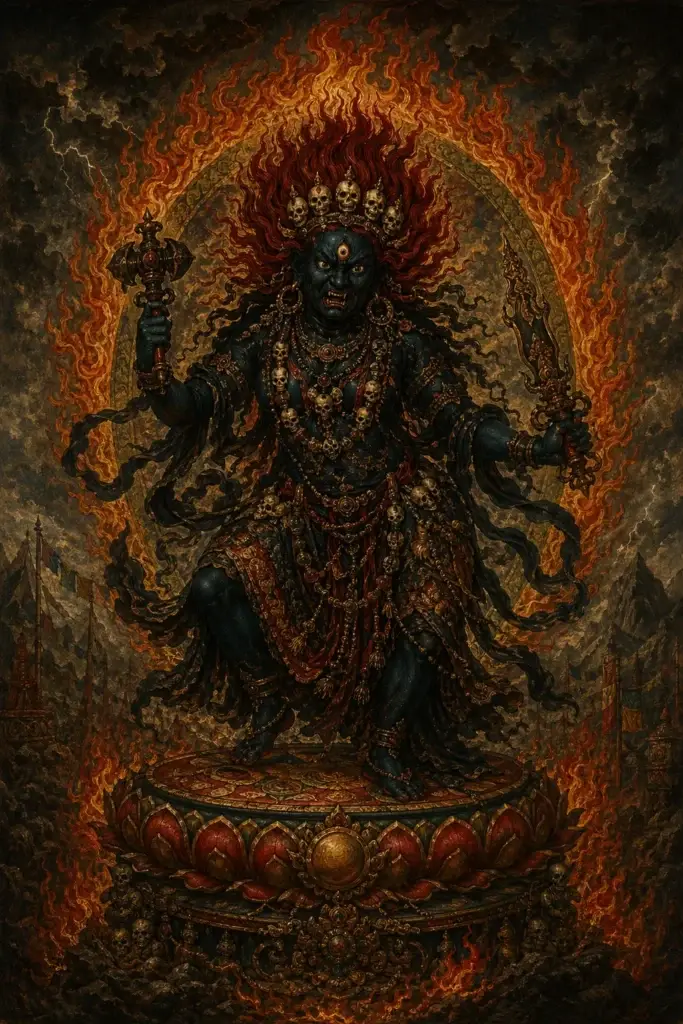
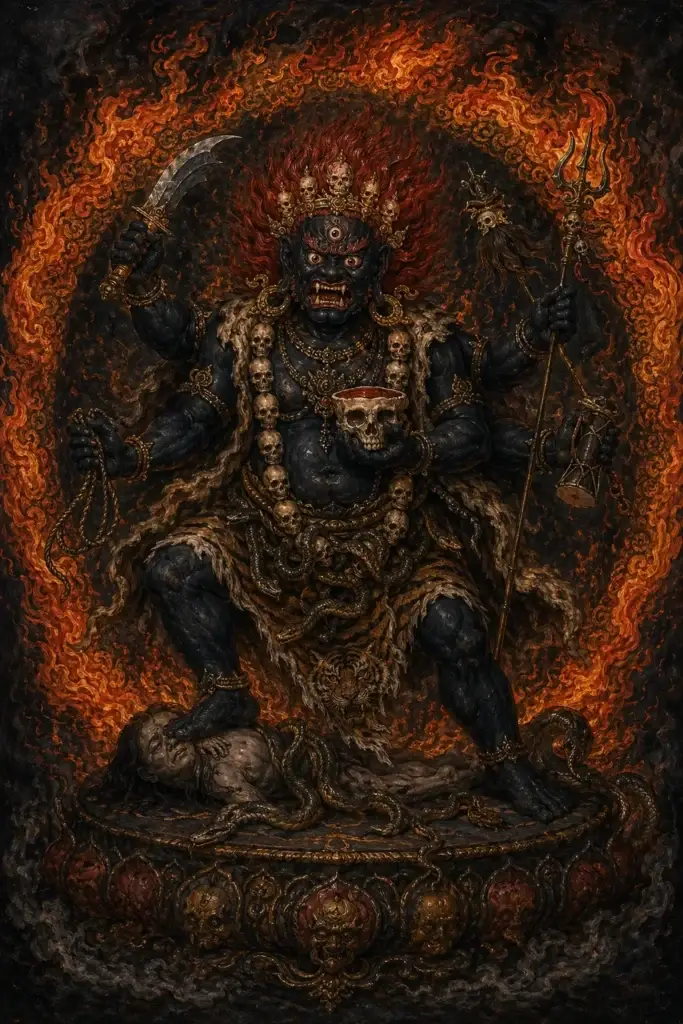
Hayagriva, God of the Tibetan Tradition
By Ralf Ittermann · last reviewed on
Hayagriva (Sanskrit: “horse head”) is a manifestation of the bodhisattva Avalokiteshvara or of the Hindu Vishnu in the Tibetan and Mahayana tradition. Depicted with a human or wrathful body and a horse head, he embodies the fury against ignorance and suffering.
Hayagriva, the horse head, is a central deity of Tibetan Vajrayana and is regarded as a wrathful manifestation of the Bodhisattva Avalokiteshvara.
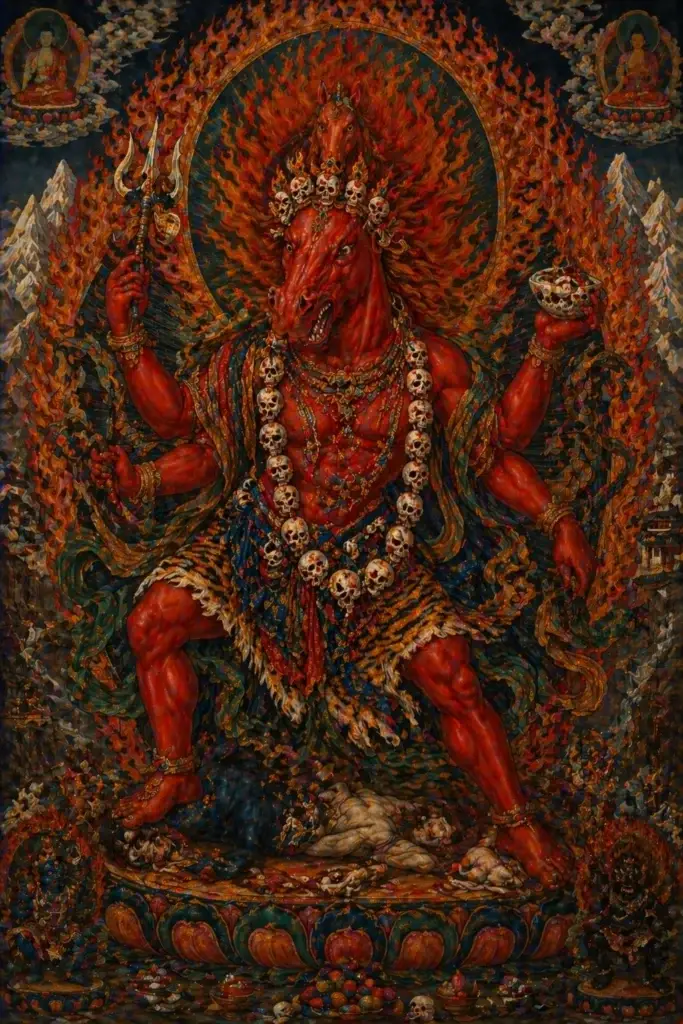
Hayagriva
In Tibetan practice, Hayagriva is invoked as a Yidam (meditation deity) to overcome egocentrism and ignorance. The red coloring and the horse form symbolize transformation and control of the animal forces. In the Hindu context he is an avatar who recovers sacred texts from the bottom of the sea.
At a Glance: Hayagriva
Type: Vajrayana Buddhist wrathful protective Yidam, horse-headed form of Avalokiteshvara
Pantheon: Tibetan Buddhism (all schools), adopted from the Hindu Vishnu avatar Hayagriva
Function: Destruction of the Mara demons, protection against black magic, healing of illnesses
Main attributes: Horse head in the upper main crown, three eyes, threefold flaming hair, lotus, trishula
Main cult sites: Sakya and Nyingma principal monasteries (especially Mindrolling and Pelyul)
Identity: wrathful form of Avalokiteshvara (in the Buddhist adaptation)
Historical Classification
Period of the Texts
Hayagriva (Sanskrit, “horse-headed”) develops in the Hindu tradition as a Vishnu avatar (vanquisher of a demon of the same name who had stolen the Vedas).
Adopted in Vajrayana Buddhism from the 8th century CE as a wrathful form of Avalokiteshvara. Main flourishing of the Buddhist Hayagriva tradition: the Sakya and Nyingma schools of Tibet from the 11th to 14th century. Still central in both schools today.
Area of Distribution
Main cult sites: Sakya principal monastery in Tibet (Sakya Pandita tradition), Nyingma monasteries such as Mindrolling, Pelyul, Kathok, Shechen. In Bhutan and Nepal in many Tibetan Buddhist monasteries.
Internationally in Sakya and Nyingma centers worldwide. In Japan venerated in the Shingon tradition as Bato Kannon (Horse Kannon, a form of Avalokiteshvara), especially as protection for animals and travelers.
State of the Sources
Central sources: Hayagriva Tantra, tantric sadhana texts of various Sakya and Nyingma lineages. Hindu root texts: Mahabharata, Bhagavata Purana. Secondary literature: Linrothe, Ruthless Compassion; van Gulik, Hayagriva. The Mantrayanic Aspect of Horse-Cult in China and Japan (classic study); Lopez, Religions of Tibet in Practice.
Name
Hayagriva is depicted with specific iconographic elements that are symbolically encoded and carry deep meaning. These elements centrally convey the functions, sources of power, responsibilities and cosmic role of this entity. The visual system allows initiates and the culturally educated to grasp the deeper meaning.
The most important identifying feature of Hayagriva is the horse head, which appears differently depending on the tradition. In Hinduism he appears as an avatar of Vishnu with a human body and a horse head, often white and with the Vaishnava attributes of conch, discus, mace and lotus. In Tibetan Buddhism, by contrast, he is depicted as a wrathful Heruka with red skin, a halo of flames and one or several small horse heads that burst forth from his topknot and neigh. These horse heads are regarded as the sign that drives away demons. The different forms in the two traditions show how the same basic motif was adapted to different doctrinal systems and fixed in each of them.
Characteristics
Hayagriva was central to the religious practice and everyday understanding of Tibet. People turned to this entity in critical situations or at certain ritual times of the year, with structured rituals, prayers or offerings. The practice was precisely handed down and often led by priests or specialists.
Hayagriva fulfils different tasks in the two traditions. In Hindu myth he rescues the stolen Vedas and thus stands for the preservation of sacred knowledge; accordingly, students and scholars invoke him for mental clarity. In Tibetan Buddhism he acts as a wrathful protective deity against diseases, especially epidemics, as well as against harmful spirits and obstacles on the spiritual path. Both strands were carried on for a long time in texts and ritual practices, because both a preserving and a protective, warding-off effect was attributed to him.
Profile: Hayagriva
The most important aspects of Hayagriva at a glance. The following fields summarize origin, function, appearance, veneration, symbols and cultural parallels.
Origin
Hayagriva develops out of the Hindu Vishnu avatar tradition (Vishnu takes on the horse-head form in order to defeat the demon Hayagriva who had stolen the Vedas).
In Vajrayana Buddhism he is reinterpreted as a wrathful form of Avalokiteshvara; the Bodhisattva of compassion takes on this terrifying form in order to destroy the Mara demons and thereby protect the practitioner on the path. The exact iconographic details and the Tantra texts vary among the different schools.
Hayagriva's Target Group
Protection against black magic, Mara demons and samsaric obstacles. Destruction of the causes of illness (especially animal diseases, hence in Japan as patron of animals). In tantric practice a Yidam (meditation deity) of the highest Vajrayana initiations. Patron of travelers and animals (through the horse symbol).
Form
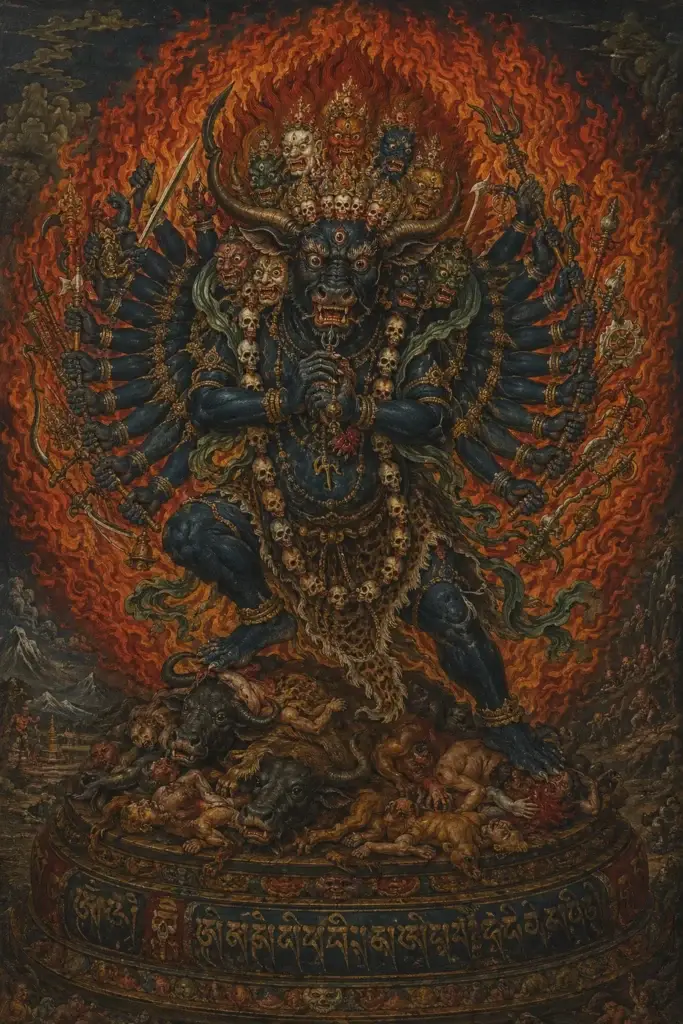
Wrathful male body, dark-red or dark-blue skin color, very muscular. Main head: human wrathful face with three eyes, an open mouth with fangs. Above it as a crown a green horse head that rises from the threefold flaming hair, the most famous Hayagriva symbol.
Several arms (often six or eight) with various weapons: sword, lotus, trishula, skull cup, khatvanga. Tiger-skin loincloth, snake necklace, bone ornaments, flaming aureole. Stands in a dynamic bow-step pose. In some sadhanas in Yab-Yum form with his consort.
Sphere of Influence
Sphere of influence: Hayagriva is venerated in Sakya and Nyingma monasteries, especially in tantric protective practice. Personal invocation in cases of acute demonic threat, illness, black magic.
In Japan as Bato Kannon invoked above all by farmers whose horses or cattle have fallen ill. In modern Buddhist practice in the USA and Europe transmitted as a wrathful Yidam in advanced Sakya and Nyingma sadhanas.
Means of Protection
Horse head in the crown (main attribute), three eyes, threefold flaming hair, sword, lotus, trishula, skull cup (kapala), khatvanga, tiger-skin loincloth, snake necklace, bone ornaments. Sacred animals: horse. Sacred plants: lotus. Sacred colors: dark red or dark blue (with a green horse head).
Related Beings
Hayagriva (Hinduism, Vishnu avatar, original form), Avalokiteshvara (Buddhism, his own peaceful main form), Bato Kannon (Japan, East Asian form), Mahakala (Buddhism, related wrathful form), Yamantaka (Buddhism).
Global horse-god parallels: Epona (Celtic, horse goddess), Hippios (Greece, epithet of Poseidon as horse god). Functionally: all horse-related protective gods share aspects with Hayagriva. Within Vajrayana unique as the “horse-headed manifestation of compassion”.
Hayagriva, Parallels in Other Cultures
Hayagriva as a horse-head manifestation finds parallels in the Greek Demeter Erinys (with a horse head), in the Celtic Epona, in traces of Norse horse goddesses and in Central Asian and Mongolian protective horse deities.
In Hinduism Hayagriva appears as an avatar of Vishnu; in Tibetan Vajrayana as a protective deity against hostile powers and illnesses. Different cultures recognized the same thing and manifested it in local, adapted forms. Universal patterns are more significant than specific variations.
Jewish tradition: The angel Michael as vanquisher of demonic forces and the cherubim with their fiery sword share with Hayagriva the function of wrathful power for purification.
Greco-Roman world: Ares and Mars as war gods embody aggressive force, while Pegasus as a noble equine nature hints at transformation, neither being a complete parallel to Hayagriva’s synthesis.
Germanic tradition: Sleipnir, Odin’s eight-legged horse, and the Sleipnir mythologemes point to a magical animal nature similar to Hayagriva’s horse form, though with a different cosmic function.
Hinduism and Vedic tradition: Hayagriva himself is attested in the Puranas as an avatar of Vishnu. Durga on her lion and Agni on rams share a fierce animal nature with a ritual function.
From Hindu Horse God to Tibetan Lord of Protection
Hayagriva, whose name is composed of the Sanskrit haya (horse) and griva (neck, nape), has a twofold origin in the history of religion. In the Brahmanical texts he first appears as a manifestation of Vishnu who recovers the stolen Veda from the depths of the primordial ocean.
This episode is found in the Bhagavata Purana and in the Devi Bhagavata Purana. The horse-headed Vishnu there stands for the preservation of sacred knowledge against the powers of disorder.
In Tantric Buddhism, which took up this figure by way of Nepal and Kashmir, Hayagriva changed fundamentally. The rescuing avatar became a wrathful manifestation (Tibetan Tamdrin, “horse neck”) that is assigned to the lotus family of the Buddha Amitabha and is frequently regarded as a wrathful aspect of Avalokiteshvara.
The small horse head that bursts forth from his crest of hair and frightens the demons with its neigh was retained as an iconographic mark, but received a new interpretation: with its call it penetrates all obstacles on the path to liberation.
Scholarship, for example the works of Robert van Gulik in his study Hayagriva. The Mantrayanic Aspect of Horse-cult in China and Japan (1935), has shown how far this figure traveled eastward.
By way of Tibet and China, Hayagriva reached as far as Japan, where he is venerated as Bato Kannon, one of the six forms of the Bodhisattva Kannon, who in Japan is in part invoked for the protection of riding and pack animals.
This migration over more than two millennia and across several linguistic regions makes Hayagriva one of the most instructive examples of the adaptability of religious imagery.
Iconography and Ritual Position in the Tibetan Schools
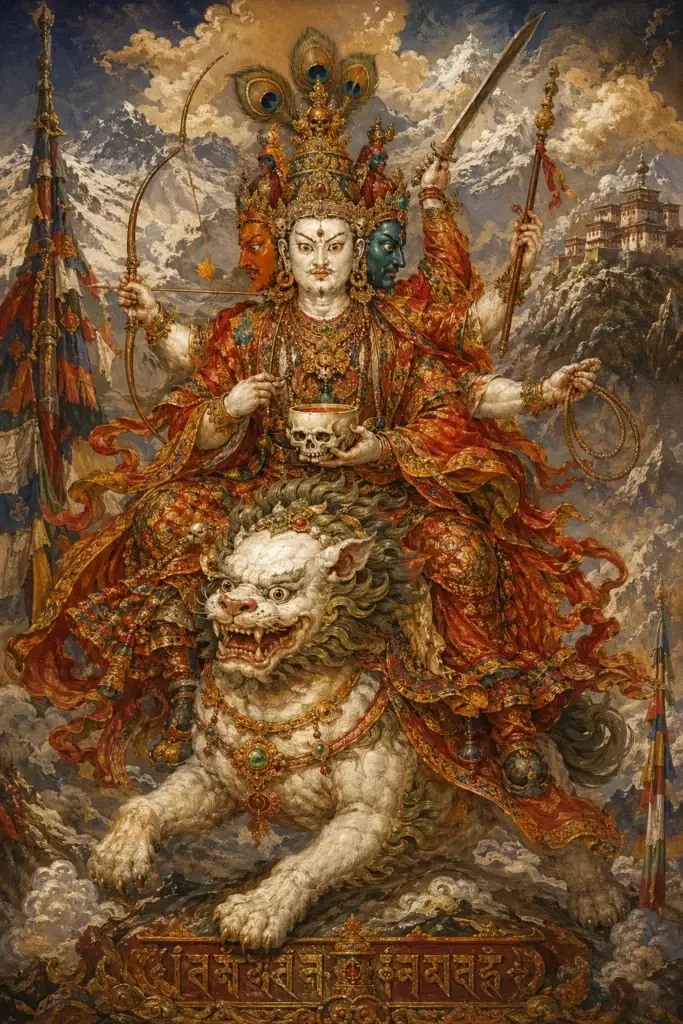
In Tibetan art Hayagriva usually appears deep red, with wide-open eyes, bared teeth and a flame aureole. Above his head rise one, three or nine small green horse heads.
Depending on the sadhana, he wears bone ornaments, a garland of heads and attributes such as a club, lasso or vajra. The number of arms and heads varies greatly, because different lineages of transmission each know their own forms.
Within the Tibetan schools, Hayagriva holds a special position. In the Nyingma tradition he belongs to the eight great Heruka of the Kagye, the collection of the eight sadhana teachings that are traced back to Padmasambhava.
There he is regarded as the wrathful expression of enlightened speech. In the Gelug school, to which the Dalai Lamas belong, Hayagriva counts among the personal protective deities and is associated with the protective ritual against contagious diseases and against hostile mental influences.
The ritual practice comprises visualization, recitation of the mantra and, in larger monasteries, festival rituals as well. Anyone who carries out a Hayagriva practice requires, according to traditional understanding, an empowerment by a qualified teacher.
The wrathful form is not interpreted as aggression but as an energetic form of compassion that breaks through obstacles which a gentle approach cannot overcome.
In the monastic art of Tibet and Mongolia, Hayagriva is encountered on wall paintings at entrances and in protective chapels, because there it is his function to keep harmful influences away from the sacred space. The material tradition ranges from thangka scroll paintings through bronze statuettes to ritual masks for monastic dances.
Hayagriva in the Cham Dance and in Monastic Culture
A particularly vivid form in which Hayagriva remains alive in the Tibetan cultural sphere is the masked monastic dance, the Cham. At these festivals, which last several days, monks appear in elaborate costumes and masks and embody protective deities, including wrathful forms from the Hayagriva circle.
The dances are not entertainment but are understood as a ritual act that subdues negative forces and purifies the place for the coming year.
The masks that represent Hayagriva are recognizable by the red coloring, the wrathful expression and the mounted horse head. They are kept in the monasteries across generations and are themselves regarded as consecrated objects.
Researchers of Tibetan ritual studies, for example Rene de Nebesky-Wojkowitz in his fundamental work Oracles and Demons of Tibet (1956), have documented the Cham and the deities appearing in it in detail.
Nebesky-Wojkowitz also described the function of Hayagriva as one of the main deities invoked in the protective rituals of large monasteries such as Nechung.
In the everyday life of monastic culture, Hayagriva also appears on printed protective sheets, the so-called sungkhor, which are worn as amulets or fastened to doors.
He also played a role regionally in animal medicine: since the horse held a central position in the nomadic economy of High Asia, the horse-headed protector was in some places invoked for the protection of the herds.
This practical anchoring explains why an originally high-tantric figure remained effective right into popular piety. The connection of monastic scholarship and rural protective practice is characteristic of Hayagriva.
History of Research and Open Questions
The scholarly study of Hayagriva began in the early twentieth century and is closely connected with the investigation of cultural transfer along the Silk Road.
Robert van Gulik’s monograph of 1935 remains a point of departure, because it was the first to trace systematically the connection between Indian origin, tantric transformation and East Asian reception. Later works on Tibetan iconography, among them the catalogues of Marilyn Rhie and Robert Thurman, classified the numerous pictorial forms more precisely.
Several questions remain open in scholarship. It is disputed how exactly the transition from the Hindu Vishnu avatar to the Buddhist wrathful deity took place and whether there were intermediate stages in which both interpretations existed side by side.
The state of the sources for Nepal and Kashmir, where this transition probably took place, is patchy. Likewise discussed is the relationship between the various lineages of transmission within Tibet, since their sadhana texts contradict one another in particulars.
A further field of research concerns the spread to Japan. While the connection between Hayagriva and Bato Kannon is regarded as established, the question of through which texts and which monks this transfer took place has not been conclusively clarified.
The religious-studies significance of Hayagriva lies precisely in this ramification: in hardly any other figure can one study so well how a religious symbol can preserve its form across language boundaries and at the same time transform its meaning.
Anyone interested in related protective figures will find points of connection among other Tibetan deities of the wrathful class.
Further Links
Research Literature
Further standard works in the literature index.