Gwishin, Spirit of the Korean Tradition
By Ralf Ittermann · last reviewed on
Gwishin is a spirit of the Korean tradition.
Spirits of the dead in Korean tradition, returning from unfinished business.
Gwishin
Gwishin (귀신, 鬼神) is the Korean collective term for spirits of the dead. Literally it means “spirit and deity“, but in present-day usage the spirits of the dead are foremost.
Gwishin are people whose souls did not find the regular path into the afterlife after death, whether because of an unresolved concern, an unatoned wrong, a missing burial or omitted ancestral rites (jesa).
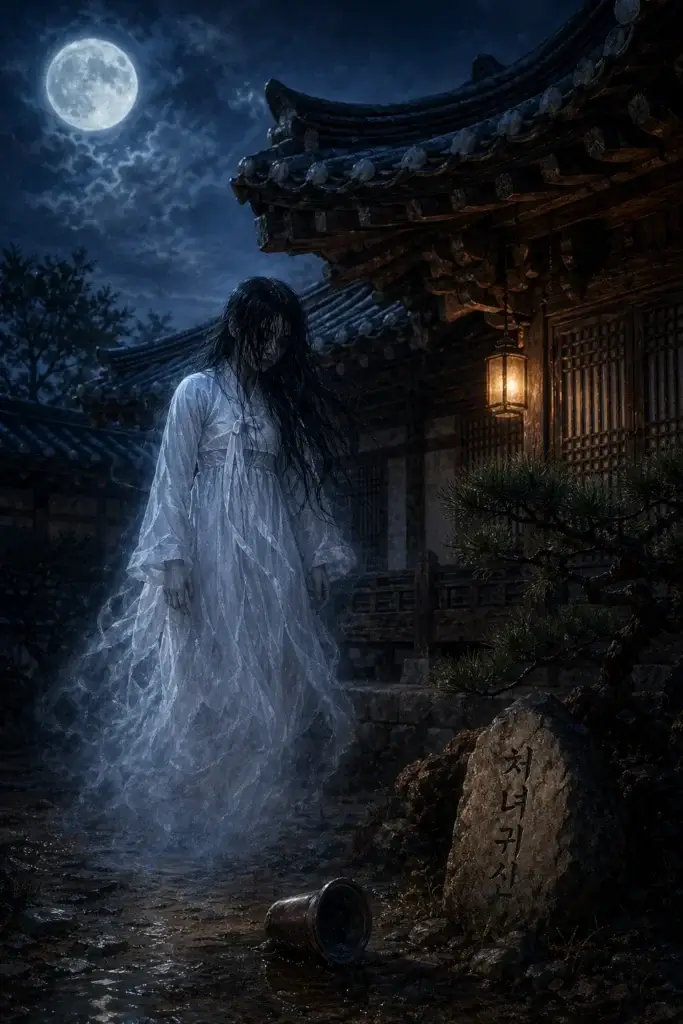
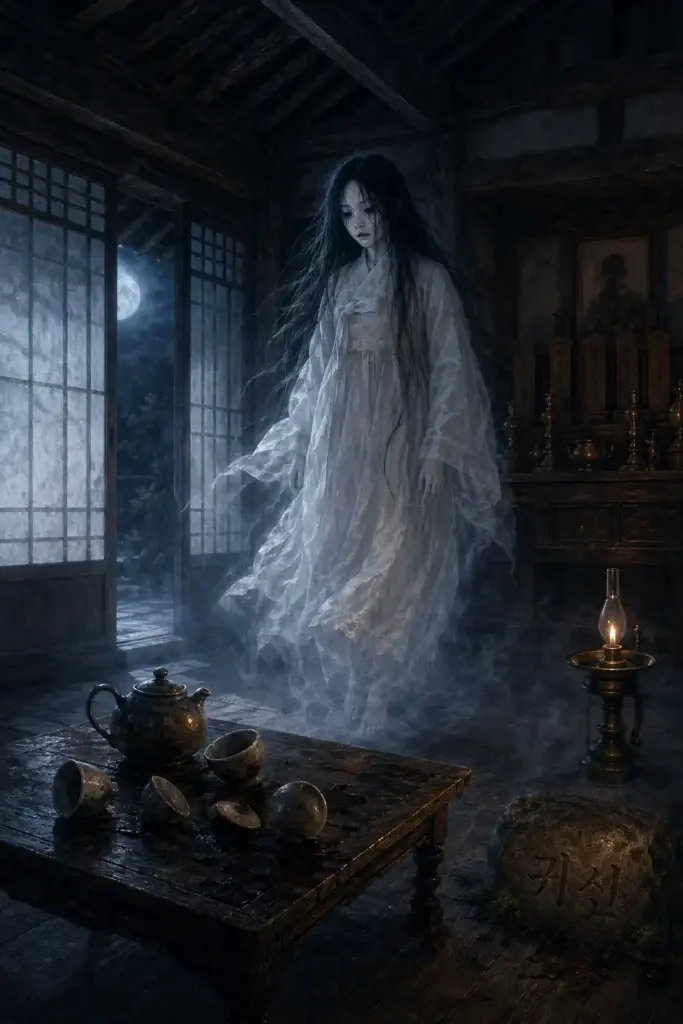
The classic appearance is that of a woman in white mourning dress (sobok) with long black hair covering the face. The motif is iconographically closely related to the Japanese Yūrei, but has its own Confucian-shaped background.
Joseon-era tradition
The written documentation of Gwishin cases accumulated during the Joseon dynasty (1392 to 1897). The yadam collections (oral traditions) were recorded systematically from the 17th century onward, the paesol (anecdotes) from the 15th century onward. These texts report Gwishin perceived by witnesses.
They differ from European ghost reports in that they do not portray the Gwishin as an autonomous evil force, but as a desperate person demanding attention.
The Confucianization of society from the 16th century onward reinforced the motif: a dead person without proper ancestral rites was said to be morally lost and unable to rest in peace.
Quick Overview: Gwishin
Type: Spirit of the dead
Origin: Human dead with unfinished business
Texts: Samguk Yusa, Joseon-era yadam collections, shamanic ritual texts
Triggers: unatoned wrong, omitted ancestral rites, violent death
Defense: jesa, shamanic gut, Buddhist death ceremonies
Context
Period of the Texts
The notion of restless spirits of the dead has been present in Korea since the earliest written sources. In the Samguk Yusa (around 1281) there are episodes of returning dead.
With the consolidation of Confucianism in the Joseon period (1392 to 1897), the motif of the deceased made restless through omitted ancestral rites comes to the fore.
Joseon-era yadam and paesol collections contain countless Gwishin stories that were put into written form in the 19th and 20th centuries.
Distribution Area
Gwishin narratives are widespread in all regions of Korea. Storytelling traditions are especially dense at former court sites, old schools and Confucian academies (seowon), military posts and plague graves. Modern contemporary literature and K-drama frequently take up hospitals, schools and subway stations as settings.
Source Situation
Important sources: Iryŏn, Samguk Yusa (around 1281); Joseon-era yadam collections; shamanic ritual texts recorded in the 19th and 20th centuries.
Modern reference works: Kim Tae-gon (1981), Kendall (1985, 2009 “Shamans, Nostalgias, and the IMF”), Walraven (1994). For film and literature: numerous works on the “K-horror” genre.
Designation and Spellings
Literally “spirit–deity” from 鬼 (“spirit, soul of the dead”) and 神 (“deity, spirit“).
- Cheonyeo-gwishin (처녀귀신), maiden spirit of the dead; a woman who died unmarried.
- Mongdal-gwishin (몽달귀신), the male counterpart; a man who died unmarried.
- Son-gaksi, related in folk tales to Cheonyeo.
- Mul-gwishin, water spirits; mostly the drowned.
- Dalgyal-gwishin, “egg spirit“; a faceless spirit, a local variant.
Characteristics
Appearance. The classic depiction: a young woman in a white mourning garment (sobok), long black hair before the face, pale skin, limply hanging hands. Some variants have no mouth or no eyes.
Behavior. Gwishin appear at the places of their death or their unresolved affair. They rarely speak, lament, and show those present their concern in dreams or mute gestures. They act through disturbances of perception, nightmares and illnesses.
Time. Preferably at night, especially between midnight and three o’clock; on rainy days and on the seventh lunar night (chilseok).
Han as a psychological and cultural deep layer
Modern literature and film art have often read the Gwishin motif psychologically. The ghostly apparition can be understood as a manifestation of Han, the Korean feeling of suppressed, accumulated grief. The Gwishin embodies not only the individual deceased but the collected suffering of a family or a historical period.
In this sense the Gwishin motif is a mirror of social injustice: when someone is buried without regard for Confucian duties, this can also appear to a modern audience as a critique of social ills. K-horror films have developed this aspect and turn Gwishin stories into metaphors for unresolved traumas and institutional failures.
Profile: Gwishin
The most important aspects of Gwishin at a glance.
Human deceased with unfinished business or omitted ancestral rites; less often as a consequence of violent death.
Surviving relatives, heirs, those responsible for the death; chance witnesses of the place; widespread in schools and hospitals.
A white-clad, long-haired, pale figure; often with a covered face and limply hanging arms.
Illness, terror, nightmares, madness, accidents; in severe cases the death of those responsible.
Properly performed jesa rites; a shamanic gut by a mudang; Buddhist death ceremonies; resolution of the unresolved concern.
Japanese Yūrei and onryō; Chinese guǐ (see Gui); European White Ladies; Indian preta.
Protective Practice
Jesa. The Confucian-shaped ancestral rites are performed annually on the day of death and on the major holidays Seollal and Chuseok. A precise arrangement of foods, bowls and ritual acts is meant to appease the soul and remind it of its place in the circle of ancestors.
Ssitgim-gut. The shamanic “purification gut” in the Jeolla region and on Jindo releases the bonds of the deceased; the mudang calls the spirit, speaks, purifies and guides it.
Buddhist death rituals. A 49-day ritual (sasipgu-jae) after death with sutra recitation; larger ceremonies (cheondo-jae) for especially restless souls.
Bujok. Consecrated paper amulets with red characters, placed on the door frame or in the house to ward off Gwishin.
Gwishin, Parallels in Other Cultures
Japan. Yūrei and onryō share the classic iconography of the white, long-haired woman of the dead; the Japanese figure is shaped more by Buddhism, the Korean more by Confucianism.
China. The guǐ (see Gui) forms the shared sinographic word field; the Chinese Ghost Festival context shares motifs.
Europe. White Ladies of the German-speaking and Slavic tradition are functionally related; no historical connection.
Buddhism. Preta hungry ghosts share the motif of the restless, unresolved dead.
Modern reception and adaptations
The Gwishin figure is omnipresent in contemporary Korean culture. Series such as Tale of the Nine-Tailed, Alchemy of Souls and films like A Tale of Two Sisters use the motif. The creators frequently modify the classic form: Gwishin become more powerful, more intelligent and take more targeted revenge than in the old traditions.
This is also reflected in literary adaptations, for instance in the prose of Han Kang or Kim Ä-ran. The traditional Gwishin is a mute, suffering figure; the modern Gwishin is an agent who tells its own story.
This shift from the passive to the active being shows a reinterpretation of the Han concept as a powerful, not merely tragic, emotion.
Position in the Korean Image of the Afterlife
The term gwishin (귀신) in Korean does not denote a single kind of being but an entire category: spirits of the deceased who have not completed the orderly transition into the afterlife.
The traditional Korean image of the dead is strongly shaped by Confucianism, which had been the official state ideology since the Joseon period (1392 to 1897).
According to this notion, a deceased person becomes a josang through correctly performed mourning and ancestral rites, a benevolent ancestor who protects the descendants. If these rites are omitted, or if the death was violent, premature or unburied, the spirit remains in the world of the living as a gwishin.
This logic links the spirit being directly to the social order. A gwishin is less a demonic being than a symptom of a disturbed relationship between the living and the dead.
Especially affected are people who died without descendants, for without male heirs the ritual addressee was lacking in the Confucian system. The shamanic tradition of musok offered a complement here: the mudang, mostly female shamans, could purify and appease a restless spirit in rituals such as the ssitgim-gut.
Religious-studies research, for instance the works of Laurel Kendall on Korean shamanism, emphasizes that the gwishin concept mediates between the systems. It combines Confucian ancestral duty, Buddhist notions of the rebirth cycle and shamanic practice.
A gwishin is thus culturally overdetermined: each of the three traditions offers its own explanation of why a dead person does not come to rest, and each offers its own path to a solution. This multilayeredness explains why the being remains so present in Korean literature and folk tale.
The gwishin in Modern Popular Culture
Since the 1990s the gwishin has been a central figure of the Korean horror genre. The film Yeogo goedam (Whispering Corridors, 1998) and its sequels relocated the restless spirit into the girls’ school and connected it with themes such as performance pressure, bullying and institutional violence.
The typical visual type, a young woman in a white mourning robe with long black hair covering the face, has since shaped the visual language of the genre and overlaps with the Japanese yūrei without being identical to it.
Television further differentiated the figure in the 2000s and 2010s. Series such as Master’s Sun (2013) or Hotel del Luna (2019) show gwishin not only as figures of terror but as beings with unfinished concerns whom the living can or must help.
With this, the narrative pattern returns to the traditional logic: the spirit is released when its wrong is recognized and set right. The horror motif and the melodramatic motif of the unfinished life lie close together here.
It is notable that popular culture often makes the Confucian deep structure visible without naming it. The gwishin narrative is almost always about a violated order: a concealed murder, a denied pregnancy, an embezzled inheritance. Modern entertainment thus uses the old being as a vehicle for social criticism.
Unlike Western haunting films, in which the spirit often remains a mere threat, the Korean gwishin usually demands a moral response. This connects it with the traditional aim of the shamanic ritual, which seeks not the annihilation but the reconciliation of the spirit.
Han as the Emotional Core
Closely connected with the gwishin is the hard-to-translate concept of han (한). It denotes a pent-up complex of resentment, grief, bitterness and unfulfilled longing that accumulates over a lifetime or across generations.
In folk belief it is precisely this han that holds a dead person in the world and makes them a gwishin. The spirit can only move on once the han is dissolved, that is, once the underlying wrong is acknowledged and, where possible, set right.
Research discusses han controversially. Some Korean cultural theorists of the 20th century declared it a national trait that arose from the history of invasions, colonial rule and division.
Others, such as the literary scholar Michael Shin, warn against essentializing han as a timeless Korean characteristic and point out that the elevation of the term is itself a relatively recent, partly colonial-era construction.
For understanding the gwishin, this debate is less decisive than the observation that folk narrative consistently defines the spirit by its feeling and the wrong it suffered, not by an evil nature.
From this follows a characteristic asymmetry. The gwishin is dangerous, but its harm is never purposeless. It seeks attention, justice or the completion of an interrupted life.
The shamanic ritual of the gut takes hold exactly here: the mudang gives the spirit a voice, lets it speak its suffering, and then leads it ritually out of the world of the living.
Anyone working with Korean spirit belief should therefore read the gwishin not primarily as a threat but as a personified demand for redress.
Further Links
Further reading:
- Culture page Korea.
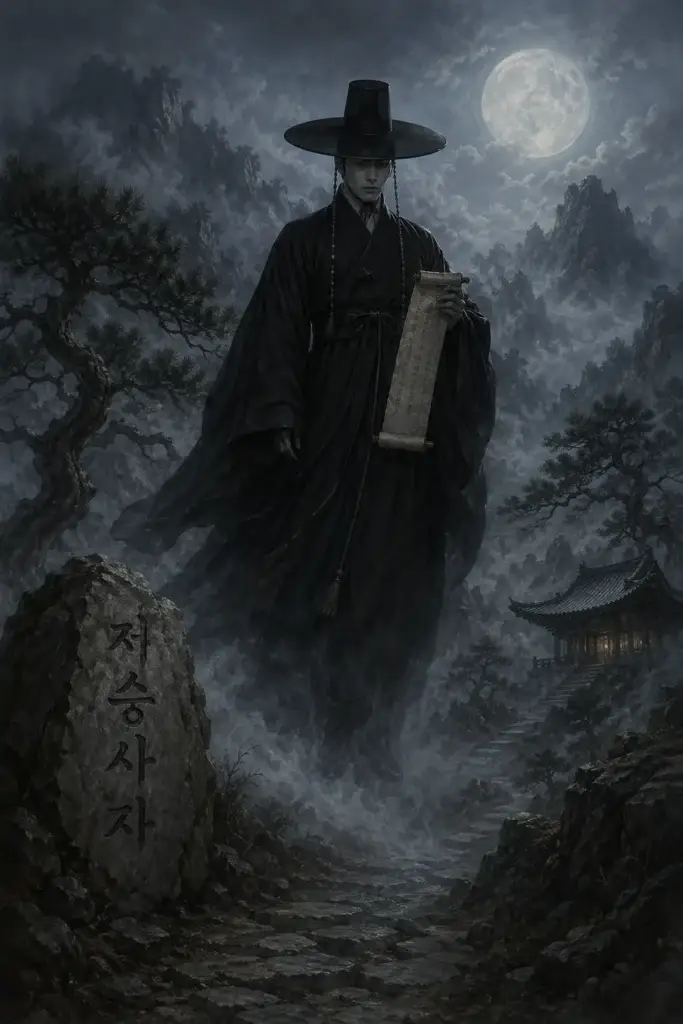
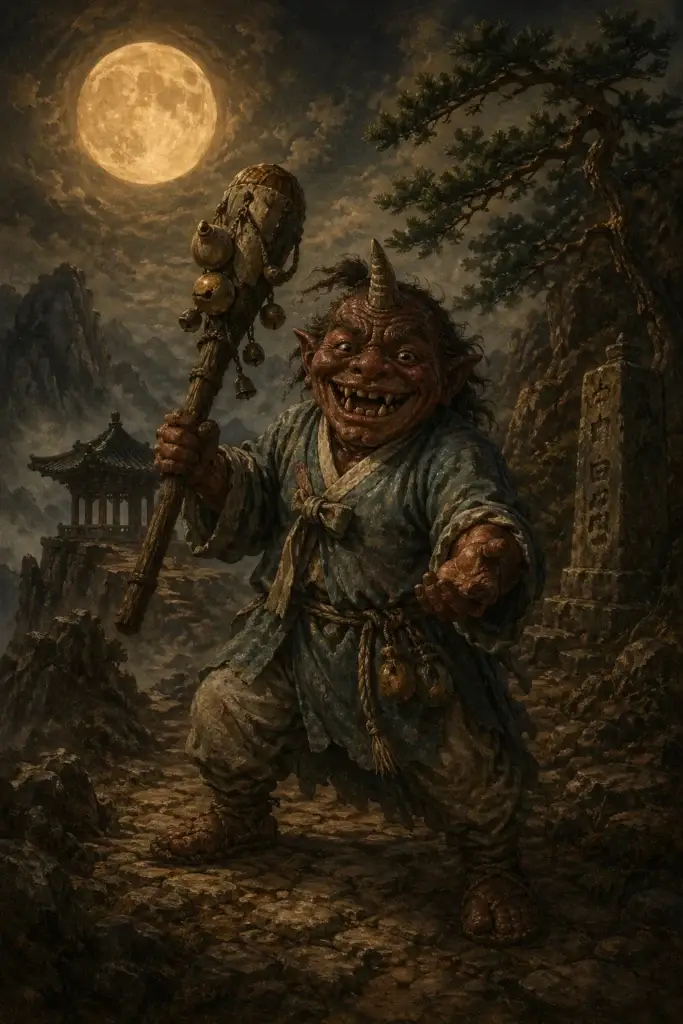
- Further individual profiles of Korea: Dokkaebi, Gumiho, Cheonyeo-gwishin, Jeoseung Saja.
- Parallels: Yūrei (Japan), Gui (China), Preta (Buddhism).
Sources and Literature
Further standard works in the literature index.
The protective practice described here is a religious-studies classification of historical traditions. iWell Guard ties into this cultural-historical line of wearable protective objects and represents a contemporary form of it. More about the iWell Guard →